Sabitlenmiş Tweet
𝔻𝕖𝕧 ℝ𝕒𝕪 ❁
10.3K posts

𝔻𝕖𝕧 ℝ𝕒𝕪 ❁
@rayklanderman
Empowering innovation through AI - ML, Web Dev, and Data Analytics for social impact 🌍💻📊
𝕏 Katılım Mayıs 2017
989 Takip Edilen1.2K Takipçiler
𝔻𝕖𝕧 ℝ𝕒𝕪 ❁ retweetledi

𝔻𝕖𝕧 ℝ𝕒𝕪 ❁ retweetledi

There will be no AI jobpocalypse.
The story that AI will lead to massive unemployment is stoking unnecessary fear. AI — like any other technology — does affect jobs, but telling overblown stories of large-scale unemployment is irresponsible and damaging. Let’s put a stop to it.
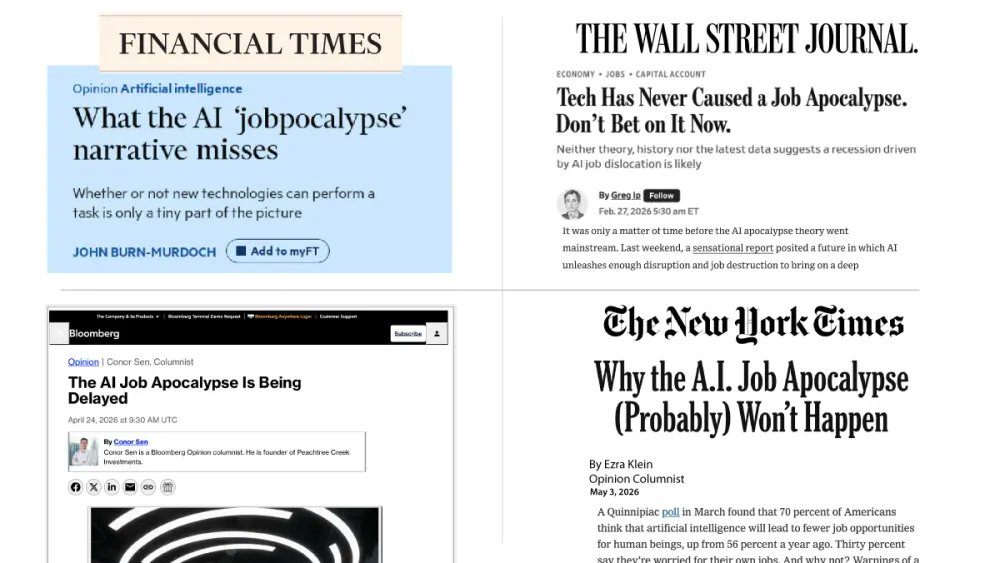
I’ve expressed skepticism about the jobpocalypse in previous posts. I’m glad to see that the popular press is now pushing back on this narrative. The image below features some recent headlines.
Software engineering is the sector most affected by AI tools, as coding agents race ahead. Yet hiring of software engineers remains strong! So while there are examples of AI taking away jobs, the trends strongly suggest the net job creation is vastly greater than the job destruction — just like earlier waves of technology. Further, despite all the exciting progress in AI, the U.S. unemployment rate remains a healthy 4.3%.
Why is the AI jobpocalypse narrative so popular? For one thing, frontier AI labs have a strong incentive to tell stories that make AI technology sound more powerful. At their most extreme, they promote science-fiction scenarios of AI “taking over” and causing human extinction. If a technology can replace many employees, surely that technology must be very valuable!
Also, a lot of SaaS software companies charge around $100-$1000 per user/year. But if an AI company can replace an employee who makes $100,000 — or make them 50% more productive — then charging even $10,000 starts to look reasonable. By anchoring not to typical SaaS prices but to salaries of employees, AI companies can charge a lot more.
Additionally, businesses have a strong incentive to talk about layoffs as if they were caused by AI. After all, talking about how they’re using AI to be far more productive with fewer staff makes them look smart. This is a better message than admitting they overhired during the pandemic when capital was abundant due to low interest rates and a massive government financial stimulus.
To be clear, I recognize that AI is causing a lot of people’s work to change. This is hard. This is stressful. (And to some, it can be fun.) I empathize with everyone affected. At the same time, this is very different from predicting a collapse of the job market.
Societies are capable of telling themselves stories for years that have little basis in reality and lead to poor society-wide decision making. For example, fears over nuclear plant safety led to under-investment in nuclear power. Fears of the “population bomb” in the 1960s led countries to implement harsh policies to reduce their populations. And worries about dietary fat led governments to promote unhealthy high-sugar diets for decades.
Now that mainstream media is openly skeptical about the jobpocalypse, I hope these stories will start to lose their teeth (much like fears of AI-driven human extinction have).
Contrary to the predictions of an AI jobpocalypse, I predict the opposite: There will be an AI jobapalooza! AI will lead to a lot more good AI engineering jobs, and I’m also optimistic about the future of the overall job market. What AI engineers do will be different from traditional software engineering, and many of these jobs will be in businesses other than traditional large employers of developers. In non-AI roles, too, the skills needed will change because of AI. That makes this a good time to encourage more people to become proficient in AI, and make sure they’re ready for the different but plentiful jobs of the future!
[Original text in The Batch newsletter.]

English

@OpenAI is quietly pulling ahead again.
Claude/Opus is insanely capable, but once you move from demos to real workloads, token cost starts to bite.
Claude Code = deep reasoning + huge context, but expensive per useful output.
Codex/GPT stack = strong reasoning + better token efficiency + faster iteration loops.
At scale, it stops being “which model is smarter” and becomes “which model is smarter per dollar, per token, per workflow.”
And right now OpenAI is winning that equation.
Back to tokens… but efficiently.

Wise@trikcode
Anthropic quietly removed Claude Code from the $20 Pro plan. You now need the $100/month Max plan to use it.

English
𝔻𝕖𝕧 ℝ𝕒𝕪 ❁ retweetledi

@OpenAI's newest image model, GPT Image 2, is state-of-the-art and performs impressively.

OpenAI@OpenAI
This is not a screenshot.
English

@unkonfined As long as we live in Christ and He lives in us, we are blessed by default.🙏🏼
English

🚀 @openclaw + @n8n_io = Your Private Personal AI Assistant
Self-hosted, agentic, and actually does the work for you.
OpenClaw = the brain (reasoning, memory, planning) n8n = the body (triggers, 400+ integrations, secure actions)
Real use cases: ✅ Job hunter that ranks remote roles ✅ GitHub/PR watcher + auto release notes ✅ Content summarizer → LinkedIn drafts ✅ Daily agenda + server alerts
Flow: Telegram → n8n webhook → OpenClaw thinks → actions fire instantly.
No vendor lock-in. Local models welcome. This is AI that operates.
What’s your favorite self-hosted Agentic Workflow stack in 2026? Drop it 👇
English

@nikitabier I think Nikita meant 'Opensumer' OSS is the way forward! @x better tap in. The more you force users into subscription package plans, the more they push back and find ways to circumvent them. Striking a balance between open-source and proprietary is the real answer.
English