razim Bob
43 posts

Want the strategies + the tools?
Reply "AI" and I'll send them over.
And tell me: should they have banned an AI this powerful? 👇
English
The most powerful AI ever made got banned in 72 hours.
Before they pulled the plug, I used it to build 5-minute scalping bots.
One backtested at 5,381%.
I'm giving 5 of them away, free. 🧵

English
@PolymarketDevs Hello team. Latency is spiking again. More than 1500ms to post an order. Insane slippage because of that. Any issues at the moment? Is this temporary? Thank you
English

Friday Update - Week of May 25th, 2026:
- Perps live in production: launched with 5 tradfi pairs and 1 crypto pair (BTC); more instruments and user access upcoming
- World Cup pages live: Globe/Map, Bracket and standings shipped
- World Cup launch features in final testing
- CLOB performance: Order Book consistency improvements shipped this week, with deeper architectural changes underway and a release next week to address queue congestion
- SDKs open-sourced: TS SDK with runnable examples, Python SDK with improved public docstrings, multiple beta feedback items addressed
- Unified API: kicked off, first Gamma endpoints wrapped
- Gamma: tighter keyset pagination and indexes on high-traffic read paths, production correctness fixes across users, profiles, comments and sports summary
English
@seemeohan given you experience would you have any recommendations? I've literally tried everything I can think of!
English
@Polymarket @mustafap0ly @PolymarketDevs
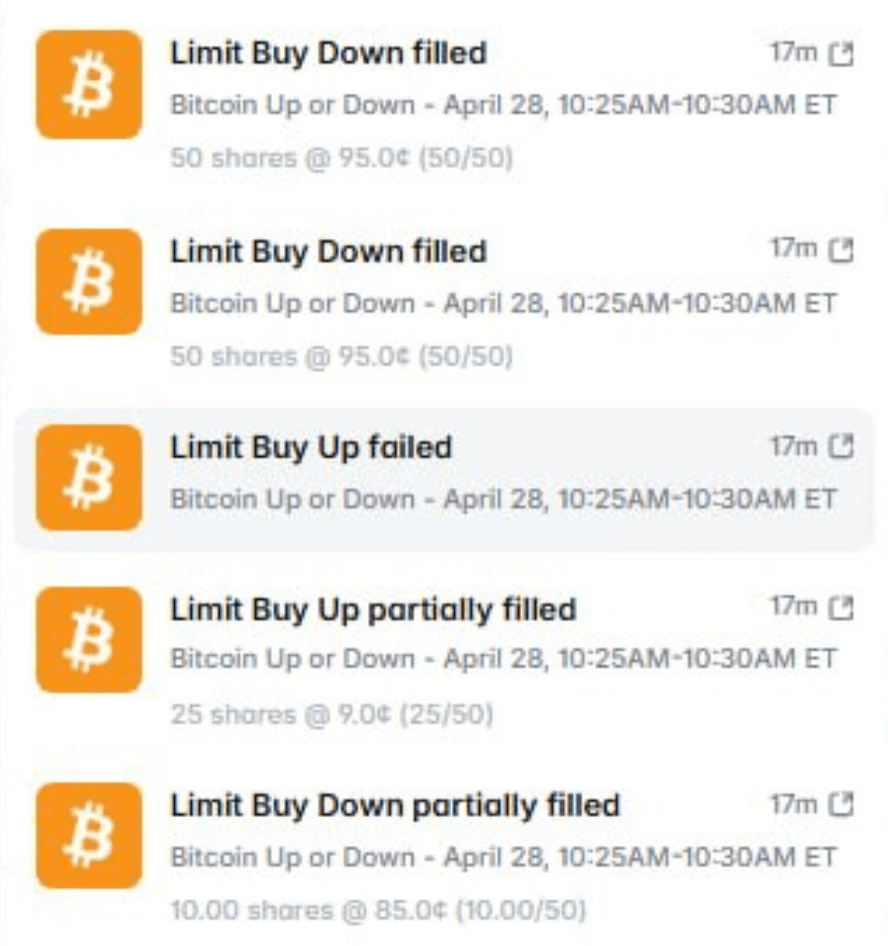
Guys any idea why the latency in the 5mn btc market is very bad? Sharing the screenshots. This applies for both maker and taker orders.1st time trading after v2 . Never saw these latencies during V1 period. Any support is appreciated


English
@seemeohan If someone can explain. I'm really confused. The markets resolve based on Chainlink subsecond data stream. An aggregate of btc price from different sources. How can one person manipulate that? Btc liquidity is huge and such a manipulation is so expensive and not worth it!
English

At some point, I decided to stop constantly adjusting one of my Polymarket crypto up/down strategies (the one running out of account "ohanism") to deal with market manipulation by toxic participants.
This is the outcome.
It is still profitable, but you can see that after May 13 it has been much lower Sharpe, much larger, more frequent drawdowns. The main reason is that new classes of manipulators emerged, and I am bleeding large amounts of PnL to their impact.
There will be a point when it stops making money entirely, and at that point I will likely turn off rather than constantly adapting.
Some thoughts.
1. If you think you have an algo capable of winning in a game with all manipulations, you are lying to yourself. You have an algo capable of dealing with *today's* manipulators. Tomorrow's will be more sophisticated.
2. People can and do make money trading around manipulation. But it's an ever-evolving game that you are playing at a massive disadvantage.
3. I feel confident that I can go back in the code, make significant changes to the way I trade around manipulation, and go back to making a profit. But to what end? Will I need to spend half my week constantly chasing what manipulators are doing next? When will I find time to work on anything else?
I would much rather spend my time providing in games where I am not at a structural disadvantage.
4. TWAP will not perfectly solve the problem, but it will help considerably. At the very least, it makes things much more annoying for today's manipulators.

English

السلام عليكم
انا احبك تفضل،.(ROYAL (2
ar.tradingview.com/script/PwglTYt…
العربية
@0x_Punisher What do you mean single tick manipulation? The resolution of market depends on Chainlink which is fully independent of any order on polymkt. Whether it's is an aggressive move in the final second or the final millisecond, it's fully transparent and can be validated on Chainlink
English

Ghost fills post got a lot of attention from devs.
Someone reached out with a concrete proposal to fix the resolution manipulation problem specifically in 5 and 15 minute BTC markets.
Worth sharing because this is exactly the kind of thinking Polymarket needs right now.
The core problem with current resolution:
One aggressive price move in the final second can flip the outcome entirely.
Single tick manipulation costs almost nothing to execute and completely changes who wins.
The proposed fix is called a Fair close price model.
Instead of resolving on one final price tick, the market uses the last 20 seconds of price data.
Sample BTC index price once per second across that window.
Calculate the median of all 20 samples.
Filter out any ticks that deviate more than 5-10 basis points from that median.
Average the remaining valid samples.
That average becomes the resolution price.
Why this works better than the current system:
Right now manipulating resolution costs one aggressive order in one second.
Under this model an attacker needs to sustain manipulated pricing across most of a 20-second window.
The cost and risk of manipulation increases dramatically.
A single wick in the final second gets filtered out completely.
There is also a recency-weighted version where samples closer to expiry carry more weight.
This keeps the resolution behaving like a true market close while removing obvious microstructure attacks.
The window is short enough that it does not drift from the real terminal price.
It just smooths against manipulation.
This would not fix ghost fills directly.
But combined with a settlement timing fix it would make 5 and 15 minute markets significantly harder to game.
Sharing because the community should push for this.
@Polymarket this is worth serious consideration.
Punisher@0x_Punisher
Interesting fact: If not ghost fills issue, my bot would be already sitting at 6 figs profit. Current PnL: +$96k My public wallet: @pbot-6?r=punisher" target="_blank" rel="nofollow noopener">polymarket.com/@pbot-6?r=puni…
Hope to see a clean $100k this week. English
@polybacktest Hello mate! Would love to discuss few strategies with you which I backtested on your 8900 markets data. Always good to have 2nd opinion and see someone who has the same interest. One day this will get cracked im sure.
English

We asked AI to take the exact testing method from this post and apply it to real Polymarket BTC up/down markets.
Here’s exactly what happened.
We built a prediction system using 6 simple indicators: momentum, RSI, volatility, trend, order flow, MACD.
We combined all 6 to estimate the probability of price going UP.
We only placed a bet when our estimate showed a profit edge after fees. Bet size was adjusted using the Kelly criterion based on confidence.
Data used: 400 markets, over a million price snapshots, and thousands of real Binance price bars.
Best setup
- Win rate: 46.9% (322 trades)
- 5-minute markets: 45.9% win rate
- 15-minute markets: 48.0% win rate
- Total profit: +$248.00
The big test (the part that actually matters): We ran the exact same strategy 10,000 times by randomly shuffling the historical data.
Results: Win rate ranged from 42.2% to 51.9%. Sometimes we made money, sometimes we lost.
Overall verdict: This strategy is not profitable.
Although this strategy made money in our first backtest, this strategy is not reliable enough to trust in real life.
Key takeaway: Many strategies look profitable in one backtest but collapse when properly tested 10,000 times.
Real signals matter far less than surviving randomness. If it can’t pass the 10k shuffle test, it won’t survive live markets.
This experiment proves the article perfectly:
One backtest = just a guess. 10,000 proper checks = the truth.
If you want to backtest your own strategies, we use polybacktest. It has sub second historical data going back up to a month.
Noisy@noisyb0y1
English
razim Bob retweetledi

ستتزين ناطحة السحاب إمباير ستيت في نيويورك بالأضواء الخضراء مساء الخميس والجمعة إحتفالا بـ عيد الفطر
#Eid_Mubarak

العربية
razim Bob retweetledi


razim Bob retweetledi

razim Bob retweetledi

razim Bob retweetledi

razim Bob retweetledi