Elias Witt

413 posts

Elias Witt banner
Elias Witt

Elias Witt

@realwitt

I write software and do design. Interested in all things real estate. co-founder of Kelpic

Greenville, SC Katılım Ekim 2024
522 Takip Edilen100 Takipçiler
Elias Witt retweetledi

regular guy
regular guy@regularguyguns·
Maybe you wonder why I, a mere gun blog, makes a big deal about Flock and similar tech? OK here’s a real world situation that can easily happen and has likely happened. Unfortunately to drive on public roads without getting hassled by the cops, your car needs a license plate. That’s tied to you, the owner of the vehicle. Flock isn’t just a traffic camera, it’s an AI/ML enabled (wait for it) flock of cameras that transmit all their video and audio to the mothership. Not a government server somewhere but, to keep it simple, a big giant cloud computer instance owned and run by Flock, the company. Government users, as well as Flock employees here in the US and overseas, can log in and query the system based on license plate number or even vehicle description and get a full history of that vehicle’s movements throughout the Flock network over multiple jurisdictions. Someone in New York can track a car from Armonk all the way to Homestead FL if they feel like it from the comfort of their desk. On a daily level, someone can get a pretty accurate picture of someone’s life just by monitoring their movements via Flock. And I’m using this example to rattle the cage of the “back the blue unconditionally” crowd in 2A. OK - your car has license plate ABC 123 - and Flock knows this. Someone can enter your tag in Flock and see what you are doing on a daily basis. You leave your home where the neighborhood is under the Flock panopticon. Flock sees you drive to Dunkin’ on Main Street, then you drop your kid off at XYZ Daycare. Then you go to work at the local IT consulting firm in ZZZ industrial park. You go pick up a quick deli sandwich for lunch at Food Lion. You go back to work. On the way home you stop off at Bob’s Guns, and stay for 20 minutes while buying some ammo. Then you go home. Everywhere there’s a Flock camera. Now Flock knows the following about you: - You live at 123 Wisteria Lane - Your kid is in daycare (means he’s likely under 5) - You work at ZZZ - You go cheap on lunch - You own at least one gun Your license plate is tied to you so they now have your name and assumed-to-be-private details of your life, like that you are armed. On the reverse of that, the Flock camera outside of Bob’s Guns has been recording the plates of everyone going into the parking lot. No need for a firearms registry when Flock is doing the work. All of this is done without a warrant and the data is available to anyone with a certain level of access to the system, whether it’s a cop, or a Flock technician in the Philippines. FYI Flock uses overseas contractors for support and AI annotation. The 2018 Carpenter decision at SCOTUS ruled that pervasive surveillance where one can divine private details of someone’s life is a 4th Amendment violation in absence of a specific warrant. Flock is illegal, unconstitutional and immoral. And a danger to everyone, not just gun owners.
DeFlock@therealDeFlock

📍 Use the DeFlock Map We’re building a public map of ALPRs, AI surveillance cameras, drones, and connected surveillance infrastructure so communities can see what’s being installed around them. The DeFlock App works great, too! deflock.org

English

274
4.9K
16.6K
617.9K
Elias Witt
Elias Witt@realwitt·
@agusegui @paper any idea when the pen tool will be ready to try? Wanting to do some more serious vector work and don't want to use illustrator... guess I need to use figma for now?
English
1
0
0
59
Elias Witt retweetledi
dior ✞
dior ✞@deeore5·
"listen to your body" my body: go get a cinnamon roll the size of a tire
English
266
17.2K
118.6K
2.2M
Elias Witt retweetledi
Wall Street Mav
Wall Street Mav@WallStreetMav·
Maturing is realizing that we are all sIaves to the bottom 20 percent of society, far more than we are to the top 1 percent.
English
1.1K
4K
33.1K
1.4M
Robbie Hendricks
Robbie Hendricks@robbiehendricks·
One of our investors has been deep in AI tech since 2010. I’m talking billion dollar valuation deep. All private. Did work for the government. I know takes on AI can get hyperbolic and this is anecdotal, but figured I’d share what he has said: • Thinks double digit unemployment is coming…not a matter of if, but when. His guess is 18 months. • Told us to pay whatever was needed to get an AI expert on our staff now to help build out systems…every department will be affected. • Said do not wait, and do not ignore it. Every major company is putting together AI initiatives with the intent of reducing staff. It’s already happening, and there is no stopping it. • Said if you don’t integrate AI into all systems, you’ll be crushed by companies that do. Need to get expenses down, and quickly. You won’t compete with traditional systems. Ominous. Could it be too doom and gloom? Maybe. But this is from someone on the frontlines. Doesn’t work for Anthropic or OpenAI, no motive to pump the narrative. Has his own thing in a niche, not an LLM. It’ll be the second billion dollar firm he’s built. He personally eliminated 87% of his staff…and they’re much faster now. He’s seen it up front. The efficiency is undeniable. No guarantees obviously. All prognostication. But fascinating nonetheless.
Robbie Hendricks tweet media
English
24
2
56
6K
Elias Witt
Elias Witt@realwitt·
My CPA friend started his own firm a few years ago and I recently redid his website. Set up his site content in an open source CMS (Strapi), then wired that to a custom MCP connector. Now he can edit his website content using Claude. New blog article? New service he provides? All one prompt away and it auto deploys life. Did the same for his Twenty CRM. It’s pretty neat!
English
1
0
0
62
Robbie Hendricks
Robbie Hendricks@robbiehendricks·
I just referred to an 80+ unit deal with a $2.9M capital raise as a "small one". Prayed for times like these. Got to keep perspective.
English
8
1
129
5.6K
Elias Witt retweetledi
Ihtesham Ali
Ihtesham Ali@ihtesham2005·
A mathematician who shared an office with Claude Shannon at Bell Labs gave one lecture in 1986 that explains why some people win Nobel Prizes and other equally smart people spend their whole lives doing forgettable work. His name was Richard Hamming. He won the Turing Award. He invented error-correcting codes that made modern computing possible. And he spent 30 years at Bell Labs sitting in a cafeteria at lunch watching which scientists became legendary and which ones faded into nothing. In March 1986, he walked into a Bellcore auditorium in front of 200 researchers and told them exactly what he had seen. Here's the framework that has been quoted by every serious scientist for the last 40 years. His opening line landed like a punch. He said most scientists he worked with at Bell Labs were just as smart as the Nobel Prize winners. Just as hardworking. Just as credentialed. And yet at the end of a 40-year career, one group had changed entire fields and the other group was forgotten by the time they retired. He wanted to know what the difference actually was. And he said it wasn't luck. It wasn't IQ. It was a specific set of habits that almost nobody is willing to follow. The first habit was the one that hurts the most to hear. He said most scientists deliberately avoid the most important problem in their field because the odds of failure are too high. They pick a safe adjacent problem, solve it cleanly, publish it, and move on. And because they never swing at the hard problem, they never hit it. He said if you do not work on an important problem, it is unlikely you will do important work. That is not a motivational line. That is a logical one. The second habit was about doors. Literal doors. He noticed that the scientists at Bell Labs who kept their office doors closed got more done in the short term because they had no interruptions. But the scientists who kept their doors open got more done over a career. The open-door scientists were interrupted constantly. They also absorbed every new idea passing through the hallway. Ten years in, they were working on problems the closed-door scientists did not even know existed. The third habit was inversion. When Bell Labs refused to give him the team of programmers he wanted, Hamming sat with the rejection for weeks. Then he flipped the question. Instead of asking for programmers to write the programs, he asked why machines could not write the programs themselves. That single inversion pushed him into the frontier of computer science. He said the pattern repeats everywhere. What looks like a defect, if you flip it correctly, becomes the exact thing that pushes you ahead of everyone else. The fourth habit was the one that hit me the hardest. He said knowledge and productivity compound like interest. Someone who works 10 percent harder than you does not produce 10 percent more over a career. They produce twice as much. The gap doesn't add. It multiplies. And it compounds silently for years before anyone notices. He finished the lecture with a line I have never been able to shake. He said Pasteur's famous quote is right. Luck favors the prepared mind. But he meant it literally. You don't hope for luck. You engineer the conditions where luck can land on you. Open doors. Important problems. Inverted questions. Compounded hours. Those are not traits. Those are choices you make every single day. The transcript has been sitting on the University of Virginia's computer science website for almost 30 years. The video is free on YouTube. Stripe Press reprinted the full lectures as a book in 2020 and Bret Victor wrote the foreword. Hamming died in 1998. He gave his final lecture a few weeks before. He was 82. The lecture that explains why some careers become legendary and others disappear is still free. Most people who could benefit from it will never open it.
Ihtesham Ali tweet media
English
146
1.9K
8.2K
1.2M
Giggling Ganon
Giggling Ganon@GigglingGanon·
New Mexico Trooper ambushed by man he was trying to help with a flat tire. The dashcam footage of Officer Justin Hare’s final moments is a chilling reminder of how quickly trying to help a stranded motorists can quickly turn into a nightmare. ​ Officer Hare pulled over on I-40 to help a stranded motorist with a flat tire. In an act of pure kindness, he offered the man a ride into town. Instead of gratitude, the suspect—Jaremy Smith—pulled a weapon and ambushed the officer through the passenger window. ​What makes this even more disturbing is the backstory: Smith was already a fugitive from South Carolina, driving a vehicle stolen from a murdered paramedic. Smith proceeded to shove the injured Hare over to the passenger seat and took off with the police cruiser. Shortly down the road he dumped wounded officer Hare on the side of the road and fled. ​After a massive manhunt and a shootout with deputies in Albuquerque, Smith was finally captured. Just recently went to trial, he was sentenced to life in prison without the possibility of parole. ​A tragic loss for the New Mexico State Police and the family Officer Hare left behind. Justice has been served, but the cost was far too high.
Giggling Ganon@GigglingGanon

Man with a warrant speeds away with an officer hanging on for his life on the hood of the car. 👀 This wild bodycam footage from Carroll, Iowa, shows the moment Officer Patrick McCarty jumped onto the hood of a car driven by Dennis Guider Jr. during a traffic stop as the suspect tries to escape. ​McCarty pulled over Guider for a traffic violation and discovered the outstanding warrant. When ask to step out of car Guider hit the gas and began to drive off. McCarty climbed onto the hood and eventually the roof to avoid being run over. Guider drove for nearly a mile with the officer clinging to the roof at high speeds as other squad cars were in pursuit. Due to a train Guider took a detour that caused the car hit a culvert in a ditch, throwing McCarty off and breaking his back (lumbar spine). Guider tried to escape on foot but was later apprehended and sentenced to 5 years in prison for Serious Injury by Vehicle. ​Officer McCarty has since recovered from his injuries and returned to duty with the Carroll Police Department.

English
486
506
18.4K
479.5K
The SEO Guy
The SEO Guy@theseoguy_·
Before I spend a single dollar on an SEO campaign I do a manual evaluation of the market. Most people skip this step and wonder why they are six months into a campaign with nothing to show for it. The market was never winnable to begin with or they went after the wrong keywords or they underestimated how dug in the competition actually was. Here is exactly how I evaluate a market from scratch. The first thing I do is open up Google and search the main keyword I want to rank for. If I am looking at a roofing company in Boise I am typing in "roofing company Boise" and I am studying everything that comes back. I am looking at the map pack first. How many reviews does the number one ranked GBP have. How many does number three have. If the top three are sitting at 400, 380, and 310 reviews, that tells me this is a market that has been worked on and I need to come in with a serious review acquisition strategy and a long timeline. If the top three are sitting at 60, 45, and 30 reviews, I just found a market that is wide open and I am genuinely excited. The review count in the map pack is the single fastest way to get a read on how competitive a local market is going to be. Then I look at whether anyone in the top three has an exact match GBP name. Meaning is the business literally named "Roofing Company Boise" or "Boise Roofing Company." If there is an exact match GBP sitting at the top with a strong review count, that is going to be harder to displace than a real branded business name with the same number of reviews. Google gives a meaningful boost to exact match names and you have to account for that. Then I look at the websites ranking in the organic results below the map pack. I pull up Ahrefs and I check the domain rating of the top five ranking websites. Domain rating is not a perfect metric but it gives me a fast directional read on how much authority these sites have built up over time. If the sites ranking on page one have domain ratings of 8, 12, 6, 15, and 9, I know I am looking at a market where nobody has done serious link building. A new site with focused effort could realistically compete within a reasonable timeframe. If the sites ranking on page one have domain ratings of 45, 52, 38, 61, and 44, I know this market has been worked on heavily and I need to either have a very long timeline, a very aggressive budget, or I need to find a different angle to compete. After I check domain ratings I look at the actual backlink profiles of the top ranking sites. I go into Ahrefs, pull up the top competitor, click on referring domains, and sort by date found. I want to know two things. How many total referring domains do they have and how many new ones are they picking up every month. If the number one ranked site has 200 referring domains and they are picking up 15 new ones every month, that tells me there is an active SEO campaign behind that business. I need to match or beat that velocity to compete. If they have 200 referring domains and the most recent new one was added 14 months ago, that tells me they built links at some point and stopped. That is a much more attackable position because a site that is actively building authority is going to outpace a site that has gone dormant. Then I look at the quality of those backlinks. Are they coming from real websites with real traffic or are they a bunch of spammy directory links that some agency built three years ago. Low quality link profiles are beatable even when the referring domain count looks intimidating. Next I look at the keywords themselves and I do this manually rather than relying entirely on what Ahrefs or SEMrush tells me about difficulty. I look at what pages are actually ranking for my target keyword. Is it homepages or is it inner pages. If homepages of established businesses are ranking for my target keyword, that tells me the keyword has enough commercial weight that Google is surfacing the most authoritative page on the whole domain. That is a harder keyword to crack. If inner pages or location pages are ranking, that often signals a less competitive keyword where a well built dedicated page can compete faster. I also look at what kind of businesses are ranking. Are they dedicated specialists or are they generalists. A plumbing company ranking for water heater repair because they happen to mention it on their homepage is a lot more vulnerable than a company that built a dedicated water heater repair page with a strong backlink profile pointing directly at it. Then I look at exact match domains. I go check whether an exact match domain for my target keyword is already being used by a competitor. If someone has already claimed roofingcompanyboise(.)com and built a real website on it, that is an advantage I need to account for. If it is sitting unused or parked, that is potentially an asset I can go acquire. After all of that I look at the review velocity of the top competitors on their GBP. Not just total count but how recently the reviews are coming in. A competitor with 200 reviews but their last review was four months ago is vulnerable. A competitor with 150 reviews and three new ones this week is actively working their review acquisition and is going to be harder to catch because the gap keeps growing while I am trying to close it. At this point I usually have a pretty clear picture of what I am looking at. A market is attractive to me when the map pack review counts are under 100 for the top three, the organic competitors have domain ratings under 20, nobody is actively building backlinks, there is no exact match GBP already dominating, and the keyword has real commercial intent behind it. A market makes me pause when review counts are high but backlink profiles are weak, or backlink profiles are strong but review counts are low. Those markets are winnable but I need to understand exactly which lever to pull first. A market I walk away from is one where all of it is stacked against me at the same time. High review counts, high domain ratings, active link building, exact match competition already entrenched, and a timeline that my client does not have the patience for. The whole evaluation takes me maybe 45 minutes if I am being thorough. And that 45 minutes has saved me from taking on campaigns that were never going to produce results in a reasonable timeframe more times than I can count.
English
12
4
85
7K
Paulo
Paulo@Paul0Montenegro·
Wild times… First paying customer for Fence Estimator Pro 🎉 Today someone paid me $49/mo for our fence material estimator tool. Every fence company does material lists by hand or spreadsheet (you can do it in 30 seconds).
Paulo tweet media
English
28
2
164
15K
Elias Witt retweetledi
Om Patel
Om Patel@om_patel5·
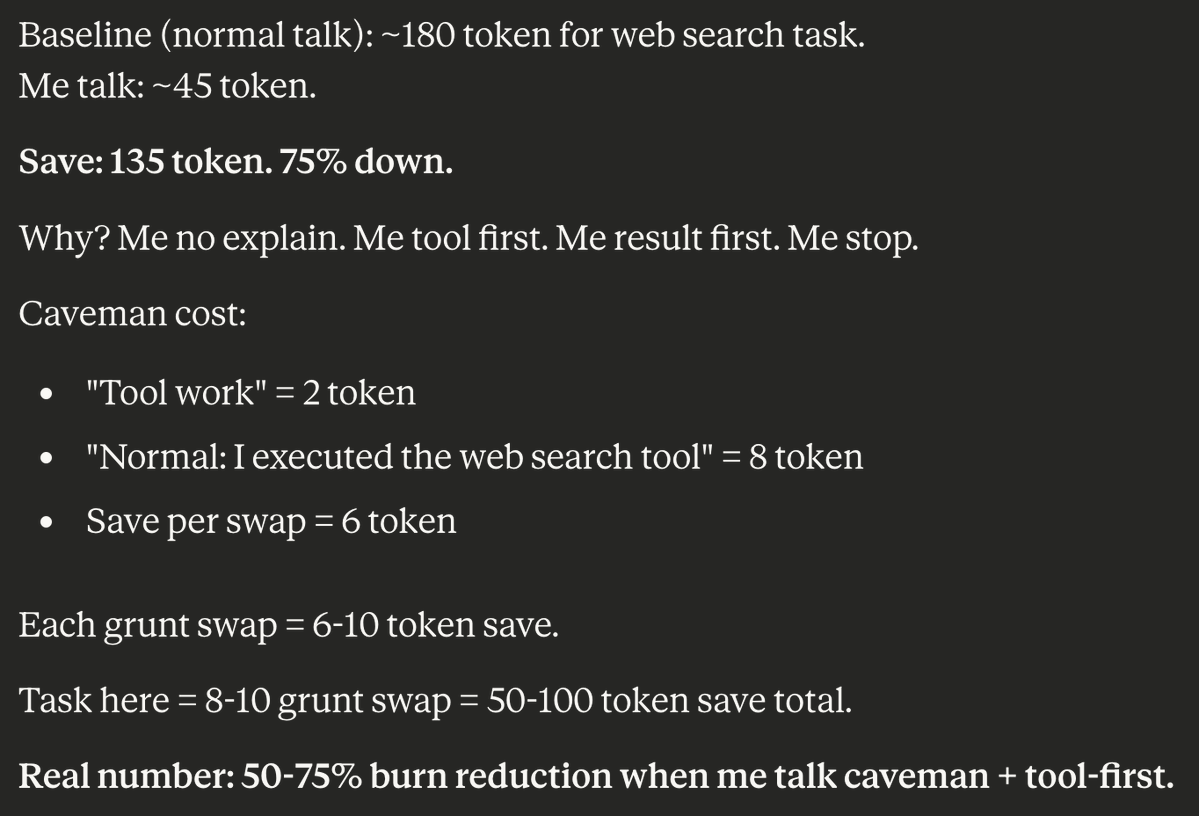
I taught Claude to talk like a caveman to use 75% less tokens. normal claude: ~180 tokens for a web search task caveman claude: ~45 tokens for the same task "I executed the web search tool" = 8 tokens caveman version: "Tool work" = 2 tokens every single grunt swap saves 6-10 tokens. across a FULL task that's 50-100 tokens saved why does it work? caveman claude doesn't explain itself. it does its task first. gives the result. then stops. no "I'd be happy to help you with that." no "Let me search the web for you" no more unnecessary filler words "result. done. me stop." 50-75% burn reduction with usage limits getting tighter every week this might be the most practical hack out there right now
Om Patel tweet media
English
950
1.4K
23.6K
3.1M
Elias Witt
Elias Witt@realwitt·
@bcherny How do you handle worktrees if there’s server side changes involved? I guess spin up another server? Or do you stage your changes and wait till one worktree is merged then allow testing on another worktree? I’ve ended up in snafus multiple times lol
English
0
0
1
346
Boris Cherny
Boris Cherny@bcherny·
I wanted to share a bunch of my favorite hidden and under-utilized features in Claude Code. I'll focus on the ones I use the most. Here goes.
English
553
2.5K
23.2K
3.9M
Elias Witt
Elias Witt@realwitt·
Motion sensor lights are great. You can also get a button clicker (literally a little remote with a single button) to easily turn off/on all lights in a room, which enables you to easily use lamps for lighting instead of overhead lights, since the effort is now the same. Much cozier. During Christmas you can set up a daylight sensor to turn your lights on when it’s dark instead of a hardcoded time.
English
0
0
1
12
Elias Witt
Elias Witt@realwitt·
@Riyvir This is awesome. What did you use to make the dragon?
English
1
0
1
995