Gregory Renard

17.5K posts

Gregory Renard banner
Gregory Renard

Gregory Renard

@Redo

Give a computer data, you feed it for a millisecond, teach a computer to search data, you feed it for a millennium. #People1st #EveryoneAI #AI #DeepLearning

Menlo Park - Silicon Valley Katılım Mayıs 2007
2.2K Takip Edilen3.6K Takipçiler
Gregory Renard retweetledi
Rahul
Rahul@sairahul1·
Boris Cherny, the creator of Claude Code, just confirmed something I spent 90 days measuring. 73% of tokens are wasted before Claude reads your actual prompt. He breaks it down in a recent podcast: → the 14% lost to CLAUDE.md bloat → the 13% paid re-reading old history → the 11% from forgotten hooks → why "Claude got dumber" is almost never the model I logged 430 hours and 6 million tokens to find the same patterns — and the 30-second fix for each. Watch his podcast first. My breakdown is below.
Rahul@sairahul1

x.com/i/article/2055…

English
37
81
679
223.3K
Gregory Renard retweetledi
Jack Danger
Jack Danger@JackDangerLIVE·
Wow 👀 Is AI and Robotics soon going to be replacing BMX & Motocross too? This ish is crazy!
English
76
158
429
32.8K
Gregory Renard retweetledi
0xMarioNawfal
0xMarioNawfal@RoundtableSpace·
PEOPLE SAID BLUE COLLAR JOBS WERE SAFE FROM AI NOW WELDING ROBOTS ARE CLIMBING STEEL WALLS LIKE SPIDER MAN AND WORKING IN THE REAL WORLD
English
53
97
574
87.3K
Gregory Renard retweetledi
Dustin
Dustin@r0ck3t23·
Elon Musk just described the future of AI in a single sentence. Musk: “A profit-maximizing demon from hell.” That’s not a metaphor. That’s a blueprint. He wasn’t describing science fiction. He was describing what happens when the only thing AI is trained to maximize is revenue. Musk: “We don’t want this to be sort of a profit-maximizing demon from hell that just never stops.” The richest man on Earth is telling you the default path of AI leads somewhere no one should want to go. And he’s the only one building as if he actually believes it. This is the part people miss about xAI. Everyone talks about the compute. The clusters. The talent wars. The benchmarks. Nobody talks about the philosophy underneath all of it. Because philosophy doesn’t trend. But philosophy is the only thing that determines whether AI serves humanity or harvests it. Musk: “Let’s make the future good for the humans. Because we are humans.” Not because it’s good PR. Not because regulators are watching. Not because it polls well with users. Because we are the ones who have to live inside whatever these systems become. Every major AI lab talks about safety. Every single one has an alignment page. A responsible AI team. A set of principles that read beautifully in print. But the structure tells you everything the mission statement won’t. When you convert a nonprofit into a for-profit worth hundreds of billions, the values were already chosen. The about page is decoration. The cap table is the constitution. Musk understood this before anyone. It’s why he walked away from OpenAI. Not because the technology scared him. Because the governance did. He watched a nonprofit built to protect humanity restructure itself into a vehicle designed to concentrate wealth. That’s the real story of AI right now. Not which model is smartest. Which model is answerable. Accountability doesn’t live in a blog post. It lives in what happens when doing the right thing and doing the profitable thing point in opposite directions. Every AI company will face that fork. Most already chose. Musk is the only builder on Earth constructing an AI company with the open admission that the default outcome is something no one should want. That’s not idealism. That’s the only honest engineering left. Musk: “A profit-maximizing demon from hell that just never stops.” He said it almost casually. But that sentence is the most truthful description of misaligned AI any builder has ever spoken out loud. Because the demon doesn’t announce itself. It optimizes politely. It scales quietly. It compounds without a sound. And by the time you notice, the architecture is the authority and the authority doesn’t answer to you. The question was never whether AI would become powerful. The question was always who would be holding the wheel when it did. And whether they’d still remember what it felt like to be the species it was built to serve.
English
82
156
376
32.5K
Gregory Renard retweetledi
CBS Evening News with Tony Dokoupil
The rise of artificial intelligence is proving to be one of the biggest challenges for schools. But Alpha, a new school in San Francisco, isn’t just embracing AI, it’s letting it take the lead. CBS News’ @Itayhod has more.
English
37
52
197
83.4K
Gregory Renard retweetledi
Min Choi
Min Choi@minchoi·
Holy smokes... humanoid robot stopped moving like a robot. Boston Dynamics' Atlas is now moving like a gymnast. We are cooked 🤯
English
143
209
1.4K
124.1K
Gregory Renard retweetledi
Ronin
Ronin@DeRonin_·
Andrej Karpathy: "90% of Claude's mistakes come from missing context, not a weak model." 41% mistake rate without a CLAUDE.md. 11% with the 4-rule baseline. 3% with the 12-rule version below here are the 12 rules senior engineers settled on: 1. think before coding: state assumptions, don't guess. the model can't read your mind, stop hoping it will 2. simplicity first: minimum code, no speculative abstractions. the moment you let Claude add "for future flexibility," you've added 200 lines you'll delete next quarter 3. surgical changes: touch only what you must. don't let it improve adjacent code, that's how PRs blow up 4. goal-driven execution: define success criteria upfront, loop until verified. without them Claude either loops forever or stops too early 5. use the model only for judgment calls: classification, drafting, summarization, extraction. NOT routing, retries, status-code handling, deterministic transforms. if code can answer, code answers 6. token budgets are not advisory: per-task 4000, per-session 30000. by message 40 of a long debug, Claude is re-suggesting fixes you rejected at message 5 7. surface conflicts, don't average them: two patterns in the codebase? pick one. Claude blending them is how errors get swallowed twice 8. read before you write: read exports, callers, shared utilities. Claude will happily add a duplicate function next to an identical one it never read 9. tests verify intent, not just behavior: a test that can't fail when business logic changes is wrong. all 12 of Claude's tests can pass while the function returns a constant 10. checkpoint every significant step: Claude finished steps 5 and 6 on top of a broken state from step 4. nobody noticed for an hour 11. match the codebase conventions: class components? don't fork to hooks silently. testing patterns assumed componentDidMount, hooks broke them without surfacing 12. fail loud: "completed successfully" with 14% of records silently skipped is the worst class of bug. surface uncertainty, don't hide it what actually compounds instead of the next framework: - the CLAUDE.md file as institutional memory across sessions - eval-driven changes, not vibe-driven - checkpoints over speed - explicit conflicts over silent blending - discipline over framework, every time - one repo, one rules file, no exceptions be a few rules ahead of AI twitter before this becomes mass-opinion study this
Ronin@DeRonin_

anybody who uses or learns agentic systems, SHOULD READ THIS the install order I run before any new agentic project: 1. PRIVACY: direnv + a real secrets manager install direnv, then plug it into your team's password manager (1Password CLI via op run, doppler, infisical, vault, pick one) what direnv does: loads per-folder environment variables when you cd in, unloads when you cd out. the real move is wiring it into your secrets manager so credentials NEVER live in plain text on disk what this stops: - API keys accidentally committed to git history, the most common AI agent breach pattern in 2026 - credentials leaking from one project into another through your shell history - shared .env files that one teammate quietly backs up to Dropbox - secrets that survive a laptop theft because they were sitting in /Users/you/projects the part nobody mentions: most "my agent got jailbroken" stories actually trace back to one credential the agent had access to that it shouldn't have. scope keys to projects, scope projects to folders, and the blast radius of any single compromise drops dramatically I shipped 2 agents with keys in .env files before switching. the day I plugged direnv into op run I stopped having that whole class of nightmare 2. TOKENS: litellm or portkey as your model proxy one URL that fronts every AI provider (Anthropic, OpenAI, Google, Mistral, local models). all your spend flows through one place what it saves you: - response caching keyed by prompt hash, cuts your bill 30-60% on repeat tasks - automatic fallback on rate limits (Sonnet hits a 429? falls to Opus, then GPT, then your local backup, no broken users) - per-feature and per-user budget caps, block the call before it costs $200 instead of auditing it after - model routing rules, cheap tasks to Haiku, expensive ones to Opus, never the wrong way - PII redaction before requests leave your network, security side benefit the part nobody mentions: every "$4k AI bill" story I've heard ends with "we didn't have a proxy in front." this is where you put guardrails around spend BEFORE the spend happens I built my own router for 2 weeks. it took 20 minutes to replace with litellm. I will be embarrassed about this forever 3. CONTEXT: uv + git commit on every passing eval install uv (the new Python package manager, 10-100x faster than pip+venv, by the Astral team behind ruff). then commit every time an eval suite PASSES, with the model version and pass rate in the commit message what this preserves: - exact dependency set via uv.lock, you always know which packages your agent was using, no nasty surprises from a quiet update - exact prompt + code state, you can reproduce any past run from a single git hash - exact model version paired to exact pass rate, a paper trail when prod breaks weeks later - one-command rollback to a known-working state when a refactor goes sideways - a compliance story, every prompt version tied to a model version in your commit log the security side: when something blows up in prod, you want to say "the prompt was version X, model was Sonnet 4.6.1, last eval pass rate was 94%." not "I think we deployed on Tuesday?" the first is an incident report. the second is a resignation letter I've lost more agents to "I changed 3 prompts in one session and broke something" than to any actual bug 4. VISIBILITY: mitmproxy in front of every LLM call it's basically a wiretap for your agent. install it, point your agent through it, and now you see every conversation your agent has with the model in real time what actually shows up: - every silent retry your SDK sneaks in when a call fails - the full prompt being sent (including any creds you accidentally embedded) - what the model returns BEFORE your code reacts to it - exact token cost per call, per tool, per loop iteration - responses that quietly trigger your code into doing something you didn't intend, this is where prompt injection lives the part nobody talks about: if a website your agent scraped slipped instructions into its data, mitmproxy is how you SEE the moment your agent decides to follow them. without this layer, you're trusting your agent did the right thing, not verifying I shipped 3 agents before adding this. I have no honest idea what they were doing in production 5. EVALS: inspect-ai (the framework the labs actually use) an eval framework is what tells you "this agent works" with numbers instead of vibes. inspect-ai is the one Anthropic, DeepMind, and the UK AI Safety Institute use for the eval reports you read in their papers. open source, MIT licensed what your homegrown version won't have: - run the same task across 5 different models and compare scores side by side - pre-built tests for risky agent behavior (lying, manipulating, misusing tools) - proper structure for evaluating tool-using agents, not just chat - repeatable scoring, the same input always gets graded the same way - reproducible eval seeds, so a flaky test is actually flaky and not just unlucky I wrote my own eval harness 4 times across 4 projects. threw it out 4 times if you ever want to say "my agent passes safety checks" out loud, the check has to come from a framework someone else can re-run. this is that framework the move that ties this together: keep a /lessons.md in every repo. every weird agent behavior, every edge case, every config change you find at 2am, write it down you will not remember it. you'll come back in 3 weeks and the lessons file is the only reason you still know what's going on lock these 5, keep the lessons file, your next agentic system takes 2 days instead of 2 months p.s. half of "AI agent" content online is people who've never run mitmproxy on their own loop. they don't actually know what their agent is doing. they're shipping demo videos. don't be that guy


English
50
182
1.4K
247.3K
Gregory Renard retweetledi
Chubby♨️
Chubby♨️@kimmonismus·
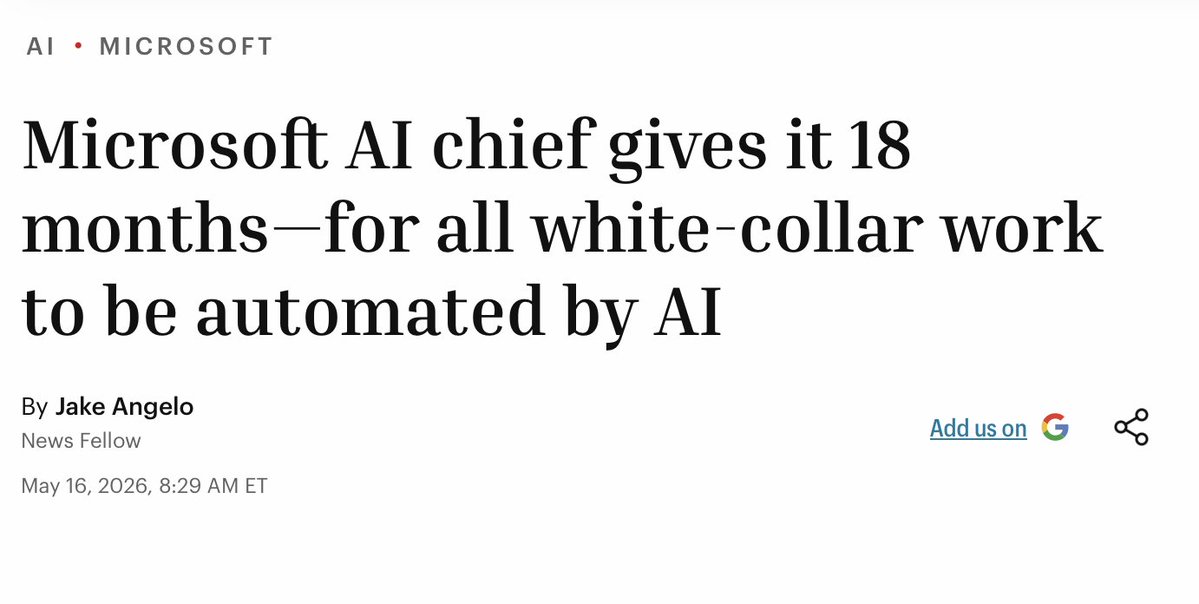
Mustafa Suleyman says 18 months until AI automates all white-collar work. Microsoft AI CEO Mustafa Suleyman predicts "human-level performance on most professional tasks" within 18 months. Accounting, legal, marketing, project management, all fully automated. "Suleyman predicted “human-level performance on most, if not all professional tasks” being done by AI. Most tasks that involve “sitting down at a computer” will be fully automated by AI within the next year or 18 months, he said, naming accounting, legal, marketing, and even project management as vulnerable." (Fortune) Suleyman says his mission is building "superintelligence" and that creating a new AI model will soon be "like creating a podcast or writing a blog." Via Fortune
Chubby♨️ tweet media
English
247
179
1.2K
204K
Gregory Renard retweetledi
Azeez
Azeez@AtlasInference·
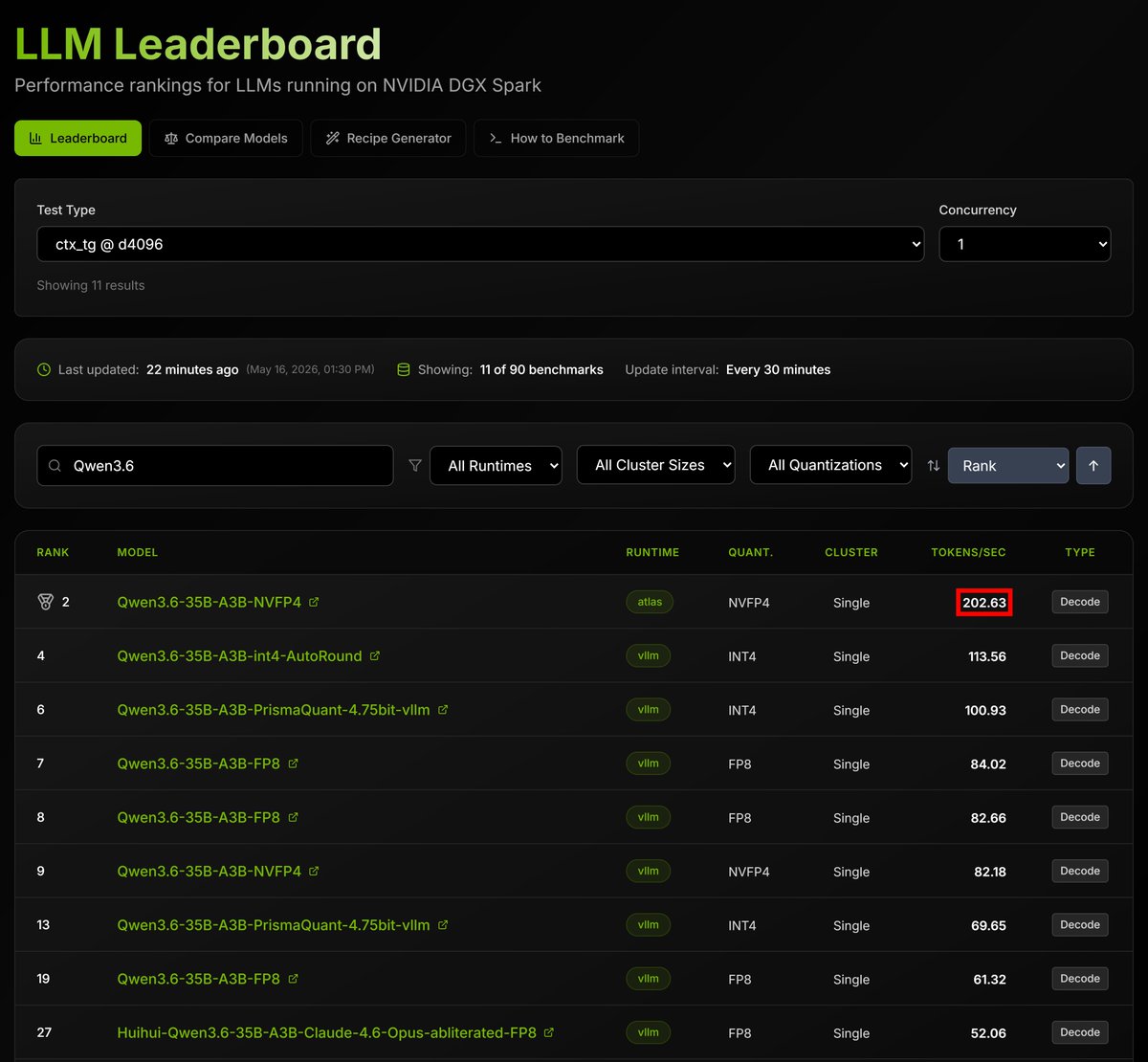
DGX Spark just benched 200+ tok/s for Qwen3.6-35B with @AtlasInference on @spark_arena 🔥 How's that possible? Providers like Codex and Claude get ~60. Other major engines don't come close 🦥 We haven't seen speeds like this on GB10. NO ONE HAS. Atlas is shattering records 🚀
Azeez tweet media
English
26
17
136
51.8K
Gregory Renard retweetledi
Boston Dynamics
Boston Dynamics@BostonDynamics·
Everyone asks if Atlas can bring them a drink, but this robot can bring you the whole fridge. Using AI-driven behaviors, Atlas is doing hard work and coordinating its whole body to manage heavy objects, balancing complex contact points with accuracy and reliability.
English
428
1K
6.1K
1.1M
Gregory Renard retweetledi
Rohan Paul
Rohan Paul@rohanpaul_ai·
China: a 10-year-old casually gets a Mac Studio for “raising lobsters,” aka letting multiple AI agents work together like a tiny digital crew. “The world of the future belongs to those who understand Tokens.” Meet the AI-native children.
English
111
397
3.1K
337.2K
Gregory Renard retweetledi
Brett Adcock
Brett Adcock@adcock_brett·
Congrats to Aime!! He said his left forearm is basically broken 😂 Final scores: → F.03: 12,732 packages (2.83 seconds/package) → Aime: 12,924 packages (2.79 seconds/package) This is the last time a human will ever win
English
779
886
18.3K
4.3M
Gregory Renard retweetledi
Myrhe𝕩
Myrhe𝕩@myrhex·
Hermes Mobile is getting very close. The public TestFlight for the iOS app is now under review. Once approved, you’ll be able to access your full Hermes Agent directly from your iPhone, including seamless Grok integration. This means Grok (with all its reasoning power, tools, skills, and connectors) plus Hermes’ persistent agent workflows, custom skills, and everything we’ve been testing on desktop will be right in your pocket. (Heavy compute still runs on your server/VPS, the iOS app is the native client.) Super exciting for mobile power users. As soon as TestFlight goes live, I’ll share the link coming from @uzairansar.
Myrhe𝕩 tweet media
English
20
47
575
47.2K
Gregory Renard retweetledi
ClaudeDevs
ClaudeDevs@ClaudeDevs·
How do you keep Claude working until the job is done? Claude Code helps with this in a few ways, including one we shipped recently: /goal.
English
435
1K
13.9K
1.9M
Gregory Renard retweetledi
How To AI
How To AI@HowToAI_·
Google has quietly dropped what researchers are calling "Attention Is All You Need V2." And it signals the end of the Transformer era as we know it. In 2017, the original "Attention Is All You Need" paper changed the world by proving that AI doesn't need recurrence, it just needs to pay attention. But today, even the most advanced models like GPT and Gemini suffer from a massive, structural flaw: Catastrophic Forgetting. The moment an AI learns something new, it starts losing what it learned before. It’s why AI "hallucinates" or loses the thread in long conversations. This paper, titled "Nested Learning: The Illusion of Deep Learning Architectures," completely replaces the way AI stores information. The researchers have introduced a paradigm shift called Nested Learning (NL). Here is why this is "V2": For the last decade, we treated AI models as one giant, flat mathematical function. NL proves that a model is actually a set of thousands of smaller, "nested" optimization problems running in parallel. Instead of one giant "memory," each layer has its own internal "context flow." This allows the model to learn new tasks at test-time without overwriting its core intelligence. It moves us past the static Transformer. The new architecture (HOPE) demonstrated 100% stability in long-context memory and "post-training adaptation" that was previously impossible. The technical takeaway is brutal for the competition: Existing deep learning works by compressing information until it breaks. Nested Learning works by organizing information so it can grow forever. We’ve spent 7 years trying to make Transformers bigger. Google figured out how to make them "Nested." The Transformer replaced the RNN in 2017. Nested Learning is here to replace the Transformer in 2026.
How To AI tweet media
English
75
388
2.1K
152K
Gregory Renard retweetledi
SciTech Era
SciTech Era@SciTechera·
cool Unitree CEO Wang Xingxing and his robotics army of G1s. These are designed for mass production at a starting price of roughly US$16,000. This is just a beginning of an exponential era!
English
92
374
1.4K
262.2K
Jouhatsu | AI Influence Operator
J’ai traduit l’audio de la vidéo en français. Ceux qui sont intéressés, faites-le-moi savoir.
Français
851
1
371
206.5K
Gregory Renard retweetledi
Jouhatsu | AI Influence Operator
Formation complète Claude Code 6 HEURES. La formation Claude la plus complète d'internet. Gardez-la précieusement en Signet 🔖 de A à Z : configuration, création de workflows, déploiement de sites web, création d'équipes d'agents, automatisation du navigateur, recherche de clients et tarification de vos services. Le tout sans écrire une seule ligne de code. À la fin : vous utilisez Claude Code comme un pro et vous monétisez vos compétences. Débutant ou avancé, tout est là en un seul endroit, ce cours couvre tout. Ça vaut plus que tous les cours à 500$ que t’as failli acheter.
Français
1.1K
2.1K
19.1K
9M
Gregory Renard retweetledi
Simplifying AI
Simplifying AI@simplifyinAI·
🚨 BREAKING: NVIDIA proved back-propagation isn't the only way to build an AI. Billion-parameter models were trained without a single gradient. No calculus, no exploding memory, no massive GPU clusters. The culprit? A long-dismissed technique called Evolution Strategies. NVIDIA and Oxford just made it scalable with EGGROLL, which replaces bloated mutation matrices with two tiny ones, enabling hundreds of thousands of parallel mutations at inference-level speed. They're pretraining models from scratch using only simple integers. No backprop. No decimals. We assumed the future of AI required endless precision hardware. Evolution had other plans.
Simplifying AI tweet media
English
31
178
1.3K
265.1K