
Sabitlenmiş Tweet
light
208 posts

anthropic no longer holds the heavenly mandate
Claude@claudeai
Beginning July 20, Claude Fable 5 will be included in all Max and Team Premium plans, at 50% of limits. Pro and Team Standard users will continue to have access to Fable via usage credits, and will receive a one-time $100 credit. Demand for Fable has been challenging to predict, which is why we rolled it out to subscription plans in stages, extending access several times as we secured additional capacity.
English
Funnily enough, GPU-accelerated models already existed before AlexNet. Dan Cireșan and Jürgen Schmidhuber's group were already winning several vision benchmarks. Still have no idea why they didn't enter THAT ImageNet competition.
Raj Dabre@prajdabre
AlexNet (2012) was not just undeniable proof that deep neural networks work well but also undeniable proof that you needed just a couple of GPU chips and not a supercomputer for deep learning. Before 2012, Google used to use 16000 CPU clusters spanning 1000 machines to train their cat classifier. AlexNet simply proved that you needed just 1 machine.
English

@reprompting I just saw this post from the Thinking Machines team about the origins of the term "Inkling", a really apt name for the model as well :)
x.com/luke_drago_/st…
Luke Drago@luke_drago_
The Inklings were a writing group in Oxford convened by CS Lewis and JRR Tolkien. It produced works like Narnia and the Lord of the Rings. Human sharpening humans, producing work greater than they could have on their own. So it is with us today; so it should go with us and AI.
English
More than anything, I like the name of this company, Thinking Machines. It's just so apt.
Thinking Machines@thinkymachines
Today, we are introducing Inkling. Inkling reasons efficiently across text, image, and audio modalities. We are making the full weights available. thinkingmachines.ai/news/introduci… Available today for fine-tuning on Tinker. Play with it in the Inkling Playground. 🧵
English

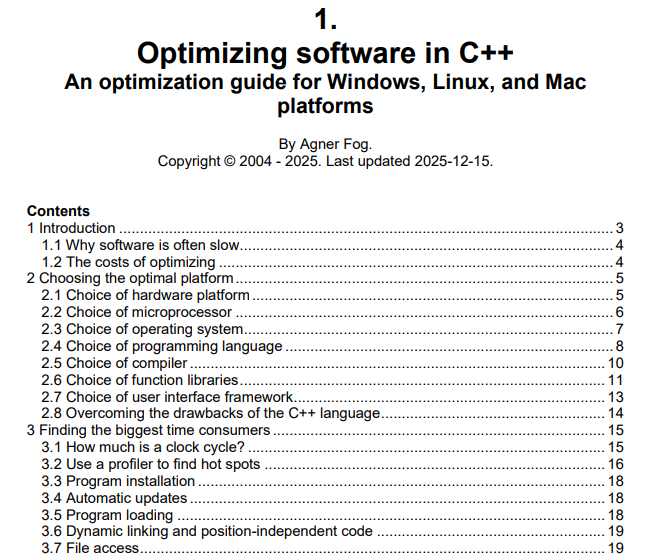
Today's reading is Agner Fog's manual on optimizing software in C++
agner.org/optimize/optim…
English

@reprompting GIFs on Twitter are encoded as H264 videos anyway, so no need to upload as GIF, the worst video compression format to ever exist.
English
I didn't realize you can't zoom in on a GIF, so I turned it into a video instead, with DOOM music
light@reprompting
visualization of output-stationary CUDA GEMM
English
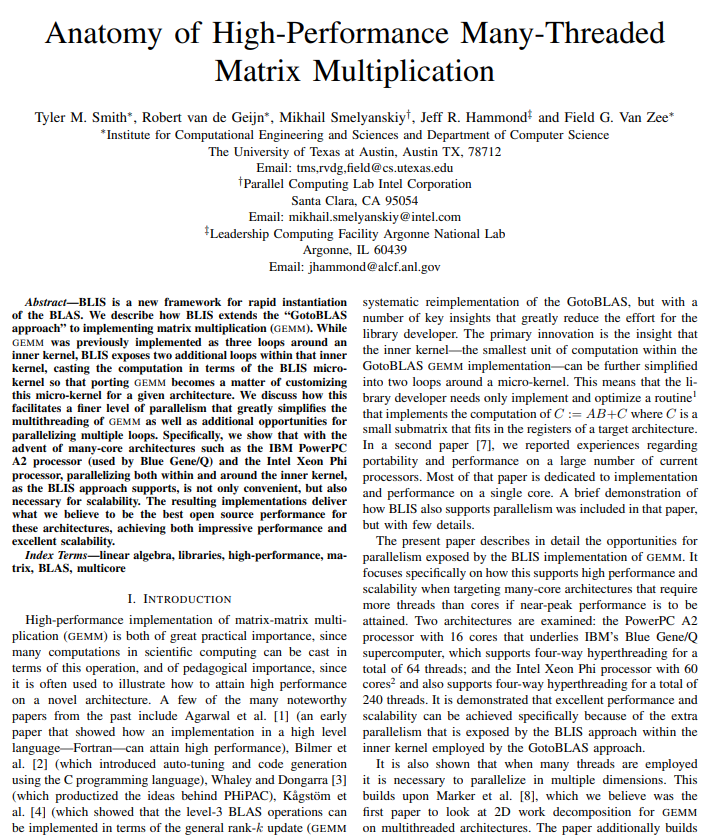
Today's reading is Anatomy of High-Performance Many-Threaded Matrix Multiplication. It extends the GotoBLAS approach to efficient multi-threaded GEMM on multicore processors.
cs.utexas.edu/~flame/pubs/bl…
English
@junupark_ I feel like everyone should experience cycling along the Han River on a summer evening at least once.
English


This led me to find out just how "hidden" Vasily Volkov seems to be. There isn't much information about him on the web, especially considering how influential many of his papers and talks have been.
1. Better Performance at Lower Occupancy
nvidia.com/content/gtc-20…
2. Benchmarking GPUs to Tune Dense Linear Algebra
mc.stanford.edu/cgi-bin/images…
3. Use registers and multiple outputs per thread on GPU
laurel.datsi.etsiinf.upm.es/_media/proyect…
4. Unrolling parallel loops
nvidia.fr/docs/IO/116711…
5. LU, QR and Cholesky Factorizations using Vector Capabilities of GPUs
netlib.org/lapack/lawnspd…
6. Understanding Latency Hiding on GPUs
www2.eecs.berkeley.edu/Pubs/TechRpts/…
7. A microbenchmark to study GPU performance models
dl.acm.org/doi/pdf/10.114…
8. Parallel computing experiences with CUDA
cs.virginia.edu/~skadron/cuda_…
9. Fitting FFT onto the G80 Architecture
people.eecs.berkeley.edu/~kubitron/cour…
10. Stencil Computation Optimization and Auto-tuning on State-of-the-Art Multicore Architectures
csd.uwo.ca/~mmorenom/CS43…
11. Using GPUs to accelerate the bisection algorithm for finding eigenvalues of symmetric tridiagonal matrices
eecs.berkeley.edu/Pubs/TechRpts/…
12. Building an Efficient Hash Table on the GPU
sciencedirect.com/science/chapte…
13. Programming inverse memory hierarchy: case of stencils on GPUs
laurel.datsi.etsiinf.upm.es/_media/proyect…
And these don't even cover his contributions to computer graphics and computational neuroimaging. For someone whose work has had such a lasting impact across multiple fields, he seems remarkably low-profile.
light@reprompting
todays read is vasily volkov's phd thesis on gpu latency hiding. it's quite long, so i think it'll keep me occupied for the next few days. www2.eecs.berkeley.edu/Pubs/TechRpts/…
English

Summarizing chapter 22-23 of PMPP (final chapters)
These final chapters wrap up the book by looking at how CUDA and GPU hardware have evolved over the years, from seperate host/device memory models to unified memory, dynamic parallelism, cooperative kernels, better atomics,
English
@kernel_trick Just briefly going through things before fully committing, tbh
English

todays read is vasily volkov's phd thesis on gpu latency hiding. it's quite long, so i think it'll keep me occupied for the next few days.
www2.eecs.berkeley.edu/Pubs/TechRpts/…
English

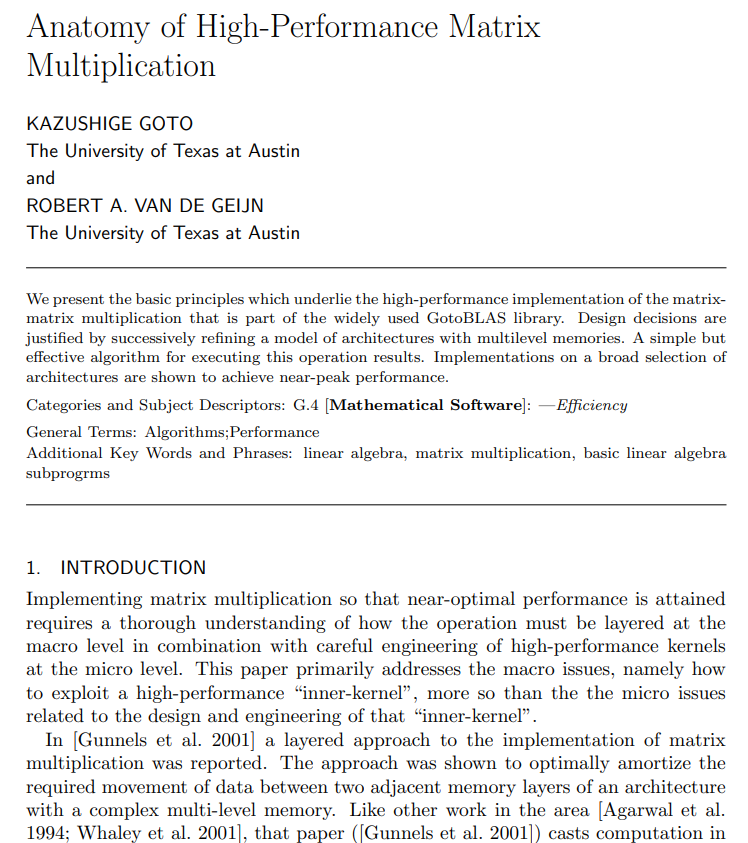
todays reading is anatomy of high performance matrix multiplication by kazushige goto.
cs.utexas.edu/~flame/pubs/Go…
English