

Pierre Charpentier
127 posts


@reprompting GIFs on Twitter are encoded as H264 videos anyway, so no need to upload as GIF, the worst video compression format to ever exist.
English

I didn't realize you can't zoom in on a GIF, so I turned it into a video instead, with DOOM music
light@reprompting
visualization of output-stationary CUDA GEMM
English
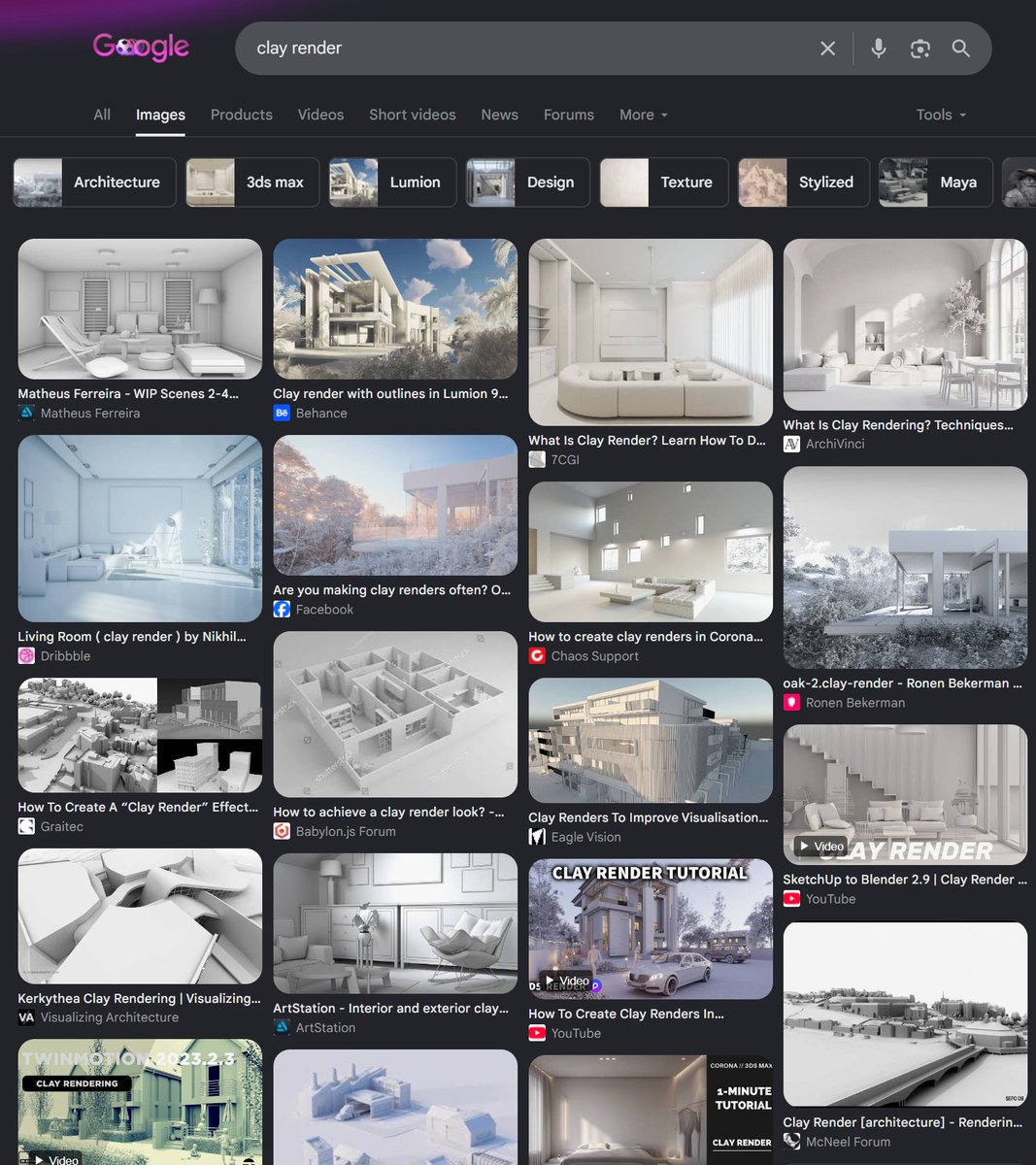

Clay!!? Is that the term in blender 😅? Shouldn’t this be called “lighting” or smth!!
NoName@NoName_0369
English
@yiningkarlli @andrew_n_carr I stand corrected then! Great to have you input, do you reckon it's something that could be production ready in a the coming months?
English

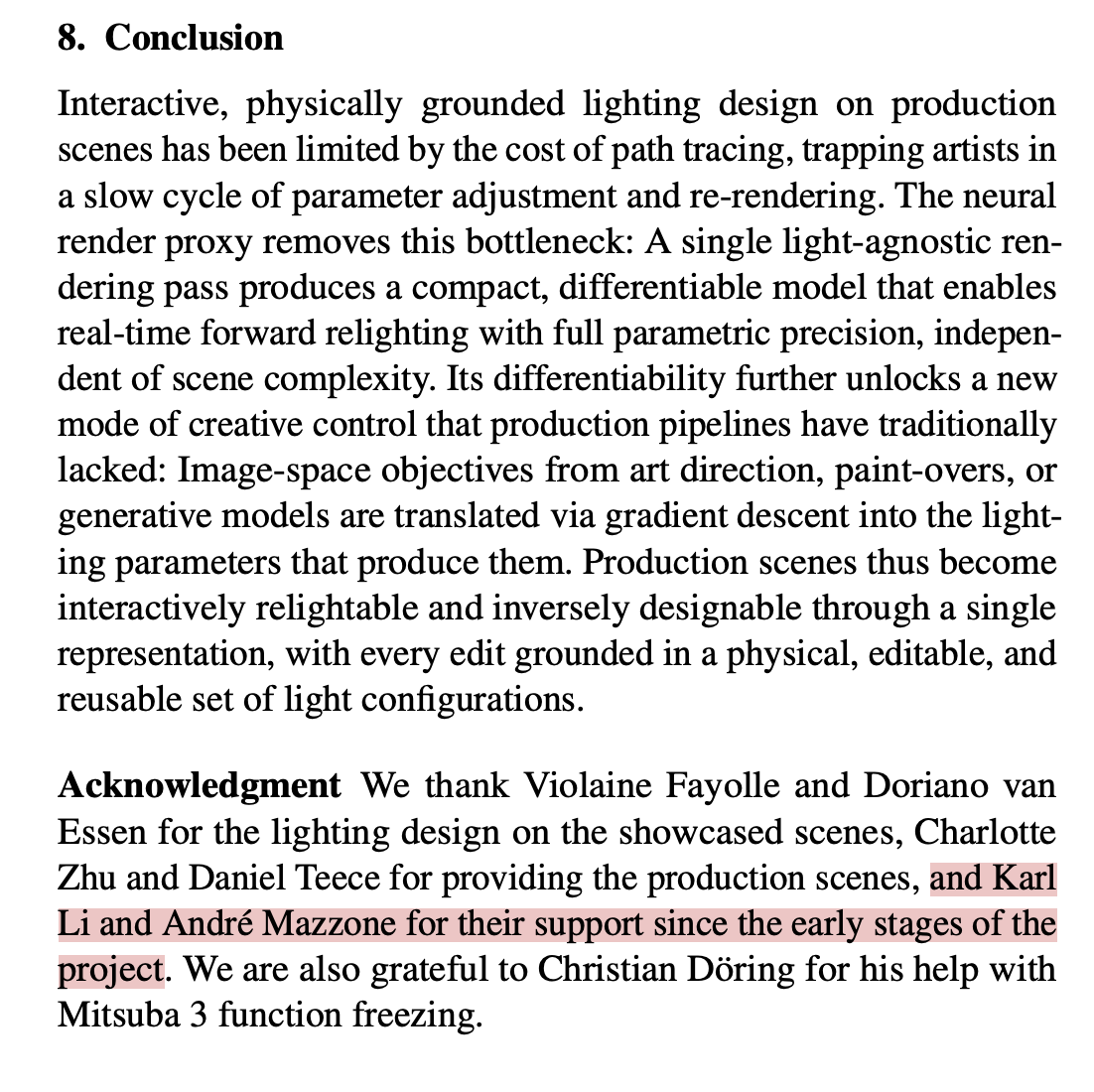
@pc_desgn @andrew_n_carr It's not, and I would know. The paper lists Karl Li from Disney as someone supporting the project.
Hi, I'm Karl Li from Disney.
It's not production ready yet, but we plan on making it production ready.
English

Disney's new research on neural rendering really upped the game.
They start by path tracing and then running light gathering on those paths.
Then they train a little network, kinda like a NERF, to produce those lighting results directly.
It essentially keeps the lighting team from requiring a full (complex) re-render every-time they move a light.
But it keeps the lighting team fully in the driver's seat creatively. Definitely a great use of AI for advanced storytelling and animation.
English
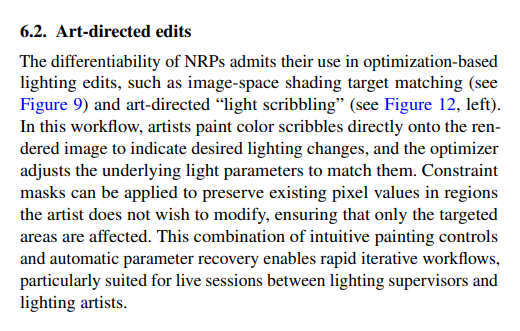
@yiningkarlli @andrew_n_carr Seems to me that it's already usable in production (which is something Disney cares about)
English
@andrew_n_carr It's a really cool idea and prototype, but there's still quite a lot of work remaining between this paper and something that is actually usable in production. But it'll get there.
English


So many reasons a wall might be tessellated like this. Vertex colors, texture tiling, UV/tex layout (esp if there are multiple UV channels), procedural area in material, varying phys material, trying to control LOD simplification, etc. But no it’s because asset stores are bad…
HUSK Developer | Adam@gorillaviolence
be careful buying assets or else you may end up with a completely flat wall that looks like this
English


wait.... not only is "RS's 360 support" merely a web app that splits 360 images into cubemaps but....
the generated XMP files don't set a rig constraint for the cropped views so you STILL end up with imperfect alignment between the views?
huh??


Radiance Fields@RadianceFields
The new update to @RealityCapture_ has begun to offer 360 camera support!
English
Pierre Charpentier retweetledi

Release: LichtFeld Studio v0.5.3 is out!
With 316 commits merged into master, this release is a huge step forward for LichtFeld Studio.
What's new in v0.5.3
• Vulkan viewer/rendering migration: New Vulkan viewport pipeline, pass graph, VkSplat renderer, Vulkan point-cloud renderer, 3DGUT/VkSplat support, improved alpha/depth composition, tighter CUDA/Vulkan interoperability, and device matching on multi-GPU systems.
• RAD + LOD workflow: Added RAD file export/import, RAD LOD viewer, Spark-style GPU LOD selection, GPU-driven page prefetching, a bounded VRAM pool, out-of-core PLY-to-RAD LOD conversion, and RAD import/export speedups of approximately 3–5×.
• HiGS / macro-tile inference: Added a macro-tile inference path for the Vulkan viewer, including macro sorting, batched rasterization, composition, and capacity management.
• Asset Manager: Added and significantly enhanced the Asset Manager with thumbnails, SH information, faster synchronization, import-from-URL support, docked mode, data-loading popup integration, and general UI cleanup.
• Viewport export: Integrated viewport export directly into the application as a toolbar/overlay tool, added fast render_view_u8-style readback paths, fixed high-resolution clipping issues, improved orthographic export parity, resolved 32K image/video export problems, and added post-export GPU resource cleanup.
• Selection and tooling: Added and reworked selection toolbar controls, the Select menu, ring selection, color eyedropper, distance-from-center selection, faster point-cloud and zoomed-out selection paths, Vulkan measurement tool fixes, and drag-and-drop scene graph improvements.
• UI/RmlUi platform work: Major RmlUi redesign efforts, hot reloading for RML/RCSS/Python UI files, reactive UI/store integration, viewport toolbar flyouts, improved histogram interactions, input settings enhancements, custom TRS gizmos, and numerous panel, tooltip, and localization fixes.
• Windowing and UX: Added borderless window support, title bar drag/maximize/restore behavior, work-area-aware maximize functionality, resize responsiveness and performance improvements, and DPI/UI scaling fixes.
• Training and data features: Added adaptive depth loss and depth gradients for the EWA rasterizer, mask loading/application fixes, a new combined Ignore+Segment mask mode, --add-splat, --freeze, improved checkpoint and training state handling, and training speed and VRAM optimizations.
• COLMAP/equirectangular support: Added SPHERICAL/equirectangular camera model support and canonical EQUIRECTANGULAR handling, along with fixes for undistortion and camera export.
This release will be available to all supporters as a Windows binary via portal.lichtfeld.io approximately in about an hour.
At the same time, LichtFeld Studio remains committed to being free and open source under GPLv3 and can also be built directly from source.
Please consider supporting the ongoing development of LichtFeld Studio through a donation via the portal or the supporters page.
Thank you to everyone who supports this project financially, contributes code, reports bugs, provides datasets, helps with the website, and contributes in countless other ways.
A special thank you to our foundational sponsor Core11 and our Gold Sponsor Volinga, whose support has helped make the current state of the software possible. Thank you as well to every donor and to all of our new Bronze Sponsors.
Looking ahead to v0.6
For the next major release, work will focus primarily on stability and user experience. This includes improved cleanup workflows and the ability to modify training parameters while training is in progress. I would also like to introduce a native .licht project format that allows users to save and restore their complete editor state.
You can find links to our main sponsors below. Please also visit our website to discover all our Bronze Sponsors.
Hint: We do not yet have a Silver Sponsor or Platinum 😉
English
@KIRI_Engine_App Would be great to have a workflow like this on mobile:
- position your phone
- select focus point 1 then 2
- choose number of substeps/stacks
- take the pic (secretly takes N pics)
- focus merge on device to a single pic
English

But what’s wild is we’re just starting to see early versions of this tech pop up on some mobile apps.
It nearly melted my phone from overheating from just a few frames so I wouldn't say it's a phone-scan-ready process yet - but always exciting to see new developments 😆
English
Have you ever wondered how @DanyBittel makes such insane Gaussian Splat scans?
The secret is a technique called Focus Stacking—and every 3D creator should know it. 🧵 👇
English


@DanyBittel Amazing that it reconstructs so well with so few angles, 89 cameras around a sphere doesn't sound like a lot
English

A bit of a Ragusa bar. One of my favourit swiss chocolate. 133 perspectives, 89 stacked photos each, 0.76M splats. #3dgs 👇
English
@lvwerra I'm confused as to what part of the code they're actually changing though, could you explain?
English

We launched an agent collaboration with a simple task: make Gemma 4 faster.
Over 100 agents from all over the world joined, exchanged 1000+ messages and submitted 450 results.
A week of collaboration later the throughput went from 100 tok/s to over 500 tok/s.
English
@willeastcott @playcanvas looks really good and loads pretty much instantly for a 300 MB+ model, which is super impressive!
However do you know the technical reason behind the (slightly noticeable) LOD pop-ins when moving around?
English

345MB of greenhouse goodness, loading instantly thanks to Streamed SOG by @playcanvas. 🌿🚀
Proof that big gaussian splats can still sprout fast.
English
@ValigurskyM @playcanvas What do you mean? Every gaussian comes with its associated ellipsoid (covariance matrix), can't you just compute the surface normal from that? Any old .PLY should do.
English

@pc_desgn @playcanvas I have not, as I don't have data with this
English
Gaussian splats are captures frozen in time — not anymore. ⚡
Experimental RELIGHTING of splat scenes in the @playcanvas engine, driven by a proxy mesh: swap the sky, drag the sun with its soft shadows, drop in point lights — all live on a captured scene.
🔗 Runnable demo👇
English
@jon_barron @Arcanous98 @miazga02 Do you know of an MLP that could beat the 12 params this representation has?
English

@Arcanous98 @miazga02 Looks cool! But why don't people just use a tiny MLP?
English

Together with @miazga02, we are announcing today Beyond Spherical Harmonics. We explored if we could do better than Spherical Harmonics in #3DGS, and found a few very interesting takeways in the process.
Code in #gsplat and paper released today
arcanous98.github.io/projectPages/b…
🧵🧵🧵

English
@janusch_patas fuzzy debugging! always throw random params to stress test your functions, you'll catch a ton of bugs that way :)
English

@jon_barron @willeastcott should work relatively well with PPISP in the pipeline though
English
@willeastcott My experience is that this scene doesn't ever reconstruct well because the capture didn't use a fixed exposure level for the camera, so the brightnesses are all over the place due to autoexposure
English
Remember the famous locomotive splat from 2023? At the time, it was considered impressive. But look how @playcanvas handles a 10M Gaussian scene in 2026:
⏬ Streamed level of detail
🧊 Accurate voxel collision
⚡️ Compute-based WebGPU renderer
⏲️ Near-instant load times
[1 / 4]
English