Rev. Fred Small

14.4K posts

Rev. Fred Small banner
Rev. Fred Small

Rev. Fred Small

@revfredsmall

Minister for Climate Justice, Arlington Street Church, singer-songwriter, author @NosyCrowUS, Cambridge, MA (Massachusett land). He/him.

Cambridge, MA Katılım Temmuz 2009
4.2K Takip Edilen2.6K Takipçiler
Rev. Fred Small retweetledi
Arnaud Bertrand
Arnaud Bertrand@RnaudBertrand·
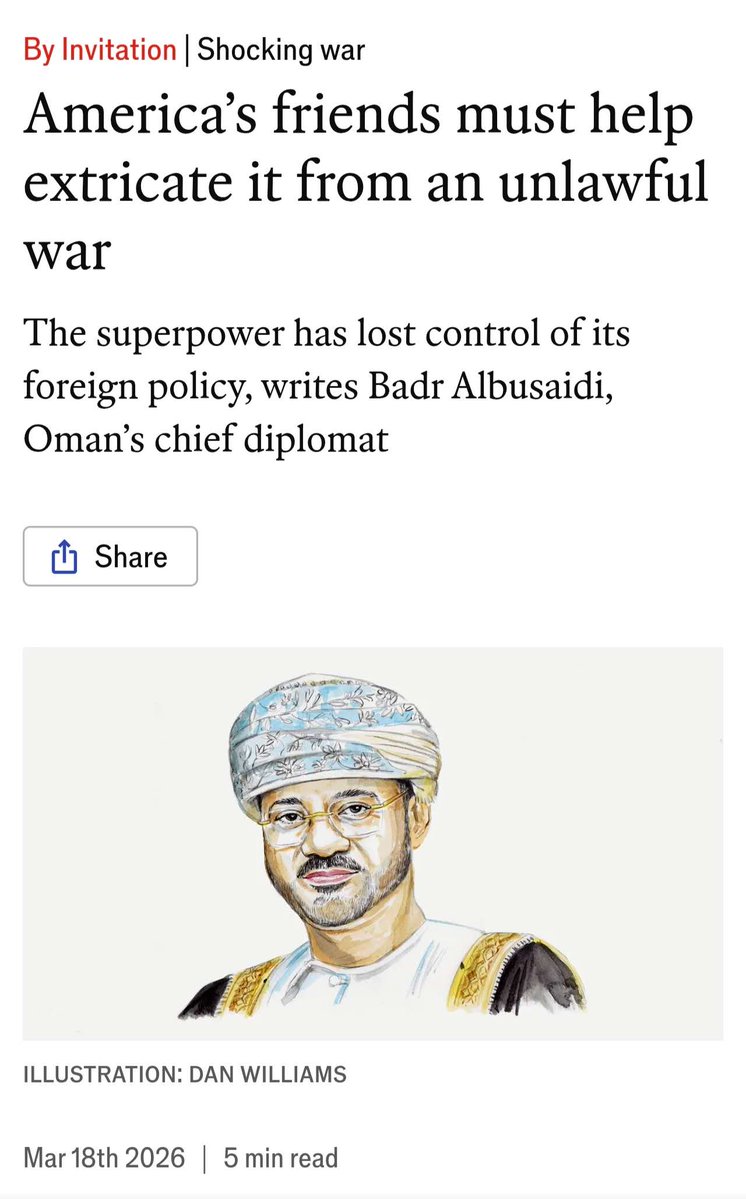
This is probably the most important article of the month: an op-ed by Oman's Foreign Minister, who mediated the talks between the U.S. and Iran, in which he writes that the U.S. "has lost control of its foreign policy" to Israel. He repeats that a deal was possible as an outcome of the talks (something confirmed by the UK's National Security Advisor, who also attended: x.com/i/status/20341…) and that the military strike by the U.S. and Israel was "a shock." Interestingly, given he is one of Iran's neighbors and given that Oman has been struck multiple times by Iran since the war began (en.wikipedia.org/wiki/2026_Iran…), he writes that "Iran’s retaliation against what it claims are American targets on the territory of its neighbours was an inevitable result" of the U.S.-Israeli attack. He describes it as "probably the only rational option available to the Iranian leadership." He says the war "endangers" the region's entire "economic model in which global sport, tourism, aviation and technology were to play an important role." He adds that "if this had not been anticipated by the architects of this war, that was surely a grave miscalculation." But, he adds, the "greatest miscalculation" of all for the U.S. "was allowing itself to be drawn into this war in the first place." In his view this was the doing of "Israel’s leadership" who "persuaded America that Iran had been so weakened by sanctions, internal divisions and the American-Israeli bombings of its nuclear sites last June, that an unconditional surrender would swiftly follow the initial assault and the assassination of the supreme leader." Obviously, this proved completely wrong, and the U.S. is now in a quagmire. He says that, given this, "America’s friends have a responsibility to tell the truth," which is that "there are two parties to this war who have nothing to gain from it," namely "Iran and America." He says that all of the U.S. interests in the region (end to nuclear proliferation, secure energy supply chains, investment opportunities) are "best achieved with Iran at peace." As he writes, "this is an uncomfortable truth to tell, because it involves indicating the extent to which America has lost control of its own foreign policy. But it must be told." He then proposes a couple of paths to get back to the negotiating table, although he recognizes how difficult it would be for Iran "to return to dialogue with an administration that twice switched abruptly from talks to bombing and assassination." That's perhaps the most profound damage Trump did during this entire episode: the complete discrediting of diplomacy. If Iran was taught anything, it is: don't negotiate with the U.S., it's a trap that will literally kill you. The great irony of the man who sold himself as a dealmaker is that he taught the world one thing: don't make deals with my country. Link to the article: economist.com/by-invitation/…
Arnaud Bertrand tweet media
English
297
8.1K
18.6K
1.1M
Rev. Fred Small
Rev. Fred Small@revfredsmall·
"Concentrated fossil power leads to concentrated political power. Had we been less dependent on fossil fuels there might have been no Pres. Trump or Pres. Putin, no ayatollahs, no PM Netanyahu. Fossil fuels push the world towards autocracy." @GeorgeMonbiot theguardian.com/commentisfree/…
English
0
0
0
78
Rev. Fred Small retweetledi
David Colon
David Colon@Colon_David·
The United States is no longer a democracy and is sliding towards autocracy faster than Hungary and Turkey, according to the annual report of the Varieties of Democracy (V-Dem) Institute at Gothenburg University. theguardian.com/world/commenti…
English
801
5.2K
10.6K
945.3K
Rev. Fred Small retweetledi
Alan Eyre
Alan Eyre@AlanEyre1·
spot-on, from @anneapplebaum Money quote: "Donald Trump does not think strategically. Nor does he think historically, geographically, or even rationally. He does not connect actions he takes on one day to events that occur weeks later. He does not think about how his behavior in one place will change the behavior of other people in other places." "He does not consider the wider implications of his decisions. He does not take responsibility when these decisions go wrong. Instead, he acts on whim and impulse, and when he changes his mind—when he feels new whims and new impulses—he simply lies about whatever he said or did before." theatlantic.com/ideas/2026/03/…
English
315
2.6K
7.8K
313.8K
Rev. Fred Small retweetledi
Anthony Scaramucci
Anthony Scaramucci@Scaramucci·
I have one question for the Republican Party today. Where is your backbone? Thune. McConnell. All of them. Where are you? Mitch McConnell is 84 years old. He has nothing left to lose. No more elections to win. No more favors to collect. No more political future to protect. And he can’t stand up and say this is not what the United States of America stands for? George Washington is literally on the wall behind you people. The man who voluntarily gave up power when he could have kept it forever. The man who warned us — in his farewell address — about exactly this kind of person. And you can’t find the words? We have removal procedures in this country for a reason. The founders didn’t put them there for decoration. They put them there because they had read enough history to know that men like this would eventually come. They built the exit door. All you have to do is use it. But instead Thune shuffles his papers. McConnell stares at the floor. And the rest of them calculate their primary margins and call it leadership. This isn’t complicated. This is a spine test. And the Republican Party is failing it in real time.
English
317
2.6K
8K
174.3K
Rev. Fred Small retweetledi
David Frum
David Frum@davidfrum·
If you wonder why Europeans flinch from helping US in Gulf - in January, NATO allies were seriously preparing for a US sneak attack on Greenland, planning to blow up runways to prevent a Trump re-enactment of Putin's failed strike on Kyiv.
Orla Joelsen@OJoelsen

Denmark prepared for a possible U.S. attack: Flew blood supplies to Greenland and planned to blow up runways Key sources in Denmark and Europe are now revealing for the first time what happened during the most critical days, when Donald Trump threatened to take Greenland “the hard way.” When Danish soldiers were rapidly deployed to Greenland in January this year, they brought explosives with them. The plan was to destroy runways in Nuuk and Kangerlussuaq to prevent American military aircraft from landing troops on the island, should the U.S. president ultimately decide to seize Greenland by force. They also transported blood supplies from Danish blood banks so wounded personnel could be treated in case of combat. This is reported by DR, which over the past year has spoken with central sources in the Danish government, top military officers, and high-ranking officials and intelligence sources in Denmark, France, and Germany. All sources have played—and continue to play—key roles in the international crisis triggered by the United States’ demand for control over Greenland. Together, the sources describe an unprecedented year marked by sleepless nights. None of them had concrete intelligence of specific American attack plans against Greenland. Still, many feared in January that the historically important ally, the United States, could attack at any moment. At the same time, Denmark reached out to its European allies, leading to closer cooperation. “With the Greenland crisis, Europe realized once and for all that we must be able to handle our own security,” said a French senior official involved in the intense period. A rapid-response force consisting of Danish, French, German, Norwegian, and Swedish soldiers was first deployed to Nuuk and Kangerlussuaq. Shortly after, a main force followed, including: -Soldiers from the Danish Dragoon Regiment in Holstebro -Elite troops from the Jaeger Corps -French alpine troops trained for cold and mountainous warfare At the same time, Danish fighter jets and a French naval vessel were sent to the North Atlantic. According to several sources, the goal of having multinational troops on the ground was to ensure that any U.S. attempt to take Greenland would require a large-scale hostile action—thereby deterring such an attempt. “We have not been in such a situation since April 1940,” said a Danish defense source, referring to the days before Denmark’s occupation during World War II. Unlike in 1940, when Denmark chose not to resist militarily, the government and defense leadership this time decided—after extensive confidential discussions—to take the opposite approach: If the U.S. attempted an attack, Danish forces would be armed and ready to fight. Danish F-35 fighter jets deployed north were also fully armed. All this despite the understanding that Denmark could not realistically withstand a U.S. military attack. “The cost for the U.S. had to be raised. The U.S. would have to carry out a hostile act to take Greenland,” said a senior Danish defense source. Source: DR

English
545
2K
8.4K
531.9K
Rev. Fred Small
Rev. Fred Small@revfredsmall·
@OJoelsen Heroic and heartbreaking. I wish our US businesses, universities, courts & Congress had the same spine. As a United States citizen, I apologize for the incalculable damage our deranged president is doing worldwide. Many of us are doing everything we can to stop him. #ResistTrump
English
2
2
31
838
Orla Joelsen
Orla Joelsen@OJoelsen·
Denmark prepared for a possible U.S. attack: Flew blood supplies to Greenland and planned to blow up runways Key sources in Denmark and Europe are now revealing for the first time what happened during the most critical days, when Donald Trump threatened to take Greenland “the hard way.” When Danish soldiers were rapidly deployed to Greenland in January this year, they brought explosives with them. The plan was to destroy runways in Nuuk and Kangerlussuaq to prevent American military aircraft from landing troops on the island, should the U.S. president ultimately decide to seize Greenland by force. They also transported blood supplies from Danish blood banks so wounded personnel could be treated in case of combat. This is reported by DR, which over the past year has spoken with central sources in the Danish government, top military officers, and high-ranking officials and intelligence sources in Denmark, France, and Germany. All sources have played—and continue to play—key roles in the international crisis triggered by the United States’ demand for control over Greenland. Together, the sources describe an unprecedented year marked by sleepless nights. None of them had concrete intelligence of specific American attack plans against Greenland. Still, many feared in January that the historically important ally, the United States, could attack at any moment. At the same time, Denmark reached out to its European allies, leading to closer cooperation. “With the Greenland crisis, Europe realized once and for all that we must be able to handle our own security,” said a French senior official involved in the intense period. A rapid-response force consisting of Danish, French, German, Norwegian, and Swedish soldiers was first deployed to Nuuk and Kangerlussuaq. Shortly after, a main force followed, including: -Soldiers from the Danish Dragoon Regiment in Holstebro -Elite troops from the Jaeger Corps -French alpine troops trained for cold and mountainous warfare At the same time, Danish fighter jets and a French naval vessel were sent to the North Atlantic. According to several sources, the goal of having multinational troops on the ground was to ensure that any U.S. attempt to take Greenland would require a large-scale hostile action—thereby deterring such an attempt. “We have not been in such a situation since April 1940,” said a Danish defense source, referring to the days before Denmark’s occupation during World War II. Unlike in 1940, when Denmark chose not to resist militarily, the government and defense leadership this time decided—after extensive confidential discussions—to take the opposite approach: If the U.S. attempted an attack, Danish forces would be armed and ready to fight. Danish F-35 fighter jets deployed north were also fully armed. All this despite the understanding that Denmark could not realistically withstand a U.S. military attack. “The cost for the U.S. had to be raised. The U.S. would have to carry out a hostile act to take Greenland,” said a senior Danish defense source. Source: DR
English
327
1.4K
4.6K
881.4K
Rev. Fred Small
Rev. Fred Small@revfredsmall·
Heroic and heartbreaking. I wish our US businesses, universities, courts & Congress had the same spine. As a United States citizen, I apologize for the incalculable damage our deranged president is doing worldwide. Many of us are doing everything we can to stop him. #ResistTrump
Orla Joelsen@OJoelsen

Denmark prepared for a possible U.S. attack: Flew blood supplies to Greenland and planned to blow up runways Key sources in Denmark and Europe are now revealing for the first time what happened during the most critical days, when Donald Trump threatened to take Greenland “the hard way.” When Danish soldiers were rapidly deployed to Greenland in January this year, they brought explosives with them. The plan was to destroy runways in Nuuk and Kangerlussuaq to prevent American military aircraft from landing troops on the island, should the U.S. president ultimately decide to seize Greenland by force. They also transported blood supplies from Danish blood banks so wounded personnel could be treated in case of combat. This is reported by DR, which over the past year has spoken with central sources in the Danish government, top military officers, and high-ranking officials and intelligence sources in Denmark, France, and Germany. All sources have played—and continue to play—key roles in the international crisis triggered by the United States’ demand for control over Greenland. Together, the sources describe an unprecedented year marked by sleepless nights. None of them had concrete intelligence of specific American attack plans against Greenland. Still, many feared in January that the historically important ally, the United States, could attack at any moment. At the same time, Denmark reached out to its European allies, leading to closer cooperation. “With the Greenland crisis, Europe realized once and for all that we must be able to handle our own security,” said a French senior official involved in the intense period. A rapid-response force consisting of Danish, French, German, Norwegian, and Swedish soldiers was first deployed to Nuuk and Kangerlussuaq. Shortly after, a main force followed, including: -Soldiers from the Danish Dragoon Regiment in Holstebro -Elite troops from the Jaeger Corps -French alpine troops trained for cold and mountainous warfare At the same time, Danish fighter jets and a French naval vessel were sent to the North Atlantic. According to several sources, the goal of having multinational troops on the ground was to ensure that any U.S. attempt to take Greenland would require a large-scale hostile action—thereby deterring such an attempt. “We have not been in such a situation since April 1940,” said a Danish defense source, referring to the days before Denmark’s occupation during World War II. Unlike in 1940, when Denmark chose not to resist militarily, the government and defense leadership this time decided—after extensive confidential discussions—to take the opposite approach: If the U.S. attempted an attack, Danish forces would be armed and ready to fight. Danish F-35 fighter jets deployed north were also fully armed. All this despite the understanding that Denmark could not realistically withstand a U.S. military attack. “The cost for the U.S. had to be raised. The U.S. would have to carry out a hostile act to take Greenland,” said a senior Danish defense source. Source: DR

English
0
0
0
34
Rev. Fred Small retweetledi
Mike Levin
Mike Levin@MikeLevin·
Let me get this straight. The federal government held a legal auction for the right to build offshore wind farms. A company won those auctions fair and square, paying nearly a billion dollars into the U.S. Treasury. The projects went through years of review. Courts repeatedly upheld their legality. Everything was above board. Then the Trump administration tried five separate times to kill other wind projects in federal court and lost every single time. Judges reviewed the administration’s supposed “national security” justification and weren’t persuaded.  So now they’ve landed on a new plan: pay the company nearly ONE BILLION DOLLARS of your tax money to just walk away. Because, and I am not making this up, the president thinks offshore wind turbines are ugly and claims without evidence that they “drive whales crazy.”  He’s been nursing this petty grudge since 2012, when he tried to block a wind farm visible from his golf course in Scotland. Fourteen years later, American taxpayers are footing the bill for it. This is stupid policy. It’s fiscally reckless, strategically blind, and driven entirely by a personal vendetta rather than any coherent vision for American energy or competitiveness. Meanwhile, China is racing ahead, building offshore wind at a staggering pace and positioning itself to dominate the global clean energy economy for decades to come. None of this is America First. nytimes.com/2026/03/17/cli…
English
292
4K
8.6K
267.1K
Rev. Fred Small retweetledi
Chris Murphy 🟧
Chris Murphy 🟧@ChrisMurphyCT·
Democrats keep trying to pass legislation to reopen TSA and Republicans keep blocking it. Why, you ask? Because they want to keep TSA closed as leverage to fund Trump’s deadly immigration round ups.
U.S. Senate Democrats Floor Updates@DSenFloor

.@SenatorWarnock asked unanimous consent that the Senate consider and pass S. 4127, TSA Pay Act Sen. James Lankford (R-OK) objected.

English
244
1.2K
3.6K
73.3K
Rev. Fred Small retweetledi
Haytham Kaafarani
Haytham Kaafarani@hayfarani·
I am a US citizen & Surgeon who took care of the Boston Maraton Bombing victims in 2013. I paid for 7 years to own a small apartment in downtown #Beirut for my 3 kids to enjoy summers there. Today, #Israel reduced my dream home to rubble, with american weapons, paid by my taxes.
English
8.9K
46.2K
197.2K
8.9M
Rev. Fred Small retweetledi
Barry R McCaffrey
Barry R McCaffrey@mccaffreyr3·
So Trump says ‘he can take Cuba…. He can do anything he wants’. His team says ‘Cuba’s President has to stand down.’ Do Republicans in Congress know this is nuts? Should we allow Presidents to take military action against seven countries without consulting Congress? Should a President threaten NATO if they don’t join an out of area. naval action to force combat passage of the Straits?
David Axelrod@davidaxelrod

I can just TAKE it?!? My goodness, he sounds less and less like an American president.

English
136
977
2.7K
48K
Rev. Fred Small retweetledi
Democratic Coalition
Democratic Coalition@TheDemCoalition·
After Trump is gone, one of the things we're also going to remember is the cowardice of the people who knew better, but went along anyways. #ResistTrump
Democratic Coalition tweet media
English
108
325
439
3.6K
Rev. Fred Small retweetledi
David Adler
David Adler@davidrkadler·
We are laying siege to the island of Cuba, turning off the lights in homes, hospitals, and the country's most critical infrastructure. These are war crimes: lethal, cruel, and criminal acts of collective punishment. It is sociopathy dressed up as foreign policy.
Acyn@Acyn

CNN: Breaking news. Cuba's electrical grid has suffered a complete and total collapse. This is according to the country's power operator. It's the first nationwide blackout since the US effectively shut off the flow of oil to Cuba

English
1.5K
13.1K
30.4K
1M
Rev. Fred Small retweetledi
Ted Lieu
Ted Lieu@tedlieu·
Had trump not violated the Constitution, the Administration would have had to present to Congress and the American people the case for war with Iran. And lots of people would have asked the Administration what is the plan to protect allies, and U.S. bases in allied countries.
Acyn@Acyn

Trump: They weren't supposed to go after all these other countries in the Middle East. So they hit Qatar, Saudi Arabia, UAE, Bahrain, Kuwait. Nobody expected that. We were shocked

English
379
1.5K
4.2K
96.5K
Rev. Fred Small retweetledi
Ilan Goldenberg
Ilan Goldenberg@ilangoldenberg·
Actually, the guy who was the point person for Iran at the White House and was fired by the Trump Administration after being Loomered wrote EXACTLY that warning 4 days before the war started. The article was titled “Why Iran Will Escalate.” But who needs experts… foreignaffairs.com/middle-east/wh…
Acyn@Acyn

Doocy: You said: they hit Qatar, Saudi Arabia UAE, Bahrain, Kuwait nobody expected that. We were shocked. Are you surprised that nobody briefed you ahead of time that that might be their retaliation? Trump: Nobody. Nobody. No no no no. The greatest experts—nobody thought they were going hit…

English
170
5.4K
15.1K
1.3M
Rev. Fred Small retweetledi
TheSteadyState
TheSteadyState@steadystate2025·
"I do believe I’ll be having the honor of taking Cuba… I can do anything I want with it.” Trump talks like a king, dividing up colonies, not a president bound by law. The question is no longer where he gets the audacity, but why anyone in Congress, the courts, or the media is still enabling it.
TheSteadyState tweet media
English
35
141
294
4.4K