Rati Gelashvili

352 posts

Rati Gelashvili banner
Rati Gelashvili

Rati Gelashvili

@rgelash

Concurrency 🥷 prev blockchain research @aptoslabs, @novi. even prior eng team lead @neuralmagic, PhD @mit.

Katılım Ağustos 2014
688 Takip Edilen38.6K Takipçiler
Sabitlenmiş Tweet
Rati Gelashvili
Rati Gelashvili@rgelash·
Granularity
Čeština
2
2
9
7.2K
Rati Gelashvili
Rati Gelashvili@rgelash·
Brilliant to see / diagnose sociopolitical processes like this - takes a gift and years of work. Reminds me of how top mathematicians deconstruct problems or engineers grasp complex systems. But while those two I am familiar with, this blows my mind: tornikemetreveli.substack.com/p/after-the-sq…
English
1
0
2
2.4K
Rati Gelashvili
Rati Gelashvili@rgelash·
PPoPP review scores for BlockSTM: Strong accept, strong accept, accept. Pretty high reviewer expertise. The best academic conference targeted to concurrency. We also got positive private feedback from legendary folks, esp. re: estimate mechanism, saying it's crazy nobody did this simple idea for 40 years. But yes, I like things simple, and will also never claim anything I co-authored was this or that. But the above take should be objectively not fair. Although I'm not with the flame wars either, and am happy to see optimistic concurrency / dynamic parallelism make any progress and get adoption - because I believe that is the right path.
English
0
1
6
747
James
James@_jhunsaker·
optimistic concurrency control was discovered in 1979, before your parents met each other software transactional memory (STM) I was working on in the Haskell context while you were still wearing diapers BlockSTM is a trivial extension of these I've never looked at any Aptos code, in fact I never think about Aptos except when you post nonsense like this any consensus related stuff we properly cite in docs and papers
Alexander Spiegelman@SashaSpiegelman

I really don't understand why it takes so much time for Monad to copy Aptos tech. It's all open source, and we have peer reviewed paper for everything. It would be much easier for you guys if you stop trying to hind it and just copy directly. Learn from Movement, they proudly copy and are doing great.


English
62
23
409
88K
Rati Gelashvili
Rati Gelashvili@rgelash·
@alessandrod @SashaSpiegelman Platitude? Really? Platitude would be asking to look up the definition of platitude. I tried to make a relevant point about your question itself, that it might be missing an important dimension. Lets let the audience judge if it was relevant, and appreciate the joke.
English
0
0
3
75
Alessandro Decina
Alessandro Decina@alessandrod·
@rgelash @SashaSpiegelman Not at all! I asked a simple question. Alexander gave me a simple answer, which I appreciate. You hit me with a platitude. Joke response feels appropriate!
English
1
0
0
91
Alexander Spiegelman
Alexander Spiegelman@SashaSpiegelman·
I've read the parallelism comparison. Overall, it's not too bad, considering they are Sui maxis. I guess BlockSTM is so good that even a biased report couldn't make it look bad. However, the conclusion is wrong. Sui is much less efficient in contented workloads because it experiences a high number of false conflicts. This happens because transactions must declare upfront every possible asset they may touch. Think of conditional logic: If the steak was overcooked by the chef, give me a salad. In this case, Sui would need to lock both the grill and the salad bar for the client. In BlockSTM, we only have true conflicts because we dynamically determine what a transaction actually touches. In the example above, we would never lock the salad bar if the steak is not overcooked. Sponsored comparisons are useful for a general understanding, but always do your own research when making big decisions.
VanEck@vaneck_us

Sui vs. Aptos: Competitive Analysis and 2025 Price Target @Patrick_Bush_VE vaneck.com/us/en/blogs/di…

English
2
11
68
14.3K
Rati Gelashvili
Rati Gelashvili@rgelash·
@alessandrod @SashaSpiegelman Platitude? Really? Platitude would be asking to look up the definition of platitude. I tried to make a relevant point about your question itself, that it might be missing an important dimension. Lets let the audience judge if it was relevant, and appreciate the joke.
English
1
0
2
206
Rati Gelashvili
Rati Gelashvili@rgelash·
@alessandrod @SashaSpiegelman Building systems is a trade-off between not prematurely optimizing, and yet being flexible enough. You could have a situation where real traffic today and tomorrow could be drastically different, and moreover today's constraints could shape tomorrow's real traffic.

English
2
0
2
2.6K
Rati Gelashvili
Rati Gelashvili@rgelash·
To me, static parallelism can't be viewed as an innovative feature from purely parallelism POV (e.g. not programmability or ways of specifying things): imo it is a basic fork-join. Value is simplicity, betting that intelligent decisions based on runtime information won't be important (or that one can swap out the engine at that point, but seems hard if the assumptions are deeply embedded). We believe in innovating in this space w. BlockSTM and actively working on v2, since it is easy to envision workloads where static pre-declarations suffer from false conflicts. Clever runtime systems have access to real information such as actual conflicts, gas consumption. The point then becomes to make the system as efficient and scalable as possible.
Rati Gelashvili@rgelash

@alessandrod @SashaSpiegelman Building systems is a trade-off between not prematurely optimizing, and yet being flexible enough. You could have a situation where real traffic today and tomorrow could be drastically different, and moreover today's constraints could shape tomorrow's real traffic.

English
0
4
12
4.9K
Rati Gelashvili retweetledi
moon shiesty
moon shiesty@moonshiesty·
> Sui resolves conflicts between competing transactions upfront, allowing it to establish an order at the outset true > This design is advantageous in scenarios with heavy decentralized exchange (DEX) activity, often called “contentious state writes,” such as traders competing for arbitrage opportunities. completely wrong. the first part should have lead you to the opposite conclusion for transactions that use global state, it is impossible know whether that transaction will result in a "contentious state write" until it is executed by the VM this is true for DEX transactions, more generally to transactions that conditionally read/write to shared state, even to transactions that revert this is even more true when traders are competing for access to the same global state (ie arbitraging the same pool) aptos dynamic parallelism can detect at RUNTIME whether two transactions actually conflict. for example when two transactions using the same pool both revert due to slippage, they can be executed in parallel (read/read no conflicts) sui ALWAYS execute those two transaction serially, because it ALWAYS assumes they conflict
VanEck@vaneck_us

Sui vs. Aptos: Competitive Analysis and 2025 Price Target @Patrick_Bush_VE vaneck.com/us/en/blogs/di…

English
11
25
177
54.1K
Rati Gelashvili retweetledi
Wolfgang Grieskamp
Wolfgang Grieskamp@wgrieskamp·
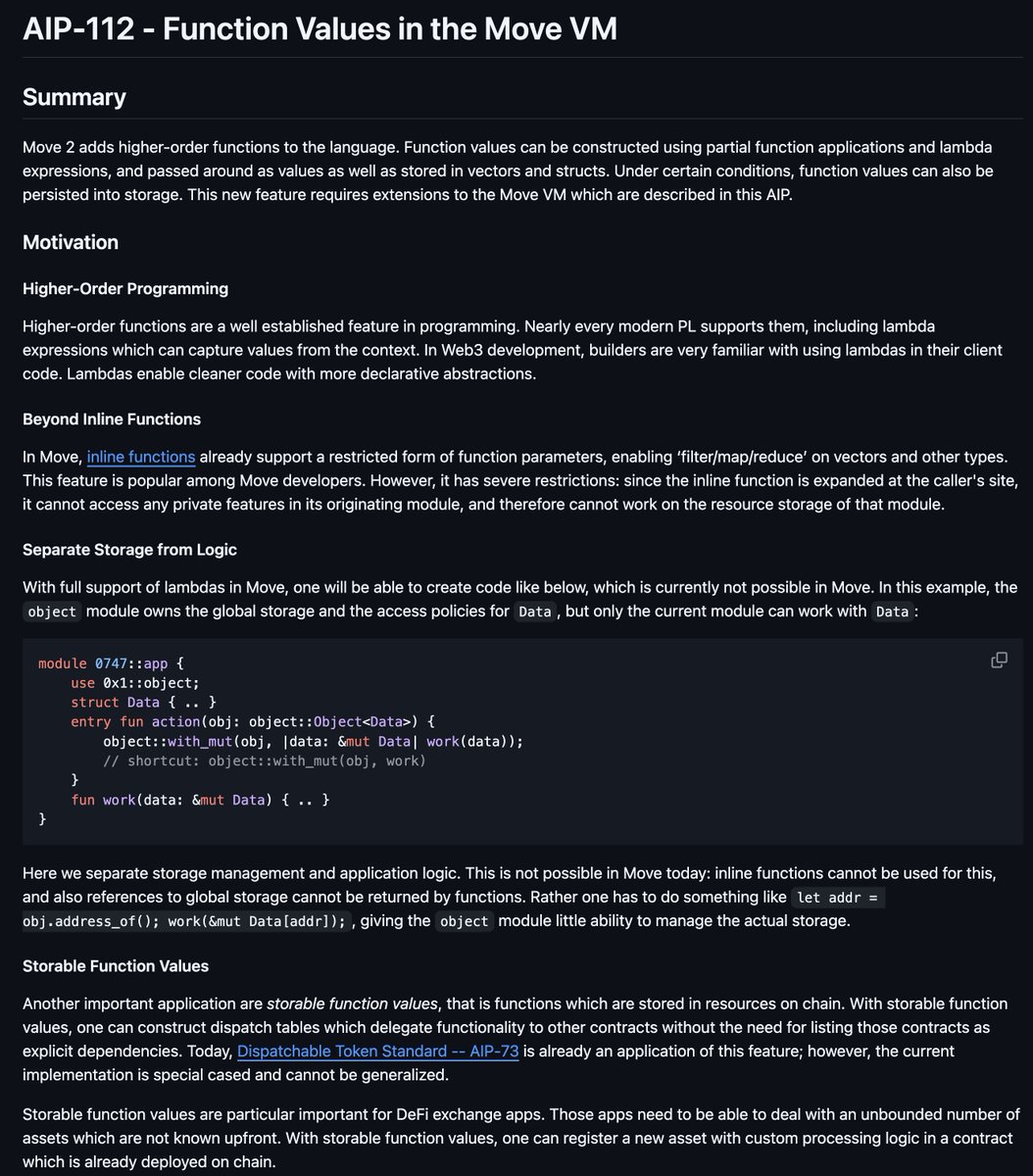
AIP-112 just freshly merged and is about function values in the Move VM. This is a major expressiveness addition to Move, as it adds (safe, I think) dynamic dispatch and enhances the power of borrow semantics with global storage.
Wolfgang Grieskamp tweet media
English
6
12
71
21.6K
Rati Gelashvili retweetledi
Alexander Spiegelman
Alexander Spiegelman@SashaSpiegelman·
So we put this graph out 3 months ago, and no one from the Sui team pushed back. Not even their paid maxis and cheerleaders. Why? Because they can't. Mysticeti is just a marketing system for low latency in perfect centralized networks, and they know it. Here is the code (a simple few lines change to drop some messages) so anyone can reproduce: github.com/ibalajiarun/my… Moreover, they promised to break Sui and demonstrate high tps on mainnet in June. Well, it is almost Christmas... Half a year later, and they probably still can't make Mysticeti work. I don't know about other stuff, but when it comes down to the tech, they can't compete with Aptos. Maybe they really need to "cancel holidays and come back to work". I mean real work.
Alexander Spiegelman@SashaSpiegelman

Many paid KOLs and Maxis are recently hyping Mysticeti, so we decided to add some color. 0.05% message drops destroys Mysticeti's latency - from 1s to 10s! We ran the latest Mysticeti code with 5/100 nodes dropping 1% of messages (starting at the red line). This is because they sacrificed Narwhal's certified DAG structure to reduce latency, but cutting corners comes with a cost.

English
22
19
95
30.5K
Mo Shaikh 🇺🇸
Mo Shaikh 🇺🇸@Moshaikh·
@SashaSpiegelman It’s been a pleasure working together and learning from you. Will miss you and can’t wait to see you on the courts :-)
English
1
2
33
16.6K
Mo Shaikh 🇺🇸
Mo Shaikh 🇺🇸@Moshaikh·
For as long as I can remember, I’ve been passionate about building systems that empower people—fairer, more open systems. Since 2016, I have been deeply involved in the blockchain world, both exploring and contributing to its transformative social and economic potential.   Three years ago, Avery and I co-founded Aptos Labs with a simple but ambitious goal: to create a resilient and scalable foundation capable of creating fair and efficient products for the future. Today, I am incredibly proud of how far we have come. Aptos stands as one of the most robust ecosystems, trusted by over a thousand builders and innovators around the globe. The ecosystem has thrived across cycles, growing stronger and more vibrant each time.   Today I am stepping away from Aptos Labs to start a new chapter.  One of my true passions lies in building companies from the ground up and we have done that at Aptos Labs by building a world-class team. I leave Aptos Labs with the utmost confidence in the team, and strongly believe the talent and drive of Aptos Labs will bring our collective vision to life in the near future. Avery will be stepping in as the Aptos Lab’s CEO to drive the company into its next phase of growth.   The Aptos ecosystem continues to shine, driven by the incredible work of early builders that have become friends, like Merkle Trade, Thala Labs, Kyd Labs, Econia, MyCo, and Aave. This growth is further amplified by the support of partners like BlackRock, Franklin Templeton, Mastercard, Google, Microsoft, NBCU, BCG and leading companies across South Korea, Japan, and beyond. The convergence of Web3 and Web2 is unfolding rapidly, and Aptos stands at the forefront, driving innovation and scaling possibilities.   None of this would have been possible without the unwavering support of our incredible investors. I want to extend my deepest gratitude to Dragonfly, Blocktower, Haun Ventures, Hashed, IRONGREY, a16z, Apollo, Coinbase, Parafi, Scribble, PayPal, Franklin Templeton, and the amazing angels who believed in our vision. Raising $400M was an incredible feat, and this strong foundation has been instrumental in enabling Aptos to thrive and grow.   Finally, the team at Aptos Labs is world-class. They have worked tirelessly to craft this ecosystem from scratch. Technology without them is technology without soul. Their care and efforts are the reason we stand with confidence today, and their work will only accelerate as Aptos enters its next chapter.   I will always remain a champion of Aptos and its mission. As such, I will stay on as a strategic advisor to Aptos Labs and look forward to continuing to help Aptos maintain its role as the world’s leading blockchain.    Over the coming months, I plan to take some much-needed time to reflect on where the world is headed and to think deeply about the ways financial systems can evolve to continue to push Aptos as the most established layer 1 in the space.    You all know where to find me. I look forward to staying connected, supporting this incredible ecosystem, and seeing what the future holds for Aptos and the broader Web3 community.
English
384
138
1.4K
979.6K
Rati Gelashvili retweetledi
Wolfgang Grieskamp
Wolfgang Grieskamp@wgrieskamp·
2/ And to add to this: I’m personally convinced that full-fledged DeFi apps need this power of randomized storage access which Aptos Move has but Sui Move does not. When I left Meta I had the choice to join either Aptos Labs or Mysten Labs. The absence of this feature in Sui Move was the tipping point for me.
English
1
1
23
826
Kostas Kryptos
Kostas Kryptos@kostascrypto·
This is definitely not true, maybe you missed all of the product and innovation meetings as some of us had to leave the office midnight and interacted at almost daily basis. @EmanAbio’s vision was a catalyst for many crypto innovations at Meta, discussions with custodians, partners, and many of the multi-sig and auth ideas, proof of solvency, digital remittances architecture and co, helping not only Libra, but even Deloitte to fix their audits, helping partners and more importantly data to build a better Ethereum and Bitcoin. It’s very sad you are claiming that, not many people have a broad vision apart from wearing blinders and live in their own world it seems. Blockchains is UX, DevEx, opening doors for startups to innovate, product and data ideas and so many other offerings, go to hackathons and inspire innovation, it’s not just the programming language (which is also an important factor indeed, but not the sole one)
English
1
4
21
622
Justin Bons
Justin Bons@Justin_Bons·
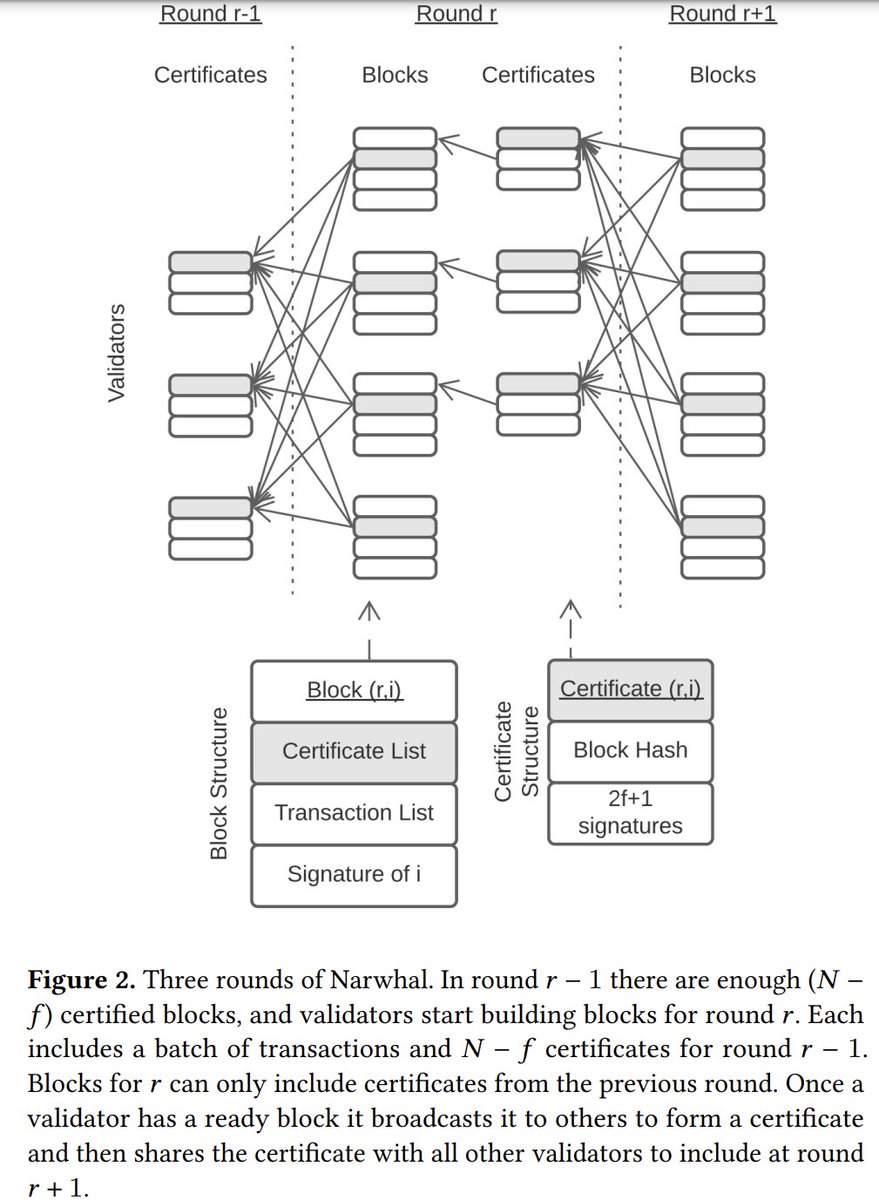
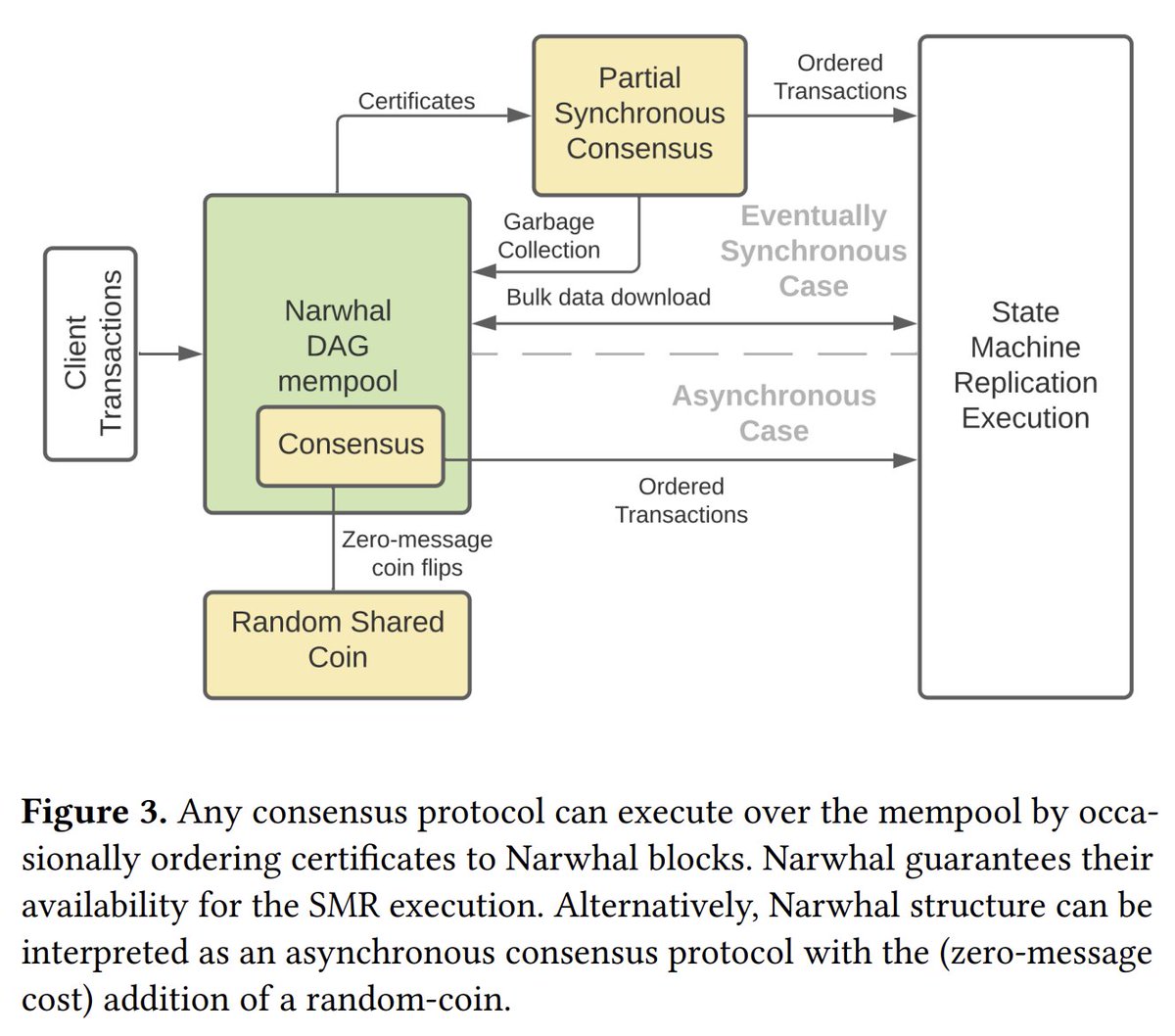
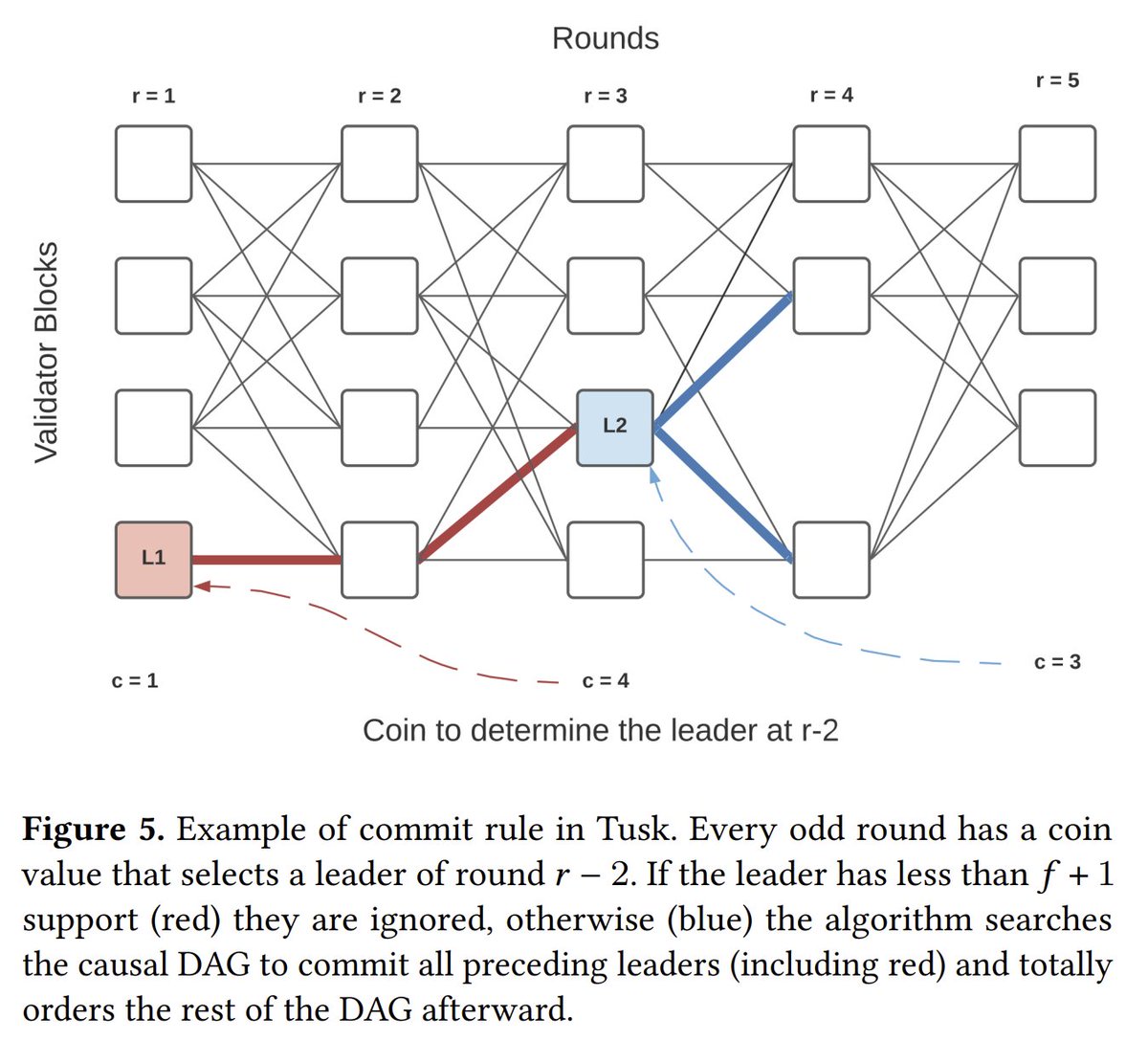
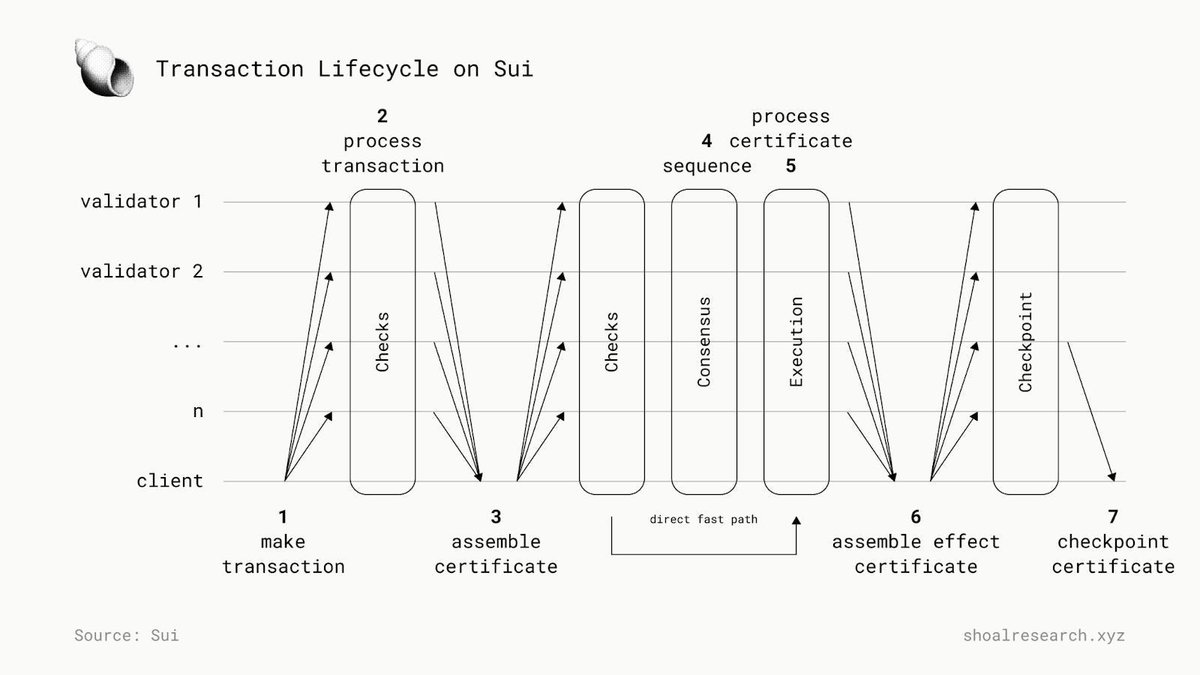
SUI's Narwhal is a paradigm shift in blockchain design! Combining speed with reliability in a way that was impossible before Overcoming a major trade-off in design; fast deterministic asynchronous verification! All achieved with a DAG-based mem-pool with pre-conf qualities! 🧵 If that sounds crazy & wild to you then you are correct, as this is an incredibly novel design! Before we assumed the trade-off between slow reliable deterministic verification & fast unreliable optimistic verification was fixed. Turns out this can be effectively overcome with different forms of pre-consensus Explaining how SUI can match SOL's speed without also paying for "failed TXs", making SUI significantly more efficient in that regard This is all achieved by layering a pre-confirmation network in the form of a DAG before a more traditional consensus mechanism. This gives a sufficiently high guarantee that TXs will make it into the final form of consensus. Even though this guarantee is technically weaker compared to a traditional confirmation it is still much stronger compared to a TX in a pre-confirmed state in an optimistic parallelized chain such as SOL: As optimistic designs such as SOL resolve such conflicts by causing TXs to fail afterward, that is what makes them "optimistic". Whereas in SUI TXs can be deterministic, in other words, you can be confident that the TX will always go through & thanks to Narwhal it now even matches SOL's speed: The way Narwhal passes "certificates" on to the validators can be compared to how cross-shard TXs often work, the main innovation here is again how the use of a DAG-like pre-conf structure has significantly sped up this process: This technology has wider repercussions as we already hinted at; as I see no reason why sharded chains could also not adopt similar technologies to put their execution speed on par with chains like SOL & SUI! Where before there was a trade-off between speed & capacity when comparing sharding to purely parallelized chains, that trade-off at least theoretically might no longer be there, allowing sharded chains to match SOL & SUI's speed while also offering far more capacity! The research done by Radix most closely resembles this innovation; a pre-confirmation/consensus network over a sharded chain that allows for fast execution, though it remains to be seen which sharded chain will implement this on mainnet first, as some are only becoming aware of this breakthrough now Despite SUI's terrible economic design, as no chain tickets all of the boxes. SUI deserves our praise, as this technology helps move our entire cryptocurrency ecosystem forward for the better! 🔥
Justin Bons tweet mediaJustin Bons tweet mediaJustin Bons tweet mediaJustin Bons tweet media
English
49
60
362
73.8K
Rati Gelashvili retweetledi
Wolfgang Grieskamp
Wolfgang Grieskamp@wgrieskamp·
@EmanAbio @SashaSpiegelman @AveryChing @Justin_Bons @Aptos Fun fact: this guy Adenyi was for a few years program manager for the Move team at Meta. He was in no one's head because no one met him, and he only talked with Evan. I remember well the Move team meetings where we discussed Adenyi, the most invisible PM everybody never met 😆
English
3
2
22
3.1K
Rati Gelashvili
Rati Gelashvili@rgelash·
160k number originated from medium.com/aptoslabs/bloc…, an execution-only (i.e. in-memory, single node / no consensus) benchmark number from the BlockSTM paper (reproduced by PPoPP reviewers as well as others), measuring purely parallel execution behavior without being affected by implementation of other subsystems. Since then, many features have landed and affected performance. And while the number was never for general throughput, Aptos mainnet has demonstrated impressive sustainted e2e performance numbers, daily transaction records, and the quest to keep improving is far from over: specifically for execution throughput, exciting work on high performance MoveVM and BlockSTMv2
English
0
1
5
302
Rati Gelashvili
Rati Gelashvili@rgelash·
@thegautamkamath It took a (SA, A, A, WA) paper getting rejected with "we agree paper is solid, but unfortunately it didn't generate sufficient enthusiasm within the PC" to realize it's a big echo / ego chamber, with people taking turns to publish papers in the most scary, not accessible, state.
English
0
1
2
165
Gautam Kamath
Gautam Kamath@thegautamkamath·
Some reasons you may avoid STOC/FOCS: - you don't want to waste time with rejections - you don't need more impressive CV lines - you want to reach a specific different community with little overlap with theory CS/algorithms - focused on appealing to industry
English
2
0
8
2.8K
Gautam Kamath
Gautam Kamath@thegautamkamath·
Expanding on this answer, for folks who may not be familiar. Descriptively first: STOC/FOCS are the premiere conferences for the theory CS/algorithms and complexity community. Papers are often long (100+ pages is not unheard of) and technical (almost exclusively).
Gautam Kamath@thegautamkamath

@gautamcgoel If it would get into STOC/FOCS, you always send it there.

English
1
7
74
28.9K