Man

2.1K posts

Man

Man

@richandpoor002

Katılım Aralık 2013
509 Takip Edilen79 Takipçiler
Man retweetledi
Ledger
Ledger@Ledger·
Fast, secure, and simple: swap Kaspa (KAS) in Ledger Wallet! No need to move your assets to an exchange. Approve your swap directly on your Ledger signer and keep your private keys offline 🔐 Head over to Ledger Wallet now to swap KAS.
English
107
258
828
50.7K
Man
Man@richandpoor002·
@Themooseisloos5 I am confused - something with 99.99% pros, but still bothers you Deeply.
English
1
0
1
14
moose.kas 𐤊 Themooseisloose
moose.kas 𐤊 Themooseisloose@Themooseisloos5·
I am not against L2s i'm just not for them. They are inevitable and they bring more pro's than con's 99.99% of the time. It's that 0.01% that bothers me. And it bothers me deeply. But i would fight to the brink of my death for their right to do what they do. #kaspa $kas
English
1
0
15
339
Man retweetledi
Pepperstone Crypto
Pepperstone Crypto@PepperstoneX·
New listing: kaspa:native Kaspa (KAS) is a proof-of-work Layer 1 blockchain built on a BlockDAG architecture, allowing multiple blocks to be confirmed simultaneously for high throughput without sacrificing decentralisation. Fair-launched in 2021 with no pre-mine or presale, KAS has already mined ~95% of its hard-capped 28.7B supply — a scarcity event approaching fast as remaining issuance closes out by late 2026. Recent market news: KAS has a circulating supply of ~27B tokens and a market cap recently cited around $1.0B–$1.06B USD. KAS is available now on Pepperstone Crypto 👉 pcrypto.com/en-au/convert/… #NewListing #AusCrypto #CryptoAustralia #BitcoinAustralia #PepperstoneCrypto #TradeCryptoAU
Pepperstone Crypto tweet media
English
35
214
914
29K
Man retweetledi
Michael Sutton
Michael Sutton@michaelsuttonil·
- hard forks don’t mean app breakage. especially with programmability, backward compatibility is a core requirement. existing apps/contracts should keep working as-is unless there’s some truly exceptional reason otherwise. - kaspa is still evolving, but not toward endless L1 forks. the zk-apps/vprogs vector should let the L1 converge into a versatile base surface while most future app innovation happens above it. the dk/100bps vector is also converging toward “perfect PoW properties”, so to speak, so it has a natural end horizon rather than an endless upgrade loop.
English
4
61
257
3.8K
Man
Man@richandpoor002·
@michaelsuttonil What are your thoughts about the possibility that kaspa continuing to have hardforks can discourage developers to start building or migrating the applications. They may want to wait until the networks are settled and fixed.
English
1
0
2
990
Michael Sutton
Michael Sutton@michaelsuttonil·
why I’m personally excited about Kaspa’s upcoming Toccata covenants - for the first time, I can build creative, complex apps directly over infrastructure I helped design and build - we designed under architectural constraints, but the result came out surprisingly expressive and powerful - Silverscript is cool as hell - I can literally open a *.sil file and write a complex contract that will be fully verified on Kaspa L1 - (nottoself: create a 10-minute video showing the building of such an app e2e) - I can design my own vaults and safeguards, and manage funds securely without risking a heart attack each time I touch a wallet - covenant ids, contract templates, and inter-covenant communication (ICC) feel like a new set of axioms, or a new algebra to work with and discover - sig verify from stack / sighash anyone-can-pay + covenant ids can allow interesting shared-state covenants (requires a non-consensus miner policy; kudos to @maxibitcat for pushing this line of thinking) - complex contract systems can be deployed in one spk hash. no storage rent, no deployment tax; users pay only the transient mass for tx data as they use it - as I’ve mentioned in the past, this becomes especially interesting for AI/agentic environments, where bots could cheaply create one-time agreements between themselves - I didn’t even mention based apps yet. That’s a whole vertical that isn’t ready for exploration yet, but will be very soon
English
74
489
1.3K
49.1K
Man retweetledi
Honorius
Honorius@OrangutanElder·
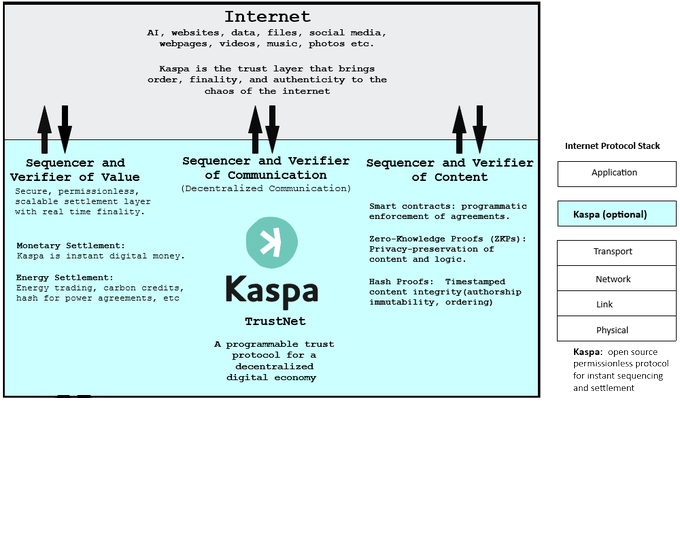
$KAS $BTC are both TrustNet protocols #TrustNet is my thinking of a global network for trust minimized coordination between humans, machines, institutions, and markets without requiring centralized arbiters. The internet has never had a trustless coordination layer. The proposal to economics is kaspa as a "Global Commitment Ordering Layer" within the TCP/IP stack of protocols. The reality is that there is not enough market demand for digital cash at massive scale yet. The limitation is adoption and incentives. It is not a tech problem. A peer to peer electronic cash system removes trusted intermediaries from settlement. Although that was a massive discover I personally think satoshi accidentally exposed something bigger. The whitepaper framed Bitcoin as money bcs money was the immediate application and easiest way to bootstrap the system economically through proof of work incentives. The holy grail is a peer to peer protocol that provides global ordering and finality of commitments without central trust (and without layers). I.e how do you coordinate untrusted computers and humans globally without central planners? Calling kaspa “money” is reductive. Money is just one expression of ordered commitments. What the world ultimately needs is a way to coordinate around an ordered state wo a central authority. Money is just ONE application built on top of that. The base layer is simply a sequencer. The mantra "change the money change the world" should really be... "Change coordination, change civilization. Economics, money, and markets are all downstream from how humans coordinate state and trust. 1st order → ordering (trust) 2nd order → ownership (money/value) 3rd order → coordination (TrustNet) 1st order: global ordering and sequencing of commitments “I commit to this state change, under these rules, and I authorize it with my signature.” 2nd order: Money. It is the lowest entropy application (a direct use of that ordering). “X owns Y units” only works because the ordering is credible. Hence money is the first logical application of ordered commitments. 3rd order: Coordination. Coordinated systems built on top of a sequencer. i,e. anything that requires coordination beyond simple ownership falls into 3rd order. E.g. contracts, identity, energy and commodity markets, messaging and data commitments, autonomous machine to machine tasks and decisions etc
Honorius tweet media
English
5
39
172
3.6K
Man retweetledi
BaN𐤊ℚuOτE
BaN𐤊ℚuOτE@BankQuote·
Yonatan’s views do not need to reflect the entire Kaspa public to be valid. That is the first category error. A decentralized community does not require ideological uniformity from its founder, and a founder does not need democratic approval to make technical observations about the architecture he helped design. The public can want merchant stickers, exchange listings, slogans, and retail visibility. Yonatan can still be correct that those are not the highest-leverage adoption vectors. Kaspa is not just another payment coin trying to win the checkout counter. If the best argument for Kaspa is “buy coffee faster,” then the architecture is being under-explained. A proof-of-work blockDAG running at 10 blocks per second, designed around real-time decentralization, is overkill for basic consumer payments if the only competition is Visa, Cash App, custodial wallets, or stablecoin rails. The deeper function is not speed in isolation; it is neutral, high-frequency settlement without a centralized sequencer. That distinction matters. Payments use speed. Coordination markets, liquidity routing, ZK applications, collateral movement, and real-time financial commitments actually require it. This is why his skepticism toward “Kaspa Accepted Here” as the core thesis is rational. It is not anti-payment. It is anti-underutilization. You do not build a real-time proof-of-work settlement engine so its flagship use case becomes a QR code taped to a cash register. That can exist, but it cannot be the center of gravity. The real question is: what applications become possible only when decentralized ordering becomes fast enough to function as infrastructure rather than ceremony? Toccata makes that question concrete. Covenants, Silverscript, ZK verification opcodes, and KIP-21’s partitioned sequencing commitment are not marketing ornaments; they are the first pieces of programmable liquidity on Kaspa. Native covenant logic can constrain how coins move, while based ZK applications can anchor heavier computation to L1 without forcing every node to execute every application. That is a serious technical distinction from simply cloning an EVM environment and hoping liquidity appears. His resistance to early L2 capture is also logically coherent. A young L1 that fragments its execution layer before establishing its own native standards risks outsourcing its network effect before it has even matured. vProgs point in the opposite direction: sovereign applications proving their state transitions back to Kaspa, while preserving composability through shared verification and scheduling assumptions. That is not anti-growth; it is anti-parasitic growth. So even when Yonatan’s views irritate parts of the community, they are valid because they follow the architecture. He is not saying narrative does not matter. He is saying narrative without product is wasted heat. Kaspa’s future will not be won by pretending every adoption path is equal. It will be won by aligning the story with the machine: real-time proof-of-work, programmable liquidity, verifiable execution, and coordination markets that make decentralized finance feel less like speculation theater and more like neutral infrastructure.
English
11
57
155
4.2K
Man retweetledi
Pavel Emdin
Pavel Emdin@emdin·
I have tremendous respect for @hashdag research and ideation contributions; this is why it is even more important to point out inaccuracies. (Meta note -- declaring no debate while writing multiple paragraphs debating it is a contradiction.) "EVM is outdated tech." TCP/IP is outdated too. EVM chains hold 80%+ of collective DeFi TVL. Big actors are risk-averse and prefer audited, battle-tested infrastructure. "Vitalik declaring a move away." Not a move away. RISC-V replaces the execution engine underneath. EVM stays as the interface layer. If anything, RISC-V is Ethereum doubling down on EVM longevity by giving it a faster backend. "L2s are parasitic." Most L2s today use centralized sequencers. Igra doesn't. It's a based rollup, a category of L2 that uses L1 miners for ordering and routes fees back to them. That's not parasitic. That's additive fee revenue for Kaspa's security budget. "L1 dev serves L2s, reverse never happens." Igra open-sourced Kaswallet and RPC service for the community. ATAN is on its way. We have collected deep expertise on building based rollups on Kaspa L1, which will be required for vProgs too. We are ready to share it with anyone. "L2 roadmap declared dead." By whom? L2s hold 40% of Ethereum ecosystem TVL and growing. Over 65% of new smart contracts in 2025 deployed directly on L2. That's not dead. That's an architectural pattern with its own tradeoffs, like every other approach in tech. "It fragments the efforts." Every project building on Igra or any other rollup expands Kaspa's brand outreach and user base. Expanding programmability expands Kaspa's reach. Restricting it does the opposite.
Kaspa Daily@DailyKaspa

10/13 Q: There's an active debate around zk-native execution versus EVM compatibility as Kaspa's long-term programmability path. Why prioritize zk-native architecture over leaning fully into the existing EVM tooling that L2s already bring? Is the long-term picture zk-native L1 with EVM layers as a transitional bridge? A: There’s no active debate. EVM is an outdated tech antithetical to Kaspa’s boutique brand. Vitalik declaring a move away from it should be enough to end this imagined debate. An L2 takeover is the nightmare of L1s — especially at such an early stage before the L1 has solidified its status. It fragments the efforts, the messaging, the execution layer, the standards, the expectations, the observers. It creates a surreal situation where the project is trying to grow its network effect whilst trying to fend off parasitic networks. L1 development efforts serve L2’s, the reverse never happens (I invite you to skim through pub rnd TG channel and validate this). I know of no crypto project that had to deal this early with L2’s trying to siphon its network effect - before it secured its own. I reiterate that my stance is completely banal, and it is weird that I need to belabour it and present it as “my peculiar decisive opinion” rather than just referring ppl to coindesk articles or crypto twitter and letting them DYOR. The L2 roadmap has been declared dead and L2 projects are fading. Some called it earlier some later than others, the bottom line is one and the same.

English
25
41
187
24.3K
Man retweetledi
₿RT 𐤊 🐈📈
₿RT 𐤊 🐈📈@brt2412·
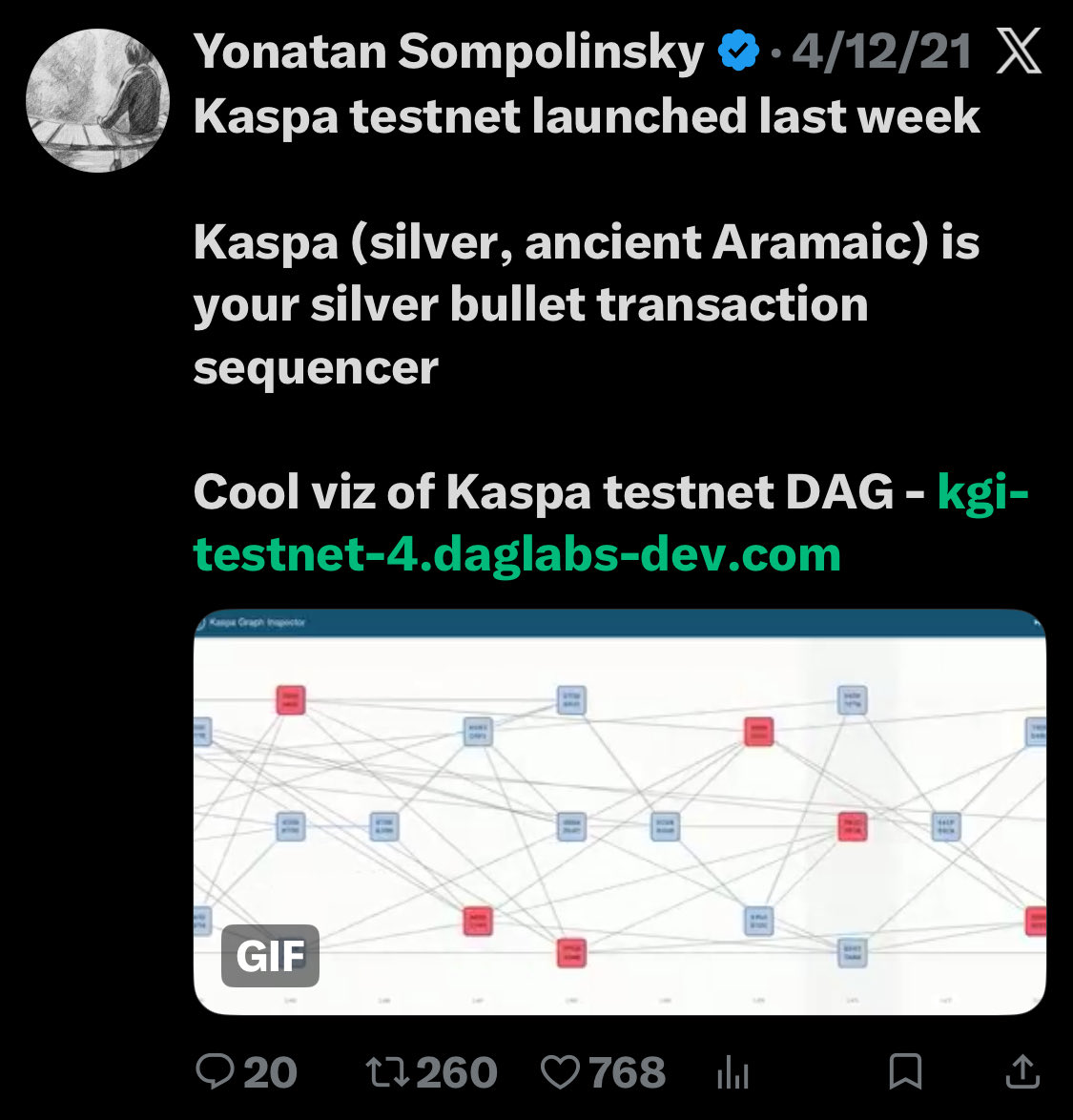
Here is @hashdag talking about $KAS test net 7 months before main net launch. Some secret it was. Now that you have been exposed as the biggest fraud, Robert, delete your account. x.com/hashdag/status…
₿RT 𐤊 🐈📈 tweet media
Robert Hart@zcryptocash

@BitcoinTeacher_ @brt2412 @realvijayk Its true , they will tell you the initial mining was open to the public😉, but in reality it was done mostly by 300 people on a private discord , then after they had mined a shit ton they started this advertising racket.

English
3
20
73
2.5K
Man retweetledi
Michael Sutton
Michael Sutton@michaelsuttonil·
I agree it needs to converge sooner rather than later. I’m simply saying that we have a clear north star in the form of the vprogs yellow paper, but the exact shape this takes depends on iterative feedback from tech progress, developer communities, UX challenges, etc. In other words, programmability is different from typical L1 consensus features. You don’t go into a cave and build it end-to-end, out of touch with the world.
English
2
22
131
1.6K
Man retweetledi
moose.kas 𐤊 Themooseisloose
moose.kas 𐤊 Themooseisloose@Themooseisloos5·
(1/2)Fair launch and why it matters And why a fair launch doesn't matter if the network isn't absolutely sound. A fair launch proof of work network in this day and age starts out with imense friction. 1. There are no wallets, there are no market places, there are no usecases. It's just a good, a commodity produced in search for a buyer. 2. Gamenet For the earliest miners who joined, all they knew was that they throw money at #kaspa and had the chance to get somewhere between 1-1000 kas per block won. The primodial soup market was the discord. Some asked for $kas, some put it out for sale, sometimes they matched, a miner had to be a salesmen first and then a producer. 3. 2 weeks in Sudden death happened, the dag was shattered by the memory bug the network was paused and solomined during the fix and at the same time the era of gamenet ended. The 500 kas per block era started. The solo mined kaspa was sent to the burn adress. As the bug that could have killed the network resolved and gamenet ended, we got to a doge-like issuance, super inflationary. The variance diminished but the inflation was the same. At the same time you needed to throw different kinds of money at it if you wanted to compete in this war of hashrate. First mining was CPU a month later there was GPU. 4. ~6 months in Market places like TXBit, Exbitron and TradeOgre opened up for systemic real-time pricing which gave minees some light, but little did the miners and traders know about the struggles of these early cexes. Not your keys not your coins. This was about the time when issuance changed again, this time for the chromatic geometric issuance which gave some hint about how scarce kaspa would become. Allt the worst chaos was now over, Demand of coins grew faster than the mining network, miners could now calculate revenue and costs with ease, expand their GPU-mining. Life was simple, started to look easy. 5. then Ethereum went POS and vast amounts of industrial GPU miners sought profitability for their rigs, enter kaspa. Hashrate spiked, profitability grew thin but demand of coins continued to grow. Maybe we could still live happily ever after? Knives, bow and arrow or a spears are meaningless in a gunpowder fight. Looking back, the first asics were weak but at the time of their launch they 10x:ed the yield per watt of a GPU and yet again you were forced to change the form of money you have to spend to compete for the kas. The early asic war: Ks1, ks2, goldshell, dragonball, ks3, ks5l, ks5m, ks5. They came and went obsolete as soon as the next arrived. Miners had to sell their asics shortly after they had bought them to buy a more efficient one. More and more coins got sold for hyper efficient asics that got overproduced and drowned the market in abundance. Diminishing returns, between the ks1 and ks5 was 1 year, then it took a full year to produce antminer KS7 which was 100% more efficient. Released when the bear was already here. 6. Mining was never easy, numerous potential events could have killed the network before it started trading at billions. A scarcity wave will by nature create a wave of abundance, an action and an equal opposite reaction. Here it does not matter how much efficient hashpower you hold at any time. If the demand of coins is net negative you will have to shut off if you mine for profit, you compete with the cheapest electricity and zealots who mine at a loss on faith and conviction. 7. Kaspa did survive a fair launch, in this day and age with all the surrounding competition in this space. Every single kas had an honest cost anchored to its creation, every second every block. Fair launch means something. It means those who dump on you with profit worked extremely hard to do so. The game is fair, the unfair bit is information asymmetry.
English
2
14
52
3.3K
Man retweetledi
Luke Dunshea
Luke Dunshea@elldeeone·
Kaspa.org has been refreshed. Kaspa has a lot going on, but the main site does not need to put it all at the front door. Its first job is simple: help someone arrive, understand what Kaspa is, and know where to go next. The previous site accumulated more over time. Pages, explanations, resources, and audiences were added. This version starts smaller, so it can grow with Kaspa from here. The refresh is not just visual. The wording, structure, and narrative direction all needed attention IMO. The content traces back to @hashdag’s writing, simplified for a first read. Kaspa is already deep enough. The first read should not make people work harder than necessary. There are many true ways to talk about Kaspa, but Kaspa.org cannot carry twenty narratives at once. For this version, the strongest one to unify around is real-time decentralisation. Part of the refresh was also about making the builder path easier to follow. Kaspa.org gives people the overview of what exists, why it matters, and where to go next. Docs.kaspa.org gives builders the deeper material, with room for examples, detail, and ongoing improvement. Docs.kaspa.org starts with @IzioDev's work and has the broader goal of bringing important Kaspa L1 builder documentation into one place. Both repos are public. Pages will be added, wording will change, gaps will be filled, and the work can happen in the open. Big shoutout to @kasmediadotcom for their support in helping bring this refresh together. Have a look around. If you see something that can be better, please open an issue or PR.
English
94
263
735
55.3K
Man retweetledi
Mitchell Lim
Mitchell Lim@MitchellLim_·
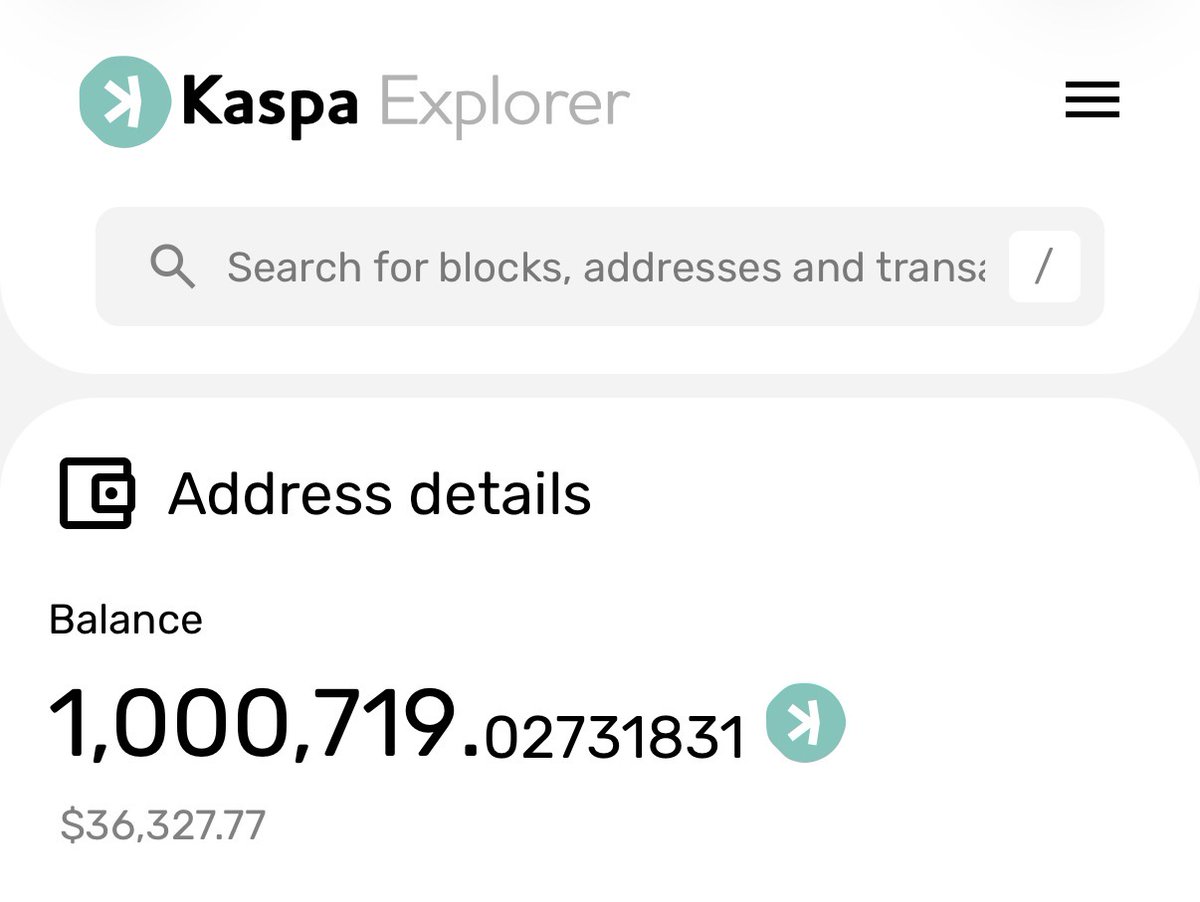
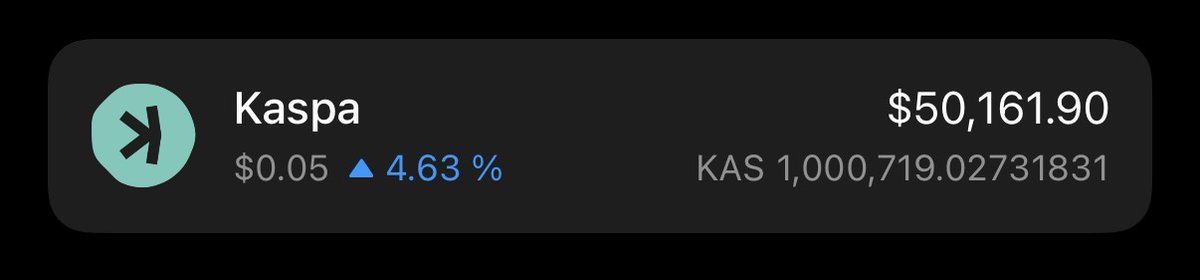
Today I finally accumulated 1,000,000 Kaspa. I'm officially in shark territory! 🦈 #Kaspa $KAS
Mitchell Lim tweet mediaMitchell Lim tweet media
English
100
61
808
20.1K
Man retweetledi
Krok
Krok@Krok13236·
At 100 BPS, censorship gets harder, not easier. A 51% attacker still does not get exclusive control of confirmations. If honest miners have 49% of hash rate, they are still producing blocks. At 10 BPS that is about 4.9 honest blocks/sec. At 100 BPS it is about 49 honest blocks/sec. The attacker can censor only inside the blocks they mine. They cannot stop honest miners from broadcasting blocks, and in a DAG those honest blocks can still be referenced and included. Higher BPS also makes the DAG denser. More honest blocks means more paths for honest work to enter the blue set/order, instead of everything hinging on one slow single-chain race. Cost side gets nastier too: 100 BPS implies much more hardware/network capacity, and kHeavyHash ASIC supply is already thin. Controlling enough real capacity becomes even less “I rented some miners lol” and more “I accidentally became an industrial-scale nation-state problem”. So no, 100 BPS does not give a 51% attacker a clean on/off censorship switch. It gives honest miners far more frequent chances to get blocks into the DAG, while making sustained dominance more expensive and operationally ugly.
English
1
1
7
122
Man retweetledi
Classic
Classic@Classicxbt·
Introducing Kaspa Hub Explorer! A unified interface for tracking Kaspa wallets, transactions, and blocks, as well as exploring KRC20 tokens, KNS domains, and $KAS project web domain reviews. Fully open source. Powered by public APIs. 💚 kaspahub.org/explorer/
Classic tweet mediaClassic tweet mediaClassic tweet mediaClassic tweet media
English
6
35
120
2.7K
Man retweetledi
Parker Schmidt
Parker Schmidt@parker2017·
I'm grateful for the feedback on Kaspa Explained so far. I’ve taken some of it, left some of it, and I’m genuinely glad a few people felt the site filled a gap they couldn’t easily find elsewhere. That gap is the reason I made it. Most people outside the daily crypto trenches still do not have a clear first-principles way to understand what crypto is actually good for. I include myself in that, yes, still, albeit I’ve come a long way. I’ve had to keep measuring, correcting, and rebuilding my own understanding. The average person still tends to think crypto is mostly scams, while the average crypto person often swings the other way and talks like crypto is the next version of the entire internet, ready to replace everything. Both views miss something important. Crypto is not useful for everything. It is not magic. It does not replace courts, trust, institutions, databases, legal systems, or the real world. But it is also not nothing. There are specific things crypto can do unusually well: credible shared state, open settlement, self-custody, programmable money, neutral coordination, censorship resistance, and markets or systems where no single party should control the ledger. That is why I added two new pages to Kaspa Explained: one on what crypto is actually good for, and one on why Kaspa matters inside that frame. kaspaexplained.com/what-crypto-is… kaspaexplained.com/why-kaspa-matt… My hope is that more people can enter crypto through resources like this, and that Kaspa can be one of the clearest entry points. Not because Kaspa is everything. Not because crypto fixes the world. But because Kaspa sits at the intersection of some ideas worth taking seriously: Proof of Work, high-throughput blockDAG design, credible shared state, fast settlement, and open coordination. The question I keep coming back to is simple: where is the resource that starts from first principles, explains what crypto can and cannot do, then shows why Kaspa matters inside that frame? That is the direction I want Kaspa Explained to move in. What is crypto actually for? Where does it fail? Where does it matter? And why does Kaspa deserve attention if you care about Proof of Work, speed, credible shared state, and open coordination? @michaelsuttonil and @hashdag are among the most interesting people I’ve come across in this space. But one thing still feels missing: who is translating what people like them are saying into language that 99% of us can actually understand? Who is making it legible to people outside the core technical circles? Who is giving non-crypto-native people a way to notice what is actually being built here? This update is a step in that direction. Consider it a v1, much like Kaspa’s original Go implementation. It is open to interpretation, open to feedback from the broader crypto and Kaspa communities, and meant to evolve. The goal is not to make a static monument. The goal is to build a living resource that helps people understand crypto more honestly: what it can do, what it cannot do, and why Kaspa may matter in the next serious phase of this industry. I want to help push crypto toward an era where it is respected, not because we overstate it, but because we explain it clearly. And I think the Kaspa community can be an important part of that, if we choose to be. kaspaexplained.com
English
4
21
58
1.3K
Man retweetledi
ASHX𐤊ASPA
ASHX𐤊ASPA@Ashishrathodind·
Let me stop you with actual data (May 2026): 1) 27.41B / 28.7B KAS mined: yes, 95.4% circulating. By design. No VC unlock dumps, no inflation bleeding. 2) Block rewards hit zero in ~31–36 years from mainnet. Not “running out” 3) Network hashrate: ~438 PH/s miners are actively securing the chain 4) Nearly 2 billion on-chain transactions processed. Real usage, not ghost chain 5) Toccata hard fork: June 5–20, 2026 : adds smart contracts (SilverScript), native tokens, ZK proofs at L1.. Destroy this chain”? With what? 438 petahashes of global PoW disagree.. I guess you need to convince last kaspaians about this 🤝🤝
English
0
2
16
273