

Old Broad
19.9K posts
Old Broad
@ringdingsrule
Left Leaning, Kindness Matters,Laughter as important as oxygen. I’m a Wokester!
Connecticut, USA Katılım Mayıs 2021
2K Takip Edilen943 Takipçiler

@Mollyploofkins @PaulSGundlach Ah yes, trump always needs his sycophant ‘splainers🙄 If you have to tell everyone it was a joke it wasn’t funny.
English

Vance thinks Trump was 'just posting a joke' and that a lot of people weren't understanding his humor.
English
Old Broad retweetledi


So I did a thing...
After losing my dearest soul dog to cancer a few weeks ago, I adopted a shelter dog. I was worried maybe it was too soon. I could never replace my baby Sy Girl. But I had all this dog love to give and no dog.
Meet Faye. She's a year old and was rescued from a homeless camp, tied to a tree when she was just a young pup. She spent 4 months in jail - as part of a training program.
She is calm and sweet. She reminds me of Sy in so many ways - though she's only half her size.
Everyone, meet Miss Faye! Today is her gotcha day and a new start in life.


English
Old Broad retweetledi
Vance admits that Trump’s blockade is an act of economic terrorism against the entire world.
Acyn@Acyn
VANCE: What they have done is engage in this act of economic terrorism against the entire world. As the President showed, two can play at that game.
English
@Acyn @Vincent19762 This is interesting considering they have been desperate to remove “separation of church and state” from our federal government. 🤔
English

@RachelBitecofer Trump takes the money path or the ego path. End of.
English

Trump: I’m going to take out your entire civilization!!!
JD: Where I think Trump’s policy is most in accord with the Catholic faith is that, more than any president of my lifetime, Trump has pursued a path of peace.
English

Trump superfan Shane Vaughn told MAGA to calm down about the Trump-as-Jesus image, saying if they looked again they would be reminded that Trump was sent by God to heal America
English

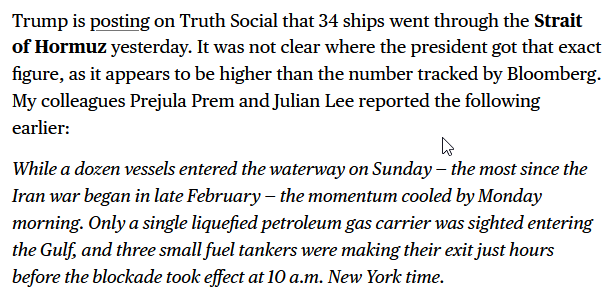
Bloomberg: "Trump is posting on Truth Social that 34 ships went through the Strait of Hormuz yesterday. It was not clear where the president got that exact figure, as it appears to be higher than the number tracked by Bloomberg."
bloomberg.com/news/live-blog…
English


Rev. James Martin: "I don't know too many doctors that have glowing hands ... it came after he had just been tweeting out a pretty hateful attack on Pope Leo, so obviously religion was on his mind last night, and that probably came from watching the 60 Minutes special with the thee cardinals"
English

@ringdingsrule RingDingsRule? Why didn’t I think of that???? Great name. Your avatar, looks very familiar, I think I motorcycle in that area.
English
Q: Did you post that picture of yourself depicted as Jesus Christ?
TRUMP: I did post it and I thought it was me as a doctor and had to do Red Cross. Only the fake news could come up with that one.
English
@atrupar @MaverickGSDmom Hillary is wrong! It’s at least 75% of the time😉
English
Hillary Clinton: "I think our allies believe we've lost our minds because they wake up in the morning like we do and see the rants from the president making no sense half the time"
English

“Doesn't matter if I look like an arrogant white motherfucker.” you greet me.
This isn't Jim Crow. What the entire fuck is wrong with impotent white men?
This customer feels that he can berate a Black special needs worker because, what, he didn't get the greeting he believed he deserved?
Black people just out here trying to live, trying to make a living.
If you have a complaint take it to a manager. This shit is evil and who the fuck is recording this without intervening. Where is the rest of the staff?
So sick of seeing this shit. #DemsUnited
English
@JamesSurowiecki Interesting. So the Iran war wasn’t about nukes?🤔
English

It's a master class in jacking up prices for ordinary Americans.

English
@UncleShitty @woofknight 😅thanks for the excellent read! Yes, when I bought that stapler (through my work supply account😉) it was $10 more than the regular one. I sweated a bit while I waited for the expense to clear🤣
English

@ringdingsrule @woofknight In more ways than you might know — Swingline only produced a red stapler in response to the movie prop.
looper.com/1706811/office…
English
Stephen Root sat in thick glasses and a rumpled shirt, mumbling into a telephone about his red Swingline stapler, and almost nobody at the studio thought this character would matter.
The movie was Office Space, Mike Judge's 1999 dark comedy about workplace dehumanization, corporate absurdity, and the slow death of the soul inside a cubicle.
Milton Waddams—Root's character—wasn't the protagonist. He wasn't even really supporting cast. He was a background joke. A running gag. The guy who gets ignored by everyone, moved from desk to desk, denied his birthday cake, told to work on Saturdays, and eventually relocated to a cockroach-infested storage room in the basement because nobody had the guts to actually fire him.
He was designed to be pathetic. Invisible. Forgettable.
And here's the part most people don't know: early studio notes reportedly wanted him reduced even further. Too weird. Too quiet. Not "commercial" enough for a comedy that was supposed to sell tickets.
Milton was almost the first thing cut.
That's the setup.
A character literally designed to disappear—nearly erased before the film even released.
But Stephen Root saw something else.
He didn't fight to make Milton louder or more likable. He didn't try to turn him into a standard comedic relief character with big reactions and clear punchlines.
He went the opposite direction.
He made Milton smaller.
Voice barely above a whisper. Mumbled dialogue that forced you to lean in. No dramatic facial expressions. No obvious comedic beats. Just this quiet, simmering, suppressed rage building under layers of defeat and resignation.
In a loud workplace comedy full of exaggerated characters and absurd situations, Root played pure, uncomfortable silence.
And that's the contradiction that made it work.
Because while everyone else in Office Space complains about their jobs, talks about their frustrations, fantasizes about escaping—Milton just keeps shrinking. Keeps taking it. Keeps mumbling to himself about his stapler, about the air conditioning, about being moved again.
Until the very end.
After years of being dismissed, relocated, ignored, and erased—Milton doesn't quit. He doesn't complain to HR. He doesn't file a grievance.
He burns the entire Initech office building to the ground.
No speech. No confrontation. No dramatic showdown.
Just quiet, methodical arson.
And suddenly, everything reframes.
The weakest character in the film—the one nobody paid attention to, the one studios wanted to cut—becomes the only person who actually acts. Everyone else fantasizes about rebellion. Milton executes it.
That ending doesn't work if Milton was loud. It doesn't land if he was sympathetic or charismatic. It only works because Stephen Root played him as someone so invisible that his revenge feels both shocking and inevitable.
But here's where the story gets even stranger.
Office Space flopped in theaters.
Hard.
It earned roughly $10.8 million against a $10 million budget. No cultural moment. No lines around the block. Critics were mixed. Audiences didn't show up.
The studio wrote it off.
And then something unexpected happened.
DVD sales exploded. Cable networks started playing it on repeat. Suddenly, everyone who'd ever worked in a cubicle, endured a pointless meeting, or dealt with a condescending boss was quoting the movie word-for-word.
"PC Load Letter? What the fuck does that mean?"
"Looks like somebody's got a case of the Mondays."
"I believe you have my stapler."
Office Space became one of the most quoted workplace films of all time—not through box office dominance, but through slow, relentless cultural infiltration.
And Milton—the character executives wanted reduced, the background joke designed to be forgettable—became the identity of the entire film.
That's the shock.
Almost deleted → becomes the most memorable part of a cult classic.
But Stephen Root didn't stop there.
Because what happened with Milton wasn't luck. It was a pattern.
Two decades later, Root joined Barry—HBO's dark comedy about a hitman trying to become an actor—as Monroe Fuches, Barry's manipulative handler.
And once again, Root played a character who seemed weak.
Fuches is pathetic. Needy. Always playing the victim. Always crying about being abandoned. He doesn't carry a gun. He's not physically intimidating. He's the guy everyone underestimates.
But just like Milton, that weakness is the disguise.
Fuches quietly manipulates every situation. He turns people against each other. He weaponizes vulnerability. He's not loud or obvious about his control—he just infects every scene he's in until everyone's doing exactly what he wants without realizing it.
Same strategy. Same precision.
Root doesn't dominate scenes.
He poisons them.
And by the end of Barry, Fuches—the weak, whining hanger-on—has orchestrated more destruction than almost anyone else in the show.
That's his system.
Play the character everyone dismisses. Make them quiet. Make them strange. Make them seem powerless.
And then prove they were the most dangerous one in the room the entire time.
From playing a character built to be ignored → to nearly being cut from the film entirely → to delivering the most cathartic act of rebellion in workplace cinema history → to becoming the anchor of a cult classic that defined office culture for a generation → to repeating the exact same strategy 20 years later in one of TV's best dramas—
Stephen Root proved something most actors never figure out:
The most dangerous character in the room isn't the one shouting.
It's the one everyone forgot was listening.

English

Wife and I got our first puppy today. Here he is on his first ride home. Meet Eugene Jeans. He’s a Red Fox Labrador. He’s already vomited on my wife and had diarrhea on our white carpet, but we’re gonna love him so hard. ❤

English


Trump: "The New York Times is a fake paper. Just believe the opposite. It's so sad when you look at CNN, the New York Times, ABC fake news, NBC fake news, it's so sad to see it. They report things they know are false. It's almost treasonous actually, if you want to really know the truth. It's almost treasonous."
English

Good morning from Nuuk, Greenland 🇬🇱
April 13, 2026 (9:19am)
Temp: -8°C.
English