Robertson Price

143 posts

Robertson Price

Robertson Price

@Robertson

New York Katılım Ekim 2007
144 Takip Edilen304 Takipçiler
Robertson Price
Robertson Price@Robertson·
Connected @planeso to my @OpenClaw today — built a custom skill to make it work. Now I literally talk about what I want done (Whisper AI), my PA decomposes it into projects and tasks, and a cron job starts coding, asking me questions, or routing work to my team. Went from 0 to 19 projects and 219 documented tasks in one day. The workflow I’ve been chasing: describe outcomes, let the system handle the how.
English

1
0
1
39
Robertson Price
Robertson Price@Robertson·
OK, so you’ve got OpenClaw. Question for you: how busy was it at 3 AM this morning while you were sound asleep? More importantly: how are you making sure it’s busier tonight? 🛠️
English
0
0
0
33
Robertson Price
Robertson Price@Robertson·
Heard from the kitchen: “I’m vibe-coding our summer schedule honey.”
English
0
0
0
45
Robertson Price
Robertson Price@Robertson·
This is wild, I now have Claude CoWork, running VS Code, where it is “Vibe coding” using both GPT Codex and Claude Code side by side. Orchestrating an entire build. CoWork is building using both tools in parallel and overseeing management context of the project. I just outsourced myself in the vibe coding paradigm!
English
1
0
2
91
Robertson Price
Robertson Price@Robertson·
Chrome about to upend how you work. Starting slow with knowledge synthesis across your Internet world, the connections that will enhance your everyday work will arrive next year. The “Omnibox” (formerly browser address bar) may become the place you do 90% of your work. blog.google/products/chrom…
English
0
0
2
118
Robertson Price
Robertson Price@Robertson·
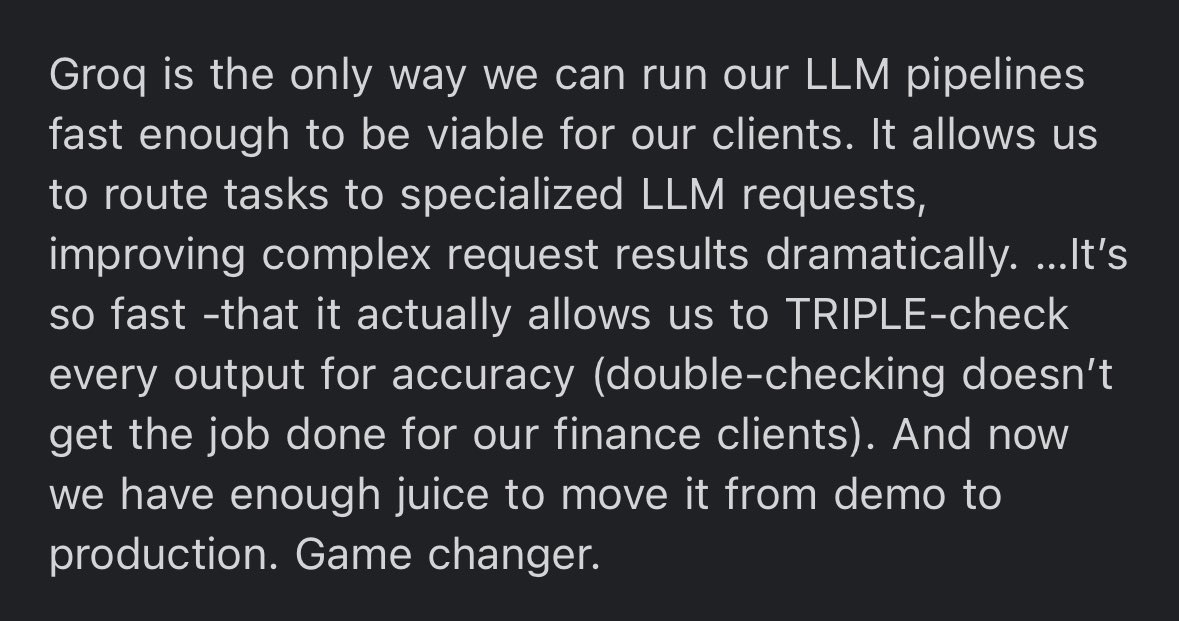
Essentially, that is correct. They (ragu.ai) are asking an LLM running on Groq Cloud to rapidly "score" the output of a custom-purpose LLM/RAG system. The Groq LLM is given the same dataset used by the primary output LLM. It is asked to confirm that all data contained in the output matches the provided dataset as one component of scoring—or else the original request is rerun with further instructions. This component of scoring is part of a system that eliminates mission-critical hallucinations.
English
0
0
1
55
sunny madra
sunny madra@sundeep·
40k tok/s input on llama3 8b. AI workloads are generally very input heavy. This, combined with our output speed will now make @GroqInc the only way to build performant AI applications. Some realtime feedback from a happy user:
sunny madra tweet media
Jonathan Ross@JonathanRoss321

Last Week: Groq exceeded 30,000 Tokens / second input rate on Llama3 8B❗️ This Week: Llama3 70B at 40,792 Tokens/s input rate‼️ - FP16 Multiply, FP32 Accumulate - 7989 tokens in - full Llama context length Next Week: ...? 😮

English
1
3
36
8K
Robertson Price retweetledi
Andrew Ng
Andrew Ng@AndrewYNg·
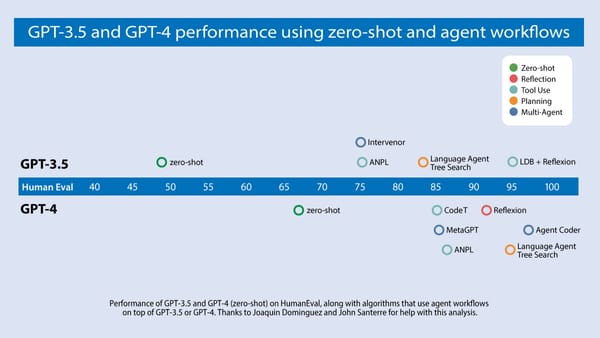
I think AI agentic workflows will drive massive AI progress this year — perhaps even more than the next generation of foundation models. This is an important trend, and I urge everyone who works in AI to pay attention to it. Today, we mostly use LLMs in zero-shot mode, prompting a model to generate final output token by token without revising its work. This is akin to asking someone to compose an essay from start to finish, typing straight through with no backspacing allowed, and expecting a high-quality result. Despite the difficulty, LLMs do amazingly well at this task! With an agentic workflow, however, we can ask the LLM to iterate over a document many times. For example, it might take a sequence of steps such as: - Plan an outline. - Decide what, if any, web searches are needed to gather more information. - Write a first draft. - Read over the first draft to spot unjustified arguments or extraneous information. - Revise the draft taking into account any weaknesses spotted. - And so on. This iterative process is critical for most human writers to write good text. With AI, such an iterative workflow yields much better results than writing in a single pass. Devin’s splashy demo recently received a lot of social media buzz. My team has been closely following the evolution of AI that writes code. We analyzed results from a number of research teams, focusing on an algorithm’s ability to do well on the widely used HumanEval coding benchmark. You can see our findings in the diagram below. GPT-3.5 (zero shot) was 48.1% correct. GPT-4 (zero shot) does better at 67.0%. However, the improvement from GPT-3.5 to GPT-4 is dwarfed by incorporating an iterative agent workflow. Indeed, wrapped in an agent loop, GPT-3.5 achieves up to 95.1%. Open source agent tools and the academic literature on agents are proliferating, making this an exciting time but also a confusing one. To help put this work into perspective, I’d like to share a framework for categorizing design patterns for building agents. My team AI Fund is successfully using these patterns in many applications, and I hope you find them useful. - Reflection: The LLM examines its own work to come up with ways to improve it. - Tool use: The LLM is given tools such as web search, code execution, or any other function to help it gather information, take action, or process data. - Planning: The LLM comes up with, and executes, a multistep plan to achieve a goal (for example, writing an outline for an essay, then doing online research, then writing a draft, and so on). - Multi-agent collaboration: More than one AI agent work together, splitting up tasks and discussing and debating ideas, to come up with better solutions than a single agent would. I’ll elaborate on these design patterns and offer suggested readings for each next week. [Original text: deeplearning.ai/the-batch/issu…]
Andrew Ng tweet media
English
216
1.2K
5.2K
837.4K
Martin Lorentzon
Martin Lorentzon@MartinLorentzon·
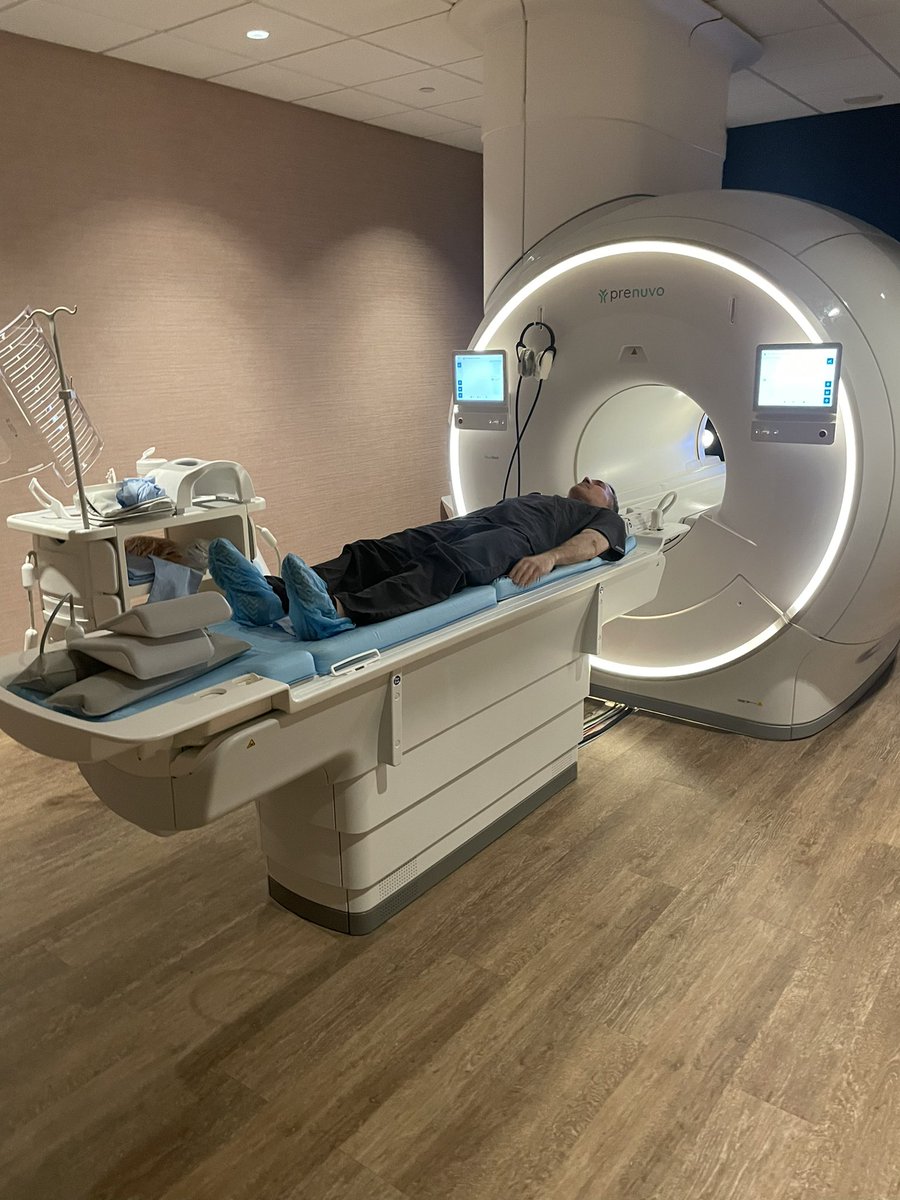
The quest to combine longevity with healthcare continues. Testing a MRI scan from Philips together with the AI supported software from Prenuvo. As a tech geek I just love technology and software!
Martin Lorentzon tweet media
English
6
1
73
10.1K
Robertson Price
Robertson Price@Robertson·
NFT's aren't art. They could represent ownership of your house, that watch you just bought, or your entire holdings of digital art. Imagine trading your home with the touch of a button - without needing a title search - and you start to see the potential of NFT's and Finance 2.0
English
1
0
6
0
Robertson Price
Robertson Price@Robertson·
10th year on Twitter anniversary Tweet!
English
0
0
5
0