

robert ratliff
1.4K posts

robert ratliff
@robratliff
Former Immigration Court Judge. Now providing immigration litigation services to clients and their families. We fight for your safety, family and future.
Cleveland, OH Katılım Ocak 2009
660 Takip Edilen135 Takipçiler

There is only one city in the United States that doesn't grow north - Minneapolis-St. Paul, restricted by geography.
Every other city in the country grows north. That's the framework Rex Glendenning has been using for 40 years to position himself in front of growth. People in Celina laughed at him 30 years ago for buying dirt in the boondocks. He plowed every dollar after taxes and overhead back into 40 and 50-acre tracts anyway.
In this clip from this week's episode - the rule of thumb Rex says should be on the first page of every real estate book.
English
@SherrodBrown You should post the links to the bills you sponsored or passed that dealt with those issues while you were senator.
English

Big banks hit you with overdraft fees. Insurance companies deny your claims. Drug companies jack up prices. Utility companies raise your rates.
Jon Husted won't take them on because he takes their money.
That's the difference between me and Husted.
English
DHS HSI targets OPT fraud. This can have a cascade effect extending to people currently on H-1b all the way to people with citizenship and green cards that started with OPT visas. removal-defense.com/2026/05/12/whe…
English
@Aguillemes Never did public defender or court appointed work?
English

-El cliente consulta en ChatGpt y cree que sabe más que tu.
-Recibir audios de 7 minutos a las 23:48.
-Todo el mundo conoce a un abogado.
-Tu apenas conoces a otros abogados de tantos que hay.
-Clientes que desaparecen cuando toca pagar.
-Ya no te respetan ni en el Juzgado.
-Gente que por ver TikToks se piensan que le han convalidad la carrera de derecho.
-Clientes que se piensan que su juicio son como los de la tele.
-Hacer de psicólogo en temas matrimoniales.
-Alguno se piensa que la vida es como Suits.
-Responder mensajes un domingo porque "es urgente".
-Acabar deseando trabajar de panadero por paz mental.
Español
Ser abogado en 1990:
-Tener clientes.
-Ser respetado.
-Ganar juicios.
-Compañerismo entre abogados.
-Cobrar sin problemas.
Ser abogado en 2026:
Español
@ClownWorld Buying tickets from a scalper outside the event.
An entire industry has been destroyed by corporate greed and a political unwillingness to enforce anti-trust laws.
English

What’s the one thing from your childhood that today’s kids will never experience?
English
@JoelWBerry @lukerosiak A major issue in Ohio is that these cities charge income tax to people that work within their city limits. Yet, those tax paying workers have no right to vote in the city elections and no say in how the tax money is spent. In their home community they then vote for tax credits.
English

There’s no reason a deep red state like Ohio should have lawless Leftist enclaves like Cincinnati, Columbus, and Cleveland.
Ohio should pass a constitutional amendment (can pass with 51% of the popular vote) that ALL citizens of the state can vote for the leadership of the 3 biggest cities, including mayor and city council.
All citizens use these cities, they travel through these cities, they conduct commerce with these cities, and they help fund these cities. They’re often victims of the lawlessness in these cities. They should have a right to vote for the leadership of these cities.
Open up the vote to all citizens, and our big cities will get cleaned up almost overnight.
Vivek Ramaswamy@VivekGRamaswamy
It’s a shame that city leaders in my hometown of Cincinnati have declared it a “sanctuary city.” That’ll change when I’m in charge of Ohio. We’ll never condone violating the law, or else the people lose respect for the rule of law itself.
English
Listen to The Immigration Podcast on Spotify open.spotify.com/episode/3GgLAn…
English
@JaneTimkenOH Um, the Ohio Republican Party has been presiding over this for the past decade. Feigned shock and outrage when an independent journalist exposes this is not a good look for those that have sat in seats of power and privilege during that time.
English

I can’t sit idly by while this is happening in Ohio. There must be accountability. The taxpayers deserve answers. Most importantly those dollars should go to actually helping the most needy among us. I want answers.
Daily Wire@realDailyWire
PART 3 OF @lukerosiak's OHIO MEDICAID REPORT JUST DROPPED ⬇️ Meet The Convicted Fraudster Running A Million Dollar Medicaid Business ‘Medicaid Millions’ investigation finds convicted fraudsters at the helm of business billing the government millions. dailywire.com/news/meet-the-…
English
@ClownWorld In the 80’s we said that about homes built in the 50’s
English

The ABA’s cartel-like control over law school accreditation drives up costs, limits access, and pushes ridiculous ideological mandates over merit.
Ending the Tennessee Supreme Court’s exclusive reliance will expand opportunity AND lower costs.
Great work @USAO_MDTN, @JusticeATR, and @FTC!
U.S Attorney-Middle District of Tennessee@USAO_MDTN
U.S. Attorney Braden H. Boucek Urges Tennessee Supreme Court to Abandon ABA's Exclusive Law School Accreditation Privilege justice.gov/usao-mdtn/pr/u…
English
The Immigration Podcast #immigration #immigrationnews #immigrationlaw youtu.be/W1DRLvFc2Kc?si… via @YouTube

YouTube
English
The Immigration Podcast #immigration #immigrationnews #immigrationlaw youtu.be/V2ZaT2weRsg?si… via @YouTube

YouTube
English

99% of people really do not understand abundance as Elon describes it.
The fundamental reason is that they don’t understand compound growth.
Same people who would probably pick 1 million dollars today over a penny that doubles in value every day for 30 days.
It’s a bad choice by the way. You lose out on millions.
Imagine if that doubling object was a labor producing robot instead of a penny.
Compounding labor. It’s actually crazy if you try and wrap your mind around it.
So Elon mentions Universl High Income and the midwits flip a lid.
“The elites won’t share”
You don’t get it. They won’t need to share. They will make everything so cheap, it is effectively free.
Charities will have immense resources to distribute.
Unfathomable intelligence will exist to help optimize production and distribution.
An unfathomably large labor pool will exist that operates on solar power exclusively.
The public work projects that are erected will be unseen before levels of breathtaking.
I think we are incredibly blessed to steward this new age of abundance.
Can you see it now?
Can you see the future?
English


I am filing a motion to expel Eric Swalwell from Congress.
English
@elonmusk 500k for a house 100k for a truck 100k+ in student loan debt on a 68k average salary for a college grad. Luckily with 350 million people in the U.S. it only takes the top .1% of income earners to make truck sales profitable.
English

Cybertruck is so awesome.
Until you’ve tried it out, you have no idea, because there’s nothing like it.
Best product Tesla has ever made to date.
Cybertruck@cybertruck
Cybertruck is extremely comfortable on long trips especially thanks to: – Minimal body roll – Comfort Mode on FSD (gentler acceleration & braking, softer damping, smoother handling) – Air suspension + self-leveling keeping the truck flat even with load
English

BREAKING: DHS confirms to @FoxNews that deceased Iranian general Soleimani’s niece first entered the U.S. in 2015 on a tourist visa, was granted asylum in 2019, then got her green card in 2021. She applied for U.S. citizenship last July, but disclosed she had traveled to Iran at least four times since getting her green card, which DHS says proves her asylum claim was fraudulent. She was arrested by ICE Los Angeles yesterday.
DHS statement to FOX:
“On April 3, 2026, ICE officers in Los Angeles arrested Hamideh Soleimani Afshar and Sarinasadat Hosseiny, the niece and grandniece of Qasem Soleimani, the late head of the Quds Force of the Islamic Revolutionary Guard Corps who was killed by a drone strike ordered by President Trump in 2020.
“Soleimani Afshar entered the United States in June 2015 on a tourist visa. In 2019, a judge granted her asylum. In 2021, she became a green card holder under the Biden Administration. In July 2025, she filed a naturalization application where she disclosed, she traveled to Iran at least four times since being issued a green card. Her trips to Iran illustrate her asylum claims were fraudulent.
“Her daughter, Sarinasadat Hosseiny, entered the United States in July 2015 on a student visa. In 2019, a judge granted her asylum. In 2023, she became a green card holder under the Biden administration.
"It is a privilege to be granted green card to live in the United States of America. If we have reason to believe a green card holder poses a threat to the U.S., the green card will be revoked.”
English
@johnkonrad Excellent review of how the inflated value of a single life can outweigh the advancement of civilization. Of course the response will
always be “but what if it was your life or the life of a loved one?” As an atheist, I try not revert back to classic literature but John 15:13
English

Personal injury law is a massive industry, not because a human life has a precise dollar value, but because we’ve built an entire culture around the feeling that it does. A feeling turbocharged by two decades of pharmaceutical advertising flooding every screen in America.
Death is part of life. But in America we’ve drifted toward the expectation that anything is preferable to death. It’s an unrealistic expectation, and it’s creating a mental health crisis alongside a strategic one.
Health and human services expenditures now dwarf the entire defense budget.
The VA, the second largest federal agency, serves a small fraction of the population. I’m not saying veterans aren’t worth the investment. But the VA fails entire categories of veterans while the suicide crisis spirals.
Why are so many vets taking their own lives?
Because the lives they’ve taken replay endlessly, and the impossibly high value our culture assigns to each individual life turns every combat death into an unpayable moral debt.
But it’s an illusion. A culturally constructed one.
War is about killing, but killing isn’t the objective. Winning is.
And to win, you sever logistics. Which is exactly what Iran is doing right now. The Strait of Hormuz isn’t closed by missiles or mines. It’s closed because P&I clubs pulled war risk coverage and no ship owner will send a vessel through when the insurance says one crewmember’s life makes the transit uneconomical.
The strait is closed by a feeling. A feeling that one life aboard a fertilizer ship, one person bleeding out on video in social media, is more valuable than the tens of thousands of people, including small kids, who will starve to death in the third world if fertilizer shipments stop.
It’s closed because Trump won’t trade the lives of a few dozen Marines on the ground to secure European energy, because the political cost of those deaths, in a culture that treats every casualty as an infinity, is higher than the strategic cost of letting Europe’s energy supply hang by a thread.
And he’s not entirely wrong.
Because we didn’t want to hit logistics and mine harbor and food shipments the pentagon threw lives away instead
Korean War: ~36,500
Vietnam War: ~58,200
Gulf War (1991): ~300
Afghanistan (2001-2021): ~2,460
Iraq War (2003-2011): ~4,490
All those Americans died because we would not carpet bomb Beijing, Hanoi, and Bagdad or mine harbor so ships couldn’t deliver food and munitions to the enemy.
Iran figured this out. So did the Houthis. The most sophisticated weapon in the adversary’s arsenal isn’t the Shahed.
PLEASE remember that Houthi drones have sunk a total of ZERO ships but they did kill 9 sailors.
“The Russell Group estimated roughly $1 trillion in goods were disrupted by Houthi attacks between October 2023 and May 2024.“
That’s over $111 Billion PER LIFE plus the global inflation the Red Sea reroutings cost
That’s a sum that would have Morgan and Morgan salivating!
Now maybe preventing a few dozen more lives by rerouting around Africa is worth the price
Of EVERYTHING costing more and being delayed.
Problem is those delays include medicine. Those delays caused summer blackouts and last year alone there were 24,400 heat-related deaths across 854 European cities.
More deaths than all those killed by guns in America combined.
So sorry Jim. I cannot praise Ukraine for the high number of poor, uneducated, badly trained Russians that Ukrainian drones have killed not winning the war.
I care a lot more about Ukraine taking out heavy infrastructure like the Kerch Bridge so the war will end quickly and lives (Europeans who can’t afford cooling & heating and poor Russian and Ukrainian soldiers) will be saved not taken.
Cost per drone per kill is a terrible metric Jim
I’ll take a single B1 bomber dropping Kerch bridge and suffocating the thousands of miles of inland rivers collapsing Russia’s economy over 2 million drones killing poor Russia soldiers any day.
English
Jim makes excellent points. But he’s missing the energy equation.
MORGAN & MORGAN is the reason we can’t reopen the strait, not drones.
Here’s the white elephant nobody in Washington will touch: Ukraine is losing. I don’t blame Jim for skating past this. It’s more politically dangerous for a journalist to say Ukraine’s strategy is broken than to misgender someone in SoHo.
But the drone revolution everyone keeps celebrating? Look at what it’s actually accomplished.
Iran spent years perfecting the Shahed. They tested it in Ukraine, with the Houthis in the Red Sea, against Gulf state targets. Thousands launched.
Years of iteration.
Then Iran got annihilated.
The U.S. Army successfully copied the Shahed for its own use. It was effective in early strikes. Less so as the war progressed and defenses adapted. This is the pattern with every new weapon: diminishing returns against prepared adversaries.
How many ships have been sunk by aerial drones? Zero.
Ukraine’s had moderate success with explosive-laden jet skis, but only because Russian naval defenses were embarrassingly poor and commercial ships cannot shoot back.
That’s a story about Russian incompetence, not drone supremacy.
Here’s what Jim and most analysts get wrong: they measure drone effectiveness by kills. But kills are a terrible metric.
Life in totalitarian states is cheap. Russia is feeding poorly trained convicts into the grinder. Killing them by the thousands hasn’t moved the strategic needle.
If drones were assassinating Russia’s top weapons scientists or defense industry CEOs, that would matter. But attriting expendable infantry? That’s not winning.
What could actually change the war is severing logistics. Destroying the Kerch Strait bridge. Ukraine has tried repeatedly and failed. Why? Because aerial munitions, unless they’re very large, simply don’t carry enough kinetic energy to drop a bridge.
You can’t build that kind of weapon in a kitchen.
When the tank appeared in 1917, people thought it would end warfare. It didn’t. Tanks turned out to be decisive only when advancing with infantry, artillery, and air cover. Drones are following the same arc: lethal in combination, insufficient alone.
There are bright spots. A large drone swarm penetrated deep into Russia and damaged bombers at Engels, forcing dispersal of strategic aviation assets. Small drones recently hit highly flammable oil and gas storage in Russia. They can be smuggled, precisely guided by satellite, and aimed at petrochemical facilities or even LNG carriers at close range.
But over distance? The Shahed has terrorized civilians and struck undefended targets. Against anything with real air defense, it fails. Look at Israel’s layered system. The drones aren’t getting through.
Now here’s the deeper problem, and it’s one Americans don’t want to hear.
Drive anywhere in this country. What’s the single most recurring image you see?
MORGAN & MORGAN 1/2
Jim Bianco@biancoresearch
I am not a military analyst. I'm a financial analyst focused on macroeconomic risk. That different lens might explain why I see something most military strategists and investors are missing. --- The New Rules of Warfare—And Why We Can't Opt Out For nearly a century, warfare belonged to whoever controlled the biggest defense budget. Aircraft carriers. Stealth bombers. Multibillion-dollar weapons systems. That model is changing in ways many aren't appreciating. Ukraine and Iran are showing the West what 21st-century conflict actually looks like: decentralized, highly iterative, fast-changing, unmanned, and cheap. Neither the US nor Russia—beginning in 2022—appears prepared. We might now have no choice but to show we can fight and win such a war. The Ukraine Approach Faced with a small defense budget, a much smaller population, and a vastly outnumbered army, Ukraine had to get creative. They couldn't match Russia's industrial capacity or spending. So they abandoned that playbook entirely. They developed an entirely new way to fight, highly decentralized, iterative, and most importantly, cheap. They also created Brave1—a completely new way to conduct war. Frontline commanders log into an iPad and bypass central command entirely. They spend digital points to purchase equipment directly from hundreds of (Ukrainian) manufacturers. When they encounter a new threat, they message the manufacturer directly and work with the engineers to find a solution, even if that means they visit to the front. The result is hardware or software upgrades that once took months now take days. Here's the crucial part: hundreds of manufacturers compete fiercely for these dollars by offering the best possible product as fast as possible. This isn't centralized procurement. It's a market. Competition drives innovation at scale. Weapons evolve as the enemy evolves in real time. Units are also awarded points for confirmed kills, uploaded from drone video—a powerfully eloquent way to grade effectiveness. But the real innovation might be how they decentralized manufacturing itself. Instead of building weapons in massive, centralized factories that make perfect targets for Russian bombing, Ukraine distributed production across hundreds of small manufacturers—workshops, machine shops, garages, and yes, kitchens. Each produces components or complete systems. This approach serves two purposes: speed and survival. You can bomb a tank factory. You destroy production for months. You cannot bomb ten thousand kitchens. If one workshop gets hit, ninety-nine others keep producing. The network regenerates faster than Russia can destroy it. This is why the manufacturing process includes actual kitchens—it's not a metaphor. It's a strategy. The Metric That Defines a New Era The result is staggering: at least 70% of battlefield casualties now come from drones. This is the first time in over a century that the primary cause of combat death is neither a bullet nor an artillery shell. Since World War I, industrial warfare meant industrial killing. Ukraine has broken that equation entirely. As a result, Russia is now controlling less territory than at any point since 2022 and going backward. In March, Ukraine made gains while Russia recorded no gains for the first time in two and a half years, and Drone-led offensives recaptured 470 square kilometers while paralyzing 40% of Russian oil exports. Ukraine has lowered the "cost per kill" to less than $1,000 per casualty—a 99.98% reduction from the millions of dollars that were common in the post-9/11 wars. This isn't an incremental improvement. This is a complete inversion of modern military economics. Yet the Western defense establishment is not learning from this. Rheinmetall CEO Armin Papperger mocked Ukraine's entire approach. In The Atlantic, he called Ukrainian manufacturers "housewives with 3D printers," dismissing their work as "playing with Legos." They are not studying this revolution. They are mocking it. And the "housewives with 3D printers" are beating the Russian army! Ukraine Is Now in the Middle East The US Military and Gulf states face an eerily similar problem. Iran's Shahed drones threaten shipping in the Strait of Hormuz—a chokepoint that funnels 21% of global oil. They cannot fend off Iran by firing a $4 million Patriot missiles at $20,000 drones. They need what Ukraine has discovered: a decentralized, rapidly adaptive defense network that doesn't require centralized industrial capacity. That's why Ukraine just signed historic 10-year defense deals with Saudi Arabia, Qatar, and the UAE. Over 220 Ukrainian specialists are now on the front lines of the Persian Gulf—exporting not just weapons, but a completely new doctrine of how to fight. The precedent is set. The model works. Everyone is watching. Mosaic On April 1st, Trump threatened to bomb Iran "back to the stone ages" if they don't reopen the Strait within weeks. It's the classic 20th-century playbook: overwhelming offense force, massive bombardment, industrial-scale destruction. The problem? That playbook doesn't work against distributed, cheap, rapid-iteration systems—especially when your enemy is organized under a mosaic structure. Iran's "Mosaic Defense" doctrine is a decentralized command system where authority and capability are distributed across multiple geographic and organizational nodes. Each region operates semi-autonomously with overlapping chains of command and pre-planned contingencies. It's designed so that when you destroy the center, the edges keep fighting. You cannot decapitate a system with no head. You cannot out-bomb your way to victory when your enemy is not centralized; this was the solution for 20th-century industrial warfare. Defense Wins Championships 21st-century asymmetrical threats require defensive shields, not aggressive offenses. Ukraine has built exactly that: rapid-iteration defenses, decentralized manufacturing, commanders empowered to buy solutions in real time and rewarded for success. That same defensive model may hold the key to opening the Strait of Hormuz. Not through massive offense, but through the ability to adapt and defend quickly. Why We're Stuck Whether you viewed this as a war of choice or not, it has now become a war to keep global trade open. And that makes it inescapable. This is precisely why the US cannot declare victory and walk away from the Strait of Hormuz— or TACO. Every adversary on the planet will interpret American withdrawal as confirmation that cheap asymmetric systems work against powerful centralized platforms. And these adversaries might have sent us a message last month. In mid-March 2026, an unauthorized drone swarm penetrated Barksdale Air Force Base in Louisiana, home to the U.S. Air Force's Global Strike Command. The fact that this happened not overseas but in the United States, and that these tests occurred just weeks ago, underscores how close this threat is now. They didn't attack. They announced their presence. Every adversary watching learned that cheap drone networks can reach into the US. The Global Supply Chain Risk If the US abandons the Gulf while Iran holds the Strait contested, markets will price this as validation that cheap systems can hold global trade hostage. The current market disruptions will become permanent. Supply chains will have to pivot from "just-in-time" efficiency back to "just-in-case" redundancy. Inflation returns as safety costs money. Trade routes diversify away from vulnerable chokepoints. The global friction tax becomes permanent. The Unavoidable Truth Once you prove that cheap, asymmetric systems can hold global trade hostage, that knowledge spreads globally and irreversibly. Every adversary learns the same lesson: you don't need a $2 trillion Navy—you need $20 million in drones and the will to use them. Withdrawing while the Strait remains contested would permanently validate this model. Supply chains shift to "just-in-case" redundancy. Insurance costs rise. The friction tax becomes structural—baked into every global transaction for decades. The cost of staying is measured in months. The cost of leaving is measured in decades of economic drag. We cannot leave unfinished business.
English
@KurtSchlichter @shipwreckedcrew I think a decision leaving birthright citizenship in place will give the admin a basis to defend the imposition of far greater entry restrictions based on existing portions of the INA. Of course that will allow the opposite effect when parties change as they always do.
English

As @shipwreckedcrew correctly observes, there is an obvious way for the Supreme Court to rule against the administration without ruling on exactly what the 14th Amendment means. It can basically say the executive order is ineffective for one of several reasons not having to do with whether birthright citizenship exists or not under the 14th Amendment.
Typically, a court is supposed to avoid ruling on a constitutional issue if it can rule on another basis. So the obvious move is that they will say they don’t need to reach the constitutional issue and rule Trump’s executive order ineffective.
English

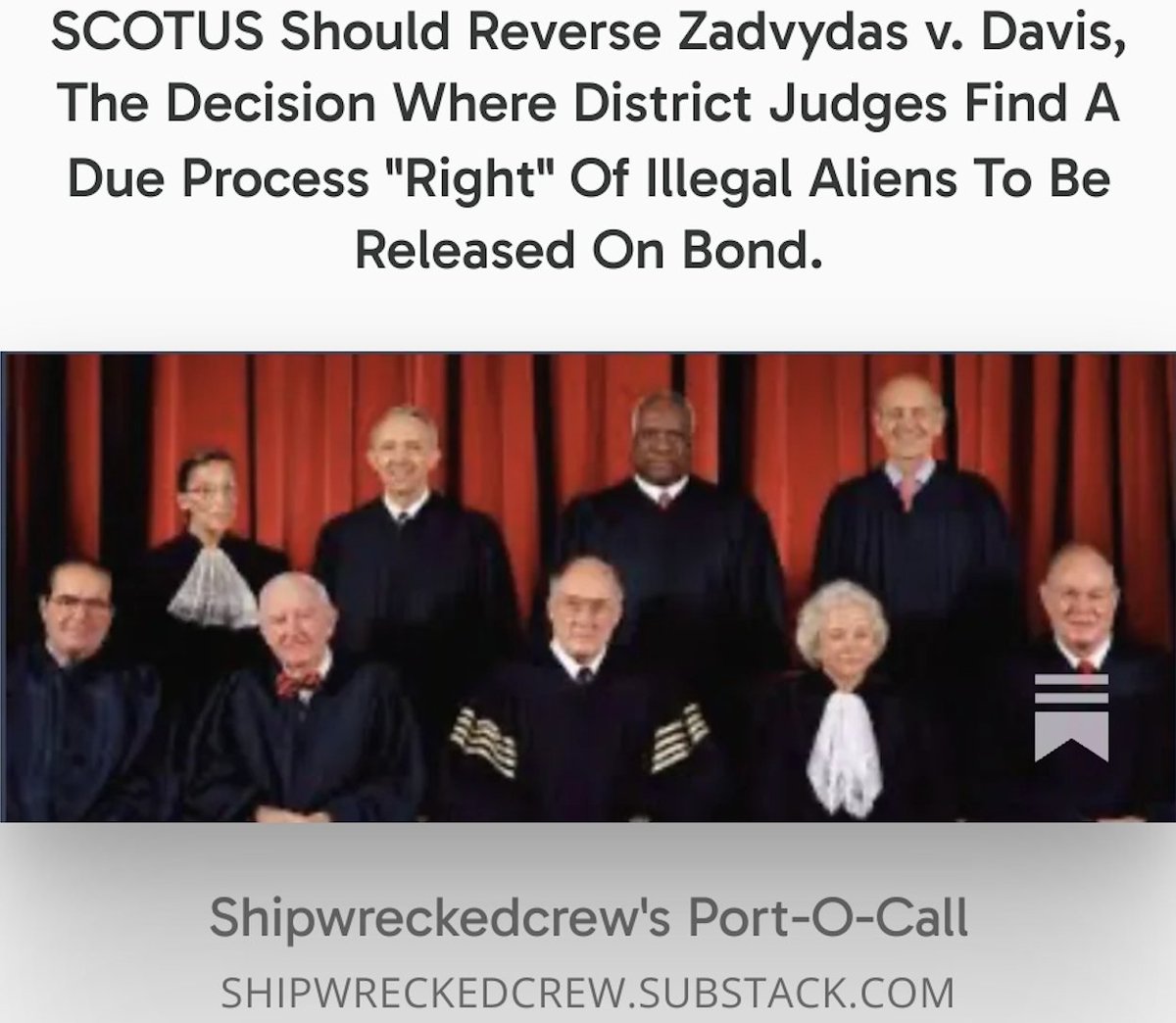
This 2001 case -- a 5-4 decision -- includes the language that all "persons" are entitled to the protections of the 5th Amendment's "due process" clause, including illegal aliens.
Dissenting were Justices Rehnquist, Kennedy, Scalia, and Thomas.
Link in next panel down.
English