Jukan@jukan05
"Samsung Union Strike Could Disrupt Memory Mass Production for At Least 1 Month"… Industry Concerns Mount
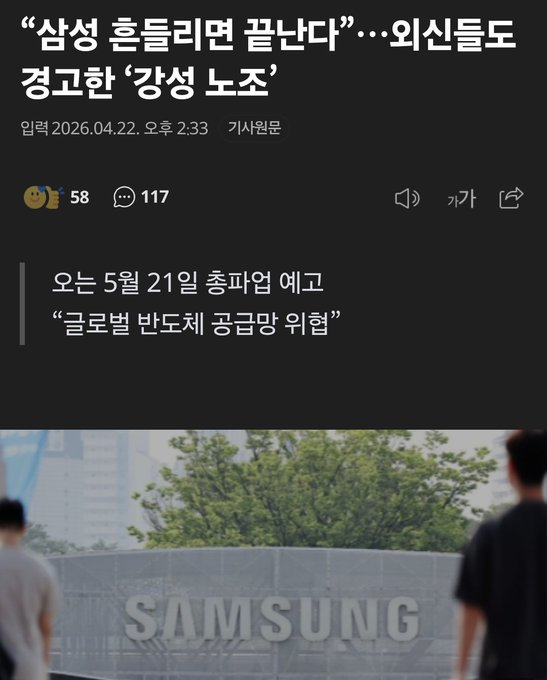
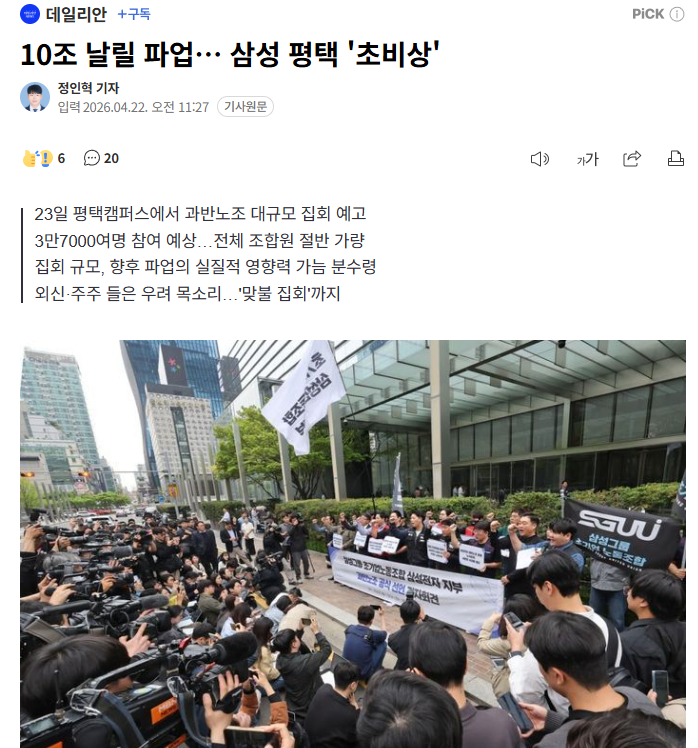
Labor-management conflict at Samsung Electronics is intensifying over the size of performance bonuses. The Samsung Group Cho-gi-eop Union's Samsung Electronics chapter (hereinafter "the union") reaffirmed on the 23rd at a resolution rally its intent to push ahead with an 18-day general strike starting on the 21st of next month.
On the 25th, concerns emerged within the semiconductor industry that the Samsung Electronics union strike could have a significant ripple effect on the memory semiconductor market.
While the union has announced an 18-day strike period, when factoring in the time required to bring equipment back online to normal operating conditions, production disruption could last at least one month or more. The impact on mass production stretches to at least double that period. There are also forecasts that, amid the memory supercycle, only Samsung Electronics' competitors will reap windfall benefits.
One semiconductor engineer explained, "If setup and maintenance (CS) work on semiconductor equipment is suspended for an extended period, restoring equipment to normal operation can take more than a month," adding, "The impact could be even greater in a supercycle situation where memory shipments need to be aggressively ramped up."
The union strike is not an issue confined to Samsung Electronics alone. If Samsung Electronics—which holds the world's largest production capacity—experiences disruptions in mass production, the memory supply crunch could worsen further. For global Big Tech and IT companies, this means greater pressure from rising manufacturing costs.
In such a scenario, competitors such as SK Hynix and Micron could enjoy the windfall of a steeper rise in memory prices. Volatility is expected to be particularly pronounced in high-performance server DRAM and eSSD (enterprise SSD) segments, where only a handful of companies are capable of mass production.
Another semiconductor engineer said, "When personnel are pulled out of the fab, equipment starts going offline one by one, creating problems," and added, "If memory equipment isn't properly managed, output can immediately drop by 10–20%."
The union is demanding that 15% of annual operating profit be distributed as performance bonuses and that the bonus system be made more transparent. Approximately 40,000 people (police estimate) gathered at the resolution rally held on the 23rd at Samsung Electronics' Pyeongtaek campus, where the same message was emphasized. More than half of the 76,100 members of Samsung Electronics' first-ever majority union in the company's history attended the rally. If a labor-management agreement is not reached, the union will proceed with a general strike.
At the rally, Union Chairman Choi Seung-ho warned, "If the company treats devoted union members as mere numbers, we too will respond with numbers—by demonstrating the massive production disruptions and losses that a strike will cause." Estimated losses from the strike have been pegged at up to 30 trillion won.