
Roy Moobola
1.2K posts

Roy Moobola
@roymoobola
Engineer/Academic/Energy transition specialist/STEM advocate/Data analyst/Doughnut economist/
Katılım Kasım 2011
323 Takip Edilen385 Takipçiler

@siphophiri @benbibozm @TraficRapBender You are celebrating an underdeveloped financial system that constrains growth. The need to pay cash for housing and cars can lead to all manner of corruption. People would be less prone to dodgy deals if they could just simply borrow from the bank and pay off loans slowly.
English

@benbibozm @TraficRapBender Most people in so called developed countries have 20-30 year mortgages and car loans. 8n Zambia 90% of all housing is debt free or 100% equity.
Even if our houses are relatively modest and our cars are second hand from Japan... it's something we should be proud of! 🇿🇲 💪🏾
English

@telvin_mwanza @mupelaIV This highlights the weakness of the CDF model of development which is linked to a political representation area and not an administrative delivery function. Does CDF then influence delimitation? The tail wagging the dog!
English

@roymoobola @mupelaIV That is understood however political voice doesn't bring about development at constituency level. That can be taken into a scientific test and the results can prove it. While improved local government through increased wards and municipalities does bring about effective change.
English

@telvin_mwanza @mupelaIV Delimitation is fundamentally about equal political voice, but in developing contexts it must account for geography and service delivery realities to avoid entrenching development inequalities. Therefore the approach I have used accounts for population, land area and remoteness.
English

@roymoobola @mupelaIV You can't improve service delivery in Lusaka by having more constituencies. Rather by having more wards which leads to enhanced local governmen, and municipalities while turning the city into a metropole. 2/2
English

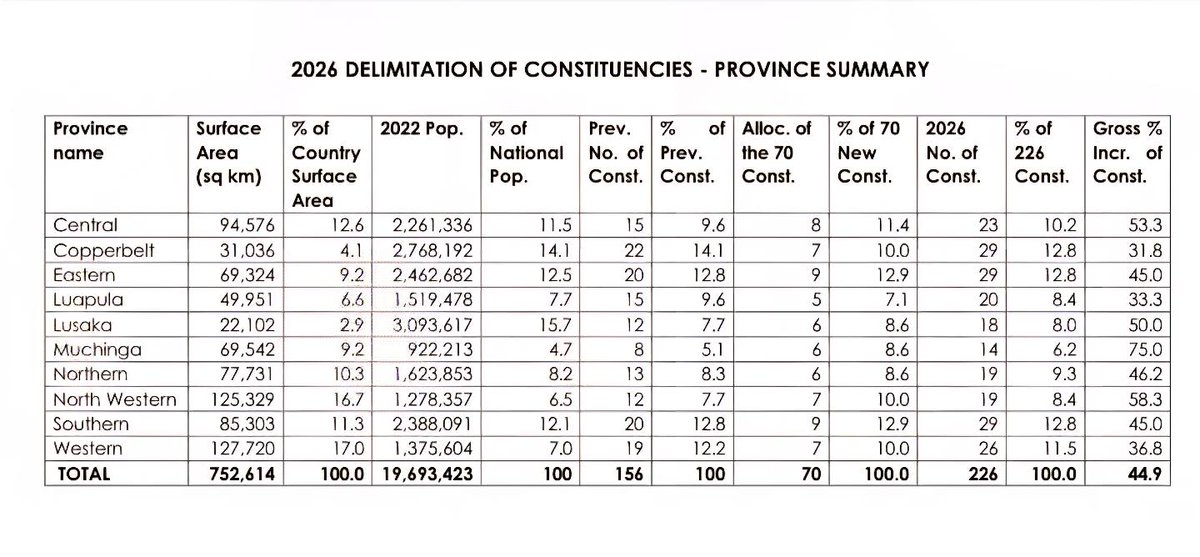
@ZambiaElections The over/under representation of each province using %constituencies minus %population is as follows:
Central: -1.3%
Copperbelt: -1.3%
Eastern: +0.3%
Luapula: +0.7%
Lusaka: -7.7%
Muchinga: +1.5%
Northern: +1.1%
North Western: +1.9%
Southern: +0.7%
Western: 4.5%
English

Solar + batteries are no longer “alternative” energy. They can deliver ~90% of electricity cheaply for most of the world at $0.09/kWh. For countries like Zambia, the constraint isn’t physics. It’s only about desire and execution.
nworbmot.org/blog/solar-bat…

English

@Kapilikisha @JWSakalajr Democracy must be built not just copied. Systems and institutions that govern democracy should be suited to the conditions prevailing in the country. The voters cannot pull themselves up by their bootstraps to get rid of their own ignorance.
English

@roymoobola @JWSakalajr The voter bears the responsibility of being informed sufficiently before casting their vote. The democratic process cannot start to vet the level of ignorance of the voters. Slippery slope.
English

@touristeagle1 The problem lies with our young demographics which skews voting towards immediate consumption over long-term investment,
politically emotive issues rather than institutional development. I would increase voting age to 21.
English

@touristeagle1 The counterpoint to your argument is that Zambia had uninterrupted leadership for 27 years without the comparative advantage seen in Singapore, South Korea etc. When we needed to change leadership we couldn't.
English

@Kapilikisha @JWSakalajr No barriers should exist if information is available perfectly to all, and people are sufficiently educated to understand the consequences. Even now there are barriers of age, citizenship, finances etc. Some places have had other barriers. Democracy needs both openness and order.
English

@roymoobola @JWSakalajr There should be no barriers. Many can aspire, its up to the people to weed out the undesirables.
English

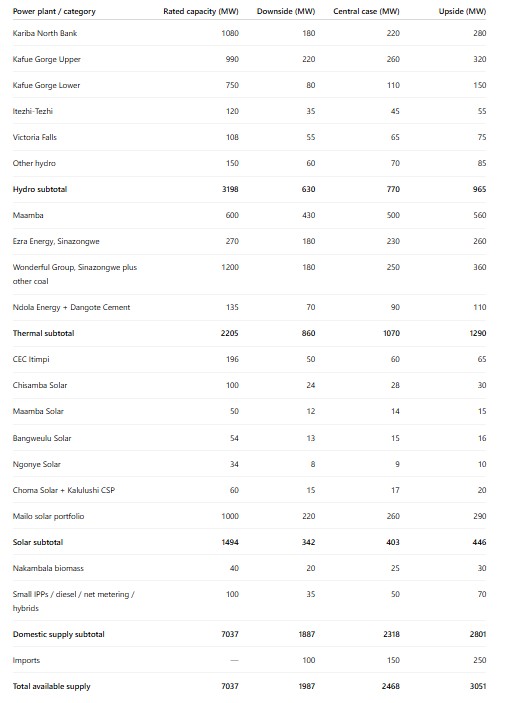
@IanECox The power envelope for March 2027 (strong El Niño) shows a system on a knife-edge. Downside supply sits under 2,000 MW. Any project delays or plant outages, and we slip straight back into deficit territory. On-time project execution will determine whether the lights stay on.

English

Facts show Zambia’s power is in stronger shape for 2026. 🇿🇲⚡️
Kariba: As of 7 April, lake level 479.61m with 28.98% usable storage (3x higher than April 2025). ZRA allocated 30 billion cubic metres for generation this year. Dry season inflows drop soon, but we start from a solid base.
Solar ramping fast: Hundreds of MW already online (Chisamba Phase I, Mansa etc.) boosting daytime supply. By election day expect another 200+ MW: Chipata West 100 MW targeted July, Chisamba Phase II 100 MW rolling out.
Game-changer: Maamba Energy expansion: existing 300 MW + new 300 MW coal + 100 MW solar = 700 MW total. Construction advanced, targeted June/July 2026. That firm 24/7 baseload covers hydro gaps and nights.
ZESCO & Energy Ministry say 2026 brings noticeable stabilisation from better hydro coordination + solar + thermal additions like Maamba. Not zero loadshedding, but much lighter & more predictable than 2023-24.
Facts over fear. The improvement has legs beyond August. What’s your take, Zambia? Stocking up on solar anyway? #ZambiaPower #LoadsheddingUpdate
Jowisa Jr@JWSakalajr
After 13th August 2026 expect heavy loadsheddding to resume.
English

@JWSakalajr Most likely in March 2027 when the true extent of the drought and the lack of preparedness becomes evident.
English
Roy Moobola retweetledi

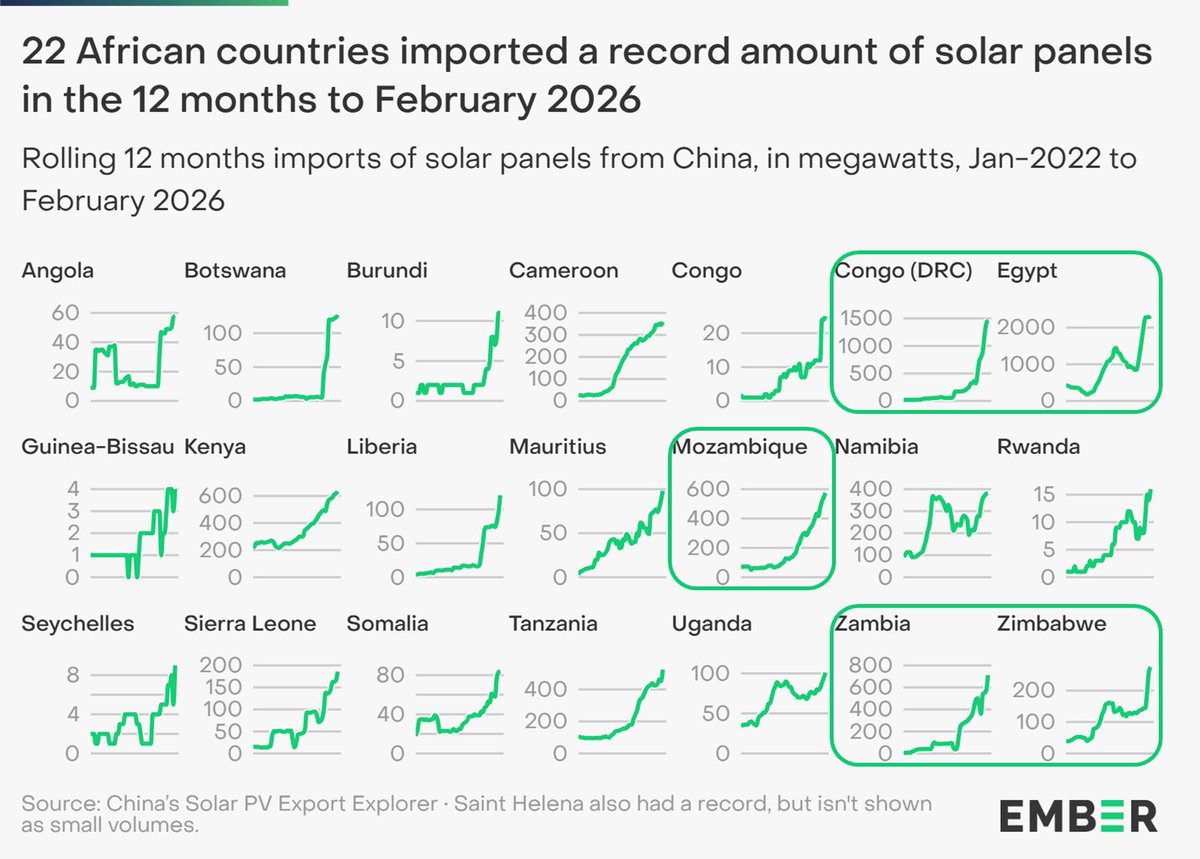
Solar continues to skyrocket in Africa through February 2026!
Solar is doing more to bring electricity to Africa than any other technology.
Solar may be doing more to increase electricity supply in Africa than all other technologies combined.
ember-energy.org/latest-insight…

English
Roy Moobola retweetledi

Emerging economies are leapfrogging to decentralised, modular solar and batteries – much like they skipped fixed-line networks for mobile.
This shift solves the last-mile challenge, bringing energy access to those the fossil system left behind.
@TheCVF
ember-energy.org/latest-insight…

English

@ZambiaMGEE please heed these warnings and make appropriate plans for 2027. Don't say you weren't warned!
The Washington Post@washingtonpost
A typical El Niño affects regional-to-global weather, as warming in the equatorial Pacific Ocean can trigger droughts, floods, and extreme heat. A super El Niño may arrive later this year, with stronger, longer-lasting, and wider impacts. wapo.st/46Q6AkX
English
Roy Moobola retweetledi