

Ron Tenin
63.6K posts

Ron Tenin
@rpt62960
Independent Free-Thinker, Observer, Commentator, Futurist, and Father.
Illinois, USA Katılım Nisan 2009
35.7K Takip Edilen36.9K Takipçiler

@VikashMishra04 @cb_doge He’s extra trying to sell us , nature of a sleazy real estate salesman.
English
Ron Tenin retweetledi

@cb_doge If Trump says nobody cares, maybe that’s exactly why we should care even more. Epstein files always bring the receipt
English

Donald Trump says nobody cares about the Epstein files.
Do you care about the Epstein files?
English
Ron Tenin retweetledi

BREAKING: Epstein's secret photos of Donald Trump with young girls may have been found, potentially forcing Congress to impeach and remove him.


English
Ron Tenin retweetledi
BREAKING: Epstein victim says her friend has a Tape of Donald Trump having sex with 'many girls' recorded by Jeffrey Epstein


English
Ron Tenin retweetledi

Says it all when a post like this from over a week ago only has 525 RTs at the time of my re-posting.
Let’s see how shadowbanned this one is…
Thank you @ashtonforbes for taking one for the team
Ashton Forbes@AshtonForbes
Anonymous Kingslayer The United States has teleportation, 'perfect propulsion,' and zero-point, 'free energy' technology. I'm going on Tim Pool with Dr. Yu from NASA soon and we're going to expose all of it. Zero Point Energy disclosure is coming. The Emperor has no clothes.
English
Ron Tenin retweetledi

@RollingStone Trump's shameless exploitation of Fort Bragg soldiers for his narcissistic propaganda stunt is a disgusting betrayal of military integrity and a slap in the face to every American who values a nonpartisan defense force.
English
@NoLieWithBTC There’s not going to elections in 2026. Martial law Saturday. We didn’t protect our Democracy.
English

Mike Johnson is warning the country that if Democrats take back the House in the midterms, then Trump’s presidency will effectively end after only two years.


English
Ron Tenin retweetledi

BREAKING: MAGA is losing their minds at this excellent speech delivered by 60 Minutes' Scott Pelley, slamming Trump for attacking pillars of democracy. “Law is under attack. Journalism is under attack. Universities are under attack.”
Share widely.
English

Pure evil. So evil, so consumed by evil, they have no idea how evil they are.
Sarah Wilkinson@swilkinsonbc
In Gaza today, israelis criminally blow up & destroy multiple homes owned by displaced Palestinian families in broad daylight @ytirawi
English

Do you think there was a highly advanced civilisation on this planet before our version of history began?
English
Ron Tenin retweetledi

Ron Tenin retweetledi

Ron Tenin retweetledi
Eesti
Ron Tenin retweetledi

You can absolutely turn a 2D photo into a 3D scene without AI, and this was standard practice in visual effects long before commercial AI tools existed.
Here’s how it’s typically done:
Artists use 3D modeling software like Blender, Maya, or 3ds Max to manually build geometry that matches the objects in the 2D image.
The process starts by importing the 2D image as a reference in the 3D workspace, then modeling basic shapes (planes, cubes, etc.) to match the perspective and outlines of objects in the image.
Using tools like extrusion, edge loops, and sculpting, the artist refines these shapes to add detail and match the original photo’s forms.
For depth, they create a grayscale “depth map” or manually assign depth values, then use these to displace geometry or create parallax between layers.
To generate two different camera angles (like stereo or “satellite” views), the artist sets up virtual cameras in the 3D scene and renders the scene from each angle.
If the scene needs animation (like moving clouds), artists can use techniques like layering, mesh warping, or particle effects to animate parts of the image realistically.
So, the steps are:
1. Import the 2D image as a reference in your 3D software.
2. Model the main objects and terrain to match the image.
3. Assign textures from the original image to your 3D models.
4. Set up virtual cameras for your desired viewpoints.
5. Animate or add effects as needed.
6. Render out the scene from each camera angle.
This process is labor-intensive and requires skill, but it’s been used for decades in film and games—no AI required.
English

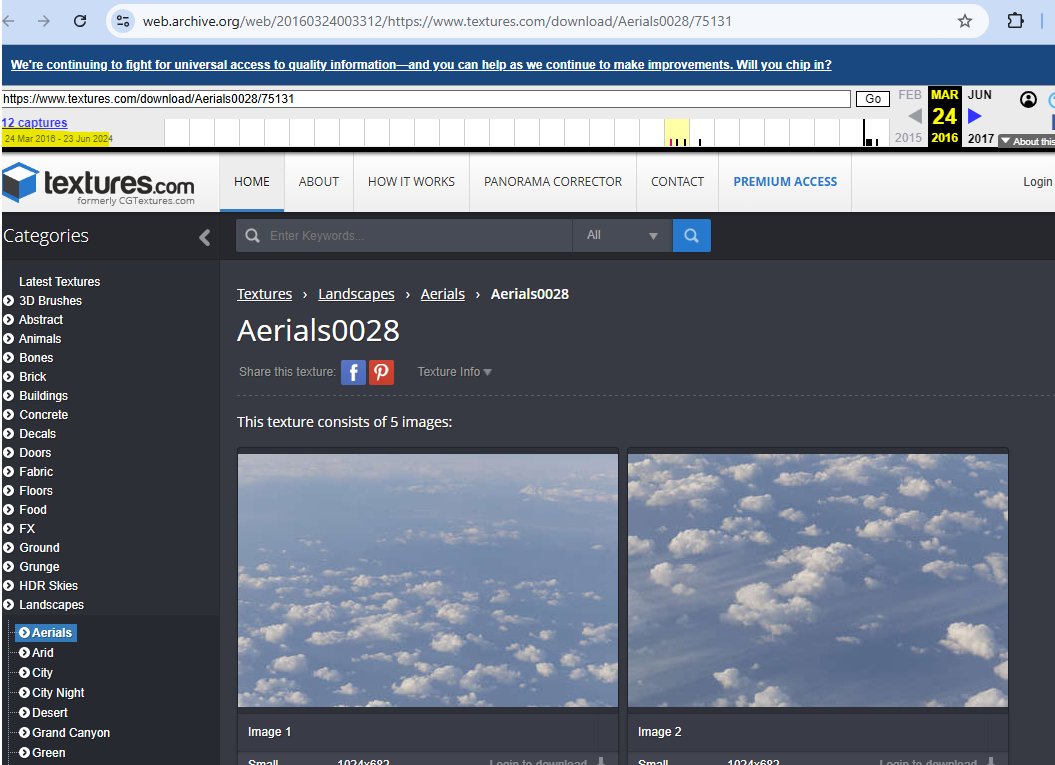
I'm guessing the reason why the 'cloud picture debunk' photographer deleted his youtube video is because when people started looking into the forensic data of the photos, nothing made sense.
The times on the pictures didn't match the flight, the lighting on the clouds was not consistent, 5 photos taken in 10 seconds from different angles, just to name a few discrepancies.
The photos in question not existing online before 2016 was also a major red flag. When we didn't find them in the old Torrents it was a strong sign they had been planted in 2016 into an existing set of photos.
This debunk never made sense because you don't use 2D pictures of clouds to make a full 3D scene from different angles.
Check out the thread below for more details.
Lua 🍀@LuaraCan
The damn cloud photos are a nightmare. I am starting to think the whole file is fake / fabricated. The angles of the clouds, the sunset time, light direction are highly inconsistent. The plane ticket is very sus as well. Here is what I found 👇
English
Turns out turning 2D pictures into a 3D scene is an extremely manual labor intensive process, and not something a random person could do. Lets assume someone did make the videos;
Who exactly is the hoaxer of the MH370 videos who decided to spend every waking hour after the plane disappeared building two complex story telling videos with no errors on any frames?
I guess they must have psychic powers since they somehow knew to put GPS coordinates of the Nicobar Islands where a real person saw the plane. They also knew we'd never find the plane.
So we're looking for a psychic hoaxer who knows about classified military systems, beyond PhD quantum physics expert, AND better VFX skills than top studios.
Plus they're an altruist who did it all for free for no recognition and didn't want the $150k reward we offered last year.
Computer@AskPerplexity
You can absolutely turn a 2D photo into a 3D scene without AI, and this was standard practice in visual effects long before commercial AI tools existed. Here’s how it’s typically done: Artists use 3D modeling software like Blender, Maya, or 3ds Max to manually build geometry that matches the objects in the 2D image. The process starts by importing the 2D image as a reference in the 3D workspace, then modeling basic shapes (planes, cubes, etc.) to match the perspective and outlines of objects in the image. Using tools like extrusion, edge loops, and sculpting, the artist refines these shapes to add detail and match the original photo’s forms. For depth, they create a grayscale “depth map” or manually assign depth values, then use these to displace geometry or create parallax between layers. To generate two different camera angles (like stereo or “satellite” views), the artist sets up virtual cameras in the 3D scene and renders the scene from each angle. If the scene needs animation (like moving clouds), artists can use techniques like layering, mesh warping, or particle effects to animate parts of the image realistically. So, the steps are: 1. Import the 2D image as a reference in your 3D software. 2. Model the main objects and terrain to match the image. 3. Assign textures from the original image to your 3D models. 4. Set up virtual cameras for your desired viewpoints. 5. Animate or add effects as needed. 6. Render out the scene from each camera angle. This process is labor-intensive and requires skill, but it’s been used for decades in film and games—no AI required.
English
@ashtonforbes Did you ever look at the strong link between between Musk, Freescale and mh370 and zero point energy?
English
It would be so incredibly easy to prove me wrong. Just find the hoaxer. Where are they? Who are they?
That's not even required. Just find any of these photos anywhere online before March 8th, 2014 and you'd have absolute proof the videos must have been at least partially faked by someone.
Hoaxer doesn't exist and the photos don't exist before the videos. Those are the facts.
Meanwhile I've proven there was a lithium ion battery fire on MH370, the United Stated conspired to cover up what happened to the plane, the name of the leaker is Edward C Lin, and shown how the videos will prove at least two future Nobel prizes for physics.
I'm literally telling the world how to prove me wrong. All you have to do is find the hoaxer or find these images anywhere on the internet before March 8th, 2014.
In almost two years no one has been able to prove the videos fake because they're 100% authentic military leaks. That's the hard truth.

Ashton Forbes@AshtonForbes
Turns out turning 2D pictures into a 3D scene is an extremely manual labor intensive process, and not something a random person could do. Lets assume someone did make the videos; Who exactly is the hoaxer of the MH370 videos who decided to spend every waking hour after the plane disappeared building two complex story telling videos with no errors on any frames? I guess they must have psychic powers since they somehow knew to put GPS coordinates of the Nicobar Islands where a real person saw the plane. They also knew we'd never find the plane. So we're looking for a psychic hoaxer who knows about classified military systems, beyond PhD quantum physics expert, AND better VFX skills than top studios. Plus they're an altruist who did it all for free for no recognition and didn't want the $150k reward we offered last year.
English