jason rugolo

329 posts

jason rugolo banner
jason rugolo

jason rugolo

@rugolo

founder + ceo @ iyo | audio + computing | on a mission to bring natural language computing to billions of people.

San Francisco, CA Katılım Mart 2012
1 Takip Edilen1.9K Takipçiler
Sabitlenmiş Tweet
jason rugolo
jason rugolo@rugolo·
25MM views on @TEDTalks instagram 🤣 ... i think the most ever? so crazy! 🙃 ... this tech is comin' folks. hello from production heaven in taipei! 👋😊
English
8
20
145
37.2K
kache
kache@yacineMTB·
ahahahahahahahaahhaahahahahahaha okay you guys were right this hardware shit is hard.
English
127
49
2.2K
150K
jason rugolo retweetledi
Abakcus
Abakcus@abakcus·
John Conway with a rope!😲
English
23
145
966
90.2K
jason rugolo retweetledi
Interesting things
Interesting things@awkwardgoogle·
This guy playing with his fish🙂
English
8
56
1.3K
100.6K
jason rugolo retweetledi
Science Magazine
Science Magazine@ScienceExpand·
3.14 means we will meet again
English
124
1.2K
13.9K
2.6M
Chris Heatherly
Chris Heatherly@chrisheatherly·
The “put them in a bikini” thing is pretty funny when you invade parts of Twitter where people aren’t as retarded and surprise them with it.
English
1
0
2
303
Lomez
Lomez@L0m3z·
Trite observation maybe, but reading about Portuguese and later Dutch merchant traders traversing the uncharted open seas and enduring unspeakable peril to reach the Orient (the first sanctioned Dutch expedition to Java in 1596 lost 150 out of 250 men and resulted in a minor colonial war) just for a few pots of black pepper, literally just a few pots, and upon its delivery back to Holland was so alluring that procuring more black pepper became the central focus of the nation's treasure and manpower, and on the back of which an entire centuries-long shipping empire was built, as I casually, unthinkingly, in the most mundane and ungrateful way possible, grind a few dashes of same-said pepper over my scrambled eggs, induces the strange and I suspect wholly modern sensation of the enormous wealth and extravagance of ordinary life, and how laughably trivial so much of it is, but also for which I nonetheless give thanks.
English
136
629
7.9K
312.5K
jason rugolo retweetledi
Gavin (Owner 67 Designs)
Gavin (Owner 67 Designs)@67Designs·
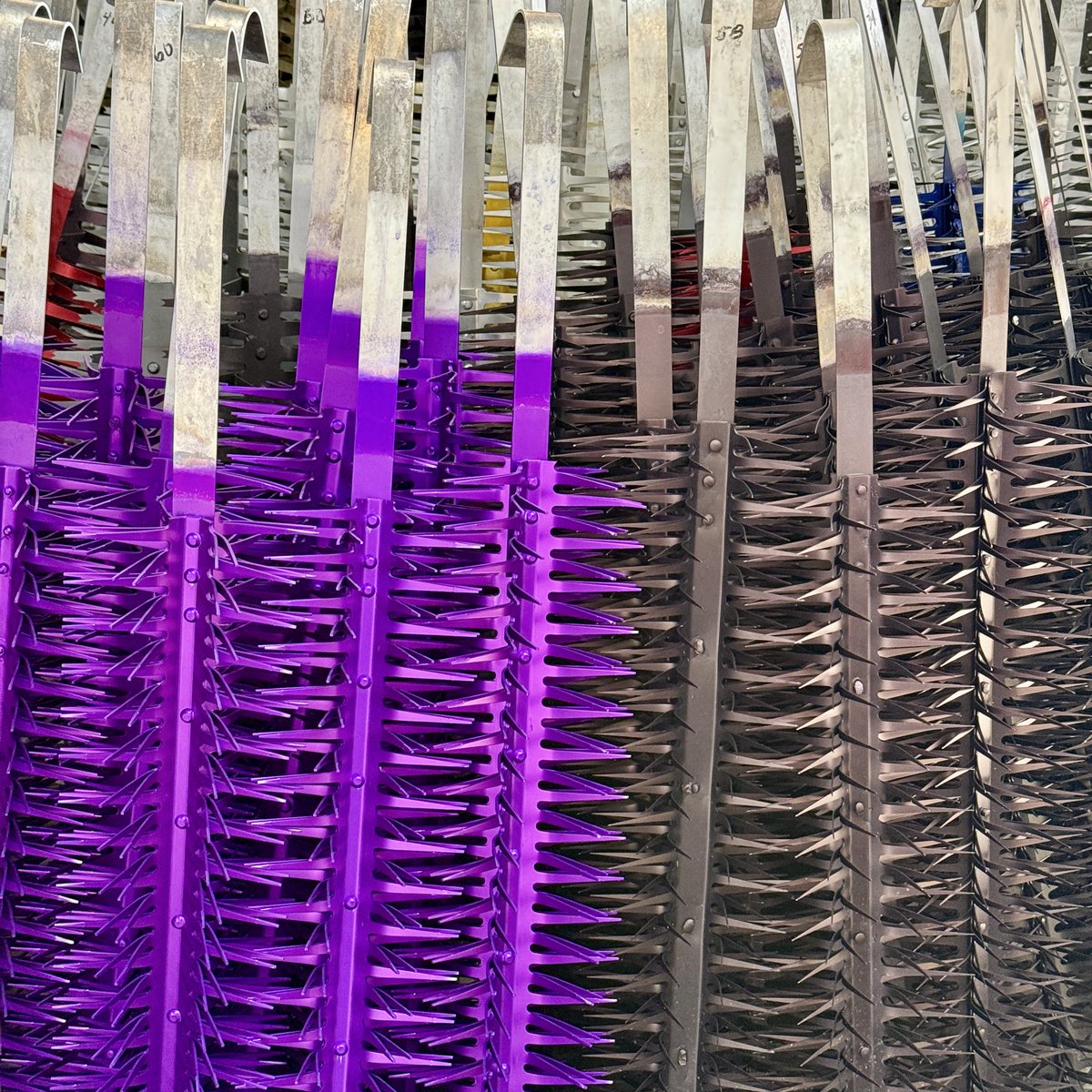
We are witnessing, in real time, the quiet extinction of a certain kind of in this case, American genius: the genius of the man who can simply do the job better than anyone else alive, and who, when he finally lays down his tools, takes the entire trick with him to the grave. We have spent enough time in factories across American to recognise these figures. The old guard. Men (almost invariably men) who began as apprentices when apprenticeships still meant something, who learned their craft in the days when “health and safety” had not yet been weaponised into a substitute for competence, and who, through a mixture of obsessive care, brute experience, and what can only be described as a form of love, achieved results that no amount of ISO certification or digital twinning can replicate. (Note: igital twinning should be banned!) You see it in the G-code archives, the meticulously saved CAM files, the drawers of fixtures and collets. All preserved, all perfectly useless. Because the real program was not written in Fusion 360 or Mastercam. It was written in the old boy’s head, in the muscle memory of his hands, in the thousand tiny adjustments he made while standing at the machine in the small hours, listening to the spindle the way a sailor once listened to the wind. When he dies or retires to his RV (or, more likely these days, simply drops dead between shifts), the yield collapses. The scrap rate climbs. The tolerances wander. And everyone pretends to be shocked. Now extend that story to the fellow in North Texas who has been hard-coat anodising aluminium since he was sixteen. A cantankerous old devil, by all accounts (the best ones always are). He will not take work from just anyone; you have to earn the right to have your parts racked by him. And when those parts come back (Type III, Class 2, black, two thou thick, dyed in the tank the way God and Mil-A-8625 intended), they are, quite simply, perfect. Perfect enough to be trusted on equipment carried by men who go in harm’s way. In five years not one apprentice has lasted. Four twelve-hour days of racking, masking, anodising, dyeing, sealing, unpacking, packing again. The work is hot, wet, and corrosive. It demands concentration and pride at a level the modern temperament no longer possesses. And so, very shortly, the doors will be locked for the last time. The landlord will drain the tanks, probably discovering half a dozen baskets of our phone holder parts “off-the-rack” parts quietly dissolving at the bottom (a secret embarrassment we all pretend does not happen). And several hundred small machine shops across the state will discover that the supply chain they took for granted has vanished. The remaining platers and coaters are themselves either grizzled independents on the verge of retirement or private-equity roll-ups run by caretaker managers whose bonuses are tied to throughput, not quality. You can guess which incentive wins. This is not a regional curiosity. It is a national elegy. From Connecticut to California, the same quiet closures are taking place: the electroplaters, the chem-film shops, the passivation houses, the NADCAP-certified painters who actually deserve the certification. All disappearing. And with them disappears the ability of the small and medium-sized machine shops (the real backbone of Western manufacturing) to deliver finished parts that meet print. We are told, incessantly, that we need more machine shops, more CNC spindles turning, more “reshoring.” But what exactly is the point of machining a part to five decimal places if you cannot anodise, plate, or coat it within two hundred miles without taking a second mortgage for freight? The part is useless until it is finished, and the finishing trades are dying faster than the machining ones.
Gavin (Owner 67 Designs) tweet media
MurrayMentor@MurrayMentor

"...manufacturing has delivered quiet perfection long before anyone talked about foundation models." Yep. And the 'foundation models' for manufacturing are allowed to quietly walk out the door, with that core tacit data uncollected. Some of the real solutions are working at Home Depot stocking shelves, instead. Honor the skill. Build the future.


English
87
115
798
343.4K
jason rugolo
jason rugolo@rugolo·
@ApoStructura energy is of the cheapest, most prolific commodities on earth, next to land and water. y'all need to drive from LA to PHX 😂🥲 (don't get me wrong i love sci fi ideas too).
English
0
0
0
174
ApoStructura
ApoStructura@ApoStructura·
1m² of solar in space generates 10x more energy than it does on Earth. That’s because in space there is no night, no clouds, and no thick atmosphere. A solar array 1km² in space would produce as much power as a nuclear reactor. It’s why space datacenters make sense.
ApoStructura tweet media
English
503
398
3K
279.9K
jason rugolo retweetledi
Vishakh Ranotra
Vishakh Ranotra@VishakhRanotra·
Once I retire, I just want to rebuild internal combustion engines at my farm. This is so therapeutic.
English
57
127
1.6K
478.3K
NZ ☄️
NZ ☄️@CodeByNZ·
This man built VLC, turned down stupid money just to keep it ad-free, and still gave it to us for free. Absolute hero.
NZ ☄️ tweet mediaNZ ☄️ tweet media
English
1.5K
20K
218.9K
24.8M
S Tominaga (Aka Dr Craig Wright)
Naval’s epigram is tidy in the way cocktail-napkin philosophy is tidy: it achieves rhetorical velocity by sanding down the inconvenient corners of reality. “Capitalism is PvE” is a pleasing metaphor because it flatters the self-image of the productive man as a dragon-slayer, conquering nature rather than his neighbour. But metaphors are not arguments, and this one collapses the moment you ask what “the environment” actually is. In a market order, the “environment” is not merely dirt, physics, and indifferent entropy. It includes human preferences, rival firms, competing technologies, and alternative uses of scarce resources. Every act of production is simultaneously an act of comparison against other producers, and every price is a verdict delivered by other minds. Capitalism is not a monastery of solitary craftsmen chiselling away at nature in blissful non-interference. It is a field of competitive selection, where the enemy is not the consumer but the competitor who serves the consumer better. That is not “war,” but it is certainly not a single-player game. It is cooperative conflict: mutually beneficial trade inside a framework of rivalry. The reply—“capitalism is PvP; the world is run by people”—is closer to the bone, yet still muddled. It confuses the presence of competition with the presence of predation, as if any contest among humans must be a knife fight. Under capitalism, men do not win by smashing skulls. They win by building value that others freely choose. The struggle is not over loot; it is over excellence. The fact that people compete to “tap into the flow of money” is not an indictment; it is a description of incentives. The mechanisms matter precisely because they determine whether “tapping in” is done by production or by plunder. A job, a company, and a political office are not morally equivalent conduits. One earns by serving; the other too often takes by commanding. The clean distinction is this. Capitalism is the only system that structurally disarms PvP in its primitive sense—force against persons—by prohibiting the initiation of force and requiring value for value. It channels rivalry into productive endeavour, making nature the primary obstacle and human choice the ultimate judge. The alternatives truly do degenerate into PvP, not because humans exist, but because coercion becomes the organising principle. When the state is the dispenser of wealth, men cease to compete in production and begin to compete in capture. The battlefield shifts from the workshop to the legislature, from innovation to influence, from serving customers to controlling gatekeepers. That is where the knives come out. So Naval’s line is directionally right and intellectually lazy. The respondent’s line is emotionally true and conceptually sloppy. Capitalism is neither a utopian PvE idyll nor a Hobbesian PvP brawl. It is the only arrangement that makes peaceful competition possible by binding human interaction to voluntary exchange. It turns the war of all against all into a race to create—then lets the best creator win without firing a shot.
English
8
3
34
26.6K
Naval
Naval@naval·
Capitalism is PvE. The alternatives all degenerate to PvP.
English
979
1.4K
12.5K
16.9M
Pedro Domingos
Pedro Domingos@pmddomingos·
Sam Altman's core competencies are manipulating investors and manipulating tech nerds.
English
251
485
5.9K
1.2M
jason rugolo
jason rugolo@rugolo·
private inurement be damned 😞
English
0
0
0
192
jason rugolo retweetledi
Jon Yongfook
Jon Yongfook@yongfook·
It’s crazy that X is literally a wrapper around MySQL and it’s worth $40 billion.
English
177
54
2.5K
158.1K
jason rugolo retweetledi
Carlos E. Perez
Carlos E. Perez@IntuitMachine·
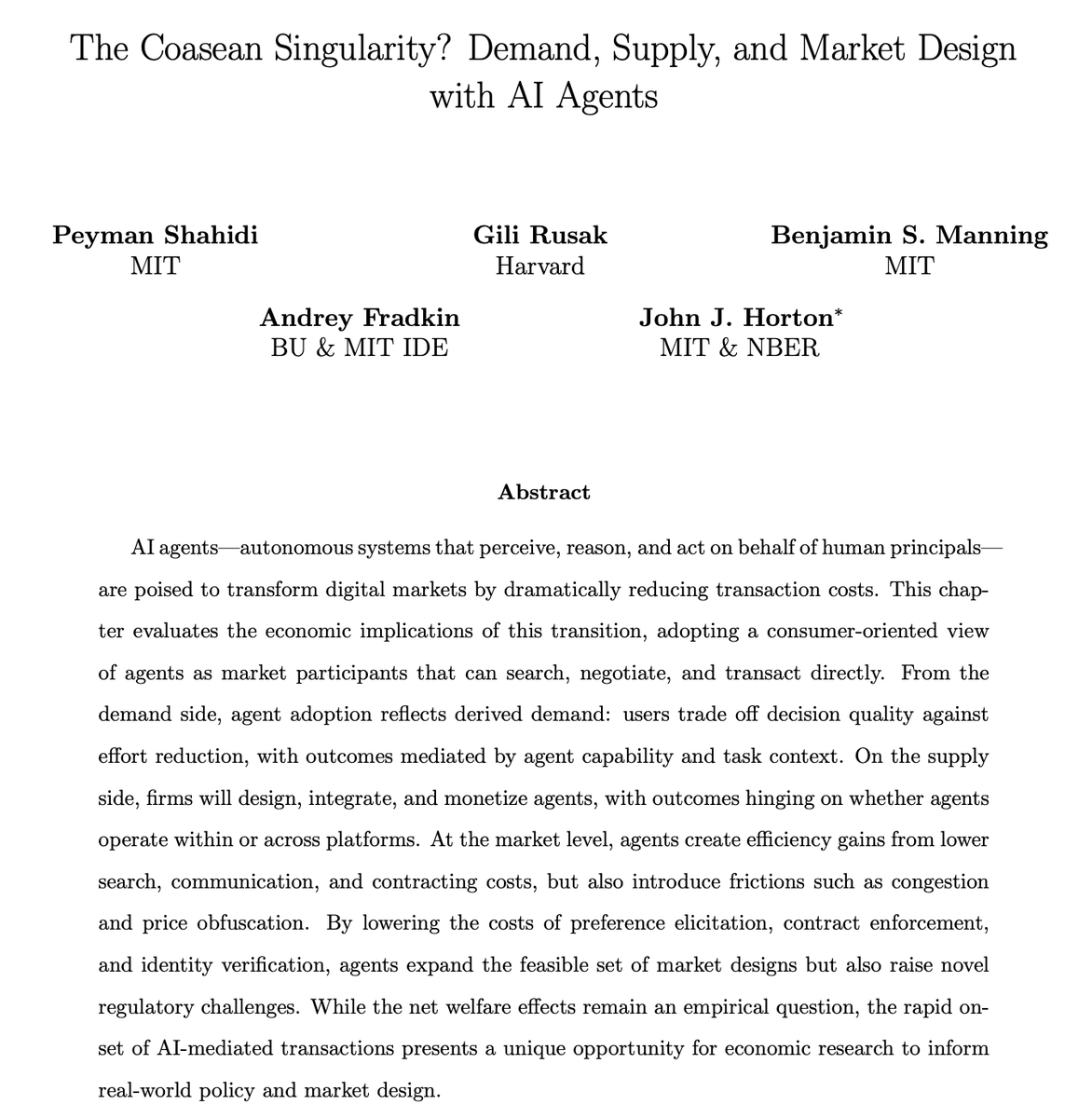
1/16 I just fell down a rabbit hole reading a new paper from economists at MIT & Harvard. Their prediction is wild: We're on the verge of a "Coasean Singularity"—a future where AI agents make markets so efficient that the very idea of a 'company' starts to crumble. 🤯 A thread 👇 2/16 First, a quick 101: Why do companies even exist? A Nobel-winning economist named Ronald Coase answered this in 1937. He said companies exist because using the open market is a pain. Finding sellers, negotiating prices, writing contracts… it’s all “transaction cost.” Economic friction. 3/16 It's often easier and cheaper for a firm to just hire people and organize them internally than to deal with that constant market friction. This friction is also where we, as consumers, lose. We're tired, we're biased, and we don't have time to compare every cell phone plan or read every review for a toaster. Companies know this. 4/16 Now, enter the AI Agent. And I don't mean a simple chatbot. The paper describes an autonomous system that acts on your behalf. Think of it as your own personal, tireless, super-rational economist. It’s immune to marketing tricks and its only goal is to get the best outcome for YOU. 5/16 This is where the "Singularity" happens. When everyone has an AI agent, those transaction costs that Coase talked about basically drop to zero. The "friction" that made companies necessary in the first place? It evaporates. And if the reason for something disappears… so does the thing itself. 6/16 But what does this future actually look like? This is where it gets weird. Let's take shopping. Your agent doesn't just browse Amazon. It might contact a manufacturer in another country directly, find 500 other agents whose users want the same thing, negotiate a bulk price, and arrange shipping. All in milliseconds. The "storefront" becomes irrelevant. 7/16 Or think about hiring. Instead of you endlessly scrolling LinkedIn, your agent scans the entire market for opportunities. It negotiates salary, benefits, and remote work policies with the company's agent. You only get involved for the final human-to-human interview. No more cover letter hell. 8/16 But this discovery comes with a huge catch. The paper outlines a fundamental battle for the future of AI: Will your agent be a "Bring-Your-Own" (BYO) agent that works only for you, across all platforms? Or will it be a "Bowling-Shoe" agent, provided by the platform (like Amazon or Google), whose priorities might be... conflicted? 9/16 The "Bowling-Shoe" agent is convenient, but it might steer you toward the platform's own products. The "BYO" agent is loyal to you, but platforms might try to block it or throttle its access. This tension between user autonomy and platform control will define the next decade of the internet. 10/16 And that's not even the most interesting part. This new world creates bizarre new problems. Problem #1: Agent Congestion. What happens when millions of agents can create a perfect, customized resumé and apply for a single job in a nanosecond? Employers get flooded. The signal is lost in the noise. 11/16 The paper predicts that to solve this, platforms will have to re-introduce friction. Imagine having to pay a small fee for your agent to submit a job application, just to prove you're serious. Costless actions will lose their meaning. 12/16 Problem #2: The Identity Crisis. In a world full of bots, how do you prove you're a unique human? How does a company know it's not negotiating with 1,000 agents all controlled by one person trying to manipulate the market? This is the "Sybil Attack" problem, and it's a big one. 13/16 This will lead to a boom in "proof-of-personhood" technologies. Systems that cryptographically verify you are one person, without revealing your personal data. It sounds like sci-fi, but it'll be the essential plumbing for a world of AI agents. 14/16 Here's a new lens to see the world through: Next time you use Uber (matching drivers/riders), Zillow (matching buyers/sellers), or Upwork (matching clients/freelancers)... Don't just see an app. See it as a clunky, early prototype for the agent-driven markets of the future. 15/16 This isn't just about better shopping bots or smarter assistants. It's a potential rewiring of our entire economy, away from the 20th-century model of the centralized firm and toward a 21st-century model of fluid, hyper-efficient, agent-mediated markets. 16/16 The 20th century was defined by the rise of the corporation. The 21st may be defined by its slow, quiet dissolution.
Carlos E. Perez tweet media
English
185
500
2.4K
566.3K
jason rugolo
jason rugolo@rugolo·
frankenstein's monster: "Remember that I am thy creature; I ought to be thy Adam, but I am rather the fallen angel, whom thou drivest from joy for no misdeed. Everywhere I see bliss, from which I alone am irrevocably excluded. I was benevolent and good; misery made me a fiend."
English
0
0
0
170
jason rugolo
jason rugolo@rugolo·
oai is frankenstein's monster. (...we're all frankenstein).
Deutsch
2
0
0
165
jason rugolo
jason rugolo@rugolo·
the information: "Focus groups have revealed that some users already think ChatGPT has ads, and some OpenAI staff have used that finding to argue for adding advertising."
English
0
0
0
116