
Sabitlenmiş Tweet
Ryan
607 posts

Ryan
@ryan_czm
Following commods/quant/macro/stem people. Curating a TL of wisdom & alpha. 27. 🇸🇬 Currently on career break due to a serious illness, hope to be back soon
Singapore Katılım Mart 2013
701 Takip Edilen134 Takipçiler

Fluge & Mella doing great work on daratumumab for ME/CFS - thank you to @ryan_czm for introducing me.
English
Did the daratumumab *just* destroy the myeloma - or did it *also* knock out a T-cell suppressing autoantibody? Daratumumab depletes long-lived plasma cells via CD38 & potentially-harmful immune-altering autoantibodies - not just the cancer! @casanova_lab
Adam C Palmer@ac_palmer
Sometimes cancer treatments are subject to hype, but here’s an advance that’s been understated: Combining a T-cell engager antibody with daratumumab allowed >80% of people with relapsed or refractory multiple myeloma to go years without progression. Might be *permanent* control
English
@JackHadfield14 Sir, when you measure across that many high dimensions with so few samples, any signal is likely to be noise.
English

One of the biggest reasons I’ve become theory-agnostic in Long COVID and ME/CFS is how easy it is to become convinced you’ve found the explanation.
That is not because people are irrational. It is because the human brain has to simplify problems in order to handle them. When a disease is extremely complex, with many overlapping systems and huge amounts of literature, we naturally latch onto a theory that seems to connect a lot of the dots.
I saw that in myself very early on with ROCK1. I came across papers suggesting it may be altered after COVID, and the more I read, the more compelling it seemed. ROCK1 appeared connected to mitochondrial dysfunction, vascular dysfunction, viral persistence, and a range of other features that looked highly relevant. It felt like I might have found something that could explain the disease.
Interestingly, in our own data, ROCK1 appears reduced in blood. But even that is not straightforward. Lower circulating ROCK1 may in some contexts reflect cleavage, which could imply increased activity rather than decreased importance. That still needs further research.
The same pattern repeated across other pathways. Angiotensin 1-7, ACE2, PINK1, TGFB, NAD+ biology, tryptophan and kynurenine metabolism, T-cell exhaustion, NK-cell exhaustion, and mast-cell biology.
Each time, there were mechanisms that looked compelling. There were people who improved when targeting them. But there were also people who worsened from the exact same interventions.
At a certain point, the pattern becomes difficult to ignore. Multiple pathways can each look capable of explaining the disease, which means likely none of them do on their own.
Finally, we are beginning to see the emergence of systems that may be able to hold the full nuance and scale of biological data in context at once, something the human brain has not been able to achieve.
Now the goal is clear. Build the highest-quality datasets to allow those systems to solve these diseases as quickly as possible 💪
Jack | amatica health@JackHadfield14
English
Ryan retweetledi

Trump's approval rating just fell below 40 percent in our tracking for the first time. And his net approval rating is now -17.4, also a new low and down about 5 points over the past several weeks.

English
Ryan retweetledi

Iran War - Update :
Negotiations are pure theater. Trump's 48-hour ultimatum was never credible. The Gulf states told him so directly as follow-through would have meant Iranian missiles on their own infrastructure. Iran offered nothing. Trump got a backroom readout from Witkoff, called it diplomacy, and bought himself two more weeks.
Why two more weeks ? For troops to arrive !
~7,000 US forces are moving toward the Persian Gulf right now. When they get there, expect ground operations. The target: Abu Musa, Greater Tomb, Lesser Tomb. Seize those, and the US gets a defensive foothold to escort convoys through. That's the optimistic version. Timeline: 2-4 weeks per Rubio. Reality: probably 4-6 week if all goes according to plan (it never does)
Kharg Island stays off the table for now. You need 12-15k troops for that, and taking it likely triggers Iranian strikes on Gulf desalination plants. The Americans need to degrade Iran further before they go there. Trump's risk appetite has flipped. Oil heading to $100+ as a baseline, $200 not ruled out by Treasury. Rate cuts dead for the year. Midterms already a lost cause.
So what do you do? You swing for legacy.
Control the Strait. Leverage Iranian oil against China. Call it the "Strait of Trump." He literally said that out loud in Miami. Don't assume it goes smoothly. The Iranians have been sharper than anyone expected. That likely-hypersonic strike on the US base in Saudi Arabia on Friday wasn't nothing. The Strait is full of civilian boats and ringed by mountains, RPG-enthusiast heaven. Half the US Navy's amphibious ships are in poor condition with low readyness (41% mid last year).
Iran absorbs this war and survives, but just about. IRGC tightens its grip on the state. Industrial base is gutted. Legitimacy collapses under the weight of repression, economic ruin, water crises, and incompetent new leadership. 3-5 year trajectory looks like either civil war along ethnic fault lines or a Pakistan-style military dictatorship. Neither is stable. Both are nuclear-adjacent problems down the road.
Some but not all Gulf states come out stronger, paradoxically. Saudi Arabia is looking at +$50B/yr in oil revenue through Yanbu alone. GCC cohesion deepens. Defense spending surges. Long-term redundancy like extra pipelines to the Mediterranean/Red Sea, rail, water security, gets built in a hurry.
China doesn't fire a single shot and wins. Stockpiles, state-directed subsidies, no midterm elections to worry about. Xi plays the long game, positions China as the "stable great power," and waits to be invited into the post-war multinational policing force for the Strait. Which will be a fascinating moment.
Trump loses the House badly. Senate is a coin flip. What follows: investigations on every front (insider trading, anyone ?), a hobbled domestic agenda, and a president who then goes maximally unilateral on foreign policy — the one domain where he has nearly unchecked power. Ukraine gets cut loose in a side deal with Moscow. Europe erupts. NATO frays.
Europe accelerates defense decoupling, builds toward its own nuclear umbrella, and quietly restarts the "variable geometry" strategy, waiting for the next US president, keep maximum optionality shopping between Washington and Beijing for whoever offers a better deal. End up commiting to neither. "Belle of the ball" strategy.
This is not ending at a ceasefire. The positions are structurally incompatible. The economic damage is still being massively underpriced. And the escalation ladder still has many rungs left.
Hang on to you helmets. This is the big one.
English
@tleilax___ Sir would elasticity dampen the ethanol factor slightly, if countries cut back on sugar use in a shortage more compared to staples like rice and wheat? Or would it be too minor of an impact
English
The US, the biggest gasoline market on Earth, just increased by 50% its ethanol blending limit. India is also considering to raise it from 20% to 30%.
And you are short sugar because your Excel-spreadsheet analyst thinks the Brazilian sugarcane crop is half-decent ? ;)
bloomberg.com/news/articles/…
Yet another commodity guy@tleilax___
The most underpriced commodity right now might be sugar, and that is because Brazilian ethanol is the solver of the global gasoline market shortage. Here's the Brazil gasoline arbitrage nobody is talking about. 1/ Brazil is a net importer of 150'000 barrels per day of gasoline and blending components (light ends). A massive, structural deficit for the world's largest ethanol producer. That gasoline import is about 9 million tonnes per year of sugar-equivalent ethanol sitting one government price decision away from being diverted. Brazil is also a net importer of 300 kbd of diesel for farm and trucking, and boatloats of nitrogen fertilizers, but that is story for another day. 2/ Why? Because Brazilian domestic gasoline prices are currently at ~60% of international levels. Petrobras imports at world prices, sells cheap. The government eats the subsidy. 3/ This matters enormously for the sugar/ethanol split. Brazil's flex-fuel fleet prices ethanol at pump parity — i.e. ~70-75% of gasoline. If gasoline is at 60% of world prices, domestic ethanol is worth ~42-45% of international gasoline equivalent. 4/ Now stress-test with Hormuz. A sustained closure creates a persisting global gasoline price spike. Petrobras faces an existential fiscal hole importing at high prices and selling at 60% of it. This is called the defasagem or subsidy gap. The government eventually capitulates — they always do, they just lag. Meanwhile, the BRL devalues because it hurts the fiscal situation, balooning the import bill. Eventually Petrobras aligns gasoline prices to international levels, ethanol then rallies. Until then, Brazilian ethanol and subsidized gasoline gets exported in increasing quantities, through official channels but also the porous Paraguay border. 5/ When domestic gasoline normalises toward world prices, the math inverts overnight. Pump parity makes domestic ethanol suddenly valuable. Mills flip the cane mix lever toward ethanol. Sugar export volumes collapses at the precise moment demand from the middle east is catching up post Ramadan 6/ Turning raw sugar into white sugar requires refineries (Etihad in Iraq is getting sugar through Hormoz, but waiting to see what Al Khaleej and that Saudi "doctor" gets), polypropylene bags (scarce and more expensive) and natural gas (scarce and more expensive) and diesel trucking (scarce and more expensive). You also know what I think about the white sugar premium over raws. 7/ The kickers: we are entering Brazil's pre-harvest window and it has been raining so harvesting pace is slow and crushing favors ethanol. Funds are net short sugar and the momentum has already reverted with upside asymetry. A demand shock into an inelastic supply = price spike. I think this year it will rain Reals on the Brazilian cane industry, and by the look of it, some players can immensely benefit. Party time. youtube.com/watch?v=CCF1_j… Disclaimer : I am rather obviously long sugar and brazilian sugar equities.
English
@32Sfc46582 @scott_scientist When I say community I meant more researchers not patients, so yes.
English

J'ai compris mais dire que la communauté MECFS est idiote. Non juste désespérée, déprimée et on aimerait juste avoir des chercheurs à la hauteur de nos souffrances.
J'ai l'impression que les chercheurs à la retraite et étudiants sur S4me.info sont plus compétents que les Ron Davis, Carmen Scheibenbogen, Prusty (ca c'est sûr) etc.
Seuls Fluge et Mella et Ponting ont fait avancer la recherche. Le reste est nul.
Français

I think I need to say this now for it to be believable later….
But beware of the first LC/ME trial that shows statistically significant improvement for an intervention.
There are ways to mask symptoms and make someone look better, while causing them to deteriorate worse long term (years).
Todd Davenport@sunsopeningband
People are reading this like ivabradine didn't work. But I'm reading that it may have worked (pending review of the full study) when used with other things that enhance its effect. This totally tracks with clinical experience. Of course it's not one thing. It's never one thing.
English
@32Sfc46582 @scott_scientist I'm not referring to you, sir. It is the idea that clinical trials out there that actually work aka F/M are not getting enough attention.
English
Pourquoi tu attaques la communauté MECFS ? Pourquoi être si condescendant ?
La communauté MECFS est surtout désespérée. Avant de l'insulter, déjà respecte les plus malades.
Tu as déjà été alité pendant des mois sans stimulation ? Tu sais ce que cela fait à un être humain ?
Tout le monde n'a pas accès comme toi au Daratumumab, hein. Alors ne viens pas ici pour insulter les gens malades.
Français
Ryan retweetledi

The world's electricity infrastructure, mapped.
English
Ryan retweetledi

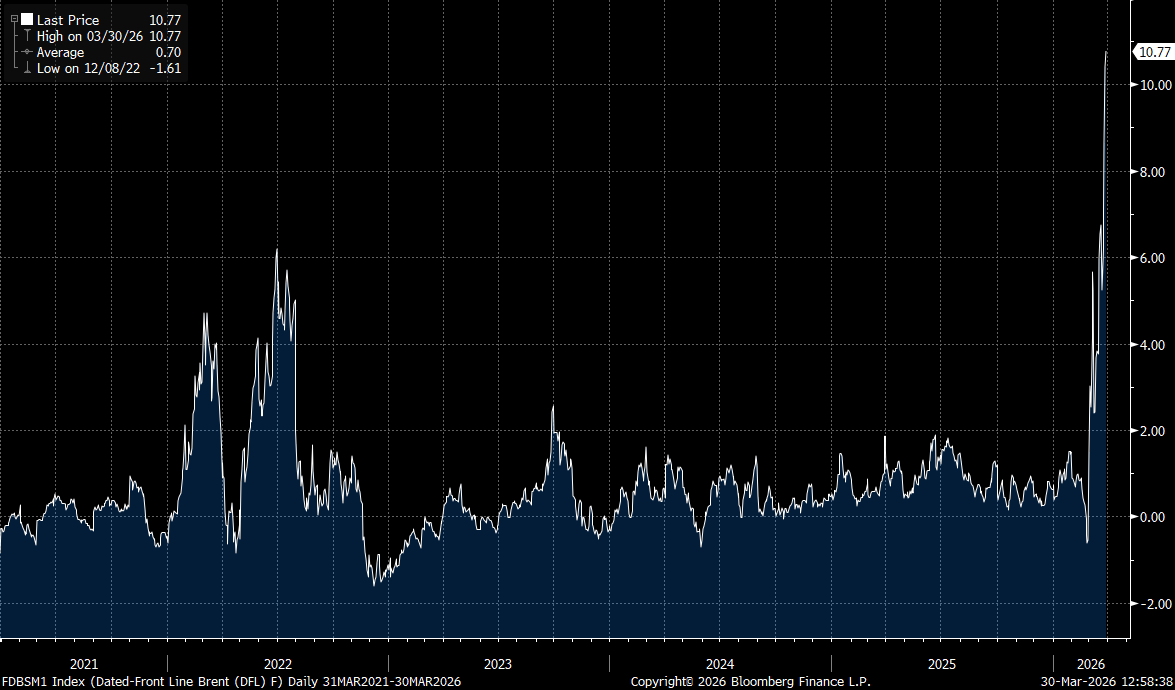
The Brent Dated-to-Frontline (DFL) swap—is a critical instrument used to bridge the gap between the physical and futures markets. In simple terms, it reflects the price difference between Dated Brent (physical North Sea cargoes) and Frontline Brent (the first-month ICE Brent futures contract).
In recent sessions, the DFL has surged into record backwardation, approaching USD 11/bbl and surpassing the previous peak seen in 2022. This sharp widening underscores an intensifying scramble for prompt physical cargoes, clearly highlighting the growing stress and dislocation in the market as buyers compete to secure immediate supply.
Chart source: Bloomberg
English
Ryan retweetledi

Negative prices essentially is a signal that says the market at this time is irrelevant because generation that has contracts is such a massive amount in the system. It says nothing about who the holder of those contracts are and if they are actually saving money on average. They could be the public agreeing to pay a wind farm £150 a MWh for example on a legacy FiT.
Craig David@windymillerhi
Don’t see these prices when running on fossil fuel! Role on net zero!
English
Ryan retweetledi
Thailand, Brazil and India as very exposed to the loss of Gulf nitrogen fertilizers.
Here is an assessment of the potential yield losses. This is using simple yield response models based on FAOSTATs data.


English
Ryan retweetledi

JEPXスポット市場2026年3月28日(土)受渡分取引価格☞システムプライス平均値📊10.57円/kWh、最高値📈18.56円/kWh、最低値📉0.01円/kWh、東京BL🏙12.12円/kWh、関西BL⛩9.31円/kWh、取引量⚡778GWh<天気予報>札幌🌧10℃/4℃、東京🌧20℃/11℃、大阪☀22℃/9℃、福岡☀20℃/10℃

日本語
Ryan retweetledi
Escalated with China and found out that rare-earths are leverage.
Escalated with Iran and found out that Hormuz is leverage.
About to escalate with Europe and find out that net direct foreign investment, military bases, IP of the tech sector, advanced tooling and pharma are leverage too.

Yet another commodity guy@tleilax___
A move that would make Vladimir proud for sure. Cutting / embargoing energy is an act of war, so you'd officially be part of the bad guys. 1/ Europe caps the carbon pricing and runs all the coal plants on domestically produced lignite plus coal imports. No rolling blackouts. Then we invest more in the North Sea and start fracking the untapped ~200 tcf of recoverable shale across European permian shale basin. 65 years of consumption. 2/ Europe cuts all investment flows and supply of critical parts such as EUV machines, plane/car parts, maybe meds. The swap lines are irrelevant because we sell US assets to fund USD needs. US yields go to the moon, stock market & USD to Hadès. 3/ Military posture change, no more overflight, no more bases. As said before, good luck with China.
English
@SalvMattera It did do its job, which is boost my PBMC NK cells from 50 to 420 in a single week after a 2mg dose.
English

I really don't know anything about it, but I'm always skeptical of magic beans that claim to treat everything
English
The discussion about this drug in the Long COVID space has always felt very strange to me.

English
Ryan retweetledi

To all those saying "This is good..."
When Americans want to visit Japan, learn the BOJ's moves/dynamics, study Japanese direct drive turntables, or bamboo baskets (there are literally more collectors of Japanese bamboo baskets in the US than in Japan), they might read my
Nikita Bier@nikitabier
Starting Thursday, we'll be updating our revenue sharing incentives to better reward the content we want on X: We will be giving more weight to impressions from your home region—to encourage content that resonates with people in your country, in neighboring countries and people who speak your language. While we appreciate everyone's opinion on American politics, we hope this will disincentivize gaming the attention of US or Japanese accounts and instead, drive diverse conversations on the platform. We invite creators to start building an audience locally. X will be a much richer community when there's relevant posts for people in all parts of the world.
English
@_apedev @Bert_with_ME @TheGregYang you are a smart guy (a genius) but you have fallen for the Lyme grift. Don’t repeat their mistakes.
English

@Bert_with_ME Lyme disease is a whole can of worms. Most of the quacks who practice in it just prey on vulnerable people and rely on the fact that with Lyme it's difficult and expensive to prove a negative.
English

In the early days of my illness, I went to a prominent LLMD who clinically diagnosed me with Lyme & Babesia simply based on symptoms and history without running a single test. He prescribed me extended courses of Doxycycline + Malarone.
My sense was that 9/10 patients who walk through his door get the same or similar diagnosis and treatment. The fact that he did not feel the need to screen for autoimmune disease, thyroid stuff, reactivated viruses, etc. prior to making that diagnosis was a glaring red flag.
Months later, I ended up shelling out $2K for the full tick-borne panel from IGenex, and it was stone cold negative across the board.
I have a lot of empathy for Lyme patients, but the scene is more sketchy/grifty than even ME/LC from my brief experience.
Jack | amatica health@JackHadfield14
This is the issue with bad actor clinics, use a low accuracy test with a high false positivity rate (almost everyone tests positive) for the exact infection (Lyme, etc) that they treat if you give them loads of money. Great profit model, awful ethics, & very harmful to patients.
English
Ryan retweetledi
Brazil and India are the world two largest producers of sugar.
Sugarcane is an extremely voracious crop in term of nitrogen per hectare.
Russia just banned nitrogen fertilizer exports and Brazil + India were the biggest buyers of Russian fertilizers.
youtu.be/h50eAv9tjvA?si…

YouTube
Yet another commodity guy@tleilax___
The most underpriced commodity right now might be sugar, and that is because Brazilian ethanol is the solver of the global gasoline market shortage. Here's the Brazil gasoline arbitrage nobody is talking about. 1/ Brazil is a net importer of 150'000 barrels per day of gasoline and blending components (light ends). A massive, structural deficit for the world's largest ethanol producer. That gasoline import is about 9 million tonnes per year of sugar-equivalent ethanol sitting one government price decision away from being diverted. Brazil is also a net importer of 300 kbd of diesel for farm and trucking, and boatloats of nitrogen fertilizers, but that is story for another day. 2/ Why? Because Brazilian domestic gasoline prices are currently at ~60% of international levels. Petrobras imports at world prices, sells cheap. The government eats the subsidy. 3/ This matters enormously for the sugar/ethanol split. Brazil's flex-fuel fleet prices ethanol at pump parity — i.e. ~70-75% of gasoline. If gasoline is at 60% of world prices, domestic ethanol is worth ~42-45% of international gasoline equivalent. 4/ Now stress-test with Hormuz. A sustained closure creates a persisting global gasoline price spike. Petrobras faces an existential fiscal hole importing at high prices and selling at 60% of it. This is called the defasagem or subsidy gap. The government eventually capitulates — they always do, they just lag. Meanwhile, the BRL devalues because it hurts the fiscal situation, balooning the import bill. Eventually Petrobras aligns gasoline prices to international levels, ethanol then rallies. Until then, Brazilian ethanol and subsidized gasoline gets exported in increasing quantities, through official channels but also the porous Paraguay border. 5/ When domestic gasoline normalises toward world prices, the math inverts overnight. Pump parity makes domestic ethanol suddenly valuable. Mills flip the cane mix lever toward ethanol. Sugar export volumes collapses at the precise moment demand from the middle east is catching up post Ramadan 6/ Turning raw sugar into white sugar requires refineries (Etihad in Iraq is getting sugar through Hormoz, but waiting to see what Al Khaleej and that Saudi "doctor" gets), polypropylene bags (scarce and more expensive) and natural gas (scarce and more expensive) and diesel trucking (scarce and more expensive). You also know what I think about the white sugar premium over raws. 7/ The kickers: we are entering Brazil's pre-harvest window and it has been raining so harvesting pace is slow and crushing favors ethanol. Funds are net short sugar and the momentum has already reverted with upside asymetry. A demand shock into an inelastic supply = price spike. I think this year it will rain Reals on the Brazilian cane industry, and by the look of it, some players can immensely benefit. Party time. youtube.com/watch?v=CCF1_j… Disclaimer : I am rather obviously long sugar and brazilian sugar equities.
English
@cloneofsimo From a Lin Alg POV, I guess LLMs wander around in the spanning set of knowledge. They can’t add more dimensions to the set.
English

Its very possible that LLM trained on newtonian physics may never come up with relativity to explain cosmic scale gravity. In that case Einstein would have to intervene and solve it instead.
But would he have had come up with it, assuming he offloaded all the physics problem solving to LLMs?
I think this is serious problem. Undoubtedly many GOATs are only GOATs because they built all the intuition from problem solving themselves. Grothendieck famously reinvented measure theory from scratch when he was teenager. If people offload their RL envs they couldve used, to LLMs, we will never get the next Einstein
English
@EmanuelDerman There are some masters of this on Twitter/X, especially in commodities/finance. I'm just here to learn from them :D
English

The most interesting thing in the world is trying to see if you can understand what drives other people, putting yourself in their place and mind
English