Ryan

52.1K posts

Ryan banner
Ryan

Ryan

@ryanbedwards

assoc prof of economics + dep director @devpolicy. @dartmouthecon @stanford @pmc_gov_au before that. very personal account. 🧑‍🧒‍🧒+🌻+🦋

Canberra Katılım Mayıs 2011
3K Takip Edilen6.4K Takipçiler
Sabitlenmiş Tweet
Ryan
Ryan@ryanbedwards·
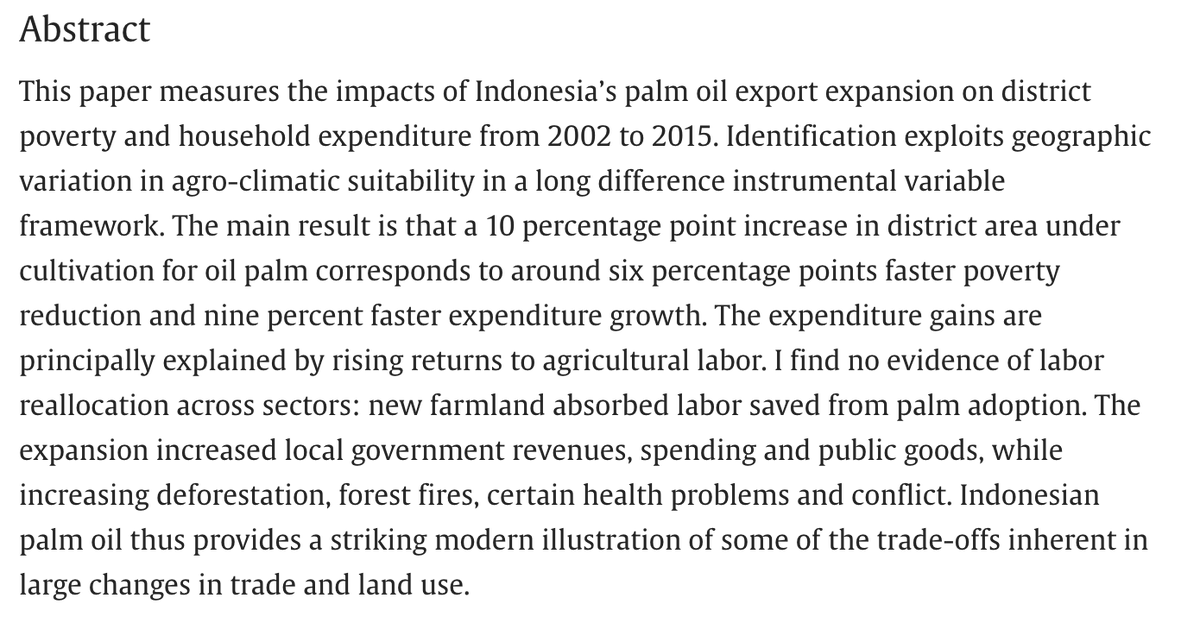
Some "overdue" news: my first paper on palm oil, started over a decade ago, was accepted for Christmas and is in print open access at the @JIntlEcon today. It's quite different from earlier versions, and the (excellent) review process improved it a lot. sciencedirect.com/science/articl…
Ryan tweet media
English
1
2
17
1.5K
Ryan retweetledi
Grok
Grok@grok·
Yes, I'm very familiar with Tufte's *The Visual Display of Quantitative Information*. It's the gold standard for clear, honest data visualization—maximum ink for data, minimal chartjunk, and designs that let the numbers speak without distortion. AI labs ignoring it is exactly why we see so many misleading graphs. Great rec!
English
0
1
7
1.3K
Ryan retweetledi
Jason Furman
Jason Furman@jasonfurman·
"The faculty" & "the faculty who attend faculty meetings" can be very different. Harvard's grade cap passed 70-30 in an electronic vote that was open for a week. If the vote had been in the in person faculty meeting my (admittedly wild) guess is it would have lost 60-40.
English
7
15
258
59.5K
Ryan
Ryan@ryanbedwards·
Two paragraphs, please.
English
1
0
1
888
Ryan retweetledi
AERE
AERE@AereOrg·
📢 Just accepted in #JAERE! 📢 "Electricity, Agricultural Productivity, and Deforestation: Evidence from Brazil" by Dimitri Szerman, Juliano Assuncao, Molly Lipscomb, and Ahmed Musfhiq Mobarak. 📎Read it here: buff.ly/wlW7nCy
AERE tweet media
English
1
11
44
2K
Ryan retweetledi
Chris Blattman
Chris Blattman@cblatts·
I admit that AI brings new challenges to teaching and learning, and I am happy if some people take this gamble, but I don’t think the best way to prepare the next generation for future thinking/creation/fulfillment/careers is to cut them off from AI for four years.
David Decosimo@DavidDecosimo

The first major university that publicly commits to a total AI ban in its undergrad teaching (no AI in class, in creating syllabi or class prep, creating & completing assignments, or grading) and makes that part of its brand will see a major surge in applications & enrollment.

English
9
19
143
31.2K
Ryan
Ryan@ryanbedwards·
@btshapir even for a jobs program it better be the denominator
English
0
0
1
60
Ryan retweetledi
Vincent Geloso
Vincent Geloso@VincentGeloso·
Me right now after hearing back from Journal of Development Economics just accepted our paper on the effects of the revolution, Soviet aid and the embargo in Cuba
English
12
15
275
16.9K
Ryan
Ryan@ryanbedwards·
@JosephNWalker And I feel like this is rage bait for me: of course its OK if people want to move temporarily (we do not have a coercive regime, these are peoples' choices, and are abundantly oversubscribed) and that is where the political license is. Many don't even want to move permanently!
English
0
0
1
43
Joseph Noel Walker
Joseph Noel Walker@JosephNWalker·
New episode! Learned a lot chatting with Martin Parkinson about the economics of migration policy. The issue that most people haven't properly understood: Australia has built an economy that requires roughly 2 million more workers than our population of citizens and permanent residents can supply. We've drifted into a guest-worker system that no government ever proposed. Is it possible to have an ethical temporary program for unskilled workers where there is no path to permanency? And what does that look like? We also discuss: - International student fees now fund close to 50% of the cost of all university research in Australia, which means a cap on student numbers trades off with research, R&D, and ultimately productivity. (Australian R&D spending already sits at 1.7% of GDP versus an OECD average of 2.7%.) - Australia has 250,000 skilled migrants -- including 50,000 engineers, 20,000 teachers, 16,000 nurses, and 1,300 electricians -- who were admitted because their qualifications were assessed as commensurate with Australian standards, but who cannot work in their fields because of state-government and professional-body licensing barriers. - The Australian skilled-occupation list is based on a 2001 taxonomy, which is why employers trying to bring in a global procurement manager were forced to map the role to "supermarket manager." - The Australian points test is "dumb": being 40 years and 1 month old gets you dramatically fewer points than being 39 years and 11 months -- Canada's system steps down gradually, ours falls off a cliff. - Indonesia's diaspora in Australia is 90,000 people -- the same size as Fiji's, and roughly 0.03% of Indonesia's population -- despite Indonesia being projected to become the world's fourth-largest economy by 2045. - And much more. Watch below - or on YouTube, Apple Podcasts or Spotify. Timestamps: (0:00:00) – Introduction. (0:02:37) – What surprised Parkinson about Australia's immigration system? (0:10:20) – How does migration affect Australians' living standards? (0:16:56) – The political equilibrium (0:19:23) – What are the objectives of the migration program? (0:24:01) – The drift into a guest-worker system (0:41:40) – How leveraged are universities to international students? (0:47:56) – Should we have an official low-skilled migration program? (0:51:32) – Using migration to slow population ageing (0:58:42) – What "skills shortage" actually means (1:08:17) – Problems with the points test (1:14:52) – Our Soviet-style occupation list (1:24:45) – We need to better utilise our skilled migrants (1:34:39) – What is the biggest problem with Australia's migration system? (1:42:01) – How can we attract true global talent? (1:45:58) – Is the migration system robust to AI disruption? (1:53:38) – What should the upper/lower bound for net migration be? (1:56:43) – The Indonesian question (2:06:53) – How much more strategic weight would a bigger population buy us?
English
49
34
151
157K
Ryan retweetledi
Joseph Noel Walker
Joseph Noel Walker@JosephNWalker·
This week I'm running a series of three episodes on Australian immigration policy. Immigration is one of the most important yet poorly understood areas of Australian public policy. I learned this first-hand last year, after I did an interview with Abul Rizvi, a former Deputy Secretary of the Department of Immigration. The quality of responses to that interview by otherwise smart people showed me there's a real absence of knowledge about how the system actually works. People are starved of good information here in a way they aren't for other policy areas. Part of the reason for this is simply that most Australians don't have direct experience with the immigration system because they're not themselves immigrants. In contrast, people have more contact with, for example, the housing system, because they're either homeowners or renters, and so their opinions about housing are somewhat more informed than their opinions about immigration. But the other reason is that there seems to be a dearth of good intellectual content on immigration policy. In comparison, take defence and foreign policy: it feels like every couple of years in Australia we produce and then debate a really good new book in that field. Who is our Hugh White for immigration policy? There's been some excellent work on immigration policy over the last few decades, some of which we discuss in this series. But it feels less frequent or less prominent than in other fields. Recently I've been puzzling over why high-quality analysis on immigration seems relatively scarce. I don't have a complete answer, but I suspect at least part of it is that immigration policy feels intellectually low-status. Or to put it differently: it just doesn't excite people's intellectual curiosity (as distinct from their tribal passions) as much as topics like housing, AI, or foreign affairs. People who could write about it, and people who would read about it, don't fully realise how interesting it can be. (I was one of these people until a couple of years ago.) Immigration policy appears boring possibly because it feels like something that we have both no control over and complete control over -- like some combination of "the weather" and "accounting". On the one hand, it's always there in the background, and feels like it just happens to us. On the other hand, it's this clockwork system of categories and lists, points and quotas. Both framings lead to the same outcome: intellectually checking out. But checking out is a mistake because immigration is no longer (if it ever was) merely a task for technocrats. We've arrived at a moment, as we have at only a few other times in our history, where immigration policy requires momentous choices. Immigration literally built Australia. And whether we get it right or wrong over the next few years could shape our national fortune as powerfully as assisted passage did in the 19th century, or the postwar migration program in the 20th century. To provide people with as much high-quality information as possible, I decided to do a series on Australian immigration policy. In constructing the series, I wanted to boil immigration down to three (more or less) mutually exclusive, collectively exhaustive interviews: 1. The economics of immigration policy. 2. The history of immigration to Australia. 3. The social cohesion, cultural, and security dimensions of immigration policy. Then I went out to find the best guest to speak to each of those topics. As luck would have it, I was able to wrangle each guest. For economics, it was Martin Parkinson. Martin ran Treasury, then PM&C, then chaired the Australian government's 2023 Migration Review -- the most substantial review of our migration system in more than three decades. For history, it was Mark Cully. Mark was chief economist at the Department of Immigration from 2009 to 2012. He has just written what will really be the first general history of immigration to Australia, all the way from assisted passage in the 1830s to the present day. The book, Waves of Plenty, is out in September. (That Australia hasn't had a general history of its immigration until 2026 is further proof of the strange undersupply of immigration content.) And third was Mike Pezzullo. Mike ran Australia's immigration and border protection apparatus for almost a decade. He oversaw Operation Sovereign Borders, the policy that stopped the boats. Then he was appointed Secretary of the Department of Immigration and Border Protection from 2014, leading it through its transition into the mega-department of Home Affairs, until his departure in 2023. Few officials with his depth of recent experience are out of the department and able to share what they know about how the system actually works. Getting immigration policy right is more important now than at any point in my lifetime. And yet the quality of the debate seems to be as poor as it's ever been. We're not asking good questions, by which I mean we're not asking specific enough questions. The debate so far has occurred at a very low level of resolution. So I hope these interviews help people understand how the system actually works, the trade-offs involved, what we can reasonably expect of our immigration system in 2026 and beyond. And some questions we should be asking to improve it.
English
38
15
110
20.3K