Sebastian Otten

433 posts

Sebastian Otten banner
Sebastian Otten

Sebastian Otten

@s_otten21

Labor Economist @UDE_Econ | Researcher @CReAM_Research | Affiliate @RWI_Leibniz_en | formerly @EconUCL. Research interests: Labor & Migration Economics.

Essen, Germany Katılım Eylül 2016
652 Takip Edilen409 Takipçiler
Sebastian Otten
Sebastian Otten@s_otten21·
📢 Call for Papers now open! 4th Workshop on Causal Inference with Spatial Data 🗓️ September 10–11, 2026 📍 University of Duisburg-Essen ⏰ Submission deadline: April 30, 2026 Keynotes: Wolfgang Dauth (IAB & University of Bamberg) Sebastian Siegloch (University of Cologne) 1/2
Sebastian Otten tweet media
English
1
1
2
53
Sebastian Otten retweetledi
Michael Lamla
Michael Lamla@M_L_a_m_l_a·
Great to see our paper "Environmental and social incidents and misvaluation-driven leveraged buyouts" jointly with Alexandros Kontonikas, Neil Kellard, Stefano Maiani and Geoffrey Wood, being accepted for publication in the Journal of Corporate Finance. doi.org/10.1016/j.jcor…
Michael Lamla tweet media
English
0
2
5
207
Sebastian Otten retweetledi
Luigi Minale
Luigi Minale@ggminale·
Conference alert! If you’re a junior scholar working on migration, don’t forget to submit your paper to the 4th Junior Workshop on the Economics of Migration, taking place in May at UC3M. Keynote speakers: Paola Giuliano, Joan Lull, and Jan Stuhler. economig2026.sciencesconf.org
Luigi Minale tweet media
English
1
18
53
4.1K
Sebastian Otten retweetledi
Attila Lindner
Attila Lindner@attilalindner·
If you want to see the best labour economists in Europe, apply and come to CEP-IFS Labour Conference. We will have a fantastic line up, including our invited speakers: Katrine Løken, @annastansbury, Andrea Weber.
Centre for Economic Performance@CEP_LSE

📢 Call for papers: 1st Annual CEP–IFS Labour Conference London | 15–16 June 2026 We invite papers on wages & inequality, firm wage-setting, monopsony, unions, worker mobility & place-based policies. Submit by 13 Feb 2026. 🔗 Details & submissions: ow.ly/5utl50XY3fL

English
0
11
17
7.3K
Sebastian Otten retweetledi
ROCKWOOL Foundation Berlin
ROCKWOOL Foundation Berlin@RF_Berlin·
(1/5)🧠RFBerlin Research Insights: New research by Dustmann, Otten, Schoenberg and Stuhler — “Immigration, Jobs and Wages: Separating Regional and Worker Effects” — shows that immigration affects places and people very differently. rfberlin.com/research-insig…
English
1
2
6
376
Sebastian Otten retweetledi
Philippe Lemoine
Philippe Lemoine@phl43·
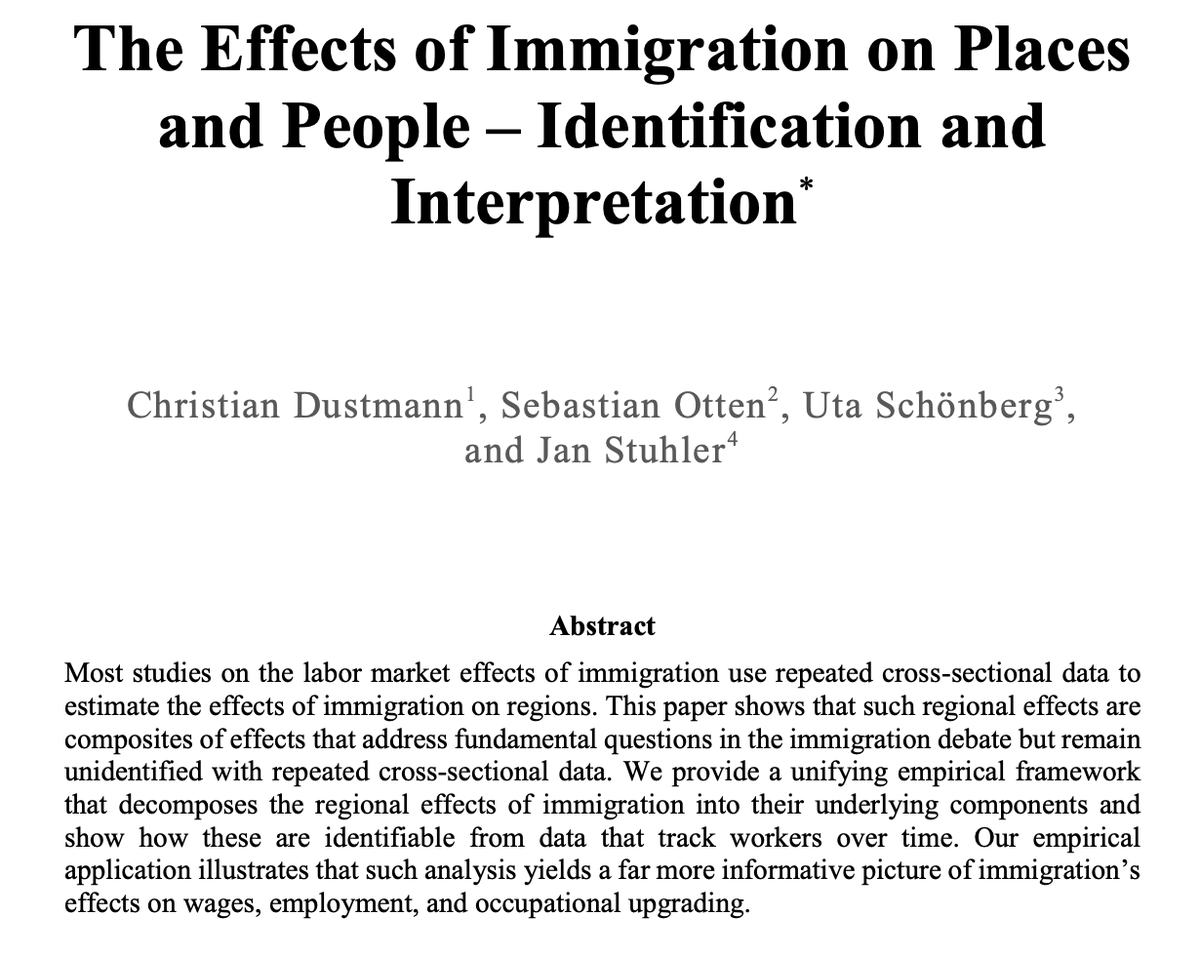
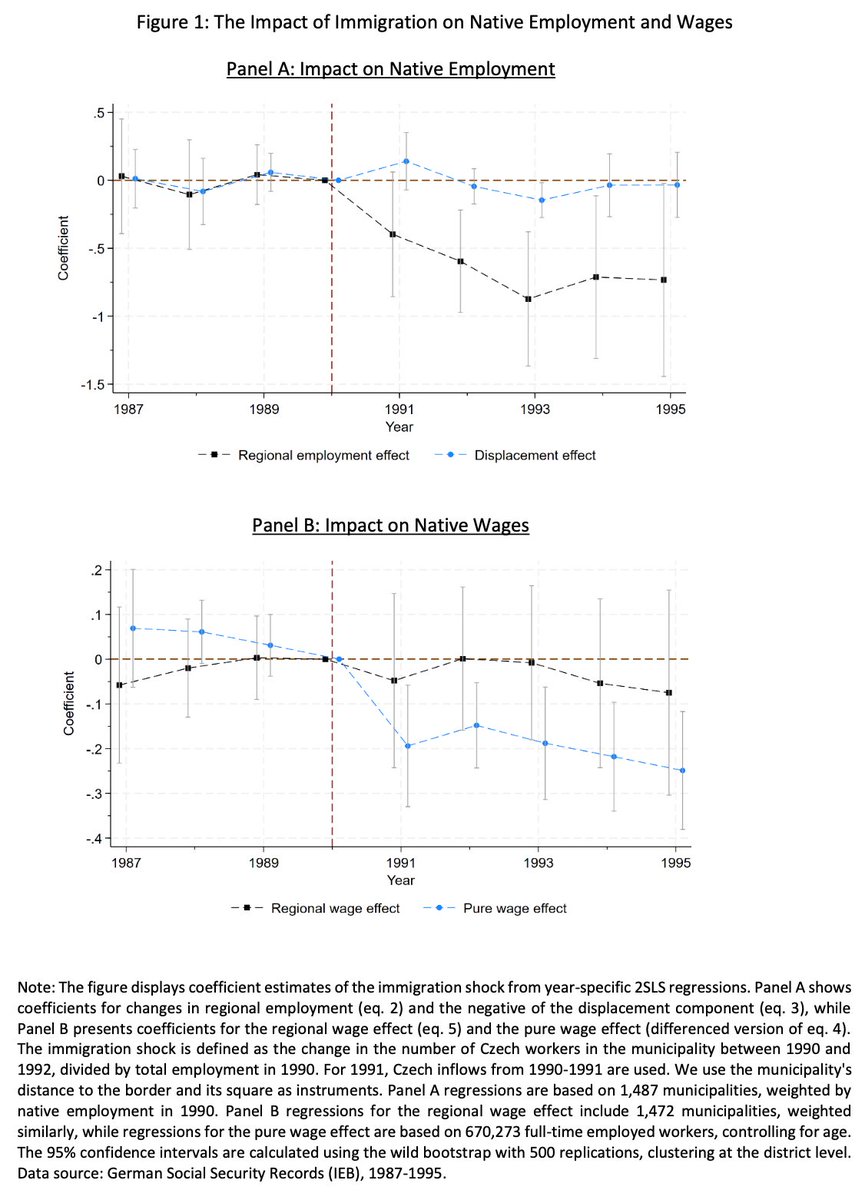
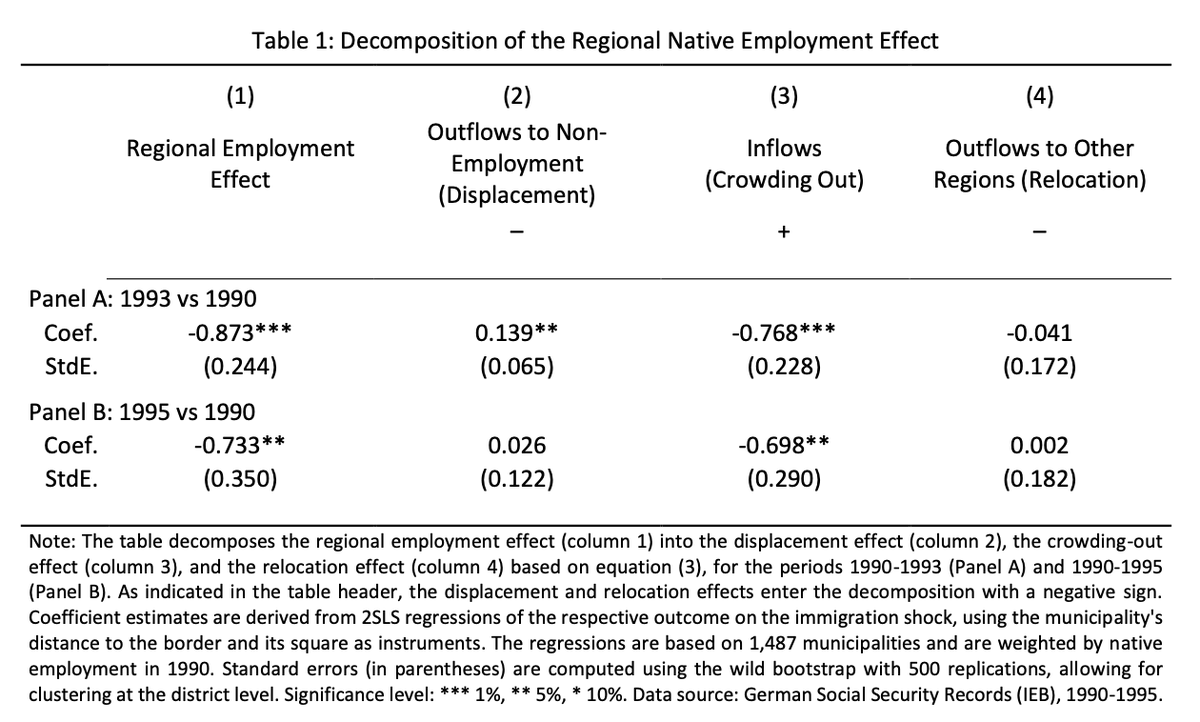
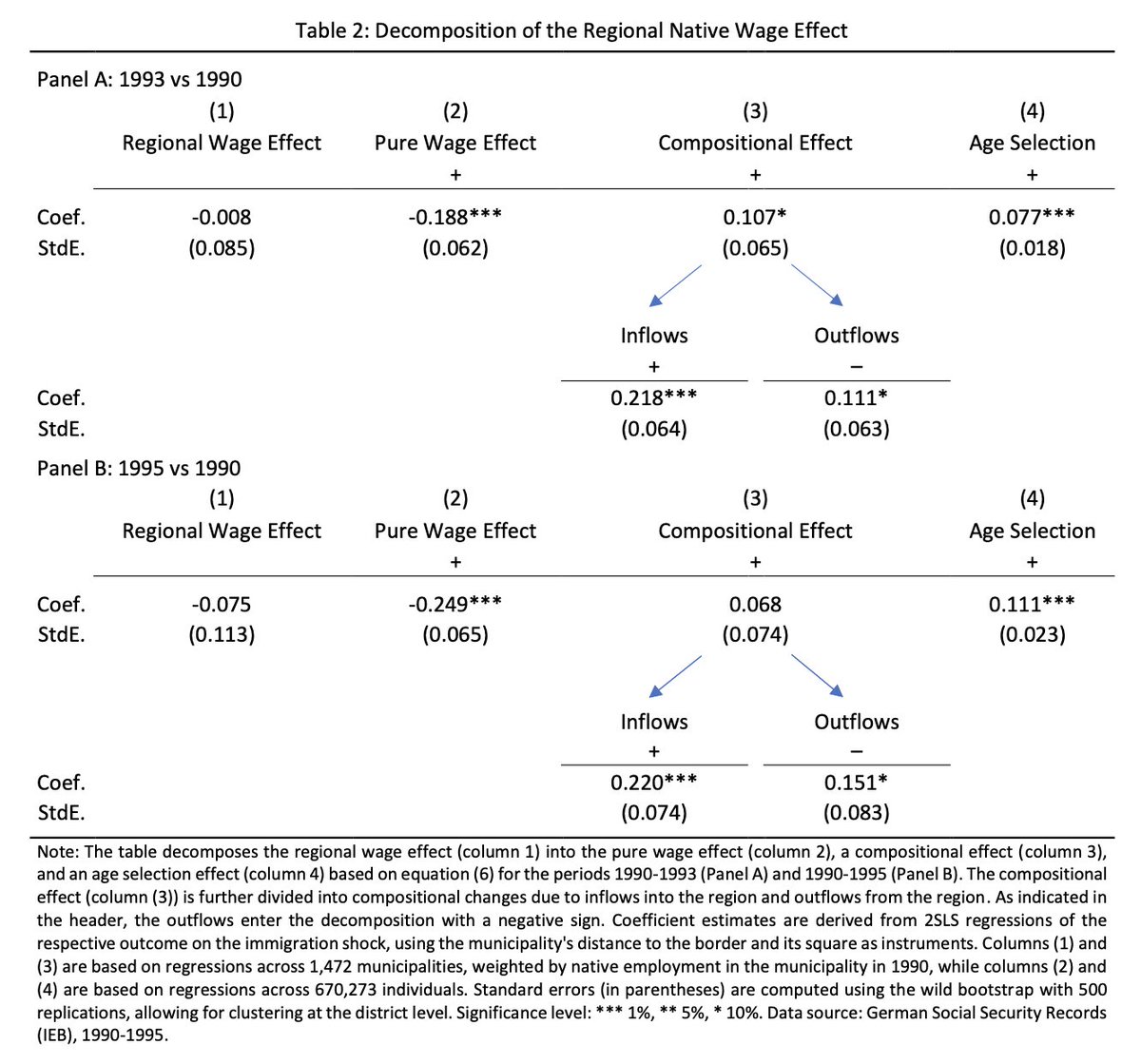
This is a very important paper that, as far as I can tell, has received surprisingly little attention so far on Twitter, so I thought I'd do a quick summary to encourage people to read it. The authors make the point that, when studies estimate the impact of immigration on wages by using repeated cross-sectional data, even when the design allows them to estimate a causal effect, that effect is what they call a "regional wage effect" and it's really a composite of several effects that is arguably not what is relevant for the debate about the impact of immigration on the labor market. In the theoretical part of the paper, they show that the regional wage effect combines what they call the "pure wage effect" that immigration has on wages in "treated" areas through the increase of the supply of labor, as well as the compositional effect it has through the changes in the composition of the workforce in those areas. The key insight is that, when immigrants move to a place, it increases the supply of labor in that place other things being equal, but other things don't stay equal because this inflow of labor will induce both an aggregate response of natives on their own supply of labor and a differential response because the native supply response will be different for different kinds of native workers. The pure wage effect depends not only on the inverse labor demand elasticity (i. e. how much wages fall when the supply of labor increases), but also on the aggregate supply response of native workers, because the negative pressure on wages caused by the inflow of immigrants will be dampened by the supply response of natives who will reduce their supply of labor, whether by leaving the workforce altogether (what the authors call the "displacement effect"), not moving to the "treated" areas from elsewhere anymore (what the authors call the "crowding-out effect") or moving to other areas for work (what the authors call the "relocation effect"). In addition to that pure wage effect, the regional wage effect will also depend on the compositional effect of immigration, because if that supply response is larger for low-wage native workers than for high-wage native workers the effect of immigration on the wages of natives will be mechanically dampened by the change in the composition of the native workforce in the "treated" areas. Similarly, using repeated cross-sectional data to estimate the effect of immigration on native employment can also be misleading, because this method will really estimate a "regional employment effect" that combines the displacement effect, the crowding out effect and the relocation effect. In the debate about immigration, people tend to focus on the displacement effect, but a large regional employment effect is compatible with a small or even zero displacement effet if immigration has a large crowding-out or relocation effect. In fact, to the extent that the regional wage effect tends to overestimate the pure wage effect because of the native supply response, the regional employment effect will tend to overestimate the displacement effect if the difference between the regional wage effect and the pure wage effect is driven by the fact that native workers tend to respond to the immigration shock by not moving to areas that were affected by it or, for those who were employed in the areas in question, by moving to other areas for work. The authors show how, by using longitudinal data on native workers who were already employed in the "treated" areas before the immigration shock and stayed in those areas after the shock, one can identify the pure wage effect and not just the regional wage effect as when one uses repeated cross-sectional data. Exploiting a natural experiment that took place in Germany after the fall of the Berlin Wall, when the German government allowed Czech workers to commute for work in border municipalities but without granting them the right of residence (which means that the resulting inflow of Czech workers can reasonably be seen as a pure supply shock that didn't also increase local demand), they find that the pure wage effect of immigration is much larger than the regional wage effect because natives responded by reducing their supply of labor, mostly through the crowding-out effect mentioned above. But precisely because immigration has a large crowding-out effect, they also find that the regional employment effect, though pretty large, is mostly driven by the crowding-out effect and that the displacement effect is pretty small. (They find a relocation effect that, though imprecisely estimated, is close to zero.) In other words, while immigration does reduce native employment in the affected municipalities, it does so mostly by reducing the number of natives who move to those municipalities for work. So what does this mean for the debate on whether immigration harms native workers? Well, it means that we don't know, because although the pure wage effect is large and the displacement effect is small, whether natives were harmed and how much depends on what happened to the natives that would have moved in the border areas for work but instead stayed elsewhere. (Strictly speaking, it also depends on what happened to the natives who would have stayed but instead left to work elsewhere, but the paper's results suggest that relocation effect is close to zero.) This is really a great paper, precisely because it shows that, despite what most economists think, the existing literature can't really address the question people really care about when they ask how immigration affect native workers. I personally think that both pro-immigration and anti-immigration advocates tend to overestimate the economic impact of immigration and that the other effects of immigration are more important in driving people's attitudes about it, but when people like Esther Duflo claim that the literature unambiguously shows that immigration doesn't harm native workers, they are going beyond what the evidence shows for ideological reasons. Anyway, another reason I think this paper is important is that, as the authors point out, their main argument doesn't just apply to the debate about the effect of immigration on the labor market but also to the impact of other shocks (such as trade or automation), because most of the papers on those issues also identify regional effects that are really composite of several different effects.
Philippe Lemoine tweet mediaPhilippe Lemoine tweet mediaPhilippe Lemoine tweet mediaPhilippe Lemoine tweet media
English
17
96
575
111K
Sebastian Otten retweetledi
Süddeutsche Zeitung
Mit den 1990er-Jahren kamen erstmals Tausende aus Tschechien zum Arbeiten nach Bayern. Hat das die Einheimischen arbeitslos gemacht? Nein, sagt eine neue Studie – für einige wurden die Zeiten trotzdem schwieriger. sz.de/li.3353049?utm…
Deutsch
2
3
5
2.3K
Sebastian Otten retweetledi
ROCKWOOL Foundation Berlin
ROCKWOOL Foundation Berlin@RF_Berlin·
🆕 RFBerlin Discussion Paper: Christian Dustmann, @s_otten21, Uta Schönberg and @JanStuhler provide an empirical framework to decompose the regional effects of immigration on labor markets. A thread 🧵 below 👇
ROCKWOOL Foundation Berlin tweet media
English
1
5
11
1.2K
Sebastian Otten retweetledi
Cevat Giray Aksoy
Cevat Giray Aksoy@cevatgirayaksoy·
📢Call for papers! We are organising 7th Workshop on the Economics and Politics of Migration on 28-29 May 2026, in Rome! Keynotes: Paolo Pinotti (Bocconi University) and Vicky Fouka (Stanford University). Submit your papers before January 23, 2026: tinyurl.com/2fvf5j9p
Cevat Giray Aksoy tweet media
English
1
77
260
26.2K
Sebastian Otten retweetledi
Ariel Rubinstein
Ariel Rubinstein@ArielRubinstein·
A NEW ACADEMIC YEAR. All those books are free downloadable from my homepage (see first comment). Teachers of the Micro and GT courses: solution manuals are available upon request (fill the form on my homepage).
Ariel Rubinstein tweet media
English
3
56
241
18.1K
Sebastian Otten retweetledi
Ariel Rubinstein
Ariel Rubinstein@ArielRubinstein·
Do you prepare yourself to a Phd\Master Microeconomics course? The 2025 version of my book "Lecture Notes in Microeconomic Theory: The Economic Agent" is available for FREE downloading. See first comment to the URL.
Ariel Rubinstein tweet media
English
6
105
584
41K
Sebastian Otten retweetledi
Philipp Lergetporer
Philipp Lergetporer@lergetporer·
We're hiring! I'm looking for a PhD student in Economics (75%, E13) to join my team at TUM Campus Heilbronn starting Oct 2025. Work on field & survey experiments in applied micro, behavioral econ & econ of education. Deadline: June 30. Please share! Call: tinyurl.com/msdsrhv6
Philipp Lergetporer tweet media
English
1
20
41
5.2K