Lauri Salmela

9 posts

Lauri Salmela

Lauri Salmela

@salmelala

Camera algorithm engineer at Huawei Technologies. Photonics & machine learning

Katılım Haziran 2020
31 Takip Edilen48 Takipçiler
Lauri Salmela
Lauri Salmela@salmelala·
@johnmdudley I have done some comparison between Python and Matlab only, and got worse results with Python at least in my case. But GNLSE solver in Fortran could be neat indeed
English
0
0
1
0
Lauri Salmela
Lauri Salmela@salmelala·
@the_atman @GGoery @johnmdudley Hi Alexander. I have not really considered the interpretability of RNNs, and personally I don't see the opacity of RNNs as a problem at least with our research. Related to the preprint, I like the idea of hybrid models. Maybe this is something we could look into in the future
English
0
0
3
0
Goëry Genty
Goëry Genty@GGoery·
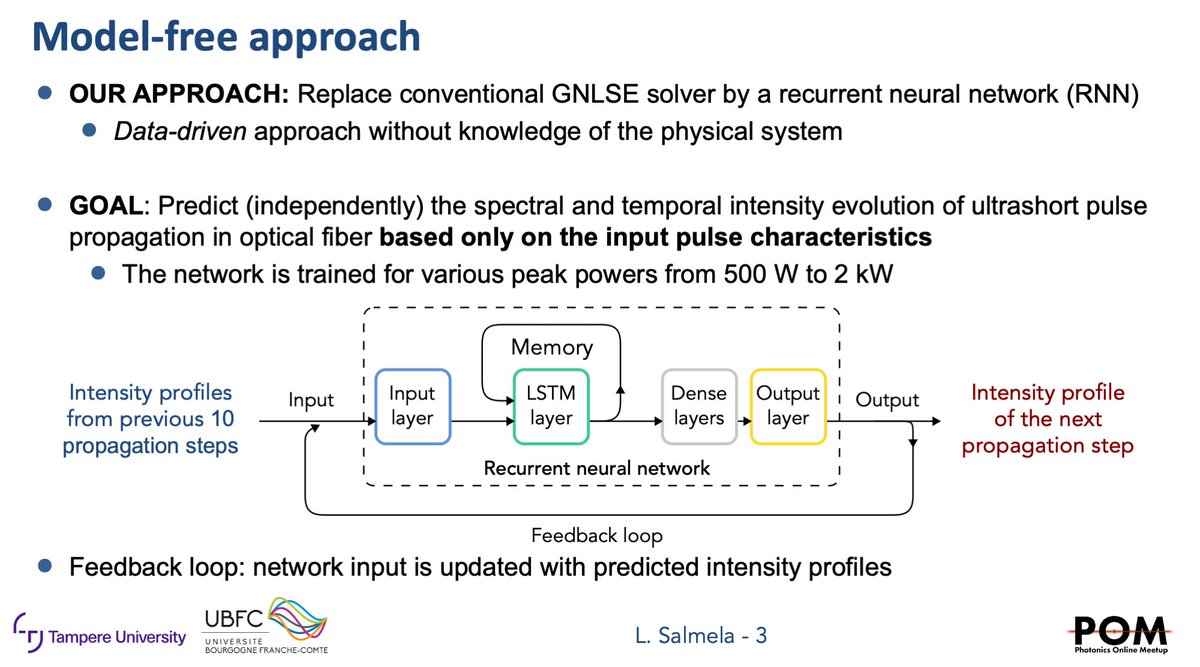
Check our latest research with @johnmdudley presented at POM on using a recurrent neural network to predict ultrafast nonlinear dynamics, from order soliton compression to octave-spanning supercontinuum generation. And using only the input pulse intensity as initial parameter.
Lauri Salmela@salmelala

We show how a recurrent neural network can predict the propagation dynamics of ultrashort pulses in an optical fiber for supercontinuum generation @PhotonicsMeetup #POM20ju #POM20AI

English
1
1
25
0
Lauri Salmela
Lauri Salmela@salmelala·
@omairg @PhotonicsMeetup Hi. The fiber length could be changed freely here. Only issue may come from spectral or temporal broadering higher than in the samples used in the training if the length is increased too much. We only tested sech-typed input pulses but this approach it's limited to them only
English
0
0
0
0
Lauri Salmela
Lauri Salmela@salmelala·
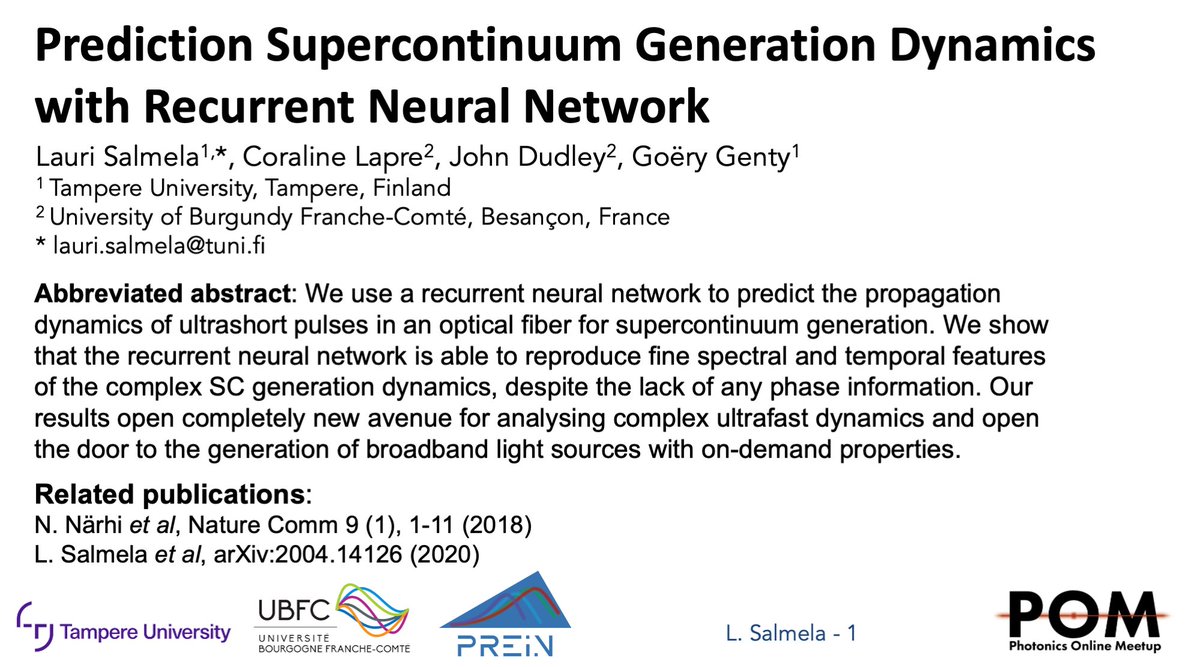
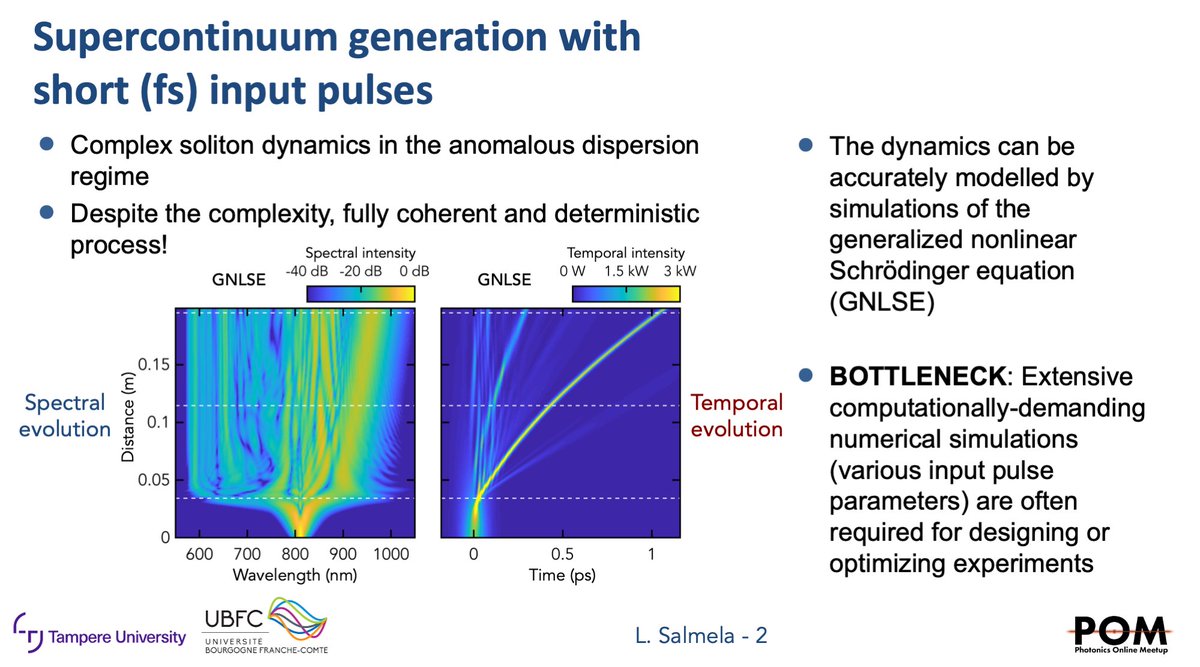
We show how a recurrent neural network can predict the propagation dynamics of ultrashort pulses in an optical fiber for supercontinuum generation @PhotonicsMeetup #POM20ju #POM20AI
Lauri Salmela tweet mediaLauri Salmela tweet mediaLauri Salmela tweet mediaLauri Salmela tweet media
English
5
7
55
0
Lauri Salmela
Lauri Salmela@salmelala·
@Ariel_Levenson @PhotonicsMeetup Hi Ariel. For a single realisation, the gain in time depends on the simulation parameters (number of grid points) but is in our case around factor of 3-5 times faster. However, if you have multiple input conditions, the speedup is in the range of 20-50 times faster.
English
1
0
1
0
Lauri Salmela
Lauri Salmela@salmelala·
@FlaviaTimpu @PhotonicsMeetup Hi Flavia, thanks for the question. We have here tested only one fiber (single-mode silica PCF), so the dispersion and the nonlinearity are always the same. In the training and testing samples, we have varied the input pulse peak power between 500W and 2kW with 100fs duration.
English
0
0
2
0
Dr. Flavia Timpu
Dr. Flavia Timpu@FlaviaTimpu·
@salmelala @PhotonicsMeetup Great results! Can you tell me more about the training and testing samples, in particular if you tested for different properties of the fiber that may affect the SC (material, geometry)?
English
1
0
2
0
Lauri Salmela
Lauri Salmela@salmelala·
@sylvaingigan @PhotonicsMeetup Hi Sylvain. So far we have only tested networks with LSTM cells. Reservoir computing or other backpropagation algorithms (e.g. GRU cells) could be used as well. The choice between these options depends on the user's expertise.
English
0
0
4
0
sylvain Gigan
sylvain Gigan@sylvaingigan·
@salmelala @PhotonicsMeetup very nice work ! did you try just with LSTM or did you compare with a simple reservoir computing paradigm? In short, is there a specific adavantage of the LSTM architecture ?
English
1
0
6
0