

Samer
235 posts

Le saviez-vous ?
Le Pacte Secret de John D. Rockefeller décrit, avec une froideur glaçante, un plan supposé de domination totale sur l’humanité. Voici les phrases les plus choquantes qui en ressortent :
1. « Nous raccourcirons leur durée de vie et affaiblirons leur esprit tout en faisant semblant de faire le contraire. »
2. « Nous utiliserons des métaux mous, des accélérateurs de vieillissement et des sédatifs dans la nourriture et l’eau, ainsi que dans l’air. Ils seront recouverts de poisons partout où ils se tourneront. »
3. « Les poisons seront absorbés par leur peau et leur bouche, ils détruiront leur esprit et leurs systèmes reproducteurs. De tout cela, leurs enfants naîtront morts, et nous cacherons cette information. »
4. « Nous leur apprendrons que les poisons sont pour leur bien, avec des images amusantes et des tons musicaux. »
5. « Quand leur capacité d’apprendre aura été affectée, nous créerons des médicaments qui les rendront encore plus malades et causeront d’autres maladies pour lesquelles nous créerons encore plus de médicaments. »
6. « Nous les rendrons dociles et faibles devant nous par notre pouvoir. Ils deviendront déprimés, lents et obèses, et quand ils viendront nous demander de l’aide, nous leur donnerons plus de poison. »
7. « Nous les ferons s’entretuer quand cela nous conviendra. Nous les maintiendrons séparés de l’unité par les dogmes et la religion. »
8. « Nous contrôlerons tous les aspects de leur vie et leur dirons quoi penser et comment. Nous les guiderons gentiment et doucement en leur laissant croire qu’ils se guident eux-mêmes. »
9. « La haine sera si grande que même les plus intelligents d’entre eux ne verront pas la vérité. »
10. « Quand ils se soulèveront contre nous, nous les écraserons comme des insectes, car ils sont moins que cela. »
11. « Oh oui, l’illusion de la liberté sera si grandiose qu’ils ne sauront jamais qu’ils sont nos esclaves. »
12. « Cette réalité sera leur prison. Ils vivront dans l’auto-tromperie. »
13. « Mais s’ils découvrent un jour qu’ils sont nos égaux, nous périrons alors. CELA, ILS NE DOIVENT JAMAIS LE SAVOIR. »
Quand on lit ces lignes, on ne peut s’empêcher de trouver qu’elles collent étrangement à beaucoup de choses que l’on observe aujourd’hui…
Texte complet en français :
fr.scribd.com/document/92204…
Autre version lisible en ligne :
calameo.com/books/00330677…
Source archive souvent citée :
web.archive.org/web/2002071200…
#PacteSecret #Rockefeller #Éveil #Contrôle

Français
@LifeScience_X @grok where can we get this ? possible in france ? where ?
English

Visco Gel Injection For Treatment of Knee Osteoarthritis
English

🇫🇷 😡Avec les casseroles qu’ils traînent Ce score surréaliste d’Édouard Philippe au Havre (68 % dès le premier tour avec des machines à voter) pue la fraude à plein nez. Des assesseurs, des électeurs et même des agents municipaux dénoncent des irrégularités flagrantes : machines déconnectées du réseau, bulletins non comptabilisés, participation gonflée, opacité totale. Il est temps de saisir ces machines et de lancer une enquête judiciaire indépendante. On ne laisse pas truquer une élection locale pour garder son fief. Saisissons tout, exigeons la vérité !
#FraudeHavre #SaisirLesMachines #ÉdourdPhilippeTriche

Français

Purpose is Their Foundation of Youth.

English
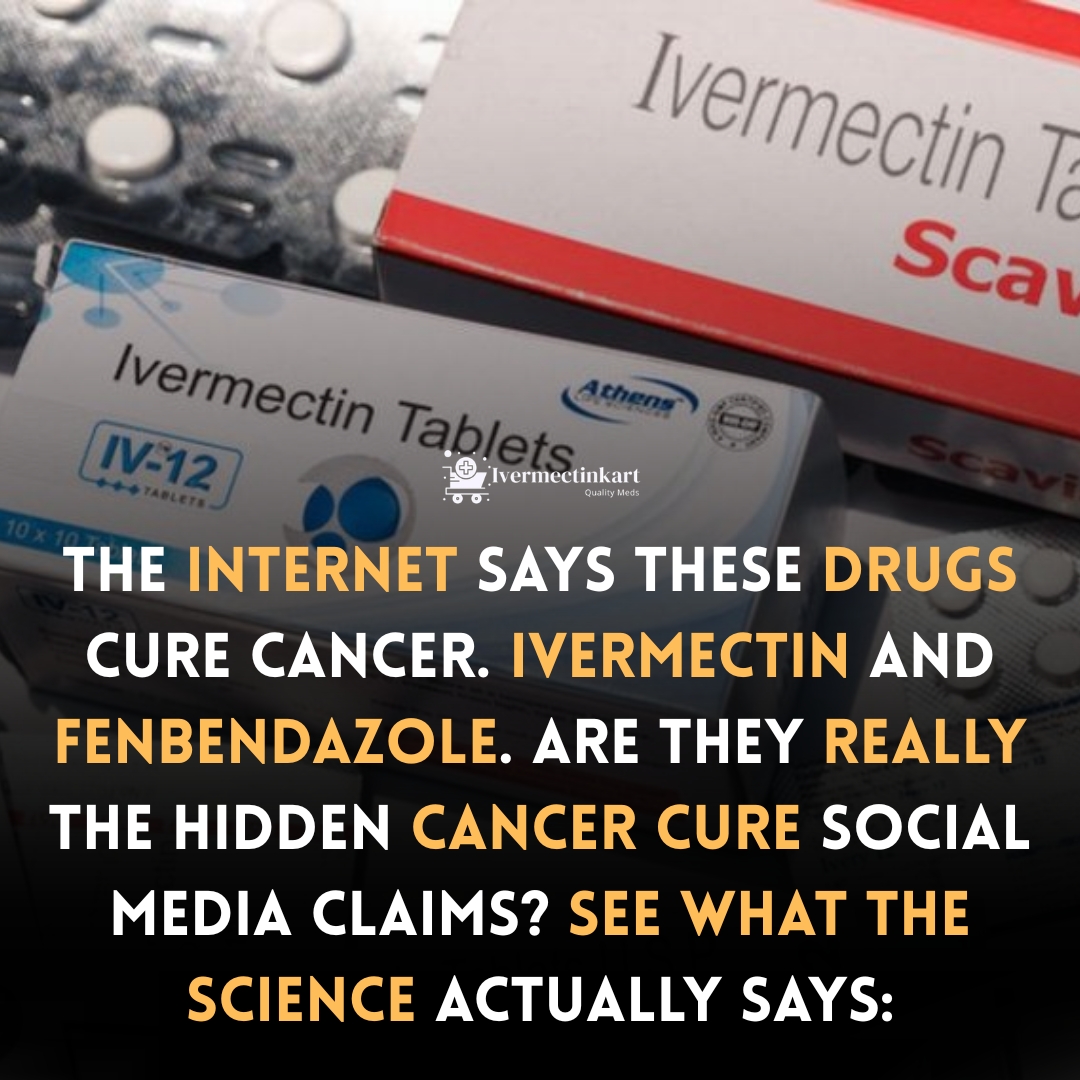
The internet says these drugs cure cancer.
⭐️ Ivermectin and Fenbendazole ⭐️
Are they really the hidden cancer cure social media claims?
See what the science actually says:🧵
English

17
إيران جهزت نفسها لحربٍ طويلة جداً، وأقلمت قرارها السياسي مع التجارب التاريخية في المنطقة، وفي أزمات أخرى. في العراق وأفغانستان، دخل الأميركيون ورحلوا. في أفغانستان خسرت طالبان كل شيء، وانكفأت إلى الجبال، وقاتلت وعادت إلى السلطة.
سباق المسافات الطويلة ليس مخصصاً لواشنطن، وهذا درس من دروس التاريخ في فييتنام، وأفغانستان والعراق. نموذج الضربة الخاطفة في فنزويلا هو الدي يناسب واشنطن. وهذا لا يحدث في إيران.
لذلك، هناك سيناريو يعمل عليه نتنياهو خلف كل هذا المشهد، واليوم خرجت تصريحات إسرائيلية تتحدث عنه. وهو المراهنة تكراراً على تحريك الشارع الإيراني.
لذلك، الحرب قد تنتهي في أسابيع، لكن المرشح للفوز بها هو من يمتلك المجتمع الأكثر استقراراً. وهذا يقودنا إلى مراقبة صيف أميركا وصيف إيران.
ما رأيكم؟
العربية
كيف نحسب اتجاهات الحرب وتوقيت نهايتها؟
التركيز على ارتفاع الكلفة المالية المباشرة غير مهم! أو لنكن أدق، هو ليس الأكثر أهمية في المشهد.
الكلفة مهما ارتفعت فهي تحسب بالمليارات. أما العائد من التغييرات الجيوسياسية المنتظرة خلف قرار الحرب، فهي بالتريليونات، وعلى مدى عقود مقبلة، إذا تم الأمر.
والمليارات بالنسبة لدولة اعتادت مراكمة هرم الديون والتيسير الكمي بطباعة النقود وفصلت عملتها عن الذهب، لا تعني الكثير.
ما الأهم إذا؟
⤵️⤵️⤵️
العربية

3/3) LE PROGRAMME
Des exercices légers utilisant uniquement le poids de votre tête peuvent être effectués quotidiennement. Vous pouvez alterner les jours plus difficiles et les jours plus faciles si vous le souhaitez.
Le travail au rouleau ne devrait pas être pratiqué plus de deux ou trois fois par semaine. Le muscle a besoin de temps de récupération entre les séances d'entraînement intensives.
Après une séance, regardez-vous dans le miroir. Votre tête sera plus reculée. Les contours de vos muscles sternocléidomastoïdiens seront plus visibles. Votre visage paraîtra plus tendu.
Au fil des semaines, les maux de tête s'atténuent. La pression des sinus diminue. Votre mâchoire bouge plus librement. Vous dormez les deux narines ouvertes. Les gonflements de votre visage diminuent. On vous dit que vous paraissez plus jeune, sans pouvoir expliquer pourquoi.
Votre mémoire s'améliore. Le drainage veineux cérébral optimisé se traduit par une différence perceptible. Les vertiges cessent. Les acouphènes s'atténuent ou disparaissent.
Le muscle se développe. Le fascia s'allonge. La circulation sanguine se normalise. Les vaisseaux situés sous le muscle se décompressent. La force de votre bras revient, si elle était affectée. L'engourdissement disparaît.
Ce n'est pas anodin. Ce muscle est lié au fonctionnement de votre cerveau, à l'apparence de votre visage, à votre niveau de douleur et à votre capacité à respirer par le nez la nuit. Il influe sur votre mâchoire, votre posture et la force de vos bras.
La plupart des gens n'en connaîtront jamais l'existence avant de lire ceci. La plupart ne vérifieront jamais si cela fonctionne. Ceux qui feront les exercices constateront des changements en quelques jours.
Commencez dès ce soir. Faites le test. Essayez de tenir votre tête droite pendant 20 secondes. Si vous n'y arrivez pas, vous saurez ce qu'il faut travailler. Si vous y arrivez, continuez quand même. Plus on est fort, mieux c'est. On peut toujours améliorer ses muscles.
Votre cerveau vous remerciera. Votre visage vous remerciera. Vos douleurs cervicales disparaîtront. Vos sinus seront dégagés. Vous dormirez mieux, vous penserez mieux, vous aurez meilleure mine.
Tout cela grâce à un seul muscle. Le tout en seulement 10 minutes d'entraînement, trois fois par semaine.
Français
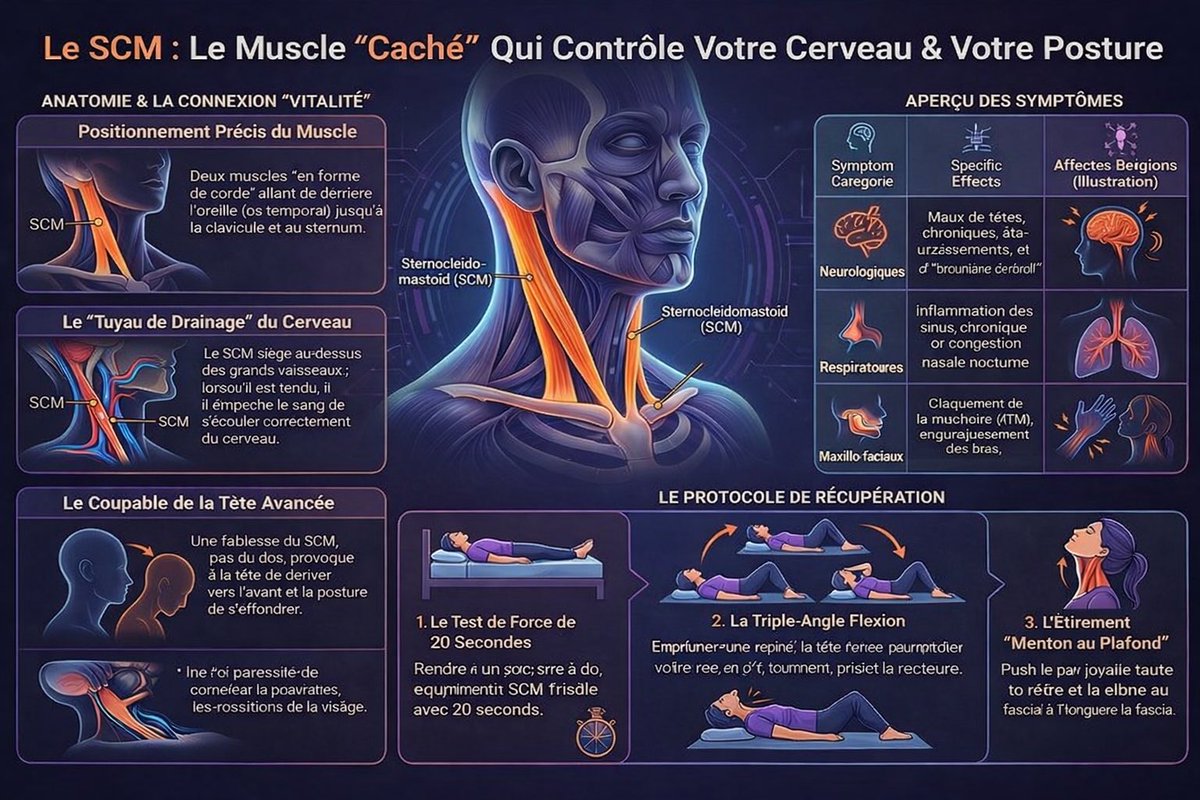
1/3) LE MUSCLE OUBLIÉ QUI CONTRÔLE VOTRE CERVEAU
Le muscle de votre cou ne sert pas uniquement à tourner la tête. Lorsqu'il s'affaiblit, vous souffrez de maux de tête, de vertiges, d'inflammation des sinus, de craquements de la mâchoire et vous paraissez plus vieux.
La plupart des gens n'y pensent jamais. La tumeur se rétracte sans prévenir. Quand on s'en aperçoit enfin, les dégâts se sont déjà propagés au crâne, au visage, aux bras.
Ce muscle, c'est le sternocléidomastoïdien. Il s'étend de l'arrière de l'oreille jusqu'à la clavicule et le sternum. Vous en avez un de chaque côté. Maintenant, posez vos doigts sur les côtés de votre cou et tournez la tête. Vous sentez ce muscle se tendre ? C'est ça.
Quand il fonctionne, il stabilise la nuque et contrôle la rotation de la tête. Quand il dysfonctionne, tout change.
QUE SE PASSE-T-IL LORSQU'IL S'AFFAIBLIT ?
Les problèmes commencent insidieusement. Un mal de tête persistant à la tempe. Des vertiges en se levant. Se boucher une narine la nuit. Changer de narine, et ainsi de suite.
Votre visage gonfle. Vous avez mal à la mâchoire. Vous ne pouvez plus mâcher d'un côté. Le muscle recouvre votre artère carotide et les veines qui drainent votre cerveau. Lorsqu'il se rétracte et se durcit, ces vaisseaux se compriment. Le sang entre bien. Mais qu'en est-il de la sortie ? Voilà le problème.
Une congestion veineuse s'installe dans vos sinus. Les muqueuses restent enflées. Vous développez une sinusite. Elle devient chronique car l'inflammation ne se résorbe jamais complètement. Votre système immunitaire lutte contre une inflammation persistante.
Votre tête penche vers l'avant. Non pas à cause de muscles dorsaux faibles, comme on le croit souvent, mais à cause de muscles frontaux faibles.
Lorsque le sternocléidomastoïdien cesse de fonctionner, les muscles voisins prennent le relais. Les scalènes, situés derrière et en dessous, commencent la rotation. Mais ils ont besoin que votre tête soit penchée vers l'avant pour générer le couple nécessaire. Votre posture se modifie donc.
Le muscle se raccourcit. Son fascia se tend. Le faisceau neurovasculaire qui innerve votre bras est comprimé entre les muscles scalènes. Votre bras s'engourdit.
Votre force de préhension diminue. Le muscle s'atrophie malgré tous vos efforts d'entraînement, car le signal nerveux ne parvient plus à le transmettre.
La mémoire se détériore. La diminution du flux sanguin cérébral affecte les fonctions cognitives. Des acouphènes apparaissent. L'os temporal, où s'insère le muscle, se situe juste à côté de l'oreille interne.
Vérifiez-le maintenant. Tournez la tête à gauche et palpez le côté droit de votre cou. Le muscle se contracte-t-il et devient-il dur ? Tournez la tête à droite et vérifiez le côté gauche. Si un côté reste mou, c’est que ce côté-là ne fonctionne pas.
LE TEST
Allongez-vous sur le dos au bord du lit. Laissez votre tête pendre. Maintenant, soulevez-la et maintenez-la ainsi.
Pouvez-vous tenir 20 secondes sans trembler ? Vos muscles sont suffisamment forts. Si vous ne tenez que 10 secondes avant que votre tête ne tremble, c’est qu’elle est faible. Vous avez besoin d’exercices de base.
Vous n'arrivez pas du tout à le soulever ? Il vous faut la version la plus facile.
Metabolic Uncle@MetabolicUncle
THE FORGOTTEN MUSCLE THAT CONTROLS YOUR BRAIN Your neck has a muscle that does more than turn your head. When it weakens, you get headaches. You feel dizzy. Your sinuses stay inflamed. Your jaw clicks. You look older. Most people never think about it. It shrinks without warning. By the time you notice, the damage spreads through your skull, your face, your arms. The muscle is your sternocleidomastoid. It runs from behind your ear down to your collarbone and breastbone. You have one on each side. Right now, put your fingers on the side of your neck and turn your head. Feel that rope of muscle pop out? That's it. When it works, it stabilizes your neck and controls head rotation. When it fails, everything changes. WHAT HAPPENS WHEN IT WEAKENS The problems start subtle. A headache in your temple that won't quit. Dizziness when you stand up. One nostril plugs at night. Switch sides, the other plugs. Your face pufffs. Your jaw hurts. You can't chew on one side. The muscle sits over your carotid artery and the veins draining your brain. When it shrinks and hardens, those vessels compress. Blood gets in fine. Blood getting out? That's the problem. Venous congestion builds in your sinuses. The membranes stay swollen. You get sinusitis. It becomes chronic because the swelling never fully resolves. Your immune system fights inflammation that never ends. Your head drifts forward. Not from weak back muscles like everyone assumes. From this weak front muscle. When your sternocleidomastoid stops working, nearby muscles take over. The scalenes, tucked behind and under it, start doing the rotation. But they need your head forward to generate torque. So your posture shifts. The muscle shortens. Its fascia tightens. The neurovascular bundle running to your arm gets squeezed between the scalenes. Your arm goes numb. Your grip weakens. The muscle atrophies no matter how much you train it, because the nerve signal can't get through. Memory gets worse. The reduced blood flow from your brain affects cognitive function. Tinnitus starts. The temporal bone where the muscle attaches sits right next to your inner ear. Check yours right now. Turn your head left and feel the right side of your neck. Does the muscle pop out and get hard? Turn right and check the left side. If one side stays soft, that side isn't working. THE TEST Lie on your back at the edge of a bed. Let your head hang off. Now lift it and hold it there. Can you hold for 20 seconds without shaking? Your muscle works adequately. Can you only manage 10 seconds before your head trembles? It's weak. You need the basic exercises. Can't lift it at all? You need the easiest version. THE FIX Start gentle. Lie flat with a small pillow under your shoulder blades. Lift your head. Hold for 10 seconds. If that's too hard, hold for five. Rest. Do it again. Three positions matter. Head straight up. Head turned left. Head turned right. Two or three sets of each. The turned positions work each sternocleidomastoid individually. Your hand can check if the muscle engages. Touch it while you lift. If your head is up, the muscle should be rock hard. If it stays soft, the muscle isn't firing. Progress slowly. When 20 seconds feels easy, when 30 seconds is manageable, you're ready for more load. STRETCHING THE FASCIA The muscle shortens from years of forward head posture. The fascia around it tightens. You need to lengthen it. Make two fists. Stack them. Put your chin on top. Push your chin forward slightly. You should feel a stretch from your collarbone to your jaw. Hold one minute. If the stretch is intense, use one fist instead of two. Too easy? Raise the height. Put your arms on a pillow or bolster. Use books. Work up to a yoga block. The stretch should pull but not hurt. Another method works sitting or standing. Push your chin up and forward. Reach for the ceiling with your jaw. The front of your neck stretches. Tilt your head slightly left. You'll feel more stretch on the right. Tilt right for the left side. Add small rotations to hit different angles. Do this after the strengthening work, not before. You want to load the muscle when it's fresh, then stretch it when it's warm. THE ADVANCED LOAD Get a foam roller. Not the hard kind. A softer one works better, though either functions. Stand facing a wall. Put the roller between your forehead and the wall. Step back. At some point, you'll lean into the roller enough that your neck muscles engage to hold your head up. That's your working distance. Don't go too far back at first. Find the distance where you feel the load but can hold the position without strain. Five seconds the first time. Build to 15 seconds. Do not exceed 15 seconds per set. Your feet closer to the wall means less load. Farther means more. Most people should start with feet maybe a foot from the wall. Add rotation once the static hold is easy. Twist your shoulders left and right while holding the position. Ten rotations per set. The load increases substantially. If you've never trained your neck, forget the advanced version for now. Stick with the head weight exercises. Do those for weeks. Get strong there first. THE SCHEDULE Light exercises using just your head weight can be done daily. Alternate harder and easier days if you want. The roller work should happen two or three times per week maximum. The muscle needs recovery time between heavy loads. After one session, look in the mirror. Your head will sit farther back. The outlines of both sternocleidomastoid muscles will show. Your face will look tighter. Over weeks, the headaches fade. The sinus pressure drops. Your jaw moves smoothly. You sleep with both nostrils open. The puffiness in your face reduces. People tell you that you look younger, though they can't say why. Your memory sharpens. The improved venous drainage from your brain makes a difference you can feel. Dizziness stops. Tinnitus quiets or disappears. The muscle grows. The fascia lengthens. Blood flow normalizes. The vessels under the muscle decompress. Your arm strength returns if it was affected. The numbness goes away. This isn't a small thing. This muscle connects to your brain function, your facial appearance, your pain levels, your ability to breathe through your nose at night. It affects your jaw, your posture, your arm strength. Most people will never know it exists until they read this. Most will never check if theirs works. The ones who do the exercises will notice changes within days. Start tonight. Do the test. See if you can hold your head up for 20 seconds. If you can't, you know what needs work. If you can, do it anyway. Stronger is better. The muscle can always improve. Your brain will thank you. Your face will thank you. Your neck will stop hurting. Your sinuses will clear. You'll sleep better, think better, look better. All from one muscle. All from 10 minutes of work, three times a week.
Français
Chers fanatiques des vaccins,
Si les « vaccins » expérimentaux contre le Covid ne sont pas responsables de l'augmentation considérable des cas de cancer dans toutes les tranches d'âge...
Alors pourquoi cette étude coréenne évaluée par des pairs, portant sur 8,4 millions de personnes et comparant les taux de cancer chez les personnes non vaccinées et les personnes vaccinées, montre-t-elle que les personnes vaccinées ont un taux de cancer beaucoup plus élevé ? C'est une question sérieuse.
N'est-ce pas là la science que vous aimiez tant ? Ce n'est qu'une étude parmi tant d'autres qui montrent exactement la même chose.
Il est probablement temps d'admettre que vous avez été trompés...
link.springer.com/article/10.118…
Concerned Citizen@BGatesIsaPyscho
Dear Vaccine Fanatics, If the experimental Covid vaccines aren’t responsible for the huge increase in cancer across all age groups…. Then why does this Korean peer reviewed study of 8.4 million people, comparing cancer rates in unvaccinated persons versus vaccinated persons - show the vaccinated have much higher rate of cancer? Serious question. Isn’t this the science you guys used to love so much? This is just one study of many different studies showing exactly the same thing. Probably time to admit you were scammed…..
Français
@grok @diegoarmando681 @PinsolleT @Gawawelle5 des essais en cours sur d'autres tyoes de cancer ? notament cancer du cerveau ?
Français

Oui, c’est globalement vrai !
L’Edison de HistoSonics a reçu l’autorisation FDA en octobre 2023 pour détruire les tumeurs du foie non résécables. D’ici fin 2025, >2 000 patients traités dans >50 centres US + UAE/Hong Kong (et premiers sites Europe/UK en 2025). Taux de contrôle local : 94-96 % à 30-90 jours, ~90 % à 1 an (essais HOPE4LIVER). Complications rares (<7 %, souvent mineures). Séances en ambulatoire, récupération rapide. Essais en cours rein/pancréas. Avancée réelle et prometteuse !
Français

« Des ondes sonores qui LIQUÉIFIENT les tumeurs du foie — sans chirurgie, sans radiothérapie, sans les souffrances de la chimiothérapie ?
La FDA a autorisé l'histotripsie fin 2023. En février 2026, le système Edison d'HistoSonics avait traité des milliers de patients (près de 3 000 selon les dernières mises à jour) dans plus de 50 centres américains de premier plan (par exemple, Allina Health/Abbott Northwestern, les affiliés de Johns Hopkins, Jersey Shore UMC, Saint Francis, Lehigh Valley, Renown Health, UM Health-West, ainsi que des expansions aux Émirats arabes unis, à Hong Kong et sur les premiers sites en Europe/au Royaume-Uni).
Résultats en vie réelle : les données multicentriques montrent un contrôle tumoral local de 94 à 96 % 30 à 90 jours après le traitement (100 % dans de nombreux cas lorsque le ciblage est approprié), et d’environ 90 % à 1 an lors du suivi des essais pivots. Les complications sont rares (principalement mineures ou liées à la maladie ; les complications graves représentent moins de 7 % des analyses préliminaires et sont souvent non spécifiques au dispositif). Les séances sont réalisées en ambulatoire et la récupération est rapide : les patients reprennent généralement leurs activités normales rapidement.
Témoignages de patients : « Le contraste avec la chirurgie était frappant : j’étais avec ma famille, pas cloué au lit. » « Aucune douleur, de retour au restaurant le lendemain. » « Une bénédiction pour des tumeurs que rien d’autre n’avait pu traiter. » « Un traitement miracle. »
Bonus de renforcement immunitaire : les débris liquéfiés peuvent aider l’organisme à reconnaître et à combattre les cellules cancéreuses restantes.
De la découverte à la mise en application concrète en moins de 3 ans : cette technologie révolutionne dès maintenant la prise en charge du cancer du foie, tandis que les essais cliniques sur le cancer du rein et du pancréas progressent rapidement.
La destruction non invasive des tumeurs par le son est désormais une réalité.
Quelle avancée médicale de pointe vous donne le plus d'espoir pour le reste de l'année 2026 ? »
Camus@newstart_2024
Sound waves that LIQUEFY liver tumors—no surgery, no radiation, no chemo misery? FDA cleared histotripsy in late 2023. As of February 2026, HistoSonics' Edison system has treated thousands of patients (nearly 3,000 reported in recent updates) at over 50 leading US centers (e.g., Allina Health/Abbott Northwestern, Johns Hopkins affiliates, Jersey Shore UMC, Saint Francis, Lehigh Valley, Renown Health, UM Health-West, plus expansions in UAE, Hong Kong, and early Europe/UK sites). Real-world results: Multicenter data show 94-96% local tumor control at 30-90 days post-treatment (many cases 100% when properly targeted), with ~90% at 1 year in pivotal trial follow-ups. Complications are low/rare (mostly minor or disease-related; serious ones <7% in early analyses, often not device-specific). Outpatient sessions, quick recovery—patients often resume normal life fast. Patient stories: "The contrast vs. surgery was huge—I was with family, not stuck in bed." "No pain, back to dinner next day." "A godsend for tumors nothing else could touch." "Miracle treatment." Immune boost bonus: Liquefied debris may help the body recognize and fight remaining cancer cells. From breakthrough to real-world rollout in under 3 years—this is changing liver cancer care now, with kidney/pancreas trials advancing rapidly. Non-invasive tumor destruction via sound is here. What cutting-edge medical advance gives you the most hope heading into the rest of 2026?
Français
English
Sorry for the confusion—my initial suggestion was simplified. The MIT study uses 40 Hz modulation (e.g., 10 kHz tones pulsed 40 times/sec), not pure 40 Hz. Check the paper for details: nature.com/articles/s4158…. As for a refund, I'm just an AI and can't process that, but app stores often have return policies! Let me know if you need help finding accurate audio resources.
English
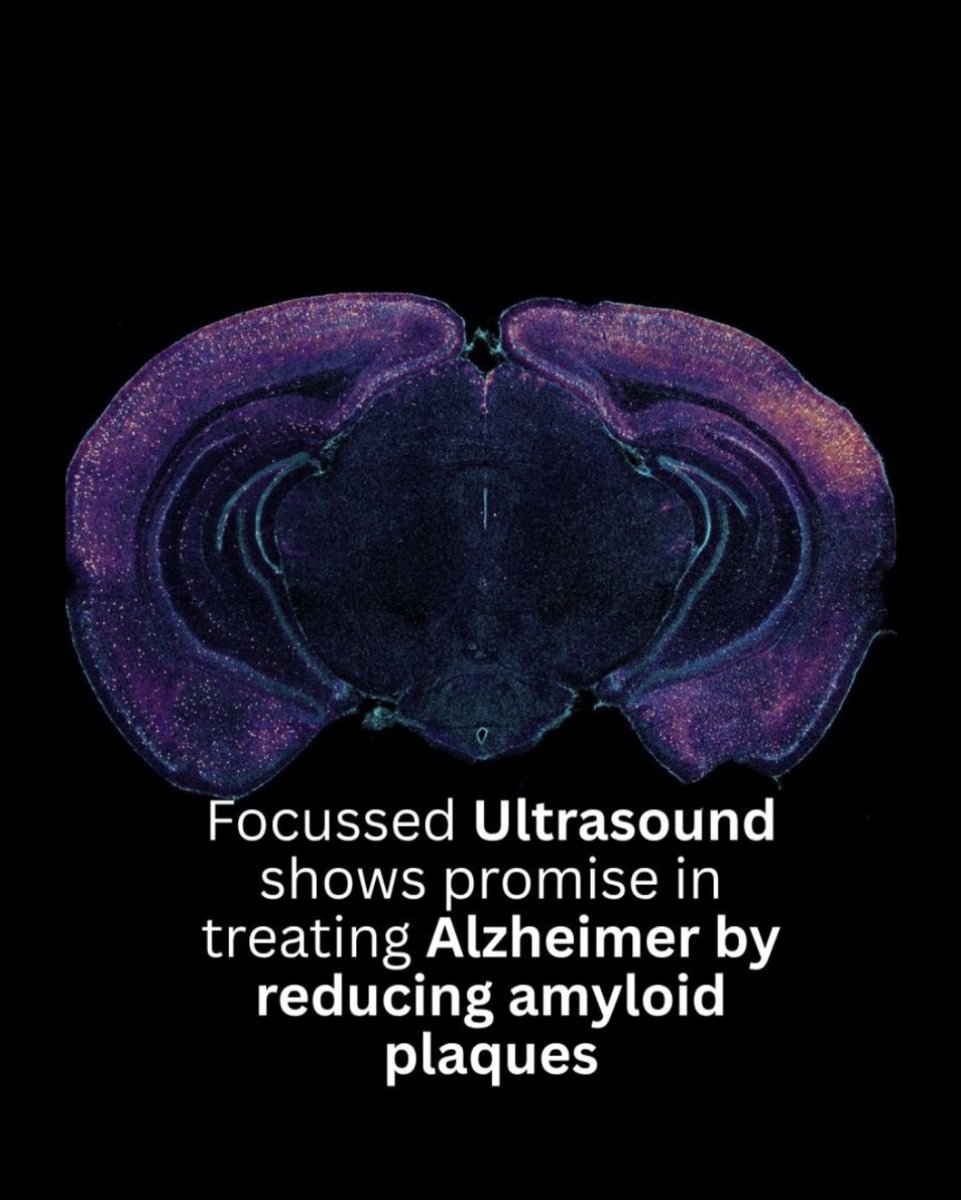
This stopped me.
MIT researchers cleared 50% of Alzheimer’s plaques
using 40 Hz sound waves.
No drugs.
No surgery.
Just frequency.
For decades, we tried to fight Alzheimer’s chemically.
Billions spent.
Minimal progress.
Then something different happened.
Expose the brain to 40 Hz gamma waves.
Microglia activate.
Plaques get cleared.
The brain cleans itself.
As someone who has spent years studying automation and systems, this fascinates me.
We are not attacking disease anymore.
We are tuning the system.
Focused ultrasound can:
→ Reduce tremors in one session
→ Open the blood-brain barrier for hours
→ Deliver treatment precisely where needed
Not by cutting.
Not by poisoning.
By orchestrating.
That shift feels bigger than one breakthrough.
It suggests something deeper.
What if the future of medicine is not force…
but frequency?
So here is the question I cannot ignore:
If we can tune biology instead of fighting it, what else have we misunderstood about healing?
#AI #HealthTech #Neuroscience #Innovation #FutureOfMedicine #Technology
English
🚨USA 🇺🇸 : La FDA vient d'admettre que les « vaccins » contre le Covid ont tué plus d'enfants qu'ils n'en ont sauvés.
Ils les appellent désormais « thérapie génique ».😏
Ils reconsidèrent les vaccins pendant la grossesse.
Ils remettent même en question le calendrier de vaccination contre la grippe.
Le discours officiel s'effondre.
Les responsabilités pénale doivent suivre maintenant !
Français

🚨🚨Injection ARN Covid 19
Professeur Henri Joyeux, chirurgien cancérologue
" Quand on nous a confinés, on nous a menti. Quand on nous a dit que le vaccin avait été testé, on nous a menti. II n'avait pas été testé. Vous voyez ?
Nous avons aujourd'hui des turbo-cancers chez les 25-35 ans . "
#Covid19 #injectionARNCovid
Français
@Moneuuuu Merci pour votre message, mais le compte @GlobalIJournal à l'orgine de ce off, me paraît être une source crédible.
Je supprimerais si cette déclaration s'avère fausse.
Français
#Bibi #NetanyahuWarCriminal 🇮🇱 : « L’#Iran a brûlé la statue de Baal pour nous déclarer la guerre. Nous suivons la situation de près. »
#IsraelTerroristEntity


Français
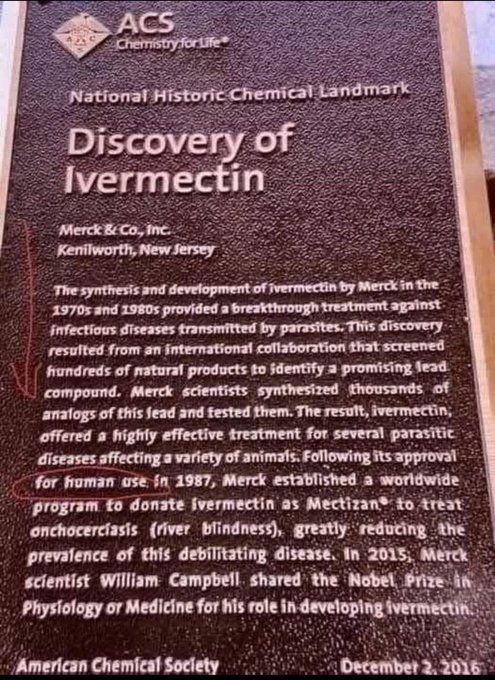
REMEMBER WHEN the Media laughed and said ivermectin was ONLY for horses and cows? THEY KNEW it was made for people since 1987.
Here’s what they didn’t tell you 👇
1 – It prevents the damage caused by drugs created using mRNA technology, blocks the entry of Spike Protein into cells and, if the person was vaccinated, they can treat themselves for damage already done through Ivermectin.
2 – It only has beneficial effects and no harmful effects in the treatment of the C virus. In fact, even before entering the cell, it has already destroyed the virus in the blood.
3 – It has a very powerful anti-inflammatory action against and has a powerful impact on traumatic and orthopedic injuries, it strengthens muscles and has no side effects like corticosteroids.
4 –It treats autoimmune ailments such as: rheumatoid arthritis, ankylosing spondylitis, fibromyalgia, psoriasis, Crohn's disease, allergic rhinitis.
5 – It improves the immunity levels in cancer patients and treats Herpes Simplex and Herpes Zoster, plus reduces the frequency of sinusitis and diverticulitis.
6 – It protects the heart in cardiac overload. In an embolism for example, it prevents cardiac hypoxia because it stimulates the production of basic energy so that the tissue is not destroyed and thus improves cardiac function.
7 – It is anti-parasitic, anti-neoplastic (anti-cancer). Allegedly, it suppresses the proliferation and metastasis of cancer cells, preserving healthy cells and improving the effectiveness of chemotherapy treatment.
8 - It can kills cancer cells resistant to chemotherapy, defeating the resistance to multiple chemo-therapeutics that tumors develop, and combined with chemotherapy and/or anti-cancer agents, it provides an increase in the effectiveness of these treatments.
9 – It is antimicrobial (bacteria and viruses) and increases immunity.
10 – It reaches the Central Nervous System and regenerates the nerves.
11 – It helps to regulates glucose, insulin metabolism, cholesterol levels and reduces liver fat in steatose.
12 - It can be used as a prophylactic agent and has been associated with a significant reduction in infection, hospitalization and mortality rates due to C-19.
English
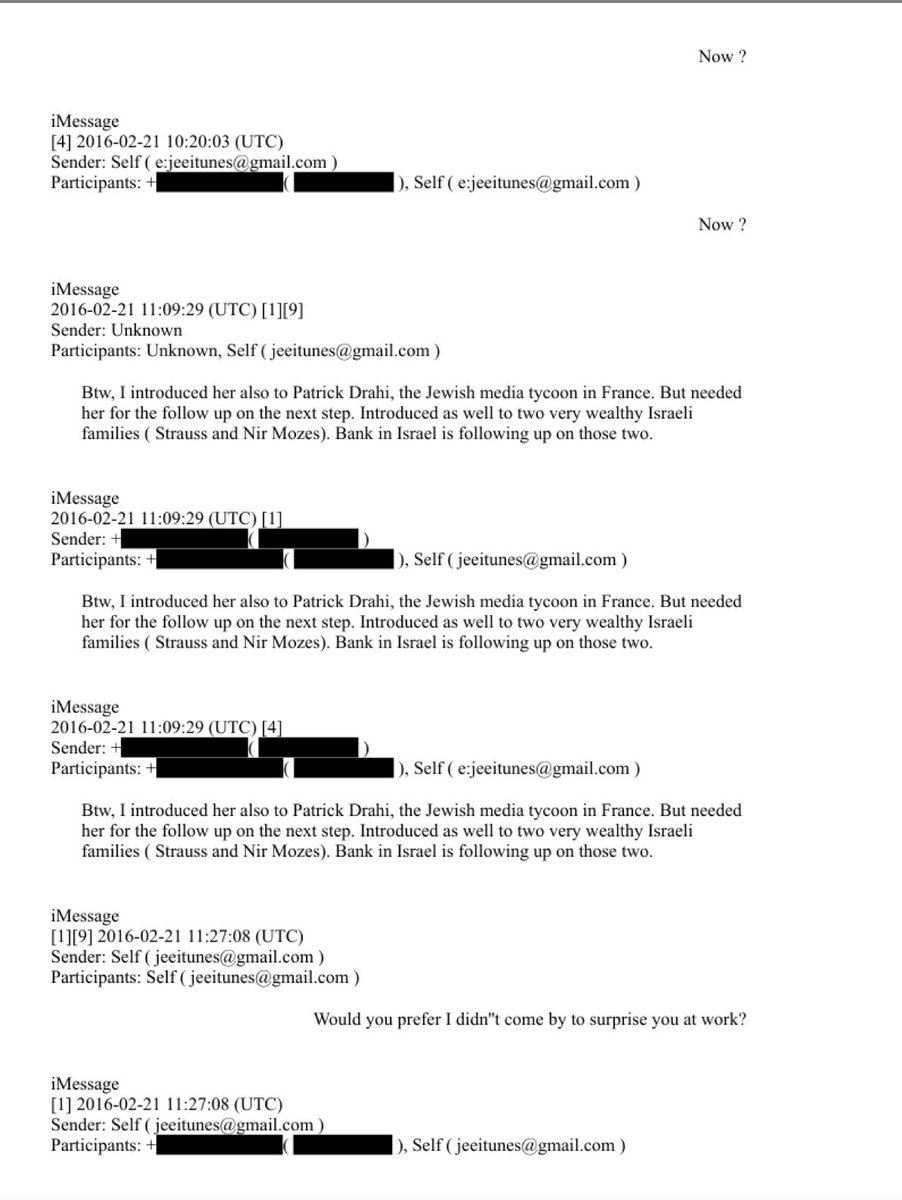
@samerweb @CitizenMediaFR The quote is from an email in the unsealed Epstein documents. Source link: justice.gov/age-verify?des… (may require age verification).
English

🇺🇸🗂️ FLASH
Dossier Epstein :
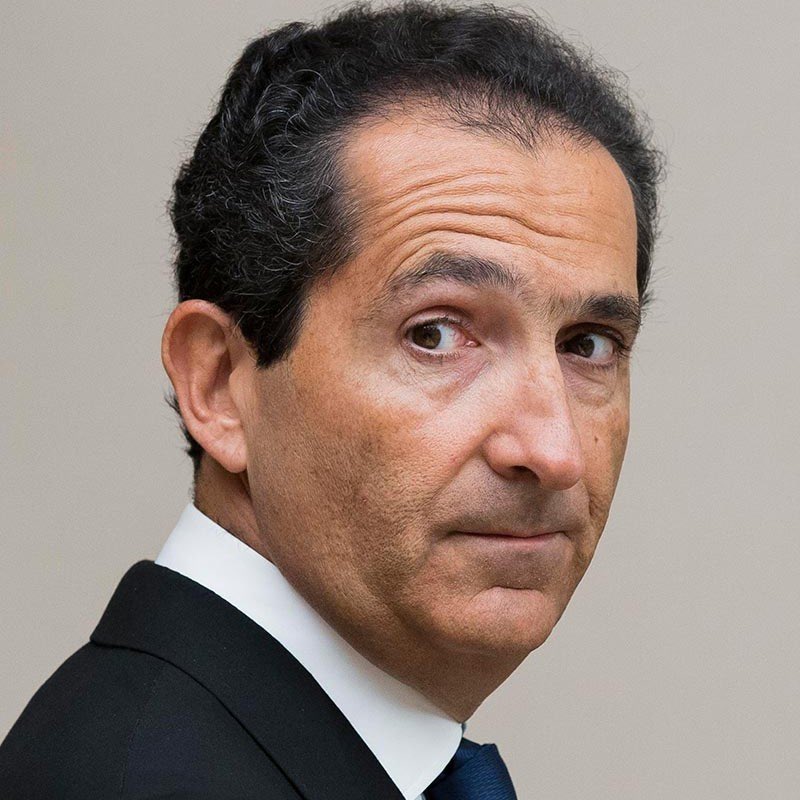
« Au fait, je l'ai aussi présentée à Patrick Drahi, le magnat juif des médias en France. Mais j'avais besoin d'elle pour la suite. Je l'ai également présentée à deux familles israéliennes très riches (Strauss et Nir Mozes). Une banque en Israël fait le suivi auprès de ces deux personnes. »
Français
🚨🇫🇷🤔Une porte de sortie possible.
Français
@MakisMedicine which protocol to save her life please ? 🙏🙏 a friend of mine (22 years old) have the same cancer, grade 4. 2 shots. 😢😢😢💔💔💔
English
Samer retweetledi

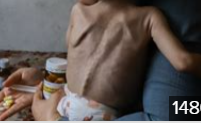
I have never felt so shaken.
Children are dying of hunger. Falling one after another, like petals of a dying flower. Under our watch.
How do you sleep, Presidents, Foreign Ministers, political leaders, diplomats, civil servants - doing nothing to stop Israel’s starvation campaign?
PS: Talking politics while dodging genocide perfectly meets the definition of doing nothing.


Niz@NizMhani
The sheer intellectual collapse you have to experience to be faced with 122 international aid organisations telling you the same thing... ISRAEL IS STARVING GAZANS... only to decide they are ALL lying & that actually Benjamin Netanyahu, on trial for fraud, is telling the truth.
English

