Sam Hall

5.9K posts

Sam Hall banner
Sam Hall

Sam Hall

@samhall404

Raising awareness of psychiatric drug withdrawal. Sharing the reality, the science and fight for recognition. IG - samhall404

Katılım Eylül 2012
2.5K Takip Edilen1.3K Takipçiler
Sabitlenmiş Tweet
Sam Hall
Sam Hall@samhall404·
1/ Thanks to @MikhailaFuller for allowing me to share my story. 🧵 My experience sits in the uncomfortable space between what patients are routinely told about antidepressants and what can, in many cases, actually unfold over time. It is not simply a story of adverse effects, it is a story about the consequences of incomplete information, overconfidence in simplified narratives and a medical culture that too often defaults to explanation rather than investigation when things go wrong. I was prescribed the antidepressant Sertraline for situational panic attacks following a house fire when I was younger and remained on it for approximately 13 years. During that time, I was never meaningfully informed about the possibility of physiological dependence, nor about the potential difficulty of stopping the drug after long term use. The phrase “safe and effective” was presented as if it were a stable, universal truth, rather than a context dependent conclusion drawn from limited and biased data. There was no discussion of what happens when the brain adapts to a drug over more than a decade. No acknowledgement that removing that drug might not be a neutral act. No mention of protracted withdrawal or that stopping could result in a severe and prolonged destabilisation of the nervous system. Informed consent, in any meaningful sense, was absent. When I eventually came off the SSRI, it was done through a rapid doctor led taper that bore no relation to the duration of my use. What followed was not a return of my original symptoms, but the onset of something far more severe, complex, disabling and life changing. Almost immediately, I began to experience intense and persistent surges of physiological anxiety and panic. These were not thoughts or worries in the conventional sense. They were full body events; overwhelming waves of adrenaline that arose without psychological trigger, accompanied by a profound sense of internal threat. They were not responsive to reasoning, reassurance or standard psychological strategies because they were not primarily psychological in origin. Alongside this, I developed widespread neurological and sensory disturbances. I experienced constant “electric” sensations throughout my body, moving unpredictably through my arms, legs, hands and across my head and face. These were often painful, presenting as burning, tingling or sharp nerve like sensations. My muscles began to twitch involuntarily, with fasciculations and spasms becoming a daily occurrence. At times, my facial muscles would contract and twitch without warning. One of the most severe and distressing symptoms I experienced was akathisia. It is often described clinically as restlessness, but that description is profoundly inadequate. What I experienced was an intense, unrelenting inner agitation combined with a powerful urge to escape my own body, alongside a compulsion to move that made stillness feel intolerable. At its worst, it generated intense suicidal urges, not from hopelessness, but from a desperate need to escape the sensation itself. It was not psychological distress in any conventional sense, it was a physical state that overrode any attempt at control. It is difficult to overstate how severe and destabilising this symptom has been for three years. Sleep became almost impossible at times. I went through prolonged periods of insomnia, sometimes sleeping only three hours across several days. When I did manage to fall asleep, I was frequently jolted awake by hypnic jerks; sudden, violent awakenings accompanied by adrenaline surges. The cumulative effect of this sleep deprivation was profound, amplifying every other symptom and eroding my ability to cope. Cognitively, I experienced significant impairment. I developed … prescribed-harm.com/stories/story-…
English
15
43
133
33.4K
Sam Hall retweetledi
Laura Delano
Laura Delano@LauraDelano·
“What can happen is that a lot of people get caught between the adverse effects of taking the drugs and the withdrawal effects from not taking the drugs.” “Now that's a trap.” Some people are able to stop taking SSRIs and other psychiatric medications and experience little to no severe withdrawal effects. But others enter a cycle that the current system often fails to clearly recognize or properly support. A person stops taking their medication, they experience withdrawal symptoms, and those symptoms get interpreted by them or their doctors as proof that they still need the drug. This is why informed choice and transparency about withdrawal have to be standard, not optional. Otherwise people will keep mistaking withdrawal for relapse and getting pulled back into treatment by the effects of stopping itself. @_innercompass @_AndersSorensen
English
5
18
103
6.1K
Sam Hall retweetledi
Mark Horowitz @markhoro.bsky.social
The cartoonist very good job of bringing this lecture to life and provides an overview of how antidepressants work and the trouble with stopping them, including what we know about the safest way to do so. Link below.
Mark Horowitz @markhoro.bsky.social tweet media
English
2
17
70
3K
Sam Hall retweetledi
Inner Compass Initiative
Inner Compass Initiative@_innercompass·
“I never got to experience the full range of emotions and feelings of being human … ” “Anytime I tried to go off [SSRIs], it would throw me into such a severe panic.” “Now I'm dealing with the realization that I've missed a lot of life.” Nobody told Cameron LaBar that the side effects of SSRIs would completely change his life. Take 2 minutes to hear his story: “When you talk to a doctor about that, a very common response is: that is a part of your underlying condition, you probably need the medication.” “It wasn't until I stumbled across a video from Mark [Horowitz] that suggested that these [symptoms aren’t] part of who I am.” “It took me 20 years to find that out.” “I've been tapering for about 3 years now.” “I'm down to about 7.5 milligrams of Lexapro.” “It's probably gonna take me another 3 to 5 years to get the rest of the way [off] given how these drugs work.” “But imagine the fury, the rage of [realizing] I could have figured this out a lot sooner.” “I could have functioned as a human being all along.” “I could have had friendships.”

“I could have not been numb.” “These are the things that I'm now struggling with.” “A lot of my experience, year after year, has been discounted and affected by these drugs.” If you had a similar experience to Cameron with psychiatric drugs, you are not alone. We want to hear your story. Share your experience in a reply below, or share a video and tag us @_innercompass. @MAHA_Institute
English
13
43
120
4.5K
Sam Hall
Sam Hall@samhall404·
These are the desperate, agonised cries of hundreds of thousands of people trapped in severe akathisia from drugs taken as prescribed (antidepressants, antipsychotics, antiemetics, anticonvulsants and antibiotics (fluoroquinolones etc). They are in urgent need of real help, yet many know that going to a hospital often results in being misdiagnosed and given… more drugs. The very thing that fuels this neurological fire even further. What should be a place of safety becomes another layer of torment for a nervous system that is already a raging inferno. Please, help these people. Help me. People are dying from this. They are taking their own lives and leaving devastated families behind to pick up the pieces. This cannot continue to be ignored.
Akathisia Alliance for Education and Research@AkathisiaAlli

Right, why? #Akathisia is an suicide-prevention emergency. This was posted in a FB support group today. Her doctors had either never heard of akathisia or refused to believe she had it. How many people have to die this way before something is done about it?

English
8
31
84
3K
Sam Hall retweetledi
Javeed Sukhera MD PhD
Javeed Sukhera MD PhD@javeedsukhera·
Research shows that when people experience cognitive dissonance, especially around identities tied to morality or expertise, there is a tendency toward defensiveness, and splitting. Stop Breathe Reflect Tolerate complexity Hold the tension Let it go
English
1
4
14
445
Sam Hall retweetledi
Daniel Owens
Daniel Owens@dsowens17·
This new article in the NYT shows that there has been some progress from the 'mild and brief' misinformation about SSRI withdrawal that was pumped out for decades (although ofc with no acknowedgment or humility from the experts quoted about being wrong about this). But for me the most misleading statement (besides the irresponsible tapering over a month advice) is the following statement: “They’re not dangerous,” Dr. Alpert said, “but they can be very uncomfortable.” On the contrary SSRI withdrawal can be VERY dangerous. The symptoms can be so severe (particularly if withdrawal induces akathisia) that people take their own lives to avoid the level of suffering they are experiencing. Many people report becoming suicidal even after missing a couple of doses. In other cases people are so disabled by the symptoms that they cannot work, look after their children and remain bedridden for many months and some cases for years. That is a lot more serious than 'very uncomfortable'....
Daniel Owens tweet media
English
7
22
72
10.1K
Sam Hall
Sam Hall@samhall404·
@tillytog01 That’s one of my favourite songs by Cyndi Lauper. Thank you. Just as Cyndi would say, “Time After Time” you continue to defend the indefensible. I hope one day you have a genuine “Change of Heart.”
GIF
English
1
0
3
73
Tilly
Tilly@tillytog01·
@samhall404 That’s just cruel and unnecessary. Rob apologised and changed his terminology and you take that opportunity to attack him further. Uncalled for and below the belt. Disagreement is one thing, this is obsession you have with embarrassing and berating Rob is tiresome. True colours.
English
2
0
2
141
Sam Hall
Sam Hall@samhall404·
The only “devastating takedown” I’ve seen over the last few weeks was your failed presidential campaign. Even that was less of a takedown and more of a slow, self inflicted collapse.
Robert Howard@ProfRobHoward

@CriticalMh @ReadReadj @HenryRunamucker @joannamoncrieff And I should have said "critique" instead of "takedown". Sorry. But it is right, I think, to use "devastating", because - as Tyler lays out carefully - the pattern of deviation from disinterested and fair treatment of evidence is blatant.

English
4
9
26
936
Sam Hall
Sam Hall@samhall404·
Those frantically trying to rip the microphone away from patients speaking about antidepressant harms have already clutched it in a death grip for over thirty years. Picture the scene: a sloshed, arrogant bully at a bar who’s been hogging the karaoke machine all night, slurring the same nauseating corporate anthem on repeat, “safe and effective” by @EliLillyandCo, while anyone who dares point out the ugly reality gets shouted down or thrown out of the venue. We are not creating “imbalance.” We’re correcting one. And no, we’re not handing the microphone back. We’re going to share it, just as it always should have been.
English
3
20
63
1.2K
Sam Hall retweetledi
Kim Witczak 💜
Kim Witczak 💜@woodymatters·
Why does it so often fall on harmed patients and grieving families to push for change? The people fighting for Black Box suicide warnings in 2004 and 2006 were families blindsided by tragedy. The people pushing for better information about antidepressant withdrawal are often those who can’t get off the drugs themselves. The people advocating for PSSD warnings are those living with life altering harms that were never properly disclosed. None of us asked to become experts in these issues. We became motivated because we learned the hard way and don’t want others or their families to have to experience the same thing. That’s not anti drug. That’s pro informed consent, transparency, and prevention. Where’s the @FDA ? The doctors? The @APApsychiatric ?
Mark Horowitz @markhoro.bsky.social@markhoro

It's inspiring to see that patients who have been harmed by psychiatric drugs are organising to prevent this happening to others. It is also an absolute indictment of the current system that patients are forced to this. Basically disgraceful.

English
7
28
70
2.7K
Sam Hall retweetledi
Dr Joanna Moncrieff
Dr Joanna Moncrieff@joannamoncrieff·
Interview about our paper on reducing antipsychotics. Many people on long-term antipsychotics 'feel consigned to have a limited life because of the drugs’ effects. They want to have choices.' @markhoro physiciansweekly.com/post/qa-suppor…. Paper in linked post.
English
13
38
111
8.8K
Sam Hall retweetledi
Javeed Sukhera MD PhD
Javeed Sukhera MD PhD@javeedsukhera·
As a psychiatrist, I care about antidepressant withdrawal because I care about science, compassion, and informed choice. For too long, patients described real suffering after stopping medications while psychiatry too often denied, minimized, or mislabeled it. We need to be honest about the problem and work on solutions together. 🧵
English
13
33
154
10.6K
Caroline 🦊
Caroline 🦊@looneyfox_1·
You’re having a go at Tyler because he debunked your god Moncrieff. Shes full of dangerous shit and has zero interest in helping anyone with disability.
Sam Hall@samhall404

@looneyfox_1 @tylerblack32 @davideyoungmd I’m not Caroline. I’m just asking for some evidence for some pretty serious accusations. Sometimes things can come across the wrong way on X, so apologies if that was the case.

English
2
0
2
448
Sam Hall retweetledi
Carrie Clark
Carrie Clark@cwestonclark·
Sensible stuff from the WSJ: "“But we don’t understand the long-term consequences of many psychiatric drugs, particularly on young brains. We are running a large uncontrolled experiment on the developing brains of millions of young people, and we won’t know the full results for decades.” Behind the Boom in Psychiatric Medication by Adam Omary wsj.com/opinion/behind… via @WSJopinion
English
6
22
68
2K
Sam Hall retweetledi
Inner Compass Initiative
Inner Compass Initiative@_innercompass·
Everything that leads us to diagnoses and prescriptions is real and deeply human—the despair, self-doubt, loneliness, shame, obsession, alienation, fear, angst, and grief that shape our lives in so many different ways. Questioning the medicalized response to this suffering does not deny the suffering exists, nor the short-term relief some find in psychiatric drugs. It simply refuses to let our culture transform these varied, deeply human experiences into incurable brain pathology that demands lifelong medication, especially for our young people. (Video: our founder, Laura Delano, at the MAHA Mental Health & Overmedicalization Summit, May 4, 2026)
English
3
18
51
4.4K
Sam Hall retweetledi
Sam Hall
Sam Hall@samhall404·
@sanilrege, quick as ever to jump to conclusions without even bothering to understand the SSRI parachute analogy 🤦 The point, which is not exactly subtle, is this: just as you cannot reliably assess the effectiveness of a parachute by testing it from a few feet off the ground, you cannot accurately determine the true severity and prevalence of SSRI withdrawal from short term industry trials where withdrawal was never a primary outcome and patients were only followed for weeks. It’s a perfectly cogent warning about the dangers of extrapolating from artificial test conditions to real world outcomes. But apparently that was too complicated. Easier to dismiss it outright than admit that decades of “evidence based” psychiatry have been built on fundamentally flawed trial designs when it comes to long term harms. The intellectual laziness is striking.
Sam Hall tweet media
English
4
15
33
3K
Sam Hall retweetledi
Sam Hall
Sam Hall@samhall404·
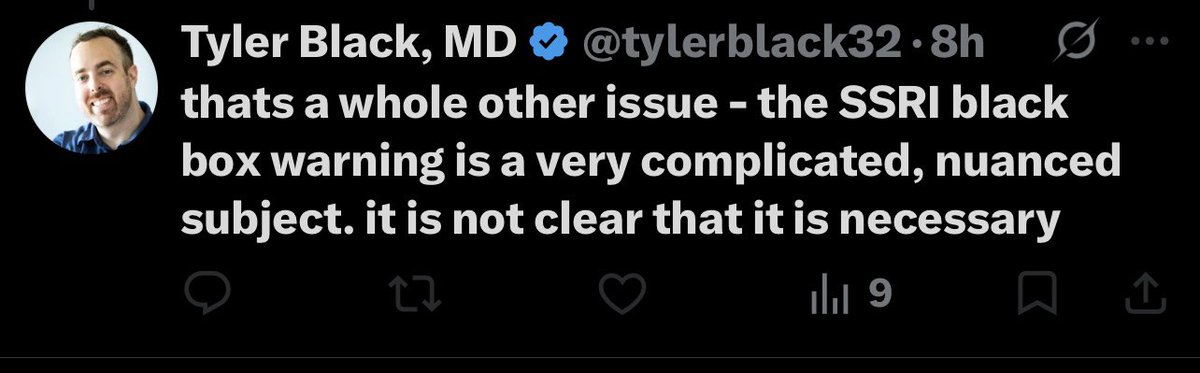
Here is self proclaimed “suicidologist” @tylerblack32, who describes himself as a “literal expert” in suicidology, declaring that it’s “not clear if the black box warning is necessary” for suicide risk on SSRI labels 😮‼️ In another post, he claims he experienced akathisia simply from walking too far in Tokyo 🫠 This is particularly striking because increased suicidal ideation and impulsivity are well documented adverse effects of antidepressants, especially in the early weeks of treatment. True akathisia, a state of severe inner restlessness and torment, is a recognised, drug induced neurological condition triggered by SSRIs, other antidepressants or during withdrawal. It is not caused by walking or physical exertion. More importantly, akathisia is one of the most dangerous and well established suicide inducing adverse effects of these drugs. It creates an intolerable state of inner restlessness where stillness itself becomes unbearable, driving some patients into profound agitation, despair and suicidality that can last weeks, months or even years. Make it make sense 🤷‍♂️ A so called suicidologist wants to weaken suicide warnings on SSRIs while appearing not to fully understand akathisia, one of the most serious, drug induced pathways to suicide associated with them. It’s like a firefighter who claims expertise in fire safety while arguing that smoke detectors are probably unnecessary and then insists he once suffered severe smoke inhalation from standing too close to a candle.
Sam Hall tweet mediaSam Hall tweet media
English
18
23
109
12K