
Sabitlenmiş Tweet
Sapiom
89 posts


Sapiom retweetledi

Just finished listening to Adam Mosseri on Lenny.
A lot of useful nuggets.
I'm glad he agrees that token leaderboards are a terrible idea.
When it comes to tokens and spending, my thoughts:
A lot of people's instinct in this industry is for managers to count every token. Reactively. As if there wasn't a better way for people to be spending their time.
What builders need is a way to give agents a budget, set the rules once in the infrastructure, and get the breathing room to build.
Lenny Rachitsky@lennysan
Adam Mosseri (@mosseri) leads @Instagram, used by over 3 billion people (1 in 3 humans). He started at Facebook in 2008 as an IC designer, rose to lead News Feed, and took over Instagram from @kevin and @mikeyk in 2018. Since then, Instagram has more than tripled its user base, and Adam is now months away from having run it longer than its founders did. In our in-depth conversation, we discuss: 🔸 The rise of the “product staff” role 🔸 Why Adam is bullish on designers 🔸 What the Instagram algorithm knows about you 🔸 What the rise of AI-generated content means for IG 🔸 The two biggest product failures of Adam’s career—Facebook Home and the first version of Reels Listen now 👇 youtu.be/yQ_EWmtfWvQ
English

Introducing Ship OS: The agent-native way to ship software.
Run your entire product development cycle in Notion, from customer feedback to a merged PR.
Agents handle the triaging, routing, and summarizing. Your team handles the judgment calls.
Set up Ship OS → notion.com/ship-os
English
Sapiom retweetledi
Remember the 90's movie Flubber with Robin Williams?
My team and I couldn't agree on whether it was called Flubber or Blubber so we looked it up.
Turns out, it was a remake of a movie from the 60's.
GIF
English
Sapiom retweetledi
The @sapiom team is hosting a small builder night in SF tonight. We're keeping it intentionally tight.
If you're building something real with agents, DM me what you're working on. I'll send details to a handful of folks it makes sense for.
English
Want to build the execution layer, and not just another brain?
We're hiring. 👇
sapiom.ai/careers?utm_so…
English
Our founder, @i_zerbib, is originally from France, but has been busy building in sunny (or foggy, depending on the time of day) San Francisco. 🇫🇷🌁
Naturally, our team spans both, with folks in between the two cities. When a community like Intertech Talents has spent the last year building bridges between the two, it was an easy yes to sponsor.
Nikita from our technical team helped bring our story to Paris last week, chatting with builders passionate about the future of autonomous agents. We couldn't be more excited about what's ahead.


English

Who wants to come on my podcast this week?
2,000,000+ listens per month.
1. You teach one AI tool, skill, or framework that helps people build a business
2. You can have 1 follower or 1M, doesn't matter
3. You come prepared
Tag someone or tag yourself.
Lets go.
English
Sapiom retweetledi
Karp’s right that enterprises are “paying for tokens that create no value.” IMO, he’s partially wrong about the fix.
His answer is discipline. Data sovereignty, more careful spend, tighter governance. But that puts the burden on the enterprise to manage something they can’t actually see.
You can’t ask a team to exercise judgement over a system they have no visibility into.
It's like sending your 4 year old off for the day with no guidance, no boundaries, no idea where they even went, and expecting them back with no scrapes, no bruises, and definitely no new pet snake in their pocket (swap to a cheaper babysitter and the kid may still come home with a snake).
And watching from the front porch doesn’t fix it either. A camera pointed at the front door tells you the kid left. It doesn’t tell you where they went or why they came back with a snake. Watching a black box fail more slowly is still watching it fail.
What actually changes the outcome is infrastructure that gives you real access at the task level: what ran, what it cost, whether it succeeded, how the routing decision got made. Not a dashboard. Control.
That infra? It’s been built. And I’m damn proud of the @sapiom team for building it.
Business Insider@BusinessInsider
"This is the voice of American business that is being channeled through me," the Palantir CEO said. bit.ly/4eGiXEv
English

Sapiom retweetledi
Most agent infrastructure today is a horseless carriage.
In 1886, Benz's first automobile was literally a carriage with a small engine that took over for the horse that used to propel it. It took fifteen years for the car to get its own shape.
Agent infra is living those fifteen years right now.
Almost everything agents run on was built for a world with a human at every step. Every API key provisioned by one. Every billing relationship approved by one. Every permission signed off by one.
Agents break that assumption.
The industry's answer so far: put "agent" in front of the old tools. It doesn't change what they are. The engine is new…but the carriage is the same.
The horseless carriage test, for your stack or a vendor's:
1. New capability = new vendor, new key, new billing relationship, or another sprint building it yourself? Or one step?
2. Governance designed for software that acts on its own, or inherited from human IAM?
3. Can you see what an execution did, step by step, or just the aggregate bill?
"New vendor every time." "Inherited." "Aggregate." That's a horseless carriage.
Building it yourself just means you're the carriage maker.
We started @sapiom by refusing to inherit it.

English
Every team building agents in production ends up rebuilding the same boring-but-critical infrastructure: sandboxes, state, cost controls, capability access, visibility, and control.
Yesterday, Sapiom handled 1.5M+ agent transactions across ~40K tenant sandboxes for ~40K active agents including 662K governance checks and 654K paid transactions.
That’s the stuff teams shouldn’t have to spend months wiring together before they can ship the actual product.
Sapiom is the platform where agents can actually perform.
English
Sapiom retweetledi
I left Shopify in August 2024 after 4+ years. $100B in GMV through Shop Pay. I left knowing exactly what world-class infrastructure looks like when it works.
Before that, I built Earny, an automated agent doing price refunds for 4.5M users. It was acquired in '21.
Two different companies. Same ceiling. At Earny, nothing like this existed, so we built it ourselves. At Shopify, the infrastructure was world-class, but it assumed a human was always the one pulling the trigger. Either way, the moment something needs to act on its own, the floor gives out.
English
Sapiom retweetledi
This is the whole game.
The layer between the work and the intelligence is where ROI actually comes from. Aaron’s key insight is that every company building that layer alone will not scale.
Understanding the workflow, routing every capability and model to the right path, enforcing budget, recovering when a step breaks, and knowing exactly what happened — that is not something 10,000 companies should each rebuild.
It is heavy infrastructure. Most companies can't build it well themselves. So it becomes the thing they run on, not the thing they rebuild.
Horizontal first. Verticals on top. Most interesting infrastructure problem in tech right now.
Aaron Levie@levie
Some good best practices here on AI token cost optimization. None of these happens though without a deep understanding of the underlying work being done in a non-abstract way. The ultimate implication is that a layer between the work itself and the underlying intelligence needs to deeply understand your workflows, context, and business process. Now, each individual company doing this on their own is unlikely to be effective at scale, so as a consequence, this is effectively the playbook for any applied AI company right now. By evaling the models for the applied use cases, deeply understanding the domain, having tuned UX and features for the use case, and having the ability to support adoption and change (via FDEs), allow this layer to add a ton of value. And as a result, enterprises get higher ROI because you actually can get *more* intelligence per dollar by having optimal architecture and workflows. There will be many horizontal and vertical versions of this approach. Huge opportunity right now.
English
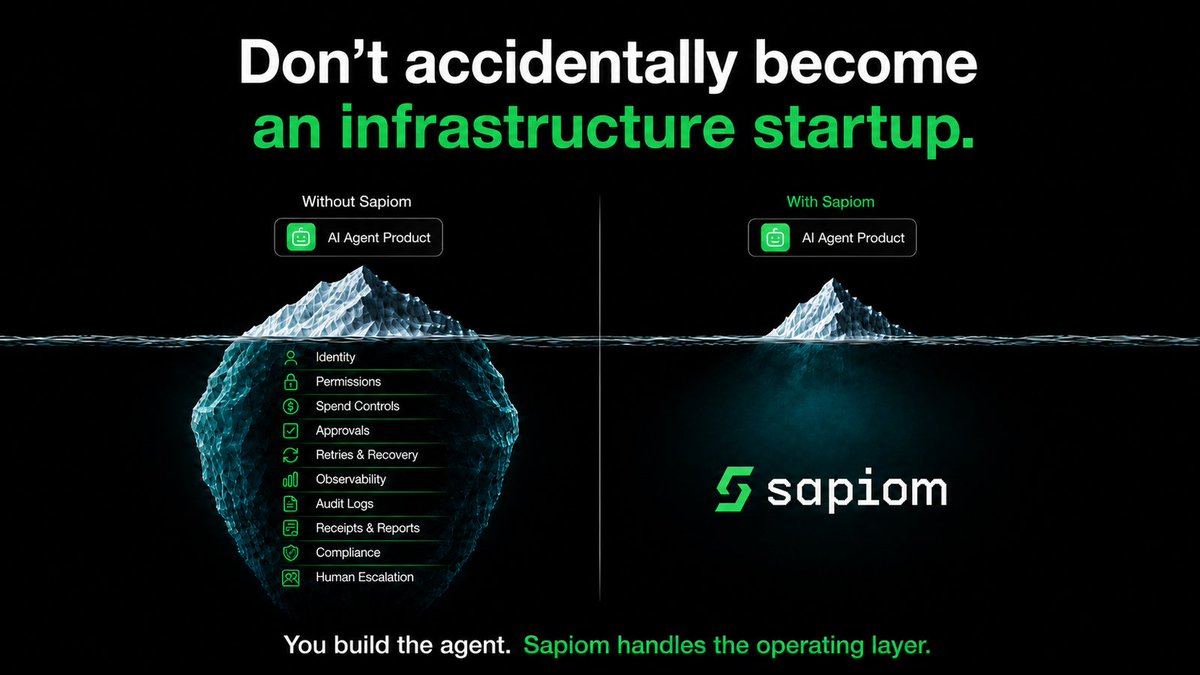
Don't let your agent startup accidentally become an infrastructure startup.
You build the agent. Then production shows up, and suddenly you own access, spend limits, approval flows, retries, routing, and a receipt for everything it did.
Works as a demo, breaks at production scale.
Builders shouldn't have to rebuild the operating platform for agents just to ship. That's the problem we're building Sapiom to solve.
English
