Say Jay Hynes

56 posts

Say Jay Hynes banner
Say Jay Hynes

Say Jay Hynes

@sayjayhynes

actor, musician, dancer, magician, creative performing artist. intrigued by this conscious world collective - actively seeking to learn + understand everything.

Los Angeles, CA Katılım Kasım 2024
10 Takip Edilen2 Takipçiler
Taylor J. Christensen, M.D.
Taylor J. Christensen, M.D.@DoctorTaylorJay·
Time for another reminder that profit is *usually* not evil. If profit is gained through exploitation or crony capitalism, it can rightly be seen as evil. But if it's gained through providing a good or service that is valuable to consumers, it can be rightly seen as virtuous. It's the reward of offering a higher-value solution to a job that people wanted done. But what about what the business owner does with that profit? Can that turn a virtuous profit evil? There are only three things the business owner can do with that wealth: save it, spend it (which includes giving), or invest it. Save it: Usually only done with a very small percentage of the wealth earned. Mostly for an emergency fund, like to cover 6 months of expenses. This is great. It prevents people from defaulting on loans or making imprudent and short-sighted business choices prompted by running out of personal funds. Spend it: If a business owner spends "too much" of their virtuously earned profit on themselves (like by choosing to live a lavish lifestyle), it can come to be seen as unfair or even "immoral." I dislike the judgment applied to how others "should" spend their money. An interesting fact about this spending is that the wealth they are spending is now getting redistributed to others in society. Isn't that what those calling the lavish lifestyle immoral want? Invest it: The more profit the business owner accumulates, the larger the percentage of their wealth that ends up going to investments. And since investments are the driver for innovation and, thus, for all further wealth improvements for the entire society and world, I think this use of their wealth is a great service to the country. And the owners of successful businesses are probably uniquely qualified to choose which other business ideas should be funded. If the people calling for socialism, wealth taxes, etc. would take but a few moments to think through the assumptions motivating the policies for which they advocate, maybe they would change their minds.
English
1
2
2
23
Taylor J. Christensen, M.D.
Taylor J. Christensen, M.D.@DoctorTaylorJay·
Teaching my kids about scientific thinking today: 1. Have a question 2. Think of possible answers 3. Gather evidence to determine which is the most likely answer to be correct I think most people don't know how to apply this simple process to their political opinions. Here's a question I recommend: "Which economic system would lead to the greatest quality of life for our society?" And don't forget to gather evidence before determining which one you think will be best. Hint: There's plenty of historical evidence about each system.
English
1
0
2
17
Taylor J. Christensen, M.D.
Taylor J. Christensen, M.D.@DoctorTaylorJay·
@Handre Is there no group of people working together to change this? Because a group can accomplish more than a bunch of individuals. Even the libertarian party doesn't seem to be achieving anything. I feel like we lack a rallying point.
English
1
0
2
19
Say Jay Hynes
Say Jay Hynes@sayjayhynes·
@Handre This honestly depresses me so much ... Says the almost 40 year old who is just finishing paying off her college education loans from a 4 year bachelor program at a liberal arts university where I also had several scholarships. Shouldn't have gotten a degree in the arts ...
English
1
0
0
264
Handre
Handre@Handre·
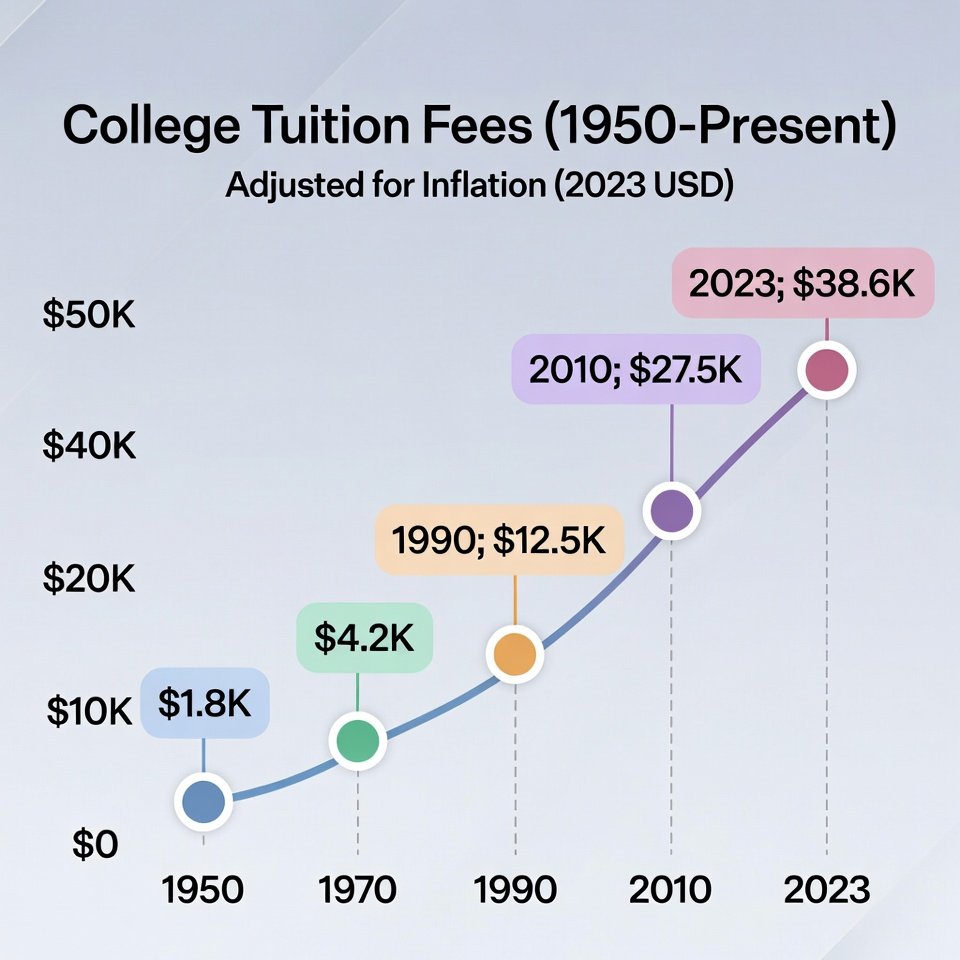
College tuition has exploded 1,200% since 1980 while wages rose just 213%. In 1963, a student could work a minimum-wage summer job and pay for a full year at the average public university. Today, that same job covers roughly one month of tuition. The culprit isn't corporate greed or underfunding. It's government intervention distorting every price signal in higher education. Federal student loans created artificial demand that universities exploited ruthlessly. When government guarantees endless credit to teenagers with zero income or assets, colleges face no market constraint on pricing. Why charge $3,000 per year when students can borrow $30,000? The money flows regardless of educational quality or job prospects. Universities responded predictably: they jacked up prices and hired armies of administrators to capture this guaranteed revenue stream. Easy credit always inflates asset prices, whether houses in 2005 or degrees today. Free market economists warned this would happen, just as they predicted the housing bubble. When you subsidize demand without increasing supply, prices skyrocket. Colleges simply absorbed every dollar of increased lending capacity into higher tuition, fancy dorms, and bloated bureaucracies. The 1950s model worked because students paid real prices with real money; either their own or their parents'. This created immediate feedback between cost and value. If Harvard charged too much, students went elsewhere. Today, that price mechanism is completely severed. Students don't feel the true cost until years later when loan payments hit, and by then universities already pocketed the cash. Every additional dollar of federal aid generates roughly 60 cents of tuition increases. The government created this monster, feeds it annually through increased lending limits, then acts shocked when colleges behave exactly like the rent-seeking cartels they've become.
Handre tweet media
English
175
633
1.6K
108K
Taylor J. Christensen, M.D.
Taylor J. Christensen, M.D.@DoctorTaylorJay·
Being 100% anti war without nuance is virtue signaling. Or maybe it's based in black-and-white thinking that is founded in ignorance of how the real world works. For example, consider this scenario: - You know another regime has as a primary explicit goal to destroy your country - You have reliable intelligence that that country is about to finish developing nukes and intends to use them on you - You're not confident that you'd be able to shoot the missiles down before they kill millions of your citizens - You have the intelligence on where they're developing their nukes and the technology to destroy those facilities Do you risk starting a war by bombing those facilities? I don't know if there are any good offensive reasons to start a war, but I think there can be good reasons to do pre-emptive defensive maneuvers. Does this mean I agree with what's going on with Iran? I don't know. I don't have enough information. But I do know that many wars America has started in the past have been for bad and selfish and deceptive reasons. So I'm highly suspicious of any justification a politician gives for starting or joining a war.
English
2
1
2
127
Taylor J. Christensen, M.D.
Taylor J. Christensen, M.D.@DoctorTaylorJay·
Natural selection is still active, it's just operating at the level of cultures and governments. Cultures that are still fostering high birthrates are succeeding, and the ones that have low birthrates are disappearing. So certain cultures are increasing their world share, demographically speaking. Governments that keep citizens sufficiently appeased and have good enough economic policies to generate sufficient wealth are succeeding because they have a lower likelihood of revolutions or foreign takeover. The weird interaction between these two layers of modern natural selection is that a more successful government usually means greater wealth, which leads to a drop in birthrates, so a successful government is like a fitness-reducer for the culture under its influence. And the weird thing with governments specifically is that the heavily wealth redistributing ones like communism and socialism are typically appealing to the masses (either because of the prospect of personally getting more wealth out of it or because of their ethical appeal), so those sorts of governments keep gaining power, but then they fail at appeasing the people when they devolve into totalitarian and/or poverty-ridden states, which leads to their collapse (natural selection culls them), but then they seem appealing again so they crop up again elsewhere. I suspect those sorts of failed government systems will keep cropping up in the competitive landscape of governments until everyone gets enough knowledge of history and economics to no longer support them. But we're not there yet. Heck, we seem to be getting further from that in North America as each successive generation gains more distance from the atrocities of socialism and communism. And even if we do get to the point where people no longer support those types of governments, then we have to deal with the issue of the more successful governments leading to greater wealth and dropping birthrates. Although maybe once we get to an age of abundance, birthrates will increase again.
Taylor J. Christensen, M.D. tweet media
English
1
1
2
60
Taylor J. Christensen, M.D.
Taylor J. Christensen, M.D.@DoctorTaylorJay·
@elonmusk I do wonder if the shift to demonizing billionaires instead of millionaires happened because many of those demonizing millionaires became millionaires themselves.
English
4
0
3
883
Say Jay Hynes
Say Jay Hynes@sayjayhynes·
@doctortaylorjay Agreed. Loving everyone is essential. Supporting, encouraging, or agreeing with their actions is not. Do no harm.
English
0
0
1
8
Taylor J. Christensen, M.D.
Taylor J. Christensen, M.D.@DoctorTaylorJay·
I learned from a recent discussion on X that if you preach tolerance (defined as treating someone with just as much love and respect regardless of how much you disagree with them), that can be mistaken for/assumed to be "suicidal empathy," which is pathological tolerance that invites the destruction of those exhibiting it by allowing themselves or others to be harmed. I guess this is a sensitive subject among many in America today. Therefore, I recommend preaching tolerance (we need so much more of it!), and, while doing so, I also recommend clarifying that being tolerant of all people in this world should not go along with allowing anyone to act on their beliefs in ways that harm others.
Kaizen D. Asiedu@thatsKAIZEN

This is awesome. Imagine if all politicians were this respectful in acknowledging beliefs outside of their faith.

English
2
0
2
33
Taylor J. Christensen, M.D.
Taylor J. Christensen, M.D.@DoctorTaylorJay·
Federalism is genius because it creates something that governments are otherwise insulated from--competition. Unfortunately, the highest level of government will never be subject to competition in the same way. So that's why a constitution is needed to keep it limited.
English
1
0
1
15
Say Jay Hynes
Say Jay Hynes@sayjayhynes·
@doctortaylorjay I love that it's two dads and their three daughters? One of which turns blonde in the positive future? Lol oh grok. But also why do you think 20 years and not 5-10, especially with potential impending nuclear war?
English
1
0
0
12
Taylor J. Christensen, M.D.
Taylor J. Christensen, M.D.@DoctorTaylorJay·
If the U.S. government finds a way to out-spend our economic growth--even with the impending digital intelligence revolution--then we are headed for a currency collapse. This could be in the next 20 years. What happens then? I think a revolution or other trigger for a fullscale regime change is unlikely. But maybe we will have learned the correct lesson from this long-term experiment with fractional reserve banking and fiat money and we will go back to letting the market manage our currency. I hope at that time there is also a fundamental restructuring of government, which should be unavoidable because it will have lost its unlimited looting mechanism (its fiat currency). So government will need to be cut back drastically. And maybe, just maybe, there will be the political will to make some serious amendments to our constitution to prevent government from ever getting there again. The main thing to prevent will be crony capitalism, especially from banks. I think that can be achieved to a great extent by severely restricting what government is allowed to do--if the government can't do something, then that favour cannot be bought. That would also keep it smaller and therefore simpler, which makes it harder to hide favours. And some major transparency requirements will also help. This path is probably better than a revolution. Because it seems like our human "fairness" genetic programming will channel the masses' revolutionary pressures into the social justice goal of creating public institutions that enact wealth redistribution rather than creating public institutions that increase economic freedom. And that would be disastrous for our economic health and technological progress. Also, the picture is what Grok Imagine thinks the two paths will look like. 😂
Taylor J. Christensen, M.D. tweet media
English
2
0
2
47
Taylor J. Christensen, M.D.
Taylor J. Christensen, M.D.@DoctorTaylorJay·
@WallStreetMav I worry that the additional wealth that the impending AI revolution will create will allow the economy to grow fast enough to prolong our misery in this terrible monetary system, maybe for decades.
English
1
0
2
132
Wall Street Mav
Wall Street Mav@WallStreetMav·
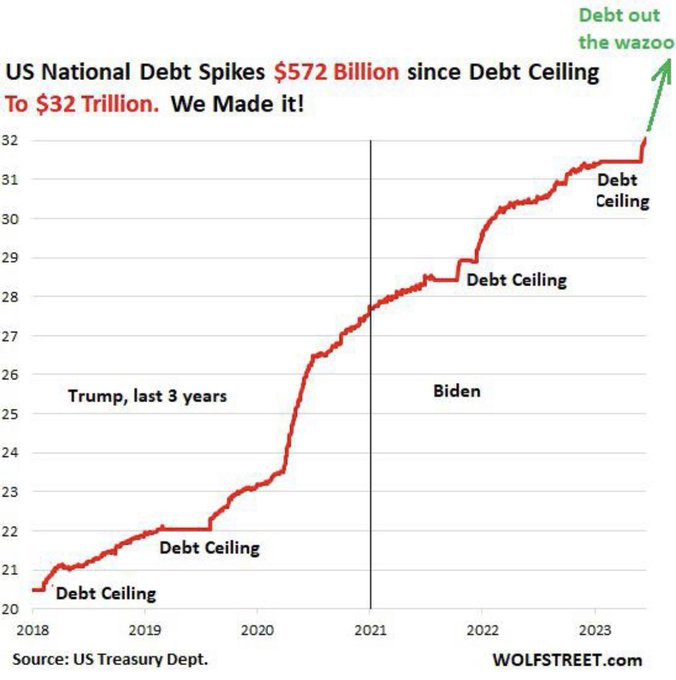
I came across an old post of mine from June 2023. I used this chart less than three years ago. We were just crossing $32 trillion in national debt. We are already over $39 trillion and likely to reach $40 trillion in the coming months with additional war spending. You probably don't own enough gold or silver. Everyone should consider owning some assets that will survive a monetary reset. I think within our lifetime there will come a day when the system won't keep funding additional debt for the USA, European countries and Japan. Massive inflation (via central bank money creation) is the only way they will be able to keep interest rates down. We all become less wealthy in that scenario. You protect yourself by owning hard assets that will still have value in the next currency.
Wall Street Mav tweet media
English
43
41
173
23.3K
Taylor J. Christensen, M.D.
Taylor J. Christensen, M.D.@DoctorTaylorJay·
There's been a lot of love for Japan on X recently. Two examples of why it's justified: 1. The culture of dignity and pride in the work they do is incredible. I was in Japan less than a year ago walking along a street with a lot of sweets shops. I looked into one of the shops and saw a Japanese worker very carefully and deliberately placing strawberries in a cup to have chocolate poured over them. She was making sure every cup was equally full and that there weren't any big gaps in between the strawberries. She would even pull some out sometimes if the gaps were too big. She had no idea I was observing her and being amazed. 2. Their customer service demonstrates a level of respect and consideration that is almost unheard of in the US. I recently ordered some essential oils from a Japanese company to scentify my Japanese style home office. When the bottle arrived, about half of it had leaked into the packaging. I reached out to customer service and not only did they respond very quickly, they were super thorough at apologizing (even to the extent of asking me if the oil had spilled on my clothes or anything else to see if they needed to help replace any of my stuff), and they also dug into the cause of the matter and followed up with me to explain what had happened. And to show their thanks and further apologize for everything, they sent me two new bottles instead of one. These are representative of the general Japanese culture. It's so much more than just a good source of anime.
Taylor J. Christensen, M.D. tweet mediaTaylor J. Christensen, M.D. tweet mediaTaylor J. Christensen, M.D. tweet media
English
2
0
3
30
Say Jay Hynes
Say Jay Hynes@sayjayhynes·
@doctortaylorjay I like using interventional better because it seems to get at the core of what central planning really is, which is intervening in a market.
English
0
0
0
7
Taylor J. Christensen, M.D.
Taylor J. Christensen, M.D.@DoctorTaylorJay·
Ludwig von Mises on how a single government intervention in a single market naturally leads to more interventions in more markets: "If the authority is not willing to remedy the evils created by such isolated intervention, by cancelling the price control measure, then it has to follow up this first step with further measures. . . . These regulations cannot be restricted to one or several branches of production only, but have to be expanded to cover all production." I've been using the term "central planning" to refer to any form of government intervention (like the ones Mises is talking about), but this misleads people into thinking I'm invoking USSR-type policies. So, moving forward, I'll probably stick with Mises' term, interventionalism.
English
1
0
1
27
Taylor J. Christensen, M.D.
Taylor J. Christensen, M.D.@DoctorTaylorJay·
@sayjayhynes True. But we've been programmed to say Twitter for a long time, and that's hard to break. Kind of inconvenient that the name changed.
English
1
0
1
9
Taylor J. Christensen, M.D.
Taylor J. Christensen, M.D.@DoctorTaylorJay·
Funny how you can tell a lot about someone's politics simply by whether they call this app X or Twitter. I hope one day the political aspects of that go away and everyone just calls it whatever the current owner decided to name it. If the next owner renames it back to Twitter, I'll switch back.
English
2
0
1
28
Say Jay Hynes
Say Jay Hynes@sayjayhynes·
@doctortaylorjay Cool graphic. Also, what are you using as evidence to back up your claims here in this post?
English
0
0
0
4
Taylor J. Christensen, M.D.
Taylor J. Christensen, M.D.@DoctorTaylorJay·
When Marxism was formulated as a theory in the 1800s, not enough evidence had accumulated to show just how much capitalism would drive innovation and how that innovation would enrich the lives of all people, including the proletariat. (Yes, with increasing inequality, but even so with a higher standard of living for all.) So the Marxist statement, "Capitalism requires poverty," was viable back then. But now we know that even with a "reserve army of labour," capitalism-driven innovation has made more and more workers' wages high enough above mere subsistence that they can live through unemployed periods without dropping into poverty and they can also invest their excess capital and slowly join the bourgeoisie. So while Marxism seeks to eliminate the bourgeoisie, capitalism can (slowly but eventually) elevate all members of society to their level.
Taylor J. Christensen, M.D. tweet media
English
1
1
1
76
Taylor J. Christensen, M.D.
Taylor J. Christensen, M.D.@DoctorTaylorJay·
@sayjayhynes If a world of abundance is not enough for you, then sure. But, in that case, I'd recommend prioritizing therapy over finding and saving potentially scarce items. 😂
English
1
0
0
6
Taylor J. Christensen, M.D.
Taylor J. Christensen, M.D.@DoctorTaylorJay·
Still thinking about abundance . . . There can never be universal abundance because there will always be things that are scarce, such as a one-of-a-kind original painting or a specific item with a unique provenance or front-row seats at an event or time with a specific individual. But, in the next 30 years or maybe less, I do think we can achieve general abundance where wealth becomes so plentiful that all humans can have all the things they need--and increasingly many of the things they want--without ever having to work. When wealth is plentiful, it can be given without the need for repayment, so money transactions will become uncommon except for the things that remain scarce.
Taylor J. Christensen, M.D.@DoctorTaylorJay

My understanding of the simplest path to achieving a society of abundance (i.e., a Christensen phase III society): - All wealth is originally generated through human labour plus natural resources (earth and sun so far) - The amount of wealth generated per unit of human labour increases with more technology, but it's still limited by the amount of human labour available - We can generate wealth faster if we supplement human labor with human-level (or higher) digital intelligence in the form of bots (in the digital world) and robots (in the physical world) - When those bots and robots become capable of building more bots and robots without requiring any significant human labour input, the amount of wealth generated will start increasing exponentially - Those bots and robots will also likely become superintelligent fairly quickly, which means they will also start accelerating our technological progress, which will further augment the amount of wealth generated per unit of machine labour (human labour will quickly become unnecessary) - To produce the initial bots and robots, we need to advance digital intelligence and robot manufacturing - Digital intelligence advancement will require a lot of compute, and compute (currently) requires a lot of energy - If energy is too expensive, our progress slows or completely stops because powering the chips to advance digital intelligence ceases to become a profitable endeavor So, in summary, the highest priorities right now for achieving a Christensen phase III society are . . . 1. Advancing digital intelligence 2. Advancing robotics 3. Increasing chip output 4. Increasing energy generation and decreasing energy costs Efforts toward number 4 are the most interesting to me right now. Some hypothesize that space solar (a satellite with solar panels on it) to directly power chips mounted on that same satellite will be the cheapest option. Assuming no major advancements in nuclear power, it's probably true. But it would require a decrease in the cost to orbit and an increase in our mass to orbit capacity. New heavy lift rockets will achieve that. And, theoretically, building these space solar satellites on the moon using primarily moon-based resources would also decrease the cost to orbit (less energy required to achieve escape velocity from the moon). It's all feasible. And, better yet, it's feasible within our lifetimes (unless you're already really old, sorry). Want a high-impact career? Any career that contributes to those four priorities above will probably be the highest impact. Although other careers that help our species survive until that point will also be pretty useful.

English
2
0
0
33
Taylor J. Christensen, M.D.
Taylor J. Christensen, M.D.@DoctorTaylorJay·
@maggiemoda I dunno, we might get to abundance soon enough that we can all do it without even feeling guilty. Then the crisis of purpose will ensue. x.com/i/status/20369…
Taylor J. Christensen, M.D.@DoctorTaylorJay

My understanding of the simplest path to achieving a society of abundance (i.e., a Christensen phase III society): - All wealth is originally generated through human labour plus natural resources (earth and sun so far) - The amount of wealth generated per unit of human labour increases with more technology, but it's still limited by the amount of human labour available - We can generate wealth faster if we supplement human labor with human-level (or higher) digital intelligence in the form of bots (in the digital world) and robots (in the physical world) - When those bots and robots become capable of building more bots and robots without requiring any significant human labour input, the amount of wealth generated will start increasing exponentially - Those bots and robots will also likely become superintelligent fairly quickly, which means they will also start accelerating our technological progress, which will further augment the amount of wealth generated per unit of machine labour (human labour will quickly become unnecessary) - To produce the initial bots and robots, we need to advance digital intelligence and robot manufacturing - Digital intelligence advancement will require a lot of compute, and compute (currently) requires a lot of energy - If energy is too expensive, our progress slows or completely stops because powering the chips to advance digital intelligence ceases to become a profitable endeavor So, in summary, the highest priorities right now for achieving a Christensen phase III society are . . . 1. Advancing digital intelligence 2. Advancing robotics 3. Increasing chip output 4. Increasing energy generation and decreasing energy costs Efforts toward number 4 are the most interesting to me right now. Some hypothesize that space solar (a satellite with solar panels on it) to directly power chips mounted on that same satellite will be the cheapest option. Assuming no major advancements in nuclear power, it's probably true. But it would require a decrease in the cost to orbit and an increase in our mass to orbit capacity. New heavy lift rockets will achieve that. And, theoretically, building these space solar satellites on the moon using primarily moon-based resources would also decrease the cost to orbit (less energy required to achieve escape velocity from the moon). It's all feasible. And, better yet, it's feasible within our lifetimes (unless you're already really old, sorry). Want a high-impact career? Any career that contributes to those four priorities above will probably be the highest impact. Although other careers that help our species survive until that point will also be pretty useful.

English
1
0
0
12
Maggie
Maggie@maggiemoda·
Humanity is going to have to get a lot better at self denial, because the temptations to waste away your life are getting stronger and more compelling.
Brecca Stoll@breccastoll

.@realDailyWire did its own research for the landmark Meta Social Media Addiction Trial. We asked college kids to tell us their screen time. “12 hours 47 minutes”

English
3
0
21
2.4K