Taylor J. Christensen, M.D.

1.2K posts

Taylor J. Christensen, M.D. banner
Taylor J. Christensen, M.D.

Taylor J. Christensen, M.D.

@DoctorTaylorJay

Physician, business strategist, revolutionary without a revolution. Govt, healthcare, sound money. I like exhaustive, mutually exclusive categorizations.

Katılım Eylül 2010
113 Takip Edilen236 Takipçiler
Sabitlenmiş Tweet
Taylor J. Christensen, M.D.
Taylor J. Christensen, M.D.@DoctorTaylorJay·
I made a community dedicated to crafting a constitution for Mars. It's mostly an opportunity for big-picture thinkers to collaborate so we can figure out how to (1) design an optimal government and (2) keep it that way. twitter.com/i/communities/…
English
0
0
19
1.6K
Taylor J. Christensen, M.D.
Taylor J. Christensen, M.D.@DoctorTaylorJay·
@DanManley5 @PerBylund Not exactly. As long as the patient pays more when they choose a more expensive provider (i.e., they need to pay at least part of the price differential between their different options), incentives are pretty well aligned.
English
0
0
0
4
Dan Manley
Dan Manley@DanManley5·
@PerBylund Can’t have competition when a third party pays. If everyone paid out of pocket, the cost would drop 95% the next day.
English
1
0
0
17
Per Bylund
Per Bylund@PerBylund·
If the government had allowed competition and entrepreneurship in healthcare, we would not be suffering from outdated standards and outrageous prices. Healthcare desperately needs to be subject to market forces.
English
18
59
331
9.7K
Taylor J. Christensen, M.D.
Taylor J. Christensen, M.D.@DoctorTaylorJay·
@deanstein12 @PerBylund I agree with it. And as for the people who don't agree with it, they don't understand how free markets work and how government has interfered with that. BTW, this doesn't mean we can't have universal access as well.
English
0
0
1
2
Drin Dajaku
Drin Dajaku@deanstein12·
@PerBylund Nobody agrees with this. Pretty much nobody. That's why healthcare won't change one bit in the next decades. It could get more State run.
English
6
0
1
177
Taylor J. Christensen, M.D.
Taylor J. Christensen, M.D.@DoctorTaylorJay·
Time for another reminder that profit is *usually* not evil. If profit is gained through exploitation or crony capitalism, it can rightly be seen as evil. But if it's gained through providing a good or service that is valuable to consumers, it can be rightly seen as virtuous. It's the reward of offering a higher-value solution to a job that people wanted done. But what about what the business owner does with that profit? Can that turn a virtuous profit evil? There are only three things the business owner can do with that wealth: save it, spend it (which includes giving), or invest it. Save it: Usually only done with a very small percentage of the wealth earned. Mostly for an emergency fund, like to cover 6 months of expenses. This is great. It prevents people from defaulting on loans or making imprudent and short-sighted business choices prompted by running out of personal funds. Spend it: If a business owner spends "too much" of their virtuously earned profit on themselves (like by choosing to live a lavish lifestyle), it can come to be seen as unfair or even "immoral." I dislike the judgment applied to how others "should" spend their money. An interesting fact about this spending is that the wealth they are spending is now getting redistributed to others in society. Isn't that what those calling the lavish lifestyle immoral want? Invest it: The more profit the business owner accumulates, the larger the percentage of their wealth that ends up going to investments. And since investments are the driver for innovation and, thus, for all further wealth improvements for the entire society and world, I think this use of their wealth is a great service to the country. And the owners of successful businesses are probably uniquely qualified to choose which other business ideas should be funded. If the people calling for socialism, wealth taxes, etc. would take but a few moments to think through the assumptions motivating the policies for which they advocate, maybe they would change their minds.
English
1
2
2
23
Taylor J. Christensen, M.D.
Taylor J. Christensen, M.D.@DoctorTaylorJay·
Teaching my kids about scientific thinking today: 1. Have a question 2. Think of possible answers 3. Gather evidence to determine which is the most likely answer to be correct I think most people don't know how to apply this simple process to their political opinions. Here's a question I recommend: "Which economic system would lead to the greatest quality of life for our society?" And don't forget to gather evidence before determining which one you think will be best. Hint: There's plenty of historical evidence about each system.
English
1
0
2
17
Taylor J. Christensen, M.D.
Taylor J. Christensen, M.D.@DoctorTaylorJay·
I've recently realized that self-driving cars will substantially accelerate innovation. Here's how: The cost of transportation is a primary factor in determining the potential size of a market for a company that sells physical goods. This is because when transportation costs are low, the value delivered by your product can even be competitive with the local options in far-flung places in spite of having to add extra transportation costs to the price. Larger markets allows economies of scale and centralizes resources for R&D to improve the value of the products being produced. Basically it maximizes the benefits of specialization through trade. So larger markets = more value-improving innovation. Self-driving cars will expand to self-driving trucks and other self-driving forms of transportation, which will substantially lower the cost of the transportation of goods in the form of lower labour costs and fewer accidents and damaged goods. Thus, expanded markets and more value-improving innovation. And this is on top of all the personal-life benefits to quality of life in enhanced safety and time saved. Thanks @Tesla for pushing this forward and generating all of these positive externalities!
English
0
0
1
13
Ironwood🌱
Ironwood🌱@ironwoodbook·
@DoctorTaylorJay That game teaches more about price discovery than most MBA programs. The knowledge is in the friction.
English
1
0
1
18
Taylor J. Christensen, M.D.
Taylor J. Christensen, M.D.@DoctorTaylorJay·
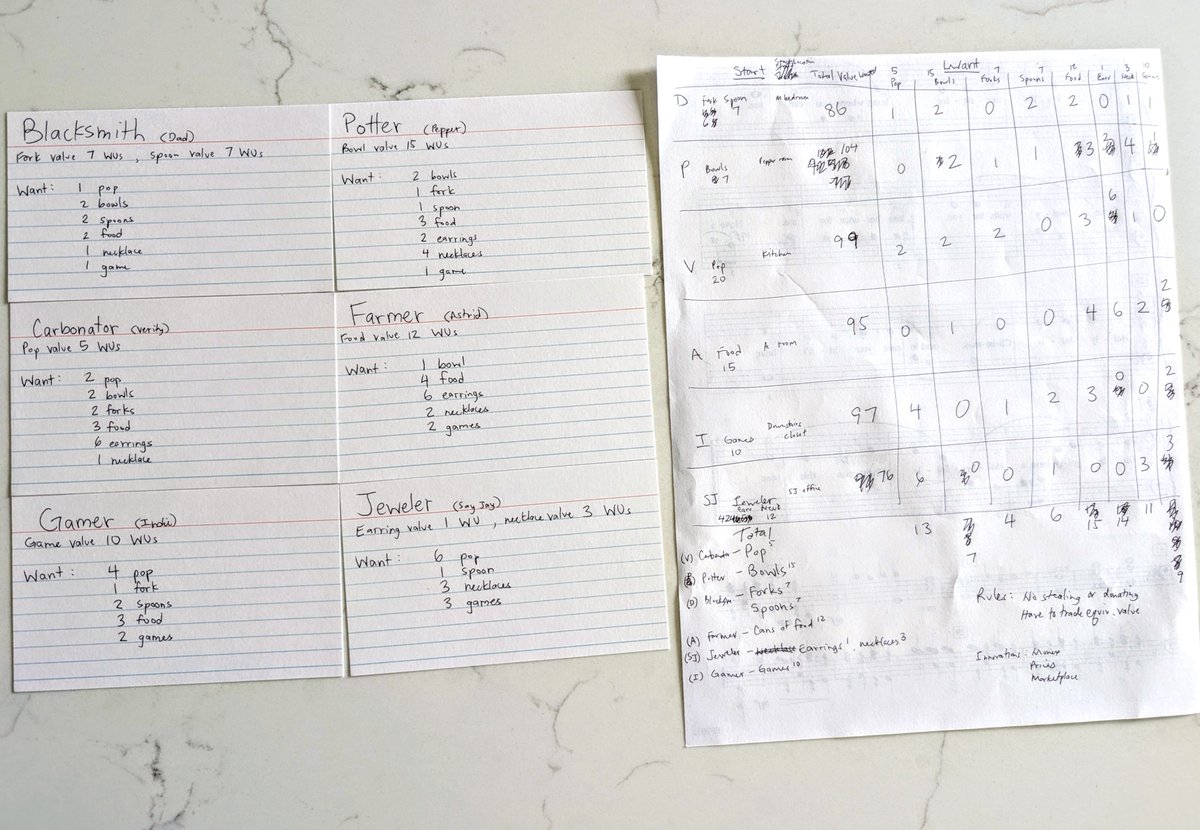
I'm teaching my kids economics for one of their homeschool classes. Today I created a game where they started with only one good and had to trade for other specific goods. I set the price of each good and only told that price to the one who started with that good. Then I gave them a rule that they can only make equivalent trades (and no stealing or donating), and I said "Go." They all started with enough wealth units to be able to buy everything they needed. I deliberately placed their starting stash of items in separate rooms. One was the jeweler, who had a bunch of earrings worth 1 wealth unit and necklaces worth 3 wealth units. The rest of the items were worth 5 or more wealth units and were mostly not simple price multiples of each other. They were frustrated at first because of a (deliberately designed) lack of coincidence of wants and a lack of money. They were also running around the house because there was no central marketplace. They took a full 30 minutes to complete the game. It was so interesting to watch market innovations start to arise organically throughout that time, including forming a centralized marketplace and starting to use the earrings and necklaces as money, all of which expedited trade. They didn't make a whole market price list, which I thought they might do, because they started memorizing the prices of everything through experience in the market. I guess I needed a greater variety of goods! The second time through, they used the innovations from the first time through and it only took 10 minutes to complete the game. I just hope our discussion afterward about markets and ways to make a market effective solidified the lessons so they can see clearly how these market mechanisms happen in the real world!
Taylor J. Christensen, M.D. tweet media
English
1
0
1
23
Taylor J. Christensen, M.D.
Taylor J. Christensen, M.D.@DoctorTaylorJay·
@Handre Is there no group of people working together to change this? Because a group can accomplish more than a bunch of individuals. Even the libertarian party doesn't seem to be achieving anything. I feel like we lack a rallying point.
English
1
0
2
19
Taylor J. Christensen, M.D.
Taylor J. Christensen, M.D.@DoctorTaylorJay·
I think he believes that after a person has accumulated a certain amount of wealth, the excess just sits there doing nothing. But what really happens is the vast majority if it gets invested. And investments into business is what drives wealth-improving innovations forward. To bring greater wealth for all. Take that away, and it's tantamount to an anti-investment (a short-term gain for a long-term greater loss). So that's what a wealth tax is. It's an anti-investment into our society's future wealth.
English
0
0
2
8
Taylor J. Christensen, M.D.
Taylor J. Christensen, M.D.@DoctorTaylorJay·
If you think of all physical things that have any value as simply different forms of wealth, and if you remember that money is simply another form of wealth (but a special one because it's useful to trade for other forms of wealth), then money becomes much less confusing. Try it next time you're struggling to figure out whether a statement about money is true.
English
1
1
2
59
Taylor J. Christensen, M.D.
Taylor J. Christensen, M.D.@DoctorTaylorJay·
I know there's a pretty good correlation between the S&P500 and the strength of the economy, but that decouples when there's a bubble. So I would say the value in the S&P500 looking good in spite of many of the top 10 (mostly AI-heavy companies) not being near their peaks is a good sign specifically because it suggests we're not in an AI bubble. Ever since you wrote about freight data being a good sign of a strong economy, I've been wondering about what the truly reliable indicators are. And I suspect you're right--trade is the basis for all wealth increases, so strong trade suggests wealth is growing.
English
0
0
0
93
Maxinomics
Maxinomics@maxinomics·
@DoctorTaylorJay Yes, it is a positive indicator of a strong economy. Dispersion adds to it
English
1
0
3
142
Maxinomics
Maxinomics@maxinomics·
It says a lot that the S&P 500 keeps hitting new highs with Meta, Microsoft, Lilly, Netflix, Tesla, and Oracle so far from their all-time highs
English
2
2
29
4.1K
Mark Havel
Mark Havel@LeConneatois·
@DoctorTaylorJay Great post good Doctor. If Verizon had their way, my cell phone would be the most important aspect of my life. This is also true of many others modern conveniences. It should be obvious to everyone that if we allow our government to control aspects of our lives, It will.
English
1
0
1
22
Taylor J. Christensen, M.D.
Taylor J. Christensen, M.D.@DoctorTaylorJay·
And organizations also don't have built-in morals to stop them from driving the humans in temporary control of them to do anything to sate that appetite. Unless maybe there's a founding document that specifies hard limits of the organization's growth and existence. For government, that's what a constition does. Ours has proven indequate to that task.
Taylor J. Christensen, M.D.@DoctorTaylorJay

@elonmusk There's nothing more power hungry than an organization. They have an intrinsic appetite for growth and immortality. That includes governments.

English
1
0
2
23
Taylor J. Christensen, M.D.
Taylor J. Christensen, M.D.@DoctorTaylorJay·
@elonmusk There's nothing more power hungry than an organization. They have an intrinsic appetite for growth and immortality. That includes governments.
English
0
0
1
42
Taylor J. Christensen, M.D.
Taylor J. Christensen, M.D.@DoctorTaylorJay·
There are many who gain from war. Not just the politicians who look good after securing reliable oil but also the military industrial complex (and the politicians supported by it) and the bankers who lend the money for it. At this point, I can't think of a good reason to go to war other than self-defense and probably pre-emptive self-defense. Stopping crimes against humanity that are being perpetrated by another regime is another consideration, but I wonder if, in the long run, more harm than good is done most of the time when that's the supposed objective.
English
0
0
1
12
Taylor J. Christensen, M.D.
Taylor J. Christensen, M.D.@DoctorTaylorJay·
Being 100% anti war without nuance is virtue signaling. Or maybe it's based in black-and-white thinking that is founded in ignorance of how the real world works. For example, consider this scenario: - You know another regime has as a primary explicit goal to destroy your country - You have reliable intelligence that that country is about to finish developing nukes and intends to use them on you - You're not confident that you'd be able to shoot the missiles down before they kill millions of your citizens - You have the intelligence on where they're developing their nukes and the technology to destroy those facilities Do you risk starting a war by bombing those facilities? I don't know if there are any good offensive reasons to start a war, but I think there can be good reasons to do pre-emptive defensive maneuvers. Does this mean I agree with what's going on with Iran? I don't know. I don't have enough information. But I do know that many wars America has started in the past have been for bad and selfish and deceptive reasons. So I'm highly suspicious of any justification a politician gives for starting or joining a war.
English
2
1
2
127
Taylor J. Christensen, M.D.
Taylor J. Christensen, M.D.@DoctorTaylorJay·
@WallStreetMav The thing is, the Dems will gain power again eventually. And they will revert policies made by the GOP. This cycle has being going on for decades, and the only progress we make is in increasing the number of pages of regulations and the number of people milking the system.
English
0
0
0
80
Wall Street Mav
Wall Street Mav@WallStreetMav·
Democrats are beginning to expand their midterm lead beyond polling margins of error for winning back control of Congress. If Republicans don’t pass the SAVE America Act, deliver mass deportations, and deliver more DOGE in the reconciliation bill, it’s going to be a bloodbath.
InteractivePolls@IAPolls2022

2026 Generic Congressional Ballot 🟦 Democrats: 46% 🟥 Republicans: 44% —— By Age (net) • 18-22: Dem +23 • 23-29: Dem +30 • 30-34: Dem +39 • 35-44: Dem +11 • 45-64: GOP +18 • 65+: Dem +4 @YalePolling | 3/9-23 | 3,429 RV

English
171
350
1.4K
64.6K
Taylor J. Christensen, M.D.
Taylor J. Christensen, M.D.@DoctorTaylorJay·
@TomSteyer I don't understand why politicians think that more interventionalism (read: central planning) will help. Maybe it's because they misdiagnose the source of the problems in the first place. Which was the first round of interventionalism.
English
1
1
6
87
Tom Steyer
Tom Steyer@TomSteyer·
Building one million homes. Single-payer health care. 25% lower electricity costs. I have a plan to address California's affordability crisis: tomsteyer.com/issues
English
300
65
502
79.9K
Taylor J. Christensen, M.D.
Taylor J. Christensen, M.D.@DoctorTaylorJay·
Natural selection is still active, it's just operating at the level of cultures and governments. Cultures that are still fostering high birthrates are succeeding, and the ones that have low birthrates are disappearing. So certain cultures are increasing their world share, demographically speaking. Governments that keep citizens sufficiently appeased and have good enough economic policies to generate sufficient wealth are succeeding because they have a lower likelihood of revolutions or foreign takeover. The weird interaction between these two layers of modern natural selection is that a more successful government usually means greater wealth, which leads to a drop in birthrates, so a successful government is like a fitness-reducer for the culture under its influence. And the weird thing with governments specifically is that the heavily wealth redistributing ones like communism and socialism are typically appealing to the masses (either because of the prospect of personally getting more wealth out of it or because of their ethical appeal), so those sorts of governments keep gaining power, but then they fail at appeasing the people when they devolve into totalitarian and/or poverty-ridden states, which leads to their collapse (natural selection culls them), but then they seem appealing again so they crop up again elsewhere. I suspect those sorts of failed government systems will keep cropping up in the competitive landscape of governments until everyone gets enough knowledge of history and economics to no longer support them. But we're not there yet. Heck, we seem to be getting further from that in North America as each successive generation gains more distance from the atrocities of socialism and communism. And even if we do get to the point where people no longer support those types of governments, then we have to deal with the issue of the more successful governments leading to greater wealth and dropping birthrates. Although maybe once we get to an age of abundance, birthrates will increase again.
Taylor J. Christensen, M.D. tweet media
English
1
1
2
60
Taylor J. Christensen, M.D.
Taylor J. Christensen, M.D.@DoctorTaylorJay·
@LeConneatois I appreciate that, Mark. I will keep striving so I can go from operating on a "pretty high level" to a "really high level." Goals. 😂
English
0
0
2
8
Mark Havel
Mark Havel@LeConneatois·
@DoctorTaylorJay Hello, good Doctor. Your mind operates at a pretty high level. People feel some sort of validation by criticizing things they don't know about. Graffiti seems to be in the same family of behavior.
English
1
0
1
19
Taylor J. Christensen, M.D.
Taylor J. Christensen, M.D.@DoctorTaylorJay·
One of the most interesting aspects of psychology on display on this platform is how quickly people who disagree with you jump to disparagement and judgement rather than curiosity. This is a simple manifestation of tribalism, which is programmed into all of us as the default.
ShortsGuy@4ft11clips

@doctortaylorjay @elonmusk He is responding to a post about an article where he imposed on billionaires and millionaires… Elon doesn’t care to inform you but your md doesn’t come with discernment huh ?

English
2
0
2
62