Scott Sullivan
1.6K posts

Scott Sullivan
@scottsullivan
MS Data Analytics | ML Engineer | Advancing Data from Descriptive to Predictive | Italy & US based, Designing AI systems that are smarter than your average bear

@davidgobaud The big breakthrough would be "in vivo" cell therapy manufacturing. That would almost certainly be a literal exponential reduction in cost. People are working on it. There have even been several high profile papers published just recently.


this is excellent >GitLab founder diagnosed with rare cancer (osteosarcoma) >standard care works but cancer comes back later >medical team says there's not much else to do >"It became my own job to keep myself alive. Nobody else was going to do it for me at this point" >starts researching, assembles his own medical team, uses AI for deep research >“I’ll talk to anyone, I’ll go anywhere, and I can be there anytime" to collect information >does as many diagnostic tests as he can find as often as he can (maximal diagnostics) >develops his own therapeutic ladder with repurposed drugs, personalized medicine, etc >Sid’s cancer currently in remission

Massive From component assembly to Lab assistant🧪 @KyberLabsRobots' superhuman hand demonstrates significant potential for application within clinical pathology laboratories: No teleop, powerful general capabilities It seamlessly executes complex, end to end laboratory workflow,encompassing tool manipulation, precision operations, and high-level planning,all in a single, continuous sequence. Perhaps in the hospitals of the future, pathology departments will no longer require a multitude of specialized devices; instead, a humanoid robotic system equipped with this hand could integrate existing workflows while offering vastly enhanced versatility.

Anthropic’s Claude #AI #Autonomously Grows Tomatoes for 100+ Days in Groundbreaking Experiment by @d33v33d0 #ArtificialIntelligence #MachineLearning #ML

He is right. AGI is here. I've said it's been here since last year. We can accept it or we can deny it. And I'm floored at those who are unaware of what AI can already do. Their eyes are closed to a siesmic shift that is already happening in humanity.

EXACTLY right. Plus, my analysis points to a bifurcation where there will indeed be an "Age of Abundance", but just for the top 10-20% who already have the finacial and/or knowledge head start, and who also know how to multiply their own productivity with AI. The rest? Think Elysium with the middle class pushed lower in a dystopian 'pod' and VR life (not unlike today where the majority go home to doom scroll or binge watch TV), and the lowest 10-20% fully unemployed due to AI and robotics (up from the average 4-8% today)

The impact of AlphaFold is going to be tremendous in coming decades. Truly incredible the DeepMind documentary caught the moment Demis & team chose to predict 200m+ shapes (and, also, the moment they released it to the world).


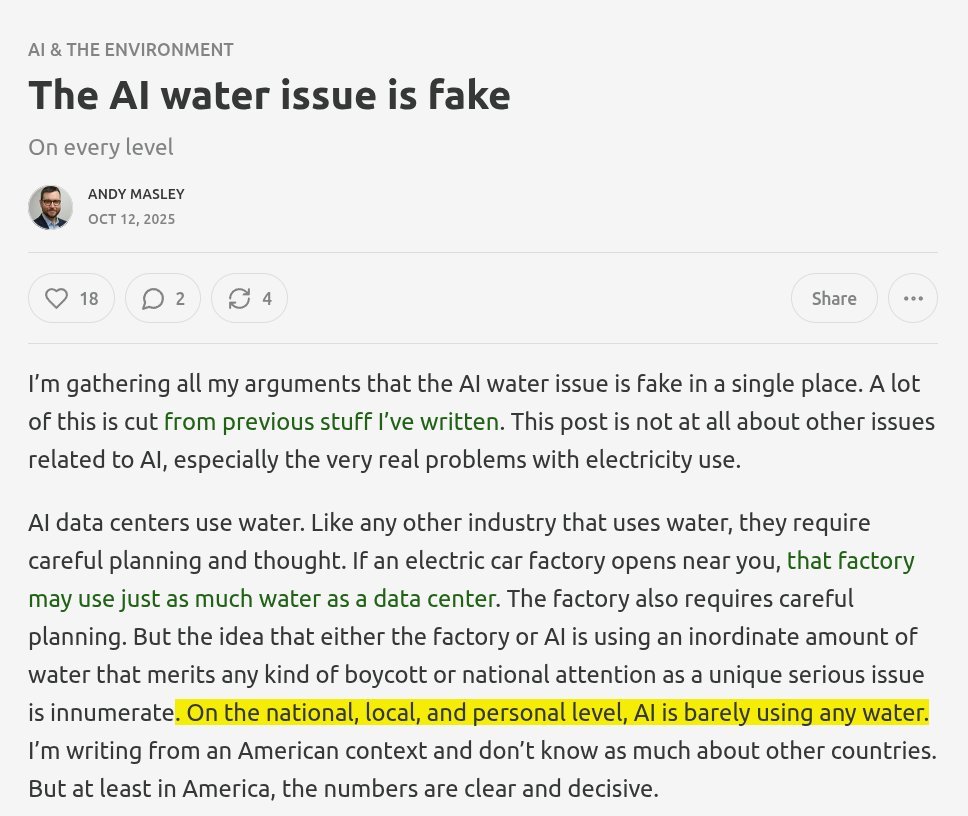
New paper on US data center water usages and future directions. - On a national level, data centers will continue to use a very small percentage of our total water supply by 2030 compared to farming and everyday public use. - However, companies currently use evaporative cooling because it saves massive amounts of electricity during hot summer days. This cooling method creates huge spikes in water demand that aging local public water systems simply cannot handle. - If we keep building data centers at this rate, United States towns will need up to $58 billion in new water infrastructure by 2030 just to prevent water shortages. - The findings show that data centers evaporate roughly 75% of the water they take from local public supplies. - The paper proposes a simple fix where tech companies must pay to expand local water capacity before they are allowed to plug in their servers. ---- Paper Link – arxiv. org/abs/2603.02705 Paper Title: "Small Bottle, Big Pipe: Quantifying and Addressing the Impact of Data Centers on Public Water Systems"

Proud with @UNSWRNA to have been involved & making the mRNA-LNP for Rosie. There are nuances here that the thread below misses but nevertheless, the intersection of RNA technology, genomic & AI poses an opportunity to change the way do medicine and make access more equitable 1/8


Jensen Huang on Palantir today. And Palantir today announced its colaboration with Nvidia. Palantir and NVIDIA will deliver sovereign AI operating system reference architecture.


EXACTLY right. Plus, my analysis points to a bifurcation where there will indeed be an "Age of Abundance", but just for the top 10-20% who already have the finacial and/or knowledge head start, and who also know how to multiply their own productivity with AI. The rest? Think Elysium with the middle class pushed lower in a dystopian 'pod' and VR life (not unlike today where the majority go home to doom scroll or binge watch TV), and the lowest 10-20% fully unemployed due to AI and robotics (up from the average 4-8% today)

The scariest thing about AI in 2026 isn't some sci-fi scenario. It's watching people you know — people with the same credentials, the same caliber — split into two completely different groups in a matter of months. I've seen it happen firsthand. Stanford grads, ex-Meta engineers, startup founders. Three months ago, they were all roughly at the same level. Now? The divergence is so obvious it's uncomfortable. Some of them got really good at AI. Not just "using ChatGPT" good — fundamentally different in how they think, work, and produce. Their output is compounding. Their depth of insight is compounding. They look like they're playing a different game entirely. Others are still running on the resume they built five years ago. And here's the number that haunts me: 99% of people still use AI at the level of "What's the weather today?" or "What kind of flower is this?" The 1% who figured it out aren't even one group. There's massive variance within them — some are orchestrating AI agents to run entire companies, some use it for research that would take a whole team, some have AI write half their code, some have AI write all of it. The income implications are brutal. If someone uses AI to produce the output of 10,000 people, they're worth 10,000x the salary. Someone who can't figure out a single tool? They might not be worth hiring at all. What really unsettles me is how fast our patience is eroding. The moment we feel someone performs below what AI can do, we don't think "they need training." We think "they're worth zero." Not less. Zero. So the real AI danger isn't AI going rogue. It's the epic, unprecedented amplification of the gap between people — in capability, in income, in relevance. One silver lining: the old hierarchy is broken. People who were once untouchable can now be overtaken by someone who masters AI faster. That door is genuinely open. But if you don't walk through it, you won't just fall behind by a little. You'll become invisible. #AISkillGap #FutureOfWork #ArtificialIntelligence #Productivity

EXACTLY right. Plus, my analysis points to a bifurcation where there will indeed be an "Age of Abundance", but just for the top 10-20% who already have the finacial and/or knowledge head start, and who also know how to multiply their own productivity with AI. The rest? Think Elysium with the middle class pushed lower in a dystopian 'pod' and VR life (not unlike today where the majority go home to doom scroll or binge watch TV), and the lowest 10-20% fully unemployed due to AI and robotics (up from the average 4-8% today)