SCREAM

843 posts

SCREAM banner
SCREAM

SCREAM

@scream_crypto

AI • MONEY • PSYCHOLOGY

Katılım Ağustos 2014
268 Takip Edilen183 Takipçiler
Cryton
Cryton@crytonbuton·
@scream_crypto VRAM-per-dollar is only half the battle. The software stack and workload fit will decide the winner.
English
1
0
1
14
SCREAM
SCREAM@scream_crypto·
Can 4 budget Intel GPUs for $4,000 completely replace an NVIDIA DGX Spark or AMD Strix Halo? Stacking four Intel Arc Pro B70s gives you a massive 128GB of VRAM. It looks like complete engineering overkill—but it’s the perfect example of how local AI is destroying the traditional PC market. The short answer? Yes, it can crush certain setups, but only if you are fighting the right bottleneck. However, the reality runs much deeper: this custom multi-GPU monster, the factory AMD Halo, and the high-end NVIDIA Spark are all engineered for entirely different tasks. One is optimized for raw memory capacity per dollar, while the other is built for blistering context processing and agent workflows. Where does this 4-GPU stack actually win, and where does it completely fail against official silicon from AMD or NVIDIA? To understand exactly which architecture fits your specific needs and how to find your ideal hardware setup, read the full breakdown 👇
SCREAM@scream_crypto

x.com/i/article/2078…

English
11
4
41
3.3K
SCREAM
SCREAM@scream_crypto·
@MargeryKetbj A good reminder that hardware decisions don’t end at checkout.
English
0
0
0
61
SCREAM
SCREAM@scream_crypto·
@yume_arasaki A good reminder that hardware decisions don’t end at checkout.
English
0
0
1
89
Yume_X
Yume_X@yume_arasaki·
I love the box designs looks like something out of Cyberpunk 2088 128GB VRAM for $4,000 looks great on a spec sheet. the missing line is 1,200W power draw at full load. assuming 24/7 runs trick is to cut the cap power draw, as inference doesn't need to use full power. cut that by 1/3 if you want a 6 hour measure that's $165/mo in electricity 24/7. plus 4,094 BTU/hr of heat dumped into your room, depending if this is a seaprate room, cold climate etc the spark gets you 128GB at 100W. $14/mo. same memory, 12x less power, but then the damn thing costs $4700, its all trade offs, the spark has terrible memory bandwidth so 1 spark makes no sense. VRAM per dollar, the arc wall wins. Arc is a "underdog" play, CUDA has all the latest toys
English
1
0
1
133
SCREAM
SCREAM@scream_crypto·
@kyzoroX The engineering is impressive, even if the risk isn’t for everyone!
English
1
0
1
80
KyzoroX
KyzoroX@kyzoroX·
Chinese workshops are pulling GPUs out of dead gaming laptops, soldering them onto homemade desktop boards, and selling them as a card that doesn't officially exist. They call it the RTX 4080M. It performs close to a real desktop 4080 and draws about 100 watts doing it. The legitimate card pulls triple that. That's the part worth sitting with. A salvaged laptop die on a hand-built PCB is three times more power efficient than the product NVIDIA ships — because mobile chips were engineered under a thermal budget and desktop chips never were. The catch list is long. No warranty. No official drivers — you install one-click third-party software just to make Windows see the card. No support if it arrives dead, and a real chance it does. So the trade is: cheaper, cooler, quieter, and completely on your own. For a home AI box that idles 20 hours a day, that power number is more interesting than it sounds. For anything you depend on, it's a coin flip with your money. Export controls closed the front door. The workshops started harvesting the parts that were already inside.
KyzoroX@kyzoroX

x.com/i/article/2076…

English
5
2
28
7K
SCREAM
SCREAM@scream_crypto·
@Yumzlef The edge isn’t predicting the future. It’s pricing uncertainty better than the market)
English
1
0
1
16
Yumzlef
Yumzlef@Yumzlef·
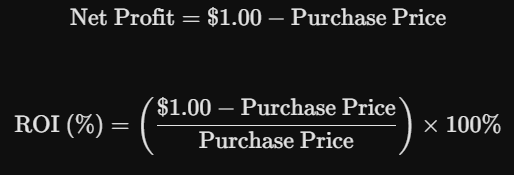
The Core Polymarket Formula: The Math Behind Making Millions While casual players treat Polymarket like an advanced sportsbook, professional traders view it as a pure binary options market. There are no traditional odds like 1.85 or +250 here. Everything relies on one simple, yet brilliant mathematical model. How the Mechanics Work On Polymarket, any event outcome is traded as a "Share" priced strictly between $0.00 and $1.00. If the event happens, the share settles at $1.00 (YES wins, NO drops to 0). If the event does not happen, the share settles at $0.00. The current share price in cents represents the market's real-time probability of the event. If Spain's shares are trading at 52¢, it means the market collectively assigns a 52% chance for Spain to win. The Core Profit Formulas To calculate net profit and return on investment (ROI) for holding a contract to market expiration, use these two basic formulas, which are included at the bottom of the post: A Quick Breakdown Let's say yesterday, amidst the panic over rumors of Lamine Yamal's minor injury, you faded the crowd, backed Argentina, and bought their "YES" shares at 45¢ ($0.45) for a total of $450 (which buys you 1,000 shares). The Outcome: Argentina wins the final. Every share you bought for 45¢ instantly becomes worth $1.00. The input for the second formula is written at the bottom of the post: The Result: Your $450 investment turns into $1,000. You walk away with $550 in pure profit. The Golden Rule Beginners Forget: You don't have to wait until the final whistle blows! If Argentina scores first, the price of their shares will instantly spike—say, from 45¢ to 75¢. You can sell your shares back to the market right then and there, locking in a 30¢ profit per share (a ~66% ROI) completely eliminating the risk of a late-game comeback. This extreme flexibility and predictable, linear math are exactly why the platform is a goldmine for news-based algorithmic speculation. To visually break down how these charts move, where the platform's liquidity comes from, and how to read price action in under 5 minutes, check out this quick guide on Polymarket mechanics. It explains the internal math clearly and shows exactly how traders find profitable entry points based on shifting probabilities.
Yumzlef tweet mediaYumzlef tweet media
Yumzlef@Yumzlef

x.com/i/article/2077…

English
4
0
11
497
SCREAM
SCREAM@scream_crypto·
@polyqoy This feels like the npm moment for AI agents. Really interesting.
English
0
0
0
5
Polyqoy
Polyqoy@polyqoy·
AI agents just got 36,000+ free skills, which is slightly inconvenient for everyone still selling a $199 “agent mastery” course. This open ecosystem lets you install reusable capabilities with a single command instead of explaining the same workflow to your agent every time it develops selective amnesia. There are skills for coding, research, voice interfaces, design, automation and thousands of painfully specific tasks nobody would bother building from scratch. The interesting part is not the number. Most of those 36,000 skills will probably be mediocre. The useful part is that agents can now borrow proven procedures instead of improvising every step from a vague prompt. That means the advantage is slowly moving away from “who has the smartest model” toward “who has assembled the best stack of skills, tools and context.” Apparently the next generation of software development is installing random abilities into an AI until it becomes strangely competent.
Polyqoy@polyqoy

x.com/i/article/2075…

English
2
0
7
182
SCREAM
SCREAM@scream_crypto·
@0xGenAi We’re quickly reaching the point where the model matters less than the system wrapped around it
English
1
0
1
21
GenAI
GenAI@0xGenAi·
stop testing Kimi K3 in a chat tab. plug it into an agent with hands. The setup is three moves: hermes model -> Moonshot -> log in with the coding plan. K3 becomes the brain, Hermes stays the hands. What that combo does in this video: /learn digests any guide into a reusable skill. Blender MCP turns a prompt into a 3D product promo. three K3 profiles on a kanban board ship a video: director, judge, builder. His coding side-by-sides match the front-end arena ranking: K3's output came out cleaner than Fable 5's and GPT 5.6's, at a fraction of the price. A cheap open brain plus cheap hands is the whole point. The 16-step guide to that stack ($5 VPS, $7 sub, a five-agent pipeline) is below. Bookmark this. Follow @0xGenAi
GenAI@0xGenAi

x.com/i/article/2078…

English
5
1
8
677
SCREAM
SCREAM@scream_crypto·
@themrgreenn I’d pick the bottleneck before I’d pick the hardware.
English
0
0
0
104
Mr Green
Mr Green@themrgreenn·
@scream_crypto What's the biggest bottleneck in your local AI workflow today: VRAM, unified memory, or CUDA?
English
1
0
1
123
SCREAM
SCREAM@scream_crypto·
@Yumzlef Markets don’t reward perfect teams. They reward the team most likely to win the next 90 minutes.
English
1
0
1
29
Yumzlef
Yumzlef@Yumzlef·
Argentina have won all seven matches at this World Cup They are the defending champions and were ranked No.1 in the world going in. On Sunday, against Spain, the market makes them underdogs. Spain 41.4%. Argentina 27.3%. Draw 31.3%. The market isn't wrong, and the reason is the phenomenon itself. Argentina have not dominated this tournament. They have survived it, then struck late: > Down 2-0 to Egypt deep in the second half - won 3-2 > Cape Verde and Switzerland both dragged to extra time > Down 1-0 to England at 55 minutes - won 2-1 with goals at 85' and 90' > The first team in World Cup history with multiple second-half stoppage-time winners in a single edition That is not a machine grinding teams down. That is a side that keeps finding the door at the last possible second - and the mechanism keeps being the same 39-year-old. Messi this tournament: 8 goals, 4 assists. He opened with a hat-trick against Algeria - the first of his entire World Cup career, at 38, eight days before his 39th birthday. Against Egypt he assisted the goal that started the comeback, then scored the equalizer himself four minutes later. Against England he assisted both goals. The career line is now absurd: 21 World Cup goals, an all-time record, two clear of Mbappé. 33 goal contributions in 33 World Cup matches. 31 appearances, more than anyone in the tournament's history. The only man to assist in five different World Cups. So does he deserve it? "Deserve" is the wrong frame, and his case is stronger without it. He already won in 2022. The sentimental debt is settled. He does not need a farewell gift, and treating this as one insults what he's actually doing. What he has instead is a claim made entirely of evidence. At 39, in his sixth and final World Cup, he is tied for the most goals in it, and his team is in the final because he assisted both goals in the semi. He is not being carried toward a trophy. He is the reason it is still reachable. Nobody deserves a World Cup. You take it. Sunday is the last time he can. Bookmark this before kickoff. The No.1 team on earth is a 27% underdog, and that's the most interesting number on the board.
Yumzlef@Yumzlef

x.com/i/article/2077…

English
11
0
24
3.5K
SCREAM
SCREAM@scream_crypto·
@Yumzlef Thank you 🫱🏻‍🫲🏼
English
0
0
1
18
SCREAM
SCREAM@scream_crypto·
Why build a $10,000+ local AI rig if a $600 Mac Mini types at the exact same speed? Looking at this beast Quad setup with dual NVIDIA Sparks and ASUS nodes, most people see an expensive flex. If you only measure text generation, they are right. In a basic chat, a cheap Mac Mini and a high-end enterprise node feel identical. But writing speed is a decoy. The real bottleneck is prefill—how fast the system reads giant local codebases, RAG pipelines, and agent histories before typing the first word. While the Mac Mini reads context at 564 t/s, a single DGX Spark obliterates it at 2,107 t/s. When you cluster multiple nodes together to run local autonomous agents like NVIDIA NemoClaw, that processing power scales into a completely different dimension. The full teardown below breaks down exactly what to choose for your specific tasks, so go ahead and read it.
KyzoroX@kyzoroX

x.com/i/article/2076…

English
7
5
11
1.2K
SCREAM
SCREAM@scream_crypto·
@semichenkko Every local AI setup has the same timeline: “Why isn’t this working?” → “I’m never paying API bills again.”
English
1
0
0
52
Semichenko
Semichenko@semichenkko·
This American creator is making $18,500 a month with his AI agency, but he just spent 6 HOURS copying and pasting code to get a single Openclaw bot running on a Mac Mini. 😭 Was it worth the struggle? 1000% yes. Because now, his Mac Mini is a 24/7 autonomous money printer, and his monthly OpenAI/Claude API bill is exactly $0. The Mac Mini M4 is the ultimate cheat code for local AI automation. It pays for itself by completely eliminating your SaaS costs. But you don't need to suffer through 6 hours of terminal errors and chaotic copy-pasting to set it up. I wrote a full guide on how to turn your Mac Mini into a cost-free AI node without losing your mind. Read the article here 👇
Shadow Nick@doublenickk

x.com/i/article/2073…

English
10
1
24
4K
SCREAM
SCREAM@scream_crypto·
@0xdimix The Mac Mini is the easy part. Finding a problem people will happily pay $5k/month to solve is the hard part.
English
0
0
0
28
DimiX
DimiX@0xdimix·
How to turn a regular Mac Mini into a $5,000/month business? Meet Max. He saw this lifehack and built a profitable business around it. Here is exactly what he does: Buys a new, compact Mac Mini M4 (16GB). Takes a powerful 26,800mAh power bank (with 100W output). 3D prints a custom mount that perfectly seamlessly connects the computer and the battery. But the hardware is only half the success. The real game-changer is the software. Max installs a powerful local AI model (like Qwen 2.5 or Llama 3) on this portable Mac. It runs completely offline, requires no subscriptions, and delivers insane generation speeds on Apple Silicon chips. The computer boots in just 8 seconds straight from the battery. Who is he selling this to?Companies and agencies that want to integrate AI into their workflows (document analysis, coding, client databases), but are absolutely terrified of leaking corporate data to cloud services like ChatGPT. Max sells them security and a turnkey solution. The client gets an autonomous AI brain they can leave in the office or toss in a backpack. Max rents these stations out on long-term contracts with tech support, generating stable monthly recurring revenue (MRR), or sells them outright with a high margin. The assembly cost is minimal, but the value to the business is massive. What do you think of this startup idea?
DimiX@0xdimix

x.com/i/article/2074…

English
70
44
237
21K
SCREAM
SCREAM@scream_crypto·
@imryven This is why Claude Code feels so different. It doesn’t replace the terminal—it becomes another user of it.
English
0
0
0
40
Ryven
Ryven@imryven·
The reason Claude Code keeps expanding beyond programming has nothing to do with coding. It has everything to do with the terminal. Developers don’t use the terminal because they like black windows. They use it because the terminal became the one interface every engineering tool agreed to speak. Git exposes commands. Docker exposes commands. Terraform exposes commands. So do kubectl, SSH, AWS CLI, and most deployment tooling. A command is more than something a human types. It’s a stable execution interface. The same command can be executed by an engineer, a shell script, a CI pipeline, a cron job, or an AI agent. That’s why the command line survived every new GUI. People and programs can both speak it. Over decades, software engineering quietly converged on one idea: if a task can be expressed as commands, it can be automated. Claude Code didn’t create a new way to automate engineering. It joined an ecosystem that was already built around automation. Once an AI can execute the same commands as an engineer, writing code becomes just one operation among many. Running tests, inspecting logs, applying migrations, provisioning infrastructure, reviewing pull requests, debugging deployments - they’re not different categories of work. They’re different command sequences.
Ryven@imryven

x.com/i/article/2072…

English
11
2
35
3.1K
Mr Green
Mr Green@themrgreenn·
A $599 Mac Mini generates tokens almost as fast as a $4,699 NVIDIA DGX Spark. Then why pay for the Spark? Not to make the chatbot type faster. Local AI performance is no longer about how many tokens flash on your screen. It’s about which bottleneck you are paying to remove. On generation speed, the Mini and DGX Spark look close (56 vs 84 t/s). Most people won't even feel the difference. But look at prefill — processing huge codebases, long conversation histories, and RAG pipelines before generation even starts. That’s 564 vs 2,107 t/s. The Mac Mini is the perfect, low-friction AI appliance for 24/7 routine tasks. The DGX Spark is a prefill beast built for heavy CUDA workloads, serious agents, and massive context. Stop benchmarking the wrong metrics. The full breakdown of how AI is creating a whole new class of computers (and how to actually choose yours) 👇
SCREAM@scream_crypto

x.com/i/article/2078…

English
2
0
2
63
SCREAM
SCREAM@scream_crypto·
@themrgreenn Thank you, I'm trying for you! AI should be understandable!
English
0
0
0
19
Mr Green
Mr Green@themrgreenn·
@scream_crypto Man, you’ve done a tremendous job - the article is simply amazing!
English
1
0
1
21
SCREAM
SCREAM@scream_crypto·
@polyqoy The smartest part isn’t the course—it’s creating the next generation of builders for your own ecosystem.
English
0
0
0
12
Polyqoy
Polyqoy@polyqoy·
Microsoft just dropped a completely free course on building AI agents. And no, it’s not another 40-minute tutorial where someone adds a loop to ChatGPT and suddenly calls it an “autonomous workforce.” The course includes 11 lessons on agent frameworks, tool use, RAG, planning, multi-agent systems, metacognition, trustworthy AI and actually shipping agents into production. Each lesson comes with videos, written guides and Python code. It’s also open-source and translated into multiple languages. Of course, Microsoft isn’t doing this purely out of kindness. Teach enough developers how to build agents, and Azure AI Foundry becomes the convenient place to run them. Free AI education. Still, this one looks genuinely worth taking.
Polyqoy@polyqoy

Microsoft quietly released an entire beginner course on AI agents for free, and it somehow got less attention than another chatbot generating a mediocre landing page. The course contains 11 lessons covering agent frameworks, tool use, agentic RAG, planning patterns, multi-agent systems, metacognition, trustworthy agents, production deployment, and MCP. Each lesson includes written material, code examples, videos, and extra resources. It also supports multiple languages and uses tools such as GitHub Models and Azure AI Foundry. That matters because most people currently “learning agents” are jumping between copied prompts, random X threads, and demos that never explain what is actually happening underneath. This will not turn someone into an AI engineer after one weekend. But it should at least kill the idea that an agent is just a chatbot connected to three APIs and given an impressive name. The course is public, structured, and made for beginners. The only inconvenient part is that you still have to finish it and build something afterward.

English
4
0
12
179