Selassie

458 posts

Selassie banner
Selassie

Selassie

@selassies2004

Katılım Şubat 2026
427 Takip Edilen18 Takipçiler
Selassie retweetledi
IGW
IGW@interstellargw·
Artemis II
IGW tweet media
CY
19
813
13.9K
115.6K
Selassie retweetledi
Chisomo Kalinga, PhD
Chisomo Kalinga, PhD@ChisomoWrites·
I feel like it’s such a shame we’ve lost connection with ancestral knowledge cuz what the fuck do you mean you tried to eat bee feces?
English
43
5.6K
146.8K
6.2M
Selassie retweetledi
NASA Solar System
NASA Solar System@NASASolarSystem·
POV: You're flying by the Moon. This visualization is designed to show you what exactly the Artemis II astronauts will see outside their window during their lunar flyby. Here, the seven-hour visualization is compressed into 28 seconds. ⬇ (1/4)
English
276
1.8K
12.6K
418.6K
Selassie retweetledi
Bear
Bear@Beargirl_1·
Sun worship is the oldest religion in existence
Bear tweet media
English
127
827
6.8K
92K
Selassie retweetledi
Archaeo - Histories
Archaeo - Histories@archeohistories·
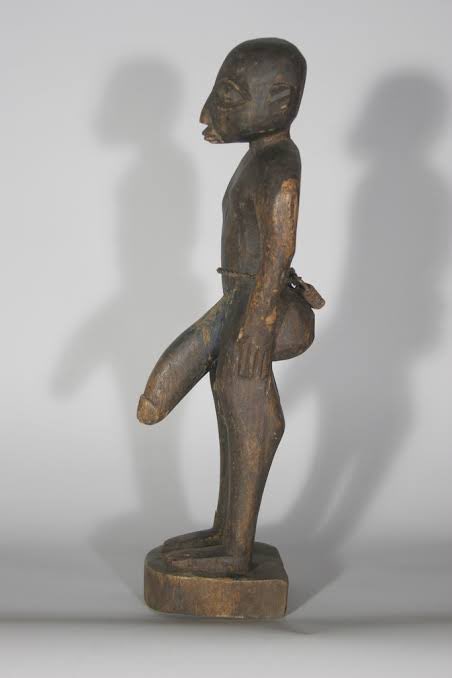
A traditional handcrafted West African wooden sculpture, likely a fertility figure or ritual object associated with themes of virility, potency, and spiritual power. It appears to be carved from dark hardwood (possibly with some pigment or patina remnants visible in the highlights), showing a standing male figure in profile with stylized, elongated proportions typical of many sub-Saharan African sculptural traditions. The prominent, oversized, and erect penis is a deliberate artistic choice common in certain African fertility or power figures. It symbolizes male generative force, life force, fertility, protection, or ancestral vitality rather than literal eroticism. Such motifs appear in sculptures from regions like West Africa (e.g., among the Fon of Benin/Togo, Yoruba-related Eshu/Elegba/Legba figures, or various groups in Nigeria, Burkina Faso, or Ivory Coast). Historically, these statues were kept in private family shrines. The exaggerated physical features are symbolic, representing fertility and the expectation of prosperity within the family unit. The figure has a slender, elongated torso and limbs, with one leg extended forward or appearing disproportionately long/bent. This creates a dynamic, striding stance. The head is stylized with simplified facial features (prominent nose, open mouth, defined ear), and the overall form is abstracted rather than naturalistic. There's a pouch, bag, or small calabash-like container attached or carved near the hip/back. This could represent a ritual container for medicine, offerings, or symbolic items (common in figures linked to trickster deities like Eshu/Legba, who often carry tools of communication or power). According to scholars, these objects representing ancestors, spirit spouses, or deities tied to fertility, protection, or crossroads/messaging between worlds. In some traditions (e.g., Fon Legba or related Yoruba Eshu), phallic imagery emphasizes creation, disruption, or life-affirming energy. They might be placed in fields, homes, or shrines to promote prosperity, ward off evil, or honor generative powers. Similar examples appear in museum collections or auction records from groups like the Fon (Benin), Lobi, Dogon, Baule, or Igbo, though exact attribution can vary without provenance. Many were carved in the 19th–20th Century for local use and later entered the art market. Some researchers stated that this object gave us the evidence about male circumcision in Africa. As male circumcision has a long and complex history in various African cultures. The practice dates back to ancient times, with evidence such as the image on the tomb of Ankhmahor around 2500 BC. Circumcision has been a significant cultural and religious ritual among many African communities. However, cultural practices can evolve over time. In some matrilineal Bantu-speaking communities in East and Central Africa, male circumcision has become less common or has ceased altogether. This shift may be influenced by various social, cultural, and historical factors. Private Collection #archaeohistories
Archaeo - Histories tweet media
English
18
85
686
32.9K
Selassie retweetledi
LAW 🅴
LAW 🅴@_lawslaw·
You think anyone would want to live with someone who will rent their house and make a mess of it and move out without even informing the landlord? You folks call us slow because we obey traffic rules, and you think we wanna roll with people like that? You lots have räpe festivals and you think anyone would want to associate themselves with people like you? You people are absolute degenerates. Just a handful of you are good to live with.
OLUCHI🫦 ( you have no funder)@Phatbabeluuu

Ghanaians are starting to move like South Africans, it’s not making sense

English
26
255
1.6K
94.1K
I am Me
I am Me@Kosiso_k·
@Andrew_AM1 Ghanaians avoid themselves abroad like plagues
English
4
0
4
400
André 👑
André 👑@Andrew_AM1·
Ghanaian’s are actually nicer to foreigners than their own countrymen lmao it’s crazy. This woman was acting all nice and asked if I’m African-American. I said no, I’m fully Ghanaian and the energy changed 😭😂😂
English
6
18
182
7.8K
Selassie
Selassie@selassies2004·
These are the people calling Ghanaians low iq btw
TENIOLA@Teeniiola

Many girls have reportedly been r@p£d and m0l£sted by men in Ozoro during what is being described as a “r@p!ng festival” in the area. According to multiple reports and videos circulating online, today is said to be the day of this festival in the Ozoro community, and girls are wvrned not to go outside. It is alleged that any girl seen outside could be att@ck£d and r@p£d by groups of men. Foreigners who are unaware of this situation have reportedly fallen v!ctim as well. There is Delta state university in Ozoro, and many female students may not be fully aware of the d@nger. It is distvrbing that something like this could be tolerated in society. This is heartbreaking, and urgent action needs to be taken.

English
0
0
0
3