Senthilnathan K

308 posts

Senthilnathan K banner
Senthilnathan K

Senthilnathan K

@senthsei

Founder @Sudotank - Building Euler, the Data Engine for Physical AI.

Katılım Şubat 2018
787 Takip Edilen56 Takipçiler
Sabitlenmiş Tweet
Senthilnathan K
Senthilnathan K@senthsei·
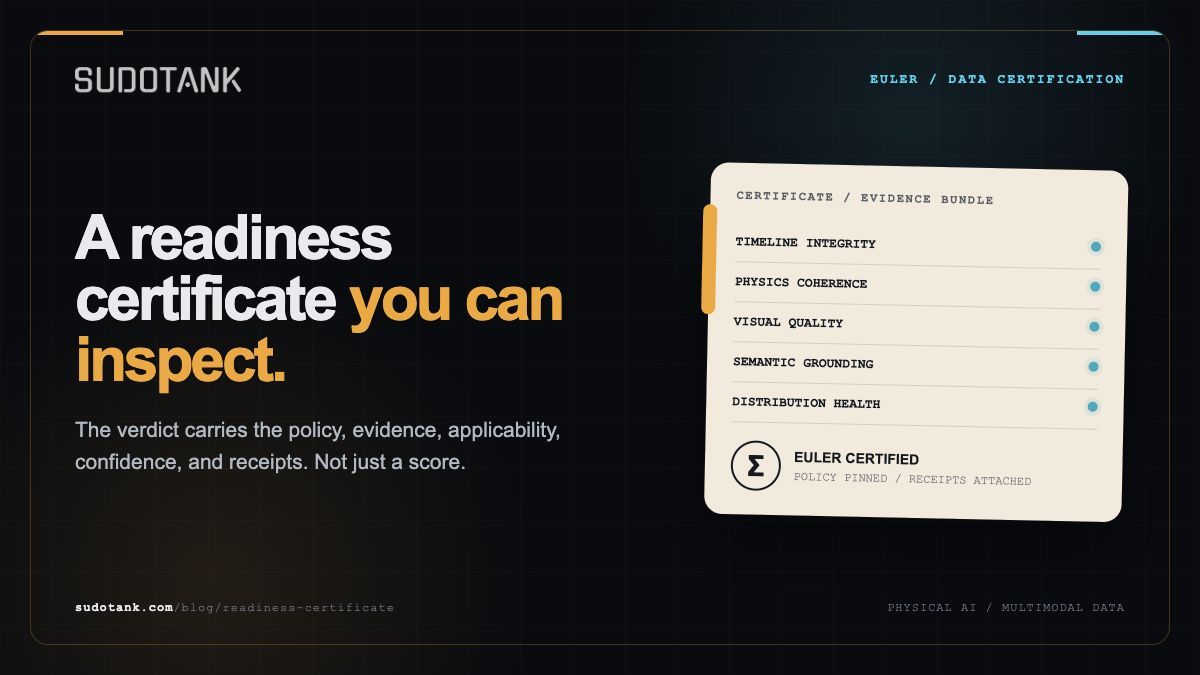
1/ Euler's technical whitepaper is live. excited to finally share this. The claim is simple: robot data should not reach training just because it exists. It should prove it is ready. We measured Euler on real teleoperation data, controlled faults, and ground truth.
Senthilnathan K tweet media
English
6
0
1
7.6K
Senthilnathan K
Senthilnathan K@senthsei·
@lucyjcai We’re doing similar work + more layers, high time we have a standard benchmark for automated labelling/curation to help us compare and keep improving on the quality.
English
0
0
0
9
Lucy Cai
Lucy Cai@lucyjcai·
today we're launching automatic captioning at Instance. send us your robot data, and every episode is segmented into captioned subtasks, graded success/fail plus 1-5 on quality and speed. if this could be useful for you, reach out and we'll caption an episode for free!
English
17
19
183
12.1K
Senthilnathan K
Senthilnathan K@senthsei·
@demishassabis Knot-tying is the real signal here. It forces continuous physical reasoning under uncertainty, not just discrete actions. Pair that with multi-robot coordination and the “one brain for any robot” idea starts to feel concrete.
English
0
0
1
25
Demis Hassabis
Demis Hassabis@demishassabis·
Gemini Robotics 2 is here, with our new suite of models, robots can now reason through every movement to manage tasks that weren’t possible before, like tying delicate knots - and even team up to solve complex workflows. Huge congrats to the robotics team on this great milestone!
Google DeepMind@GoogleDeepMind

One brain. For any robot. 🤖 We’re launching Gemini Robotics 2: our next-generation physical AI bringing full body intelligence to humanoids, advanced dexterity, multi-robot teamwork and more.

English
164
409
3.8K
298.9K
Senthilnathan K
Senthilnathan K@senthsei·
Absolutely, data is still a serious bottleneck, and the messier truth is that most of what gets collected never reaches a state where it’s actually usable for training. That’s the gap we’ve been working on with Euler at Sudotank: turning raw multimodal robot logs into structured, scored, and transformed datasets that can actually feed VLAs and policies instead of sitting idle.
English
0
0
1
37
Yu Xiang
Yu Xiang@YuXiang_IRVL·
If you work on robotics or embodied AI, you (like me) may wonder: when and how can we have models like Kimi K3 for robots? I feel the data scarcity problem in robotics is very serious. If we don't have the data, how can we fully explore what these models are capable of? Today, only a few organizations have relatively large-scale robot datasets (e.g., Sunday, Generalist). Most academic labs are still working with relatively small datasets collected independently. Meanwhile, robot data companies are collecting data, but it's still unclear how to best leverage that data to train general-purpose robot models. We still need to figure out how to solve the robot data problem.
Kimi.ai@Kimi_Moonshot

Releasing the model weights and technical report of Kimi K3. Kimi K3 is our most capable model: a 2.8T MoE model with native visual understanding and a 1M-token context window. New model architecture: 2.5x the intelligence per unit of compute, not just more params. Alongside Kimi K3, we're opening up more of the stack behind it — high-performance attention kernels, MoE communication library, and infrastructure for running agent environments at scale. Model weights: huggingface.co/moonshotai/Kim… Tech report: github.com/MoonshotAI/Kim… Tech blog: kimi.com/blog/kimi-k3

English
13
8
94
17K
Senthilnathan K
Senthilnathan K@senthsei·
In recent pilots, Euler surfaced duplicated timestamps and companion-stream mismatches before training. The policy, receipts, diagnostics, applicability, confidence, and exclusion logic travel with the verdict. sudotank.com/blog/readiness…
English
0
0
0
19
Senthilnathan K
Senthilnathan K@senthsei·
It returns four honest verdicts: certified, review required, not ready, and not assessable. Missing evidence stays visible. It cannot disappear inside an average or become a passing value.
English
1
0
0
21
Senthilnathan K
Senthilnathan K@senthsei·
A robot dataset can look clean and still hide a broken clock, a mismatched stream, an unreliable caption, or a narrow distribution. We built Euler Data Certification so the verdict carries evidence, not just a score. Thread:
Senthilnathan K tweet media
English
1
0
0
42
Senthilnathan K
Senthilnathan K@senthsei·
@drfeifei Sim engines seem to be the obvious training ground given that scaling hardware is still a huge bottleneck, excited to try this out!
English
0
0
0
123
Fei-Fei Li
Fei-Fei Li@drfeifei·
In our taxonomy of world models, we called the simulator the linchpin: the place where agents can act, learn, and be evaluated. Our R2S2R engine can move robot development beyond slow, expensive, hardware-bound iteration toward more scalable and cheaper training and evaluation. worldlabs.ai/blog/real-to-s…
English
6
6
69
10.9K
Fei-Fei Li
Fei-Fei Li@drfeifei·
When SceniX joined World Labs, we said spatial intelligence was never only about perceiving and generating virtual and physical worlds, but also interacting with them. Today, we’re sharing early results from that vision: building worlds that train robots. 🌎🤖↓
English
33
113
828
242.5K
Hanming Ye
Hanming Ye@DozenDucc·
Introducing Waddle Labs: Claude Code for robots. Connect our API to your robot and enter a prompt, then our agents write code to achieve the task in 20 minutes. @yiding_song @theWaddleLabs
English
200
231
2.4K
676.9K
Senthilnathan K
Senthilnathan K@senthsei·
@antopatrex1 An LLM wrapper using code-as-policy is great only till they realise how expensive or inefficient it gets to trace back and loop until failed tasks turn successful unlike a typical programming agent and doing that generally across embodiments via skills would be pain-staking.
English
0
0
1
103
Anto Patrex
Anto Patrex@antopatrex1·
a pre-seed team with an API key can now replicate what billion dollar robotics labs spent years and hundreds of millions building. 20 minutes to get a robot doing real tasks. the entire physical AI moat just got cooked and most VCs haven't priced it in yet.
Hanming Ye@DozenDucc

Introducing Waddle Labs: Claude Code for robots. Connect our API to your robot and enter a prompt, then our agents write code to achieve the task in 20 minutes. @yiding_song @theWaddleLabs

English
13
6
191
35.2K
Karolina Dubiel
Karolina Dubiel@karolina_dubiel·
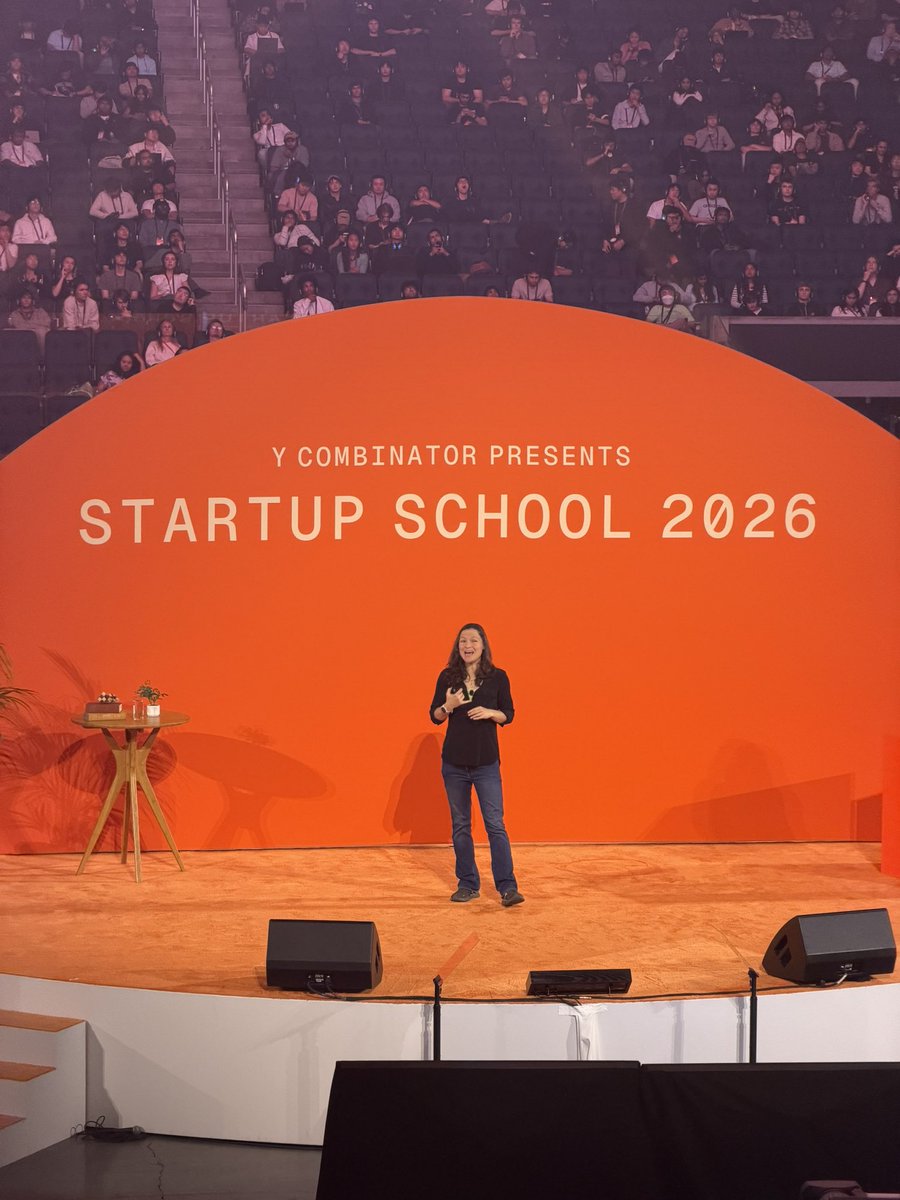
Highlights from Chelsea Finn’s (@physical_int Co-Founder) talk at YC Startup School: > RL for robotics is bottlenecked by physical rollout cost, not just algorithm quality. 1M trajectories of a 1-minute task would take ~700 robot-days, which makes direct scaling of PPO/GRPO-style methods fundamentally different from LLM post-training. > Memory is still a major missing piece in robot foundation model: most SOTA systems have effectively zero memory, and naive video history is too expensive (10s at 50Hz across 4 cameras ≈ 500K tokens). π solves this through short-term video memory plus long-term text summaries of the prior 10–15 minutes, which enabled a fully autonomous multi-step kitchen cleaning task. > Generalist robot models may already be beating specialist pipelines: π0.7 mixed demos, rollouts, human video, and web data, then used rich prompting + metadata to make even lower-quality data useful — and it matched/outperformed fine-tuned specialists while showing compositional transfer to new tasks/platforms. @chelseabfinn Thank you for the great talk!!
Karolina Dubiel tweet mediaKarolina Dubiel tweet media
English
16
33
507
68.4K
Varun Nair
Varun Nair@_varunnair·
Universal Manipulation Exoskeleton operated Teleop picking and passing a beer Robot Party Time?
English
1
4
29
4.5K
Eric Jang
Eric Jang@ericjang11·
Free my boy 100B Gemma 4
English
6
0
39
7.9K
Senthilnathan K
Senthilnathan K@senthsei·
Sudotank is now a member of NVIDIA Inception. Thank you, @NVIDIA. We will put the program's developer tools, technical resources, and startup ecosystem to accelerate progress on Euler, the data layer for physical AI. sudotank.com
Senthilnathan K tweet media
English
0
0
0
84
Senthilnathan K
Senthilnathan K@senthsei·
@HaiyuWu1 Yes, it would be challenging to have this latent architecture translate action learning to other complex tasks in dynamic uncontrolled environments unlike computer-use.
English
0
0
1
161
Haiyu Wu
Haiyu Wu@HaiyuWu1·
Learning causality from internet videos in latent space first, and then using RL to teach the foundation model how to act. This approach is 30× cheaper than Gemini 3.1 Flash on pretraining and achieves a better result. JEPA is all you need! However, actions are still learned during post-training. Figuring out how to automatically learn actions without action labels is still very important!
Induction Labs@induction_labs

We’re introducing imagination models: a new foundation model architecture that unlocks learning from internet-scale video. Our first imagination model, Photon-1, learned to use a computer by watching 18 years of screen recording video without action labels.

English
16
32
408
57.2K