Sarvesh Patil

865 posts

Sarvesh Patil banner
Sarvesh Patil

Sarvesh Patil

@servo97

Your friendly neighborhood PhD in Robotics @CMU. Dexterous Manipulation | Generative Control | Reinforcement Learning

Pittsburgh, PA Katılım Kasım 2014
578 Takip Edilen305 Takipçiler
Sarvesh Patil retweetledi
Gokul Swamy
Gokul Swamy@g_k_swamy·
This post elucidates a couple of things that have been troubling me: ergosphere.blog/posts/the-mach…. I believe people are *always* the ends, not the means of research. When we start to automate away "good friction," I think we compromise on the true objective for short-term proxy gains.
English
2
6
41
4.9K
Sarvesh Patil retweetledi
Anurag Ghosh
Anurag Ghosh@anuragxel·
God tier talk by Prof. Max Simchowitz. The insight that action chunking ensures we are in the scenario of incremental stability is very cool. His talk understates how it helps bridge the asynchrony gap (Pi's Real-Time Action Chunking as Inpainting). youtube.com/watch?v=UX1YXc…
YouTube video
YouTube
English
1
1
2
244
Sarvesh Patil retweetledi
Uksang Yoo
Uksang Yoo@UksangYoo·
Excited to share SoftAct, a framework for retargeting human manipulation demos to soft robot hands using explicit contact force reasoning! How do you transfer human skill to a hand that looks and moves nothing like yours🐙🖐️? It turns out VR environments can let us capture privileged force interaction demonstrations to help. 🧵1/7
English
5
42
133
18.8K
Sarvesh Patil retweetledi
Ai2
Ai2@allen_ai·
MolmoBot, our open robotic manipulation suite trained entirely in simulation, now has code, training data, a data generation pipeline, & evals all available. This puts our robotics models within reach of any research lab—no extensive real-world data collection required. 🧵
Ai2 tweet media
English
9
36
236
52K
Sarvesh Patil retweetledi
Yuke Zhu
Yuke Zhu@yukez·
Today, we publicly released RoboCasa365, a large-scale simulation benchmark for training and systematically evaluating generalist robot models. Built upon our original RoboCasa framework, it offers: • 2,500 realistic kitchen environments; • 365 everyday tasks (basic skills + long-horizon mobile manipulation); • Over 3,200 objects with many articulated fixtures/appliances. All are designed for fully controlled, reproducible benchmarking of robotic policies. Progress in robotic foundation models is real. But it’s still hard to answer basic questions like: How close are we to general-purpose autonomy? What factors drive generalization? What are the model/data scaling curves like? Real-world eval is slow and noisy, and existing sims (like LIBERO, which we built 3 years ago) often lack sufficient task and scene diversity. This benchmark comes with 2,200+ hours of demonstrations and 500K+ trajectories to support studies of multi-task training, pretraining, and continual learning at scale. Check it out at robocasa.ai
English
13
60
335
21.5K
Sarvesh Patil retweetledi
Quanting Xie
Quanting Xie@DanielXieee·
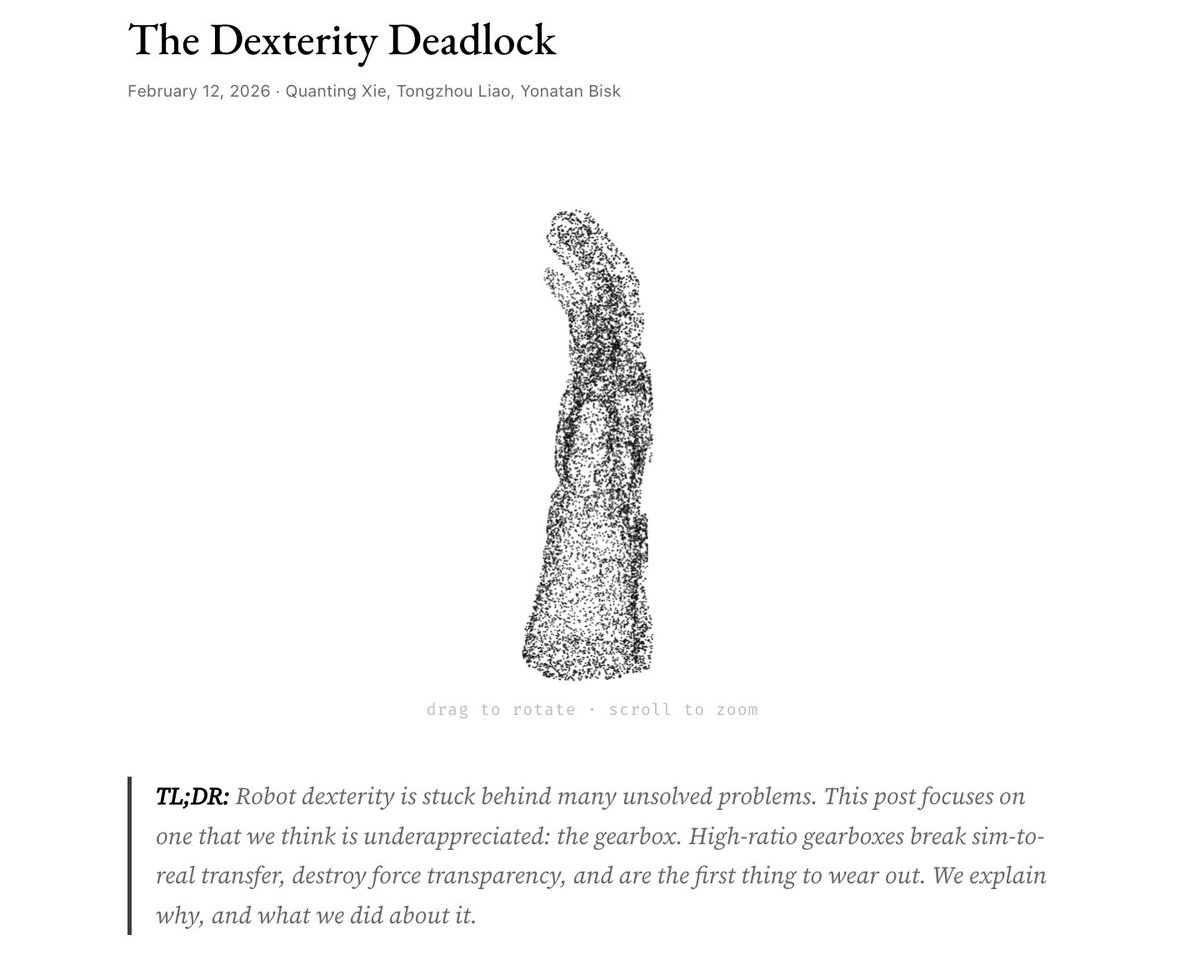
Why does manipulation lag so far behind locomotion? New post on one piece we don't talk about enough: The gearbox. The Gap You've probably seen those dancing humanoid robots from Chinese New Year. Locomotion isn't entirely solved; but clearly it's on a trajectory. But we haven't seen anything close for manipulation. 𝗪𝗵𝘆? When sim-to-real transfer fails, the instinct is to blame the algorithm. Train bigger networks. Crank up domain randomization. Those approaches have made real progress; we don't deny that. But we started wondering: are we treating the symptom or the disease? The Hardware Bottleneck: Fingers are too small for powerful motors. So most hands use massive gearboxes (200:1, 288:1) to get enough torque. But those gearboxes break everything manipulation needs:   • Stiction and backlash are complex to simulate. Policies trained on smooth physics hallucinate when they hit that reality.   • Reflected inertia scales as N². At large gear ratio, the finger hits with sledgehammer momentum.   • Friction blocks force information. The hand becomes blind. And they're the first thing to break. What we are trying to build at Origami, we cut the gear ratio from 288:1 to 15:1 using axial flux motors and thermal optimization. The transmission becomes more transparent: backdrivable, low friction, forces propagate to motor current. Early signs are encouraging. Still running quantitative benchmarks. Why Interactive? I love how Science Center uses interactive devices to explain complex ideas. I want to borrow this concept and help people understand the hard problems in robotics better visually. The post has demos where you can toggle friction, slide gear ratios, watch the sim-to-real gap widen in real-time. What's inside:   • Interactive demos (friction curves, N² scaling, contact patterns)   • Comparison table: 14 robot hands by sim-to-real gap and force transparency   • The math behind why low-ratio matters Read it here: origami-robotics.com/blog/dexterity… We're not claiming we've solved dexterity. The deadlock has many pieces. But we think this one's foundational. Curious what you think.
Quanting Xie tweet media
English
24
101
655
145.3K
Sarvesh Patil retweetledi
Max Simchowitz
Max Simchowitz@max_simchowitz·
My friends @elvisnava and @mimicrobotics (makers of awesome robot hands 🧤) just put out a video-first VLA. 📹📹 Motivation: A bitter-lesson alternative to retargeting, and a path to cross-embodiment. Key Idea: Nvidia Cosmos backbone with T5 text encoder, and but pre-train from RGB rather than low-dim actions. Low-Dim actions only needed for a lightweight flow-decoder for task-specific fine-tuning. Benefits: Opens to the door for human data collect with off-the-shelf cloth gloves (and maybe soon, YouTube!), leverages internet scale video, embodiment agnostic. Excited to see where you go next!
Elvis Nava@elvisnavah

Today @mimicrobotics and friends are excited to share mimic-video, a new class of Video-Action Model that elevates video model backbones as first class citizens for robot learning!

English
4
14
114
8.9K
Sarvesh Patil retweetledi
Max Simchowitz
Max Simchowitz@max_simchowitz·
👋👋New Generative Modeling Paper from @electronickale and @KeelyAi04: Evaluating sample likelihoods is a fundamental primitive in flow-based generative modeling . Now we can compute them faster. Much faster. Like 10-100x faster. ✈️✈️ Check out our new work on fast likelihood distillation, F2D2, lead by Kelly and Xinyue, together with @_albertgu , @rsalakhu, @zicokolter, and @nmboffi . And stay tuned for more in this direction in the next few months 😉 (And: @KeelyAi04 's applying to grad school and she is aawesome)
Yutong (Kelly) He@electronickale

Diffusion/Flow-based models can sample in 1-2 steps now 👍 But likelihood? Still requires 100-1000 NFEs (even for these fast models) 😭 We fix this! Introducing F2D2: simultaneous fast sampling AND fast likelihood via joint flow map distillation. arxiv.org/abs/2512.02636 1/🧵

English
2
18
100
11.4K
Sarvesh Patil retweetledi
Yutong (Kelly) He
Yutong (Kelly) He@electronickale·
Diffusion/Flow-based models can sample in 1-2 steps now 👍 But likelihood? Still requires 100-1000 NFEs (even for these fast models) 😭 We fix this! Introducing F2D2: simultaneous fast sampling AND fast likelihood via joint flow map distillation. arxiv.org/abs/2512.02636 1/🧵
Yutong (Kelly) He tweet media
English
9
71
430
119.2K
Sarvesh Patil retweetledi
Chaoyi Pan
Chaoyi Pan@ChaoyiPan·
Generative models (diffusion/flow) are taking over robotics 🤖. But do we really need to model the full action distribution to control a robot? We suspected the success of Generative Control Policies (GCPs) might be "Much Ado About Noising." We rigorously tested the myths. 🧵👇
English
16
94
546
109.2K
Sarvesh Patil retweetledi
Chaoyi Pan
Chaoyi Pan@ChaoyiPan·
🕸️ Introducing SPIDER — Scalable Physics-Informed Dexterous Retargeting! A dynamically feasible, cross-embodiment retargeting framework for BOTH humanoids 🤖 and dexterous hands ✋. From human motion → sim → real robots, at scale. 🔗 Website: jc-bao.github.io/spider-project/ 🧵 1/n
English
12
60
233
64.4K
Sarvesh Patil retweetledi
Prasanna Sriganesh
Prasanna Sriganesh@realprassi007·
Spot dressed up for Halloween!🎃 It's on a mission for its favorite 'candy'! 🔋 But two 'ghosts' were blocking the path… A fun demo of our new paper on how robots can intelligently 'make way' on cluttered stairs! (1/4) @CMU_Robotics
English
1
3
13
3.9K
Homanga Bharadhwaj
Homanga Bharadhwaj@mangahomanga·
I'll be joining the faculty @JohnsHopkins late next year as a tenure-track assistant professor in @JHUCompSci Looking for PhD students to join me tackling fun problems in robot manipulation, learning from human data, understanding+predicting physical interactions, and beyond!
Homanga Bharadhwaj tweet mediaHomanga Bharadhwaj tweet mediaHomanga Bharadhwaj tweet media
English
87
115
852
130.9K
Sarvesh Patil retweetledi
Seth Karten
Seth Karten@sethkarten·
🔴 Final speaker lineup confirmed - PokéAgent Challenge Hackathon starts in 48 hours! NeurIPS 2025 competition featuring two tracks advancing AI decision-making through Pokémon: 🥊 Competitive battling 🏃 RPG speedrunning Research talks Saturday 12-1:30 PM EDT $2k in GCP prizes for winners
Seth Karten tweet media
English
3
13
35
11.5K
Sarvesh Patil retweetledi
Tabitha Edith Lee
Tabitha Edith Lee@TabulaRobot·
Announcing our EXAIT@ICML workshop paper: CURATE! Have a difficult target task distribution with sparse rewards that you want to train an RL agent to complete? 🤔 We tackle this problem using our curriculum learning algorithm, CURATE. 🎓 Link: openreview.net/forum?id=mAeQu… 1/6
Tabitha Edith Lee tweet media
English
2
7
23
2.6K
Mathieu
Mathieu@miniapeur·
@n0ramami Basically all my existing obligations haha
English
1
0
2
67
Mathieu
Mathieu@miniapeur·
I kind of want to learn quantum mechanics and then quantum information theory or quantum chaos.
English
17
4
107
8.1K
Seth Karten
Seth Karten@sethkarten·
Give me 1 reason why this cant be my poster
Seth Karten tweet media
English
1
0
11
625
Sarvesh Patil retweetledi
Simon Stepputtis
Simon Stepputtis@SimonStepputtis·
Thrilled to join @virginia_tech as an assistant professor in @VirginiaTech_ME this fall! At the TEA lab (tealab.ai), we’ll explore hybrid AI systems for efficient and adaptive agents and robots 🤖 Thank you to everyone who has supported me along the way!
Simon Stepputtis tweet media
English
2
6
33
1.8K
yisha
yisha@yswhynot·
@servo97 It’s easier to debug because it’s open source. In general I feel like GPU+soft body simulation still has a long way to go 😂
English
1
0
1
64
yisha
yisha@yswhynot·
For years, I’ve been tuning parameters for robot designs and controllers on specific tasks. Now we can automate this on dataset-scale. Introducing Co-Design of Soft Gripper with Neural Physics - a soft gripper trained in simulation to deform while handling load.
English
7
38
127
34.4K