Seshan Ranganathan🇮🇳

114K posts

Seshan Ranganathan🇮🇳

Seshan Ranganathan🇮🇳

@seshanm

Husband of one, father of two, Trustee, Health, Education And Development (HEAD) Trust and in actual essence, a poet.

Thane, Maharashtra, Bharat Katılım Kasım 2011
748 Takip Edilen1.5K Takipçiler
Sabitlenmiş Tweet
Seshan Ranganathan🇮🇳
@htTweets U look at the eyes of the children & can sense that they will remember this moment all their lives;unexpected humanity in a depraved world.
English
8
9
56
0
Sunanda Vashisht
Sunanda Vashisht@sunandavashisht·
Women of India and Pakistan need to have a separate relationship now? This next chapter of Aman ki Asha is Asha ki Asha :)
Nirupama Menon Rao 🇮🇳@NMenonRao

The women of India and Pakistan need to deploy our ingrained common sense and suggest ways forward in our relationship. We need a women’s caucus. Not to throw accusations against each other but to think calmly and sensibly about the future ahead. For the sake of our children. We need to bring in the counterpoint: without naming it, without sounding defensive, but making it impossible to dismiss. For decades, India–Pakistan engagement has been trapped in a single script: territory, terror, recrimination. We repeat it with ritual precision, but it yields diminishing returns. What if we widened the frame? In West Asia, especially the Gulf, our interests often run in parallel: energy security, diaspora welfare, maritime stability, crisis response. These are not abstractions since they affect millions of lives and the resilience of both economies. Engaging here need not dilute our positions, create false parity, or reopen familiar disputes. It can remain tightly bounded, issue-specific, and without prejudice to core differences. Skeptics will argue that Pakistan cannot compartmentalise, that any engagement risks being instrumentalised, and that peripheral cooperation has never altered core hostility. But the purpose here is not transformation, it is insulation. Not to resolve the conflict by other means, but to prevent it from defining all means. Some may also say Pakistan has found a “role” in the Iran crisis and India should not be seen as seeking one. But this is not about visibility or mediation. Our interests are structural not transitory. If anything, the moment underscores a larger truth: even adversarial states operate beyond their disputes when interests demand it. When the central track is blocked, responsible statecraft does not stand still. It explores parallel ones, carefully, deliberately, and on its own terms. Sometimes, widening the field is not weakness. It is strategy. The women must speak.

English
21
25
125
2.9K
Seshan Ranganathan🇮🇳 retweetledi
KNS
KNS@KNSKashmir·
#𝐕𝐈𝐃𝐄𝐎 || 𝐌𝐞𝐬𝐬𝐚𝐠𝐞 𝐟𝐫𝐨𝐦 𝐀𝐳𝐞𝐞𝐭𝐚 𝐐𝐮𝐫𝐞𝐬𝐡𝐢 (𝐉𝐊𝐀𝐒) 𝐮𝐧𝐝𝐞𝐫 𝐒𝐞𝐜𝐫𝐞𝐭𝐚𝐫𝐲 𝐋𝐆 𝐆𝐫𝐢𝐞𝐯𝐞𝐧𝐜𝐞 𝐂𝐞𝐥𝐥. @OfficeOfLGJandK @diprjk @AzeetaQureshi
English
4
14
61
6.8K
Seshan Ranganathan🇮🇳 retweetledi
Amit Kumar Sindhi
Amit Kumar Sindhi@AMIT_GUJJU·
-Kashmiri Pandits had monopoly on govt jobs -Kashmiri Pandits were rich -This is why Muslims had to do their Gen0cide If you think Bollywood propaganda was the worst pre 2014 You haven’t seen the propaganda by our Media
English
65
1.2K
3.2K
51.3K
Seshan Ranganathan🇮🇳 retweetledi
Rahul Shivshankar
Rahul Shivshankar@RShivshankar·
"BREAD FOR SEX" SHOCKER In a lecture titled “Kashmir and Our Hypocrisy,” Pak deobandi cleric close to Imran Khan claims that terrorists, supported by Pakistan’s security establishment, preyed on vulnerable Kashmiri Muslim women in refugee camps, coercing sexual favours in exchange for basic sustenance like a single roti.
English
52
1K
2.1K
97.7K
Mohammed Zubair
Mohammed Zubair@zoo_bear·
People mocking BJP IT cell. This video is viral on Instagram.
English
27
309
1.2K
14.8K
Lotus 🪷🇮🇳
Lotus 🪷🇮🇳@LotusBharat·
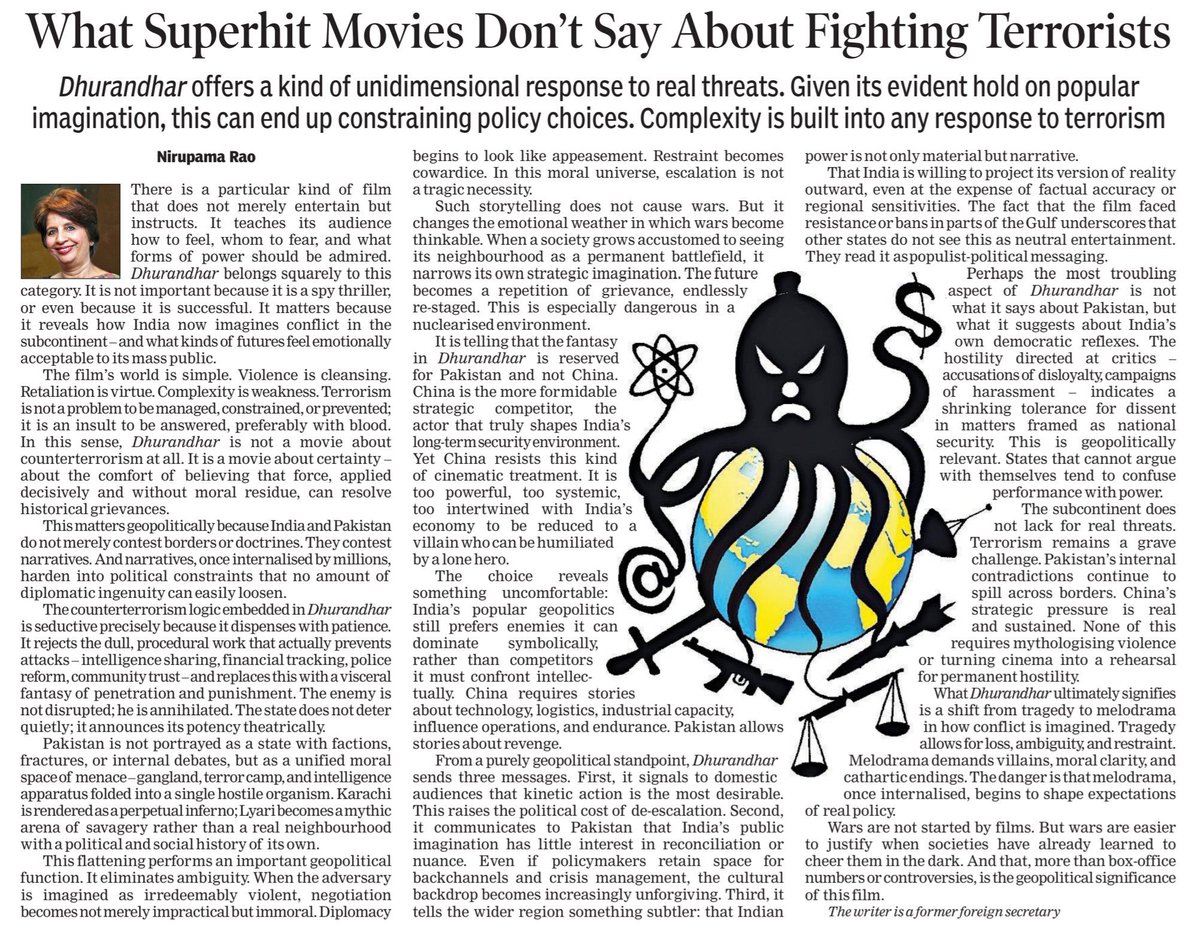
If the Prime Minister is not spared from criticism why should a foreign secretary be when she is peddling a narrative which is quickly lapped up by the enemy country ? Why do you lefties feel that you are born with some special privileges and are above the rest of us?
Sanket Upadhyay@sanket

For the former foreign secretary to be subjected to unsettling trolling. Who has spent a career in restraint and measure. Really sad. They aren’t worthy of your time & energy.

English
36
572
2.1K
27.4K
Seshan Ranganathan🇮🇳
"Congress is busy spreading fear and rumours. Congress is actively inciting the public. Like political vultures, Congress is waiting, hoping that troubles will escalate so that it can exploit the situation to gain political advantage," the PM alleged, as per news agency ANI.
English
0
0
0
1
Seshan Ranganathan🇮🇳
going to pull some magical rabbit out of a hat and resolve all issues, is criminally daydreaming. The truth is that there seems to be no one except a bunch of Iranians, representing a repressive regime(we would have condemned) who have got up to say THE EMPEROR HAS NO CLOTHES!
English
0
0
0
0
Seshan Ranganathan🇮🇳
as the Jihadis of Iran. Paradoxically, from a victim nation, before this war ends, they may end up as a pariah nation. If possible, it should pull back from the brink. @IDF @IsraelinIndia
English
0
0
0
11
Seshan Ranganathan🇮🇳
The overwhelming tech power America & Israel enjoy, should have made them careful about its use. In a civilisational power viz Iran, they may have finally met their nemesis. I feel sorry for Israel. A siege mentality has removed all restraints and made them almost as extreme
English
1
0
0
6
Shefali Vaidya. 🇮🇳
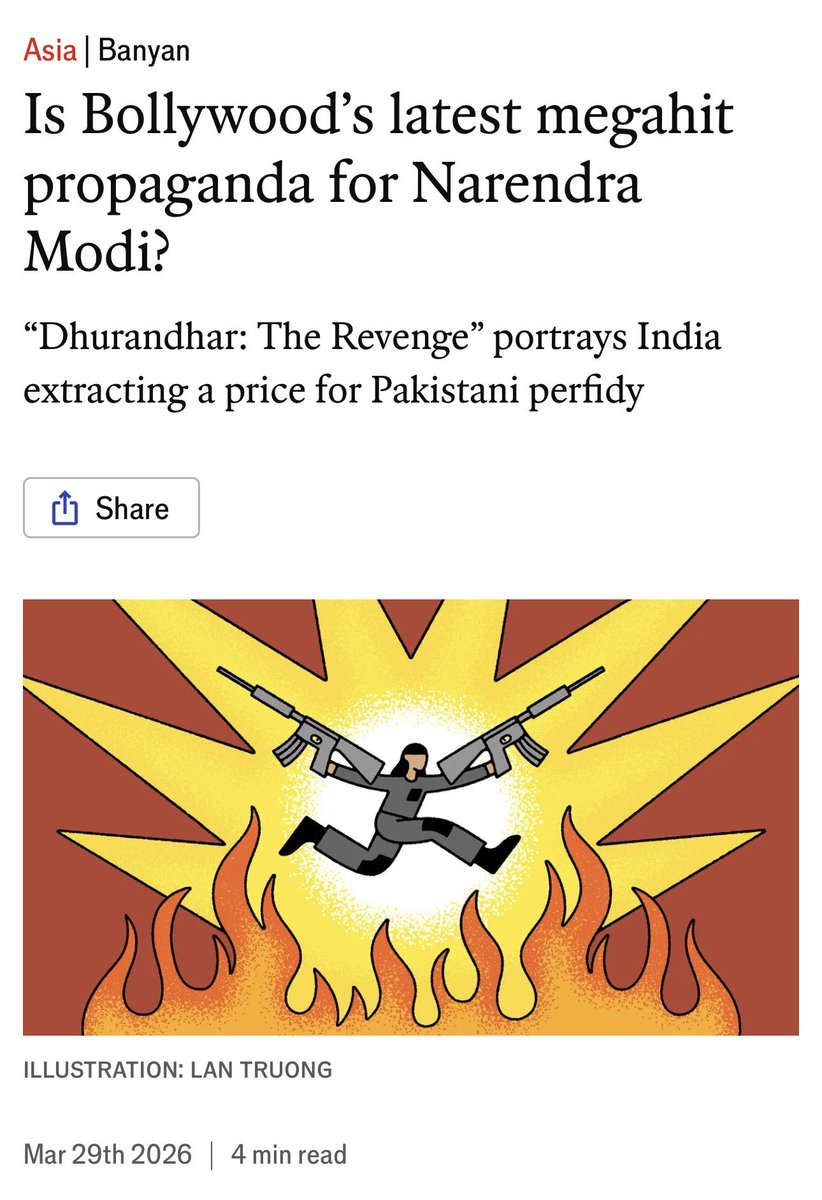
So the handwringing and breast-beating on #Dhurandhar2‌TheRevenge has gone international! Now @TheEconomist joins the desi rudaali gang. Don’t bother reading the article, it is full of the usual shrill screams of liberal grief! Economist calls Dhurandhar ‘propaganda’ because it dramatises real Pakistani-sponsored terror attacks, the 1999 hijacking, the 2001 Parliament attack, the 26/11 attacks, all real, all documented. They have a problem because Indians in cinema halls cheer when they watch a fictional spy avenge real acts of terror! So Indians who have been victims of terror and Islamic fundamentalism for decades do not have the right to catharsis? As expected, the economist article drips with gora sahib condescension. Also hilarious to see The Economist describe Bollywood as ‘long an apolitical but patriotic place”! There have been movies that started off with a tribute to Sanjay Gandhi, there have been movies that glorified Garibi Hatao, that cringy election slogan of Indira Gandhi. There have been movies like Parzania that have demonised Hindus for 2002 riots, without mentioning the Godhra burning once. There have been movies where the hero wears a 786 badge that repels even bullets, movies like Haidar that show the Shankaracharya temple in Srinagar as the abode of Satan, but Economist has never bothered to comment on that. Problem is not that Dhurandhar is propaganda, but in the Economist’s eyes, it is propaganda that THEY do not approve of! @AdityaDharFilms
Shefali Vaidya. 🇮🇳 tweet media
English
75
817
2.2K
39.5K
The Economist
The Economist@TheEconomist·
The genius of “Dhurandhar” is to reflect the world many Indians, browbeaten by years of shrill pro-Modi messaging on TV news and social media, already believe to be real economist.com/asia/2026/03/2…
English
786
416
1.9K
1.1M
Mahesh Jethmalani
Mahesh Jethmalani@JethmalaniM·
That is the fraud. American power on screen is “craft.” British power on screen is “heritage.” Indian power on screen is suddenly evidence of political conditioning. Same cinema. Same nationalism. Different skin colour. The Economist has a wonderfully colonial rulebook for cinema. When America straps a camera to Pentagon hardware and sells state power with a soundtrack, it is “spectacle.” When a film is made with CIA-adjacent mythology around national revenge, it is “serious storytelling.” But when India puts its own enemies and terrorist attack scars on screen, suddenly the magazine reaches for the psychiatrist’s couch. That is the real joke here. Fighter jets, spies, commandos and national vengeance are perfectly acceptable as long as the flag fluttering in the background is American or British. Then it is culture. It is craft. It is cinema doing what cinema does. The Economist has invented a very elegant little rule for cinema: Top Gun: Maverick can fly on Pentagon muscle, RAMBO & Zero Dark Thirty can ride CIA mythology, James Bond can sell six decades of British spy glamour, Dunkirk can turn wartime memory into national legend, and all of that is called storytelling. But the moment India puts terror, retaliation and national memory on screen with Dhurandhar, the magazine starts diagnosing the audience instead of reviewing the film. What @TheEconomist cannot digest is not one film. It is the fact that Indians are no longer outsourcing their memory to London’s approval. A country that has lived through decades of Pakistan-sponsored terror is apparently expected to process all that pain in whispers, with tasteful disclaimers, and preferably under the supervision of foreign editors who still think they are qualified to explain India to Indians. And that is why the review reeks. Not of sophistication, but of the old imperial tic: Western nationalism on screen is a nation telling its story; Indian nationalism on screen is a pathology requiring diagnosis. The costume has changed. The sneer has not. The funniest part is that The Economist probably thinks this is fearless criticism. It is not. It is just another imported lecture from people who never mind propaganda when it wears aviators, a tuxedo, or a CIA badge, but develop exquisite moral sensitivity the moment India stops being apologetic on its own screen. Just FYI: Decades of Pakistan-sponsored terror are apparently meant to be processed quietly, apologetically, and preferably without ever producing a mass-market cultural response. That is the old script. India is no longer following it.
The Economist@TheEconomist

The genius of “Dhurandhar” is to reflect the world many Indians, browbeaten by years of shrill pro-Modi messaging on TV news and social media, already believe to be real economist.com/asia/2026/03/2…

English
183
3K
9.2K
169.8K
Rishi Bagree
Rishi Bagree@rishibagree·
Nirupama Rao served as India’s Foreign Secretary from August 2009 to July 2011, when the deadly 26/11 attacks took place in Mumbai. Yet she thinks that India should treat Pakistan with empathy and should not make movies like Dhurandhar, which portrays Pakistan in a bad light.
Rishi Bagree tweet media
English
66
360
918
20.7K