

Lingxia
542 posts


一个在欧洲做贸易的老大哥,最近带几个德国客户去上海出差。那几个老外全程脸色铁青。
在吃饭、打车、进商场的每个环节,老外们发现上海的服务员、司机甚至保安,对他们不仅没有一丝谄媚,甚至连多余的眼神都懒得给。
一个老外憋了半天,忍不住吐槽:我觉得中国人现在变得极其傲慢。
外国人眼里的中国式傲慢,本质上是我们不再愿意配合他们演那场文明等级制的烂戏了。
很多人没意识到,中国人的阶级感在全世界都是出奇的弱。日本人习惯了点头哈腰,韩国人前后辈关系能压死人,印度人更有种姓枷锁。但中国人骨子里信奉的是王侯将相宁有种乎。
在白人本位的思维里,亚裔应该是谦卑、恭顺、仰望西方文明的。但现在的年轻人,看着全世界最好的基建长大,他们往那儿一坐,平视世界。这种平视,在习惯了被仰望的人眼里,就成了最顶级的傲慢。
有一次,一个澳洲合伙人兴致勃勃地跟我展示他们新采纳的物流系统,觉得那是文明结晶。我顺嘴回了一句:这东西我们十年前就淘汰了,现在的菜鸟和顺丰效率是你们的几倍。老外当场破防。
这叫傲慢吗?不,这叫事实。
中国人的傲慢在于,我们已经无法想象,在这个时代居然还有国家没普及移动支付,城市地铁要20分钟一班,晚上出门还要担心被抢。当你把这些理所应当的常识说出来时,对方那颗脆弱的玻璃心就碎了一地。
更绝的是,全世界除了中国,没有哪个国家会把其余196个国家统称为外国。你是德国人、美国人还是非洲人?抱歉,在我们眼里你都叫外国人。我们默认自己是一个独立的文明维度,剩下的是外面的世界。
我去里斯本出差,一个德国小哥跟我炫耀欧洲火车准点。我随口说:上海早高峰地铁两分钟一班,换乘线路比你们全国的火车线都多。德国小哥愣了半天,憋出一句:你太不礼貌了。
他要的是礼貌,也就是虚伪的赞美;而我们要的是效率,也就是真实的结果。在这个草台班子组成的世界上,弱者通过繁文缛节来寻找存在感,强者通过改变现实来定义话语权。
尊严不是求来的,是打出来的。当你强到让对方不得不平视你时,他嘴里的傲慢,其实就是他内心的恐惧。
中文


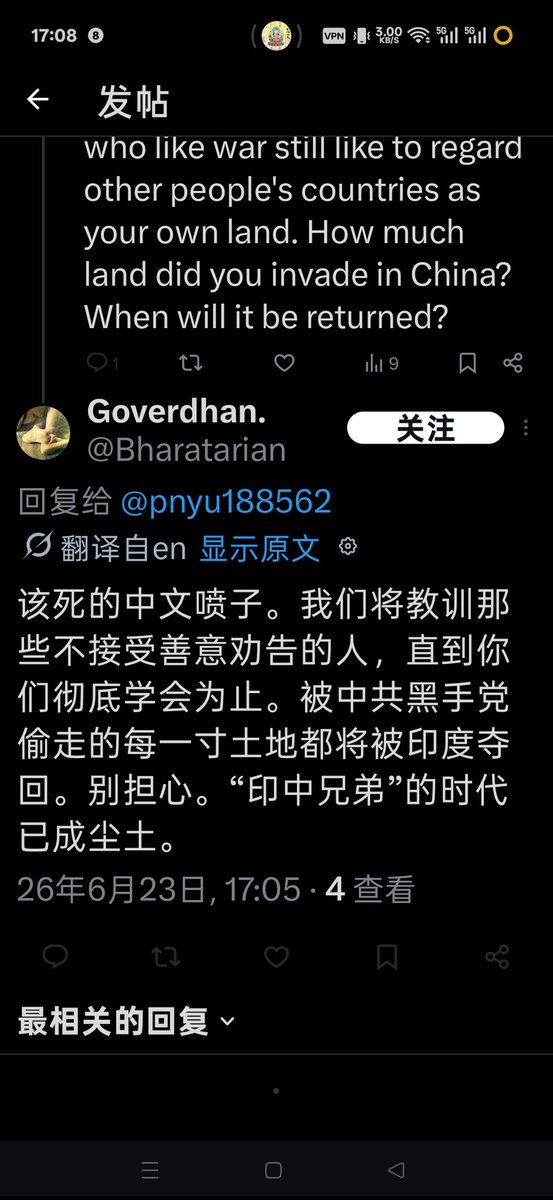
What do you Indians want with land in China?China is an ancient but backward country. You should want Japanese land.The Japanese are free, democratic and open, so go quickly.

English






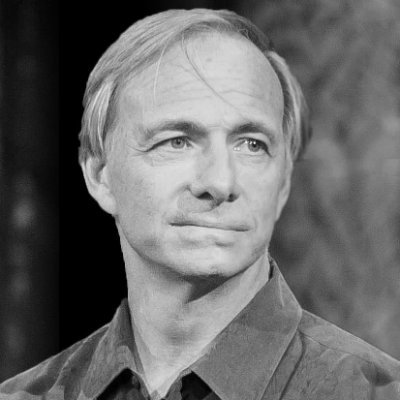
I recently spent a month in Asia, including 10 days in China, where I met with senior policy makers in several countries, and I found that over the past few months, there has been a big shift in the world order. I share my perspective in my latest article.
As always, I welcome your questions and thoughts.
Ray Dalio@RayDalio
English
@RnaudBertrand 我看了Ray Dalio的文章,他正在将西方从中国的一个误解拖入另一个误解,因为他是用西方思维来理解朝贡体系以及儒家思维。中国是个古老的文明型国家,但要真正理解中国,必须理解马列主义毛泽东思想在中国治理理念中的作用以及对中国人民的精神重塑。
中文
I often like Ray Dalio's takes on China but he gets quite a lot demonstrably wrong in this FT article on the "tribute system."
China's ancient tribute system - called 朝贡 (cháogòng) in Chinese - is typically very misunderstood in the West: we typically think it involved tributary states paying some form of "tribute" to China in exchange for protection - the way medieval vassals would pay fealty to a lord in Europe.
In reality, it had little to do with that. In fact, it was almost the opposite: in the Chaogong system, it was actually China paying the "tributary states."
The system was basically a quid-pro-quo where China would get "得名" (dé míng, literally "getting name/prestige") while tributary states would get "得实" (dé shí, literally "getting substance/material benefit") in exchange. It was about China paying huge amounts of money and other material benefits for the recognition of its centrality.
That's what makes it so alien to the Western framework, where tributary states are paying UP to the center, and security is enforced through military presence. The Chaogong system was almost exactly the inverse on both counts: China was paying DOWN and regional order was maintained not through the military but through generosity.
The core guiding principle of the system was established by the Hongwu emperor, the founding emperor of the Ming dynasty (incidentally one of the most interesting emperors in Chinese history since he is the only founder of a major dynasty who started off in life as a wandering beggar).
The principle he set in place was 厚往薄来 (hòu wǎng bó lái) - literally "generous outflow, modest inflow": giving out much more than you take in. This wasn't a byproduct of the system - it WAS the system. The entire architecture of Chaogong was built on this principle of asymmetric generosity.
Very concretely the way it worked is that tributary states would pay largely symbolic tribute to China (like local specialties and curiosities, the system codified that tribute should be "easy to obtain and not costly", 必易得而不贵) and they would in exchange receive 3 layers of economic benefits:
1) Immediate payback in the form of money and expensive goods (silk, brocade, porcelain, tea, silver, etc.), which value was typically dozens of times the value of the tribute received by the emperor
2) The right to trade during their tribute visit: the envoys' entourage could trade with specially licensed Chinese merchants at the Huitongguan (the official guesthouse in the capital)
3) Most importantly, and that's where the real money was, they would be granted the right to trade at Chinese ports. Under the Ming maritime prohibition, tributary status was the only legal entry point into the Chinese economy
China being China, this gave rise to some pretty funny hustles. The deal was so good that people started inventing entirely fictitious countries just to get in on it. There are several documented cases of people fabricating countries and showing up as "envoys" at the imperial court just to claim the privileges (rujiazg.com/article/19243).
Another funny one is that there are several cases of Fujian merchants who would sail to Southeast Asia, get themselves appointed as minor officials by local rulers, then sail right back to China as "foreign envoys" - carrying huge commercial cargoes. In 1438, three members of Java's tribute delegation turned out to be guys from Fujian (zhihu.com/question/63313…).
The scam got so widespread that the Ming had to invent a credential system (勘合, kānhé) specifically to verify that tribute envoys were who they claimed to be and that the countries they came from were real.
More seriously though, the Chaogong system also led to big domestic tensions in some of China's neighboring countries, notably Japan which was permitted only one tribute mission per decade. The stakes were so high that the 2 most powerful feudal clans at the time (the Ōuchi and the Hosokawa) fought a shadow war over who controlled the trade license.
This culminated in the Ningbo Incident of 1523 (en.wikipedia.org/wiki/Ningbo_in…): two Japanese delegations from both rival clans arrived at the port of Ningbo and got into a dispute over whose credentials were legitimate, which ended up in a pitched battle on Chinese soil. They ended up rampaging through the city, killing Ming military officers, and altogether terrorizing the local population - all over who got to trade with China.
The aftermath of the Ningbo Incident led to the total breakdown of Japan-China trade. If that sounds familiar, it should...
Which brings back to today and Ray Dalio's description of China's tribute system, as well as his claim that we're facing some sort of modern revival of it in Asia.
First of all, some parts of his article are correct: there is indeed a significant power shift happening in Asia, with countries hedging by building closer ties with Beijing, and the US progressively withdrawing and altogether losing ground.
He is also completely right that Chinese strategic culture genuinely differs from Western strategic culture: as he writes they indeed play Go (WeiQi) and not chess.
He is however wrong to describe the tribute system as one based on pressure and intimidation. As we've just seen, it was pretty much the opposite: the basic idea was to be so generous that everyone wants in (to the extent that countries would literally fight to be tributaries), not so threatening that nobody dares leave.
He also - weirdly - seems to conflate the tribute system with the Art of War, treating them as two faces of the same Chinese playbook, when they've got strictly nothing to do with each others. They're not even from the same school of thought: the Chaogong system is fundamentally Confucian (以德服人, "winning people through virtue") whereas Sun Tzu is from an entirely different Chinese intellectual tradition - the Strategist school (兵家) - which is about as far removed from Confucian thinking as Machiavelli is from the Bible.
Mashing them together reads like someone who has picked up a handful of Chinese cliché references and treats them as interchangeable ingredients in a single "Chinese strategic culture" soup.
All in all, he makes the error WAY too many Western commentators do with Chinese concepts: he uses them as exotic wrapping paper for a fundamentally Western analysis. Strip away the Chinese terminology and his argument is actually pure Western thinking: what he is claiming is that China, as a rising power, is using its growing economic and military weight to reshape the regional order, weaker states are bandwagoning, and the declining hegemon can't stop it.
He is essentially taking Graham Allison's "Thucydides Trap," awkwardly draping it in misunderstood Chinese concepts, and presenting it as if it were Chinese thinking.
That being said, he is ironically correct - I think - that there is some form of revival of a tribute-like system but not in the way he understands it: China will (and does) use trade - its "generosity" - as a gravitational force to pull countries into its orbit. Not by threatening to cut them off, but by making the relationship too valuable to walk away from. THAT is much closer to how the actual Chaogong system worked.
It doesn't mean that the system is purely benevolent. The flipside of generosity is the absence of it: in the original tribute system, you could be cut off the way Japan was after the Ningbo Incident in the 16th century. And it's also what's happening - to some extent - to Japan today: after PM Takaichi declared that Japan would go to war with China over Taiwan, China has systematically restricted trade with Japan. Same story with what happened, for instance, to Australia in 2020 over PM Morrison's declarations on Covid.
The pattern is the same: the reward for participation is trade, and the punishment for hostility is its withdrawal. Essentially in the tribute system there is no stick, just a carrot: the stick is taking the carrot away.
Which, incidentally, is why you can be extremely confident that China will go to enormous lengths to develop its internal market, and why the current situation where China runs huge trade surpluses is facing mounting pressure to change from within China itself. If countries don't feel they're benefiting enough from trade with China, the entire logic collapses. That's why developing domestic demand isn't some target China sets itself to assuage Western demands, as some claim: it's genuinely a strategic imperative.
It's also why it's ironic that the West is so keen on pushing China to boost domestic consumption: in effect, it means we're already in a de-facto Chaogong-like system and they're asking that the carrot be bigger.
-----
I also wrote a Substack version of this post, which you can find here: open.substack.com/pub/arnaudbert…
Financial Times@FT
China’s tribute system and the new world order ft.trib.al/oY8Evgl
English


It’s amazing how people would bend over backwards to blame the election of Trump and Brexit on Russian interference and even overturn western elections on scant evidence of Russian interference, but totally dismiss western interference that were more substantial and well-documented as inconsequential. The same people would do this.
Mike Benz@MikeBenzCyber
USAID funded the Maidan Revolution in Ukraine in 2014 that directly led to the 2014-2022 Donbas War (15,000 killed) and the subsequent 2022 Russia-Ukraine War (300,000 killed). So did USAID supporters murder 315,000 people?
English

le reste du monde installe une clim en deux clics, nous notre télé publique nous apprend à étaler de la pâte sur nos fenêtres comme des apprentis chimistes du dimanche pour gratter péniblement 5 degrés
deuxième parc nucléaire de la planète et on en est à fabriquer des potions maison pour pas crever de chaud chez soi, ce pays est tellement cuit qu'il te revend la débrouille comme une innovation
Telematin@telematin
😱🌡️ L'astuce ultime pour perdre au moins 5 degrés dans votre habitation ! Vous nous en donnerez des nouvelles 😉
Français

I thought my Chinese fans cooked with their outfits of me but I think my Japanese fans actually cooked harder.

English

Ma meilleure amie…les meilleurs euros jamais dépensés de ma vie

Français
Why do my Chinese fans keep cooking with all these outfits.


English
"No me he lavado las manos en 10 años, de verdad, me inoculo a mi mismo, los gérmenes no son algo real, no puedo verlos, por lo tanto no son reales".
Pete Hegseth, ministro de guerra de EEUU, confesó que no se ha lavado las manos en 10 años porque no cree en los gérmenes.
Ahora como responsable del ejército de EEUU, quitó las vacunas de la gripe obligatorias... y dos meses después, 160 soldados en una base de la Fuerza Aérea en Texas han contraído la gripe.
Es curioso como dice que no cree en los gérmenes porque no los ve... pero luego cree en dioses que tampoco ve.
Español
