Shashank Agarwal

411 posts

Shashank Agarwal banner
Shashank Agarwal

Shashank Agarwal

@shashank734

Co-founder @ https://t.co/9KXf7Sj8x2 , @southpkcommons Founder Fellowship, Ex Founder Thirdwatch (Acquired by @Razorpay)

india Katılım Eylül 2009
854 Takip Edilen482 Takipçiler
Shashank Agarwal
Shashank Agarwal@shashank734·
@signulll context is getting solved and the gap is closing. but the real test is the taste layer. AI will expose who was gatekeeping vs who was actually thinking. but “actually thinking” isn’t evenly distributed either. I think we won’t get a flat hierarchy. we’ll get differently shaped.
English
0
0
0
8
signüll
signüll@signulll·
for ~30 yrs, a lot of career capital of a knowledge worker (esp in leadership) was basically: - access to information - ability to synthesize scarce data - coordination across silos - gatekeeping decisions that arbitrage collapses when information becomes ambient, searchable, & increasingly agentic. i mean, what does a senior director really do? if you removed them tomorrow, does output drop 30% or just the meeting volume?
English
46
56
920
75.8K
Shashank Agarwal
Shashank Agarwal@shashank734·
@natashamalpani Context is getting solved and the gap is closing. But the real test is the taste layer. AI will expose who was gatekeeping vs who was actually thinking. but “actually thinking” isn’t evenly distributed either. I think we won’t get flat hierarchy, we’ll get differently shaped.
English
1
0
1
65
Natasha Malpani 👁
Natasha Malpani 👁@natashamalpani·
knowledge work was never about knowledge. it was about controlling information. you could hide behind excuses: -you had to be in the room. -context takes years to build. most hierarchy existed to manage information flow in a high-friction system. when knowledge was scarce, that structure made sense. but AI removes the scarcity. reference is instant. analysis is cheap. context is searchable. now it’s harder to pretend the work was harder than it was. we’re about to question some sacred assumptions: does expertise equal authority. effort equal value. seniority equal judgment? a new divide will form. people who admit this and rebuild workflows bottom up versus people who spend the next decade defending institutional knowledge. the dirty secret is that AI doesn’t need to automate every workflow to cause disruption. it only needs to expose what the workflow actually was. the revolution is the cultural permission to finally ask: what are we actually doing here?
signüll@signulll

for ~30 yrs, a lot of career capital of a knowledge worker (esp in leadership) was basically: - access to information - ability to synthesize scarce data - coordination across silos - gatekeeping decisions that arbitrage collapses when information becomes ambient, searchable, & increasingly agentic. i mean, what does a senior director really do? if you removed them tomorrow, does output drop 30% or just the meeting volume?

English
13
12
75
8.5K
Shashank Agarwal
Shashank Agarwal@shashank734·
If you’re building support systems: the “human-in-the-loop” trigger is the product. Would you rather have cheaper support with AI-only… or pay a bit for real escalation when it matters?
English
0
0
0
6
Shashank Agarwal
Shashank Agarwal@shashank734·
I think we’ll see a new model: AI-first by default, human support as a tier. But the real differentiator won’t be the AI. It’ll be: how well you decide when a human should step in. (And how easy you make that switch.)
English
1
0
0
14
Shashank Agarwal
Shashank Agarwal@shashank734·
Something I keep noticing: companies are getting better at AI support… and worse at escalation. AI is great for 80% of requests. But the remaining 20% is where trust is built (or lost).
English
1
0
0
25
Shashank Agarwal
Shashank Agarwal@shashank734·
I think human-in-the-loop redirection could be improved; from recent experience, it’s not working. It leaves you helpless with a genuine query.
English
0
0
0
22
Shashank Agarwal
Shashank Agarwal@shashank734·
I think the new business model will be charging a premium for talking to a human in customer support cause I know at least AI support is not working in the case of @zomato, it makes you helpless sometimes. @deepigoyal
English
2
0
0
55
Shashank Agarwal
Shashank Agarwal@shashank734·
@MailchimpHelp Nope, it's not a symbol issue. When I change the currency to INR, the amount is now INR 35,370.33/mo for 150 contacts. I don't know how many users like me decided not to pursue due to this : ) like now I have chosen some other provider.
Shashank Agarwal tweet media
English
1
0
0
31
Intuit Mailchimp Help
Intuit Mailchimp Help@MailchimpHelp·
Mystery solved! It looks like the site is showing a currency mismatch. The ₹390 amount is in Indian Rupees (₹), but it’s displaying with a dollar sign. The actual add-on cost is ₹390 (about $4.60 USD), not $390. Thanks for catching this 'yikes' moment for us. We’re getting the team to fix that symbol right now!
English
1
0
0
39
Natasha Malpani 👁
Natasha Malpani 👁@natashamalpani·
i’d say the opposite: the real white space is at the application layer. everyone wants to sell shovels, but the gold is in how people actually use them. the infra race is a knife fight between hyperscalers: openai, google, anthropic, meta, amazon. they’ll undercut each other on price, latency, context window, and token cost until margins collapse. developer tooling looks safer, but it’s crowding fast and every improvement gets absorbed upstream by the foundation models or downstream by open-source forks. meanwhile, applications are where behavioural moats form. data isn’t the only barrier. habits are: -users don’t live in apis or eval dashboards; they live in experiences. -context, workflow, brand, and trust compound fast -distribution and feedback loops create data advantages that scale locally even when models converge globally. you win if you own feedback surface to capture every edit, action, and intent/ build domain depth/ embed in daily workflows/ collect proprietary exhaust (behaviour and telemetry that the model providers will never see). some infra will break through- security, evals, low-latency edge, compliance- but the broader white space is still at the application layer, where people, agents, and systems actually interact. go deep enough that a foundation model can’t care, and sticky enough that users won’t leave even when it can.
Yishan@yishan

My AI investment thesis is that every AI application startup is likely to be crushed by rapid expansion of the foundational model providers. App functionality will be added to the foundational models' offerings, because the big players aren't slow incumbents (it is wrong to apply the analogy of "fast startup, slow incumbent" here), they are just big. Far more so than with any other prior new technology, there is a massive and fast-moving wave that obsoletes every new app almost as fast as it can be invented. There is almost no time to build a company and scale it. There are two ways AI application startup founders can make money: - Make a flash-in-the-pan app that generates a ton of cash and bank the cash (my estimate is that you have about 12-18 months cashflow generation) - Make a good enough app that you get acquired by one of the big players for sufficient equity The situation is highly unstable - we don't know if it's going to crash or go to the moon but both scenarios make it very unlikely that any AI application startup will independently become a generational supercompany (baseline odds are low to begin with). The best odds are finding an application niche in a highly specialized field with extremely unique and specific data barriers, ideally ones relating to real atoms (hardware or world-related) data and not software/finance.

English
60
73
769
196.3K
Shashank Agarwal
Shashank Agarwal@shashank734·
Net-net: an “agent” isn’t a feature. It’s a secure workflow + governance layer + integration fabric—wrapped in a great UX.
English
0
0
1
35
Shashank Agarwal
Shashank Agarwal@shashank734·
Multitenant SaaS basics: tenant isolation, regional data residency, BYOK/KMS, SLAs/SLOs.
English
1
0
2
38
Shashank Agarwal
Shashank Agarwal@shashank734·
Building AI agents for banks isn’t “add an LLM.” It’s earning trust across data, identity, governance, and failure modes. #EnterpriseAI #Banking
English
1
0
2
68
Shashank Agarwal retweetledi
South Park Commons
South Park Commons@southpkcommons·
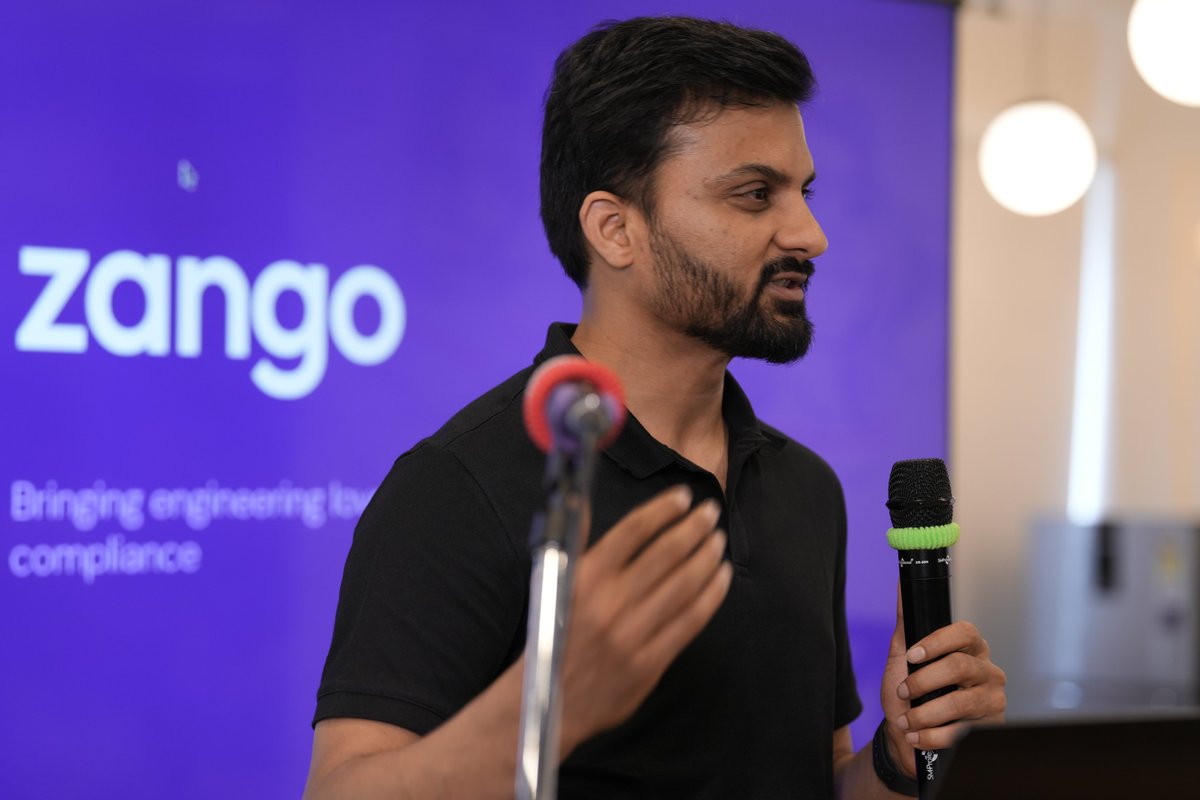
6/ Zango Compliance processes are constantly in flux. Keeping up is a time-suck. @shashank734 & @riteshs01 are building AI agents at @zangoai that interpret these complex processes, so institutions can stay up to date on regulations. zango.ai
South Park Commons tweet media
English
1
3
12
1.6K
TheLiverDoc™
TheLiverDoc™@theliverdoc·
Dear friends, an update on the Citizens Protein Project 2 which you have publicly funded. The reports of the complete analyses will be available to us on the 8th of July 2025 (Tuesday). Our team will review all reports and release the complete reports and summary on 13th of July 2025 (Sunday). For more details please see our project page, where you can also support and donate to future public healthcare projects: meshindia.org/introducing-th…
TheLiverDoc™ tweet media
English
77
147
1.5K
128.2K