
Sabitlenmiş Tweet
Shawn Li
433 posts


Shawn Li
@shawnlidev
🇺🇸Family | AI | Systems | State direction Building verification-layer surfaces for the agent economy. Trying to understand what's actually changing.
Katılım Ağustos 2021
196 Takip Edilen33 Takipçiler


i like the aspiration. the structural trend moves the opposite direction tho. it does not eliminate hierarchies. it just relabels them faster.
this thread is the evidence. two people fighting over whose status signal should count. same move. same game. different referee. what you call decentralized merit mostly means the old gatekeepers lost and the new ones have not figured out how to extract yet.
English

Because “respect your superiors” is fundamentally hierarchical thinking. the idea that status, titles, wealth, or position should outweigh open discussion and independent thought. That mindset dominated most of history.
By “future,” I mean systems becoming more decentralized, merit-based, collaborative, and bottom-up, where ideas stand or fall on their substance, not on who said them.
English

LMFAOOO Elon cooked the “Ph.D at 19” clown 💀😭

Elon Musk@elonmusk
@iScienceLuvr Putting “Ph.D.” in your social media name is a sure sign of a pompous retard
English
@AmberSmith11911 @cacafuti222 @ns123abc @nnnzzznnnzz What makes it old thinking just curious, and define future.
English
English
what gets called earned insight is usually just pattern recognition from having done the cerebellum work at enough scale. college was good at forcing that volume. but the credential it used to signal that youd done the work is eroding. what replaces it is direct lineage. somebody who has done the work vouching that you have too. thats the guild structure coming back.
English

This is one of several reasons you shouldn't drop out of (or skip) college to start a startup at 18. Founders who do that tend to match the second paragraph rather than the first, because they haven't had time to have the "earned insight" he describes.
Garry Tan@garrytan
The companies I love working with in office hours are the ones where the founder has a specific, weird, earned insight that nobody else has. Not "AI for X." A genuine edge that came from living inside a problem. The ones that are dying almost always have the same pattern: technically competent founders building something nobody asked for, moving metrics that don't matter, avoiding the conversation with the one user who'd tell them the truth. The lucky thing is that 2nd type of founder can become the 1st kind if they don't stand still, they are willing to talk to people, try things, and always seek high rate of learning.
English
The university was a credential factory. It took millions of people and stamped them with a degree that said they could do the office job, the hospital job, the firm job. The degree was a proxy. Not proof of competence. Proof that you cleared a threshold designed to be passable at scale.
AI eats exactly that layer. Junior analysts, entry-level accountants, first-year associates. The routine that the degree qualified people for is being automated. The proxy still exists. The jobs it was a proxy for are gone. The middle that the diploma built is thinning from underneath.
The replacement is not a new kind of degree. It is an older way of proving yourself. Before universities, every trade ran on one question: can someone who already knows the craft vouch for you. You worked under them. They saw what you could do. Their word was your credential. The problem was scale. One person can only train so many others in a lifetime.
AI changes that math. The person who knows the craft can now oversee more people because AI handles the routine layer. The arithmetic. The compliance checks. The form-filling. Their time goes to the one thing only they can do: judge whether you know what you are doing. The old model becomes scalable without watering down the standard.
The credential of the future is a name. Someone who already has standing saying you have it too. The degree won a century by trading depth for width. The next one might work the other way.
Michael Green@profplum99
We actually have historical precedent for this. When guilds collapsed, so did apprenticeships. Young craftsmen defected to factories, and societies lost the slow, embodied skill transmission that produced things like the stonework of Notre Dame. Productivity rose—but craftsmanship thinned. When big-box retailers displaced local hardware stores, we didn’t just lose small businesses. We lost succession. The “heir apparent” who learned inventory, customers, and judgment over decades was replaced by a store manager trained to follow a system. AI is doing something structurally similar. As noted, entry-level QA, junior analyst roles, and “grunt work” weren’t inefficiencies — they were discovery mechanisms. They let firms observe curiosity, resilience, judgment, and learning velocity under real conditions. Automating them removes the lowest rung of the ladder, not just the cost center. The danger isn’t that AI replaces junior work. It’s that we eliminate the environments where raw talent proves itself. If we don’t deliberately rebuild new apprenticeship structures (rotations, shadow systems, paid learning tracks, scoped responsibility sandboxes) we’ll get short-term efficiency and long-term talent collapse. History suggests the market won’t fix this automatically. When the on-ramp disappears, so does the next generation of masters. The real question isn’t “how do people get in?” It’s whether employers are willing to re-create intentional paths for becoming excellent, rather than assuming excellence simply arrives fully formed. H/t @INArteCarloDoss
English
English

@EALTurner @Jebus The "US" isn't the communist the op was referring to.
English

I always find Chinas attempt to pretend they’ve been a consistent civilization very funny
50 years ago this new civilization was trying to burn every trace of the old civilizations they could find
Tree is lucky the commies spared it
Michelle@D162Michele
China literally has trees in Xi Jinping’s garden that are older than the United States! 🤣
English

Personal update: I've joined Anthropic. I think the next few years at the frontier of LLMs will be especially formative. I am very excited to join the team here and get back to R&D. I remain deeply passionate about education and plan to resume my work on it in time.
English
Shawn Li retweetledi


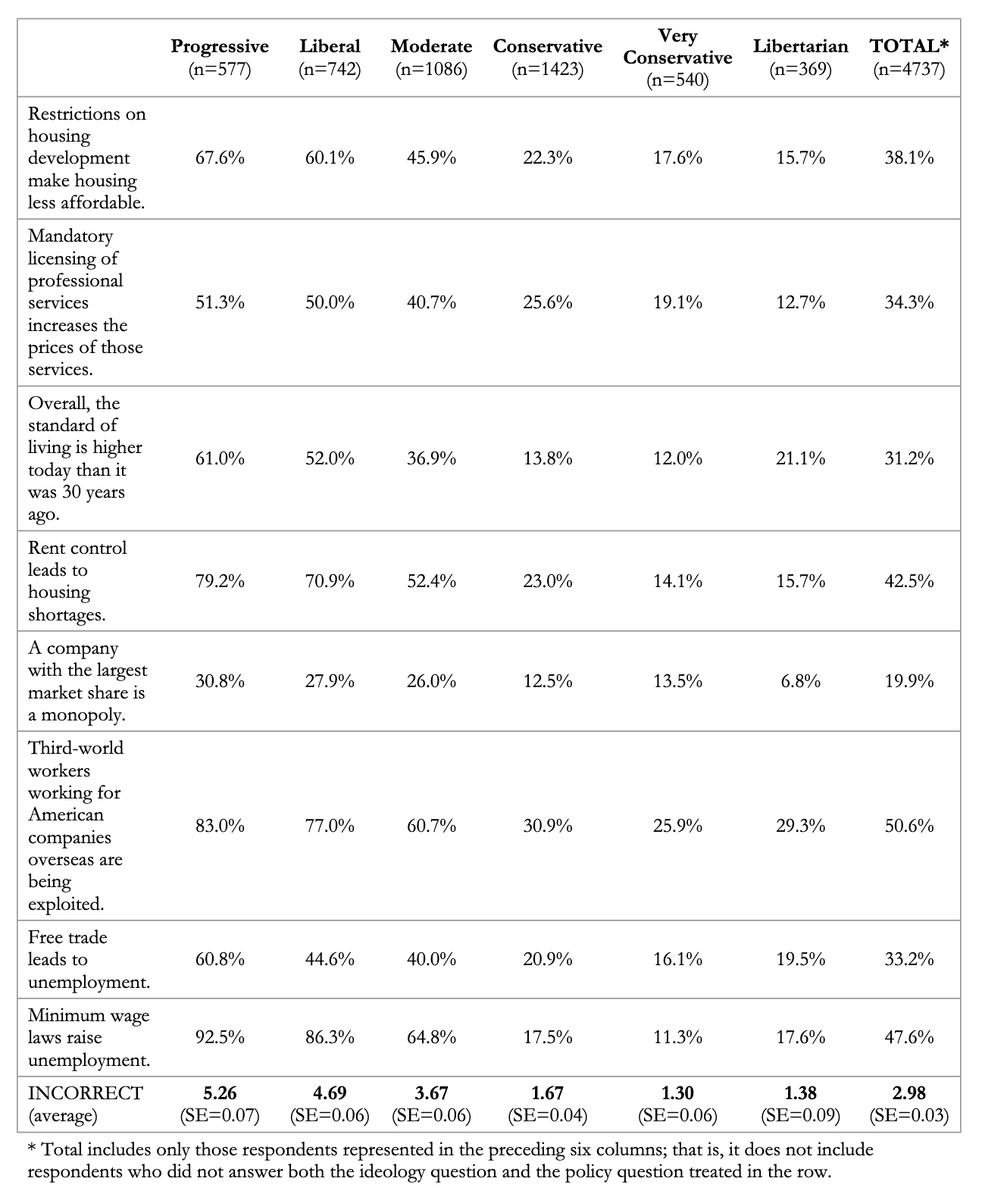
"Source: Buturovic and Klein, 'Economic Enlightenment in Relation to College-going, Ideology, and Other Variables: A Zogby Survey of Americans,' Econ Journal Watch, May 2010.
econjwatch.org/file_download/…
English
A 2010 Zogby survey by Buturovic and Klein tested Americans on basic economics.
Self identified progressives scored significantly lower than conservatives and libertarians.
This was not a one off. Follow up studies kept finding the same gap. The survey asked Econ 101 questions.
What happens when you cap prices below market rate. What trade restrictions actually do to domestic employment.
Whether minimum wage laws reduce employment for the workers they target. Progressives got more of these wrong. Not slightly more. Significantly more.
There are two ways to read this. One is tribal: my team is smarter. That is lazy and the data does not support it.
The survey also found that more education did not close the gap. College graduates on the left still scored worse than college graduates on the right. This is not about raw intelligence.
The better read is about which policies survive on vibes and which ones force you to study the mechanism.
Economics is the study of unintended consequences. The policies that feel most compassionate in the frame are often the ones whose destructive chain is hardest to see without training.
Rent control feels like it helps. You have to study economics to understand why it destroys housing stock. Trade barriers feel like they protect.
You have to study economics to see the retaliatory cycle and the supply chain damage. Price controls feel like justice. You have to study economics to understand why they create shortages.
The survey is not evidence that one team is smarter. It is evidence that one team's preferred policies require more study to evaluate honestly.
The other team's policies have their own blind spots. But on basic economic literacy, the pattern is consistent, replicated, and awkward for anyone whose political identity depends on never admitting it.
Thomas Sowell Quotes@ThomasSowell
“Why has evil been such a hard concept for many on the left to accept? The basic agenda of the left is to change external conditions. But what if the problem is internal? What if the real problem is the cussedness of human beings?” — Thomas Sowell
English

@deredleritt3r @willyl0wman I haven't seen any yet but I imagine they may already be out there. I haven't really investigated.
English

We are, indeed, living through the singularity - and it has been fascinating to watch this realization slowly permeate through society:
- People in SF and a handful of those on X (including yours truly) generally believe in the imminent singularity. This is significantly more aggressive than my views regarding AI progress were ~12 months ago.
- CEOs/management of large enterprises, various public figures and the federal government have recently come to believe in rapid AI progress - I would call this the "Mythos Moment". These views are in line with my views from ~12 months ago (now hopelessly outdated).
- Tens (hundreds?) of millions are now using AI in the workplace extensively, and probably mostly view it as a "useful tool". 12 months ago, this was limited to coding, and even the number of coders who were using AI in their day-to-day work was significantly smaller.
- Yet the public at large still seems to live in the "hallucinating stochastic parrot" Gary Marcus land. No update in beliefs regarding AI capabilities between GPT-3.5 and now.
Dr. Dad, PhD 🔄🔼◀️🔽▶️@GarrettPetersen
We really are living through the singularity aren't we.
English
Shawn Li retweetledi

L'IA est en train de remplacer les intellectuels.
Celle là personne ne l'avait vu venir. Mais force est de constater que des comptes X qui ne font "que" prompter et copier-coller obtiennent des textes de qualité bonne voire très bonne, qui plaisent à des millions de lecteurs, et mobilisent des Musk, Ted Cruz ou Milei.
Bien sûr les intellectuels "officiels" s'insurgent : comment un homme de la rue peut-il prétendre jongler entre auteurs et concepts avec l'aisance d'un agrégé, du jour au lendemain ? Il est pourtant évident qu'il en serait incapable "à l'ancienne" ! Que fait la police !
Je trouve ce phénomène fascinant. Il nous dit qu'au fond, un des rôles des intellectuels était de préciser et mettre en forme la pensée de son audience.
D'une population qui ressent des choses mais n'a "pas les mots" pour les exprimer, et signifie à l'auteur qu'il a tapé juste en achetant son livre, assistant à sa conférence, ou votant pour le parti qui reprend sa réthorique.
Avec l'IA, l'homme de la rue a à sa disposition en "self service" les outils autrefois monopole des intellectuels classiques : raisonnements à tiroirs, références pointues, comparaisons virtuoses, connaissance fine de la généalogie des idées... La machine ne fait qu'une bouchée de tout cela.
Alors bien sûr, on dira que tout cela n'est que forme et ne dispense pas de savoir ce que l'on veut dire.
Mépris suprême répondent les néo-penseurs, qui affirment savoir ce qu'ils pensent. Il ne leur manquait que les mots pour le dire !
Français
@BaldingsWorld china doesn't have binding rules, just politically adjustable suggestions.
English

I said before the summit I would be happy if nothing happened. Nothing happened. I'm happy.
My analysis has nothing to do with Trump but everything to do with China. Every deal the US has made China this century had proven worthless. So to me even if China gave Trump everything he asked for I would find it pointless. I make this point to note my analysis has nothing to do with Trump but who he was dealing with.
The hacks in think tanks are so obsessed with Trump there is basically zero thought given to who you are negotiating with. I guarantee if Trump had come back with a deal giving him everything he wanted the headlines and Galaxy Brains would be writing about how it couldn't be enforced.
The key points are this: the question you ask will determine a lot of your outcome or answer. I don't focus on Trump because any outcome requires Chinese adherence which we know won't come; the lesser mind of political hacks focus on the personality of a president which as we know from lengthy experience across administrations and foreign policy problem has marginal impact. Focus on the foundational structural issues rather than the marginal issues
English
Shawn Li retweetledi

"First they ignore you, then they laugh at you, then they fight you, then you win."
Unite The Kingdom 🇬🇧
English
I've been watching the Trump-Xi summit coverage this week and thinking about something I've seen before.
There's a pattern in these high level meetings that's easy to miss if you only read the headlines. Xi says "partners not rivals" in public. Privately, his team is warning that Taiwan could lead to conflict. Trump calls Xi a "great leader" while keeping every tariff and tech control in place. Both things are true at the same time.
I noticed this first when I lived abroad. You'd hear warm words at a press conference and then watch the actual policy move in the opposite direction. It's not lying exactly. It's more like the public language is for a different audience than the private language. The surface praise and the real message are often pointing in opposite directions.
The gap between what they say and what they do is the real story. And it's not just a China thing or a Trump thing. Both sides do it. After a while you learn to watch what people actually do more than what they say in front of cameras. The words matter for the relationship. The policies matter for the outcome.
English
Shawn Li retweetledi

Sanders and AOC introduced a bill to pause ALL AI data center construction. 300+ local bills filed. Half of planned 2026 data centers facing delays or cancellation. Each one brings billions to local economies.
The people who say they want American jobs are trying to block the biggest job creation engine since the interstate highway system.

English
English

@corelightmusic @Ken_LoveTW Oh how little you know, you wumao don’t operate off of facts. 55% of the world relies on the US dollar, including the CCP elite. You wouldn’t know because you’re at the bottom. You rely on the yuan, but the world doesn’t.
English

Trump Walks Into Beijing Holding ALL The Cards, While Xi Jinping Has Never Been This Weak Before Meeting Trump.
President Trump is heading to Beijing at a moment when the balance of power may be shifting dramatically against the CCP.
From China’s economic slowdown and collapsing consumer confidence to the failure of BRICS dedollarization to Beijing’s growing geopolitical exposure through Iran, this video breaks down why Trump enters these negotiations holding far more leverage than most people realize.
English
Jen here assumes both sides want the same thing. they dont. the US wants china in the scaling role. china wants out of it.
calling that a partnership is like two people agreeing on the destination while heading in opposite directions. the frame sounds good. the interests just dont line up.
English

I have long argued & advocated for US + China. US vs China is a losers mindset. If the 2 nations collaborate while drawing clear boundaries wherever necessary, the mankind would cure cancer, overcome climate change, empower humanity w most advanced but affordable/accessible AI, & go to Mars by 2050.
US can’t stop China’s ascend. China has been the most powerful nation on earth in 18 centuries of the past 20 centuries. It’s not an accident. The US is the most extraordinary nation in human history because it’s the only nation built upon an idea.
The only logical, rational, & smart conclusion is to peacefully co-exist, co-develop, co-create, & holding each other accountable for the mankind. 🇨🇳🤝🇺🇸
English
Shawn Li retweetledi

@petergyang i think the premium is real but the mechanism is off. it's not that people will pay for better craft than AI. it's that they'll pay for verified outputs, someone who knows the workflow well enough to catch the edge cases AI misses and underwrite the result.
English
I feel like AI gets people to average quickly but if you really know your shit (or you actually care enough to go the extra mile) you’ll be more in demand than ever because people will long for craft in a sea of slop
English