Shift By Design

57 posts

Shift By Design banner
Shift By Design

Shift By Design

@shiftbydesign

Many things are going to be completely redefined by AI. What does it mean for the Design industry.

Katılım Şubat 2024
529 Takip Edilen4 Takipçiler
Shift By Design
Shift By Design@shiftbydesign·
@sgnoogle This is essentially what WisprFlow or Typeless have been doing for a while now. Nothing innovative, this is just Google playing catch up
English
1
0
1
191
Francesco Sgnaolin
Francesco Sgnaolin@sgnoogle·
"To that". Those two words are what Nothing needs to focus on right now. Google just announced Ramble. Basically Nothing's Essential Voice. But. There’s a catch that makes it much more useful: contextual editing. Once you stop talking, you can hit the mic again and refine the text just by saying "to that" at the end. Example: 1. I dictate a rough message to a client. 2. Text appears. 3. "Add some professional flair to that!" 4. Email is instantly ready. Probably is not going to be just a "to that", but the flexibility to either add more text or edit what you just said makes this "AI voice" experience feel complete. I have a potential easy solution: 1. You need to SELECT THE TEXT you want to edit 2. Hit the Essential Voice button (or Key) 3. Done.
Francesco Sgnaolin@sgnoogle

I’ve been using Essential Voice since yesterday. I love it. ​BUT. ​A minor complaint from a perfectionist like myself: I love the color combination with the light theme, and I hope the same approach will be applied to the dark theme (basically making the yellow bars white, while leaving only the dot on the right yellow)

English
7
2
153
26.5K
Gokul Rajaram
Gokul Rajaram@gokulr·
DESIGN: THE FIRST AI CASUALTY I'm increasingly sure that 2026 signals the end of product design as a full-fledged stand-alone function within companies. If so, it will be the first role / function to be eliminated by AI on a go-forward basis. Instead of hiring FT designers, startups are hiring / will hire design consultants to create a design system that the founder likes (this takes a few weeks max). Once the design system is finalized, PM/Eng feed it into their AI tool of choice to generate prototypes. The design system is refreshed annually by the same consultant. Larger companies will likely not backfill design roles and will do some targeted attrition to reduce the design department to 20% the size it is today. If you're a designer, I think you have two choices: 1. Become an entrepreneur: Start a design agency and become the go-to resource for design systems for startups and even larger companies. This can be a good recurring revenue business. 2. Become a builder: Add PM/Eng responsibilities to become a product builder. Would suggest you embrace this proactively vs waiting for the other shoe to drop. I'm really sorry about this - some of my best friends and the people I admire most and have learnt the most from are designers - but it seems inevitable.
English
285
81
1.1K
718.8K
Shift By Design
Shift By Design@shiftbydesign·
@gokulr Agreed, except timeline. I’m transitioning my designers to outcome-driven product owners focused on strategy, data, and validation to stay ahead of future trends.
English
1
0
0
34
Shift By Design retweetledi
Alex Albert
Alex Albert@alexalbert__·
Glasswing is possibly the most consequential event in the AI industry I've seen up close since joining Anthropic almost 3 years ago. It feels like we're at a turning point in history.
Anthropic@AnthropicAI

Introducing Project Glasswing: an urgent initiative to help secure the world’s most critical software. It’s powered by our newest frontier model, Claude Mythos Preview, which can find software vulnerabilities better than all but the most skilled humans. anthropic.com/glasswing

English
139
142
3.1K
348.4K
Shift By Design retweetledi
Cameron Moll
Cameron Moll@cameronmoll·
How a Chief Design Officer (yours truly) uses AI to design like an IC. This demo is for any designers that haven't yet embraced AI in their workflow. I’m one of two designers working on this plugin. I manage an organization of about 40 designers of various flavors, but I still keep myself in the trenches whenever possible. Lynt is one of these efforts. The examples I share are intentionally very simple to demonstrate how any designer at any level can leverage artificial intelligence to amplify and accelerate their human intelligence. AI is revolutionizing how we work as designers, yet I think of it more like a renaissance; a return to designing in consideration of the medium in which our designs are rendered, much like we did years ago when I first started. Arbitrarily, something like 80% of what we do as designers (in the act of designing) is exploration and iteration. For the past decade or more so much of that has happened in Figma and previously Sketch. These are great tools. But as a result of designing exclusively in a static environment, many have lost the ability to connect ideation with execution. Handholding your work from start to finish eventually gave way to handing off your work, and we never looked back. Artificial intelligence flips all of this on its head, positioning you (the designer) to be the one who first turns your design into code, iterate and iterate again, and experience using your work as users will, literally from day one of your design process. All the while freeing our engineering colleagues to focus on the work that only they can do, while designing alongside them.
English
15
38
703
46.3K
Shift By Design retweetledi
JUMPERZ
JUMPERZ@jumperz·
karpathy is showing one of the simplest AI architectures that actually works.. dump research into a folder, let the model organise it into a wiki, ask questions, then file the answers back in. the real insight is the loop...every query makes the wiki better. it compounds.. now thats a second brain building itself. i think this is so good for agents if applied right instead of pulling from shared memory every session, they build a living knowledge base that stays. your coordinator is not just coordinating tasks anymore.. it is maintaining institutional knowledge so every execution adds something back to the base. the bigger implication is crazy tho. agents that own their own knowledge layer do not need infinite context windows, they need good file organisation and the ability to read their own indexes. way cheaper, way more scalable, and way more inspectable than stuffing everything into one giant prompt.
JUMPERZ tweet media
Andrej Karpathy@karpathy

LLM Knowledge Bases Something I'm finding very useful recently: using LLMs to build personal knowledge bases for various topics of research interest. In this way, a large fraction of my recent token throughput is going less into manipulating code, and more into manipulating knowledge (stored as markdown and images). The latest LLMs are quite good at it. So: Data ingest: I index source documents (articles, papers, repos, datasets, images, etc.) into a raw/ directory, then I use an LLM to incrementally "compile" a wiki, which is just a collection of .md files in a directory structure. The wiki includes summaries of all the data in raw/, backlinks, and then it categorizes data into concepts, writes articles for them, and links them all. To convert web articles into .md files I like to use the Obsidian Web Clipper extension, and then I also use a hotkey to download all the related images to local so that my LLM can easily reference them. IDE: I use Obsidian as the IDE "frontend" where I can view the raw data, the the compiled wiki, and the derived visualizations. Important to note that the LLM writes and maintains all of the data of the wiki, I rarely touch it directly. I've played with a few Obsidian plugins to render and view data in other ways (e.g. Marp for slides). Q&A: Where things get interesting is that once your wiki is big enough (e.g. mine on some recent research is ~100 articles and ~400K words), you can ask your LLM agent all kinds of complex questions against the wiki, and it will go off, research the answers, etc. I thought I had to reach for fancy RAG, but the LLM has been pretty good about auto-maintaining index files and brief summaries of all the documents and it reads all the important related data fairly easily at this ~small scale. Output: Instead of getting answers in text/terminal, I like to have it render markdown files for me, or slide shows (Marp format), or matplotlib images, all of which I then view again in Obsidian. You can imagine many other visual output formats depending on the query. Often, I end up "filing" the outputs back into the wiki to enhance it for further queries. So my own explorations and queries always "add up" in the knowledge base. Linting: I've run some LLM "health checks" over the wiki to e.g. find inconsistent data, impute missing data (with web searchers), find interesting connections for new article candidates, etc., to incrementally clean up the wiki and enhance its overall data integrity. The LLMs are quite good at suggesting further questions to ask and look into. Extra tools: I find myself developing additional tools to process the data, e.g. I vibe coded a small and naive search engine over the wiki, which I both use directly (in a web ui), but more often I want to hand it off to an LLM via CLI as a tool for larger queries. Further explorations: As the repo grows, the natural desire is to also think about synthetic data generation + finetuning to have your LLM "know" the data in its weights instead of just context windows. TLDR: raw data from a given number of sources is collected, then compiled by an LLM into a .md wiki, then operated on by various CLIs by the LLM to do Q&A and to incrementally enhance the wiki, and all of it viewable in Obsidian. You rarely ever write or edit the wiki manually, it's the domain of the LLM. I think there is room here for an incredible new product instead of a hacky collection of scripts.

English
137
724
8.2K
929.4K
Geoff Charles
Geoff Charles@geoffintech·
Sharing some of my learnings on the impact of AI on product management and leadership. We cover how AI is accelerating the product development lifecycle, redefining roles, increasing velocity of teams, and why this is both scary and exciting. Things are moving so fast that most of this is probably already outdated. Shoutout to the incredible team at Ramp who I get to learn from every day.
Peter Yang@petergyang

"My job is to automate my job. That's all of our jobs from now on." Here's my new episode with @geoffintech (CPO @tryramp) where he shared the best AI-native company playbook I've seen so far, including: ✅ His go-to Claude Code skill to turn ideas into great products ✅ Exclusive demos of AI agents that Ramp built for customer research, data, and coding. ✅ The L0-L3 framework to get every employee to ship production code Some hot takes from Geoff: "If you're not in Claude Code, no matter what your role is, you're probably underperforming." "I still see very high performing PMs who don't get it. That is the biggest danger." "Management is probably dead. What you should be optimizing for is to become the best builder in the world." 📌 Watch now: youtu.be/RBqT2PHWdBg Thanks to our sponsors: @meetgranola - The best AI meeting notes app I've ever used: granola.ai/peter @Replit: Try Agent 4 to turn ideas to apps in minutes: replit.com/?utm_source=cr…

English
11
12
238
51.8K
Lisa Demchenko
Lisa Demchenko@llsbetdigital·
My tool stack as an AI-Native designer. What's yours?
Lisa Demchenko tweet media
English
26
5
193
11.8K
Google AI
Google AI@GoogleAI·
A LOT happened last week. ICYMI, @koraykv (CTO of @GoogleDeepMind and Chief AI Architect of @Google) and @LoganKilpatrick discuss Gemini 3, the state of AI, and where we are on the path to AGI. Chapters: 0:00 - Intro 2:00 - Gemini 3 launch reception 4:16 - Continuous progress and innovation 6:47 - Key areas for Gemini improvement 11:45 - Product scaffolding for model improvement 13:56 - Chief AI architect role 17:04 - Engineering mindset and collaboration 18:37 - Future growth areas for Gemini 20:33 - From research to engineering mindset 23:22 - The rise of generative media 27:22 - Nano Banana Pro capabilities 29:31 - Towards unified model checkpoints 36:26 - Organizing for AI success 38:26 - Balancing exploration and scaling 41:40 - DeepMind's collaborative culture 45:21 - Innovating at Google 48:37 - Closing
English
54
82
448
179.3K
Shift By Design
Shift By Design@shiftbydesign·
@DannPetty Totally agree with this. This is how I started my career as well. I also joined a bunch of startups for free early in my design journey to just learn more about it and business in general. In retrospective, this gave me an edge compared to designers who focused solely on design.
English
0
0
0
62
DANN©
DANN©@DannPetty·
Quick thoughts on doing “free work”
English
51
38
543
72.2K
Riley Brown
Riley Brown@rileybrown·
Rumor has it OpenAI is releasing a web browser soon called “Codex Browser” powered by a browser specific model called “Codex-Web-High”
English
51
14
535
53.5K
Shift By Design
Shift By Design@shiftbydesign·
Apps are fading. AI agents will infer needs, connect across systems, and deliver proactive insights — shifting enterprise software from dashboards and logins to intent-driven, intelligent experiences. shiftbydesign.substack.com/p/the-end-of-a…
Shift By Design tweet media
English
0
0
0
16
Shift By Design
Shift By Design@shiftbydesign·
@rileybrown_ai A lot of things will happen directly inside the genAI tools we are using. Search for Shopify MCP UI for a glimpse at the future. This not only adds functions inside LLM tools but also gives it a UI view. This will give LLMs more specialized functions
English
0
0
0
45
Riley Brown
Riley Brown@rileybrown·
Genuinely curious... How do you think mobile apps will change over the next 24 months? What apps will exist in 2 years that don't exist now?
English
49
6
81
24K
Shift By Design retweetledi
Addy Osmani
Addy Osmani@addyosmani·
Announcing Gemini 2.5 Flash Image! (Nano Banana) from @GoogleDeepMind. This model brings you state of the art image generation! Here's 7m of demos. Today marks a leap forward in AI-powered image creativity with the launch of stronger native image generation and editing in Gemini 2.5 Flash. Here's what's new: 👤 Consistent character design: Maintain a character's identity across multiple images, changing their outfits, poses, and scenes without losing their core look. 🎨 Creative composition: Seamlessly merge elements from up to three different images into a single, cohesive masterpiece. The potential for surrealist art and unique compositions is endless. ✍️ Targeted edits with natural language: Go beyond the prompt. You can now make highly specific edits like "change the background," "restore this faded photo," or "edit the character's outfit" with simple commands. ✨ Design & identity adaptation: Apply a specific style, texture, or pattern from one image to another, unlocking new possibilities for fashion, product design, and architectural visualization. I've put together a ~7-minute video demo to walk you through these features and show just how powerful they are in action. We can't wait to see what you all create! Try the model out in Google AI Studio, Gemini app or the Gemini API.
English
34
224
1.4K
158.9K
Shift By Design retweetledi
Shruti
Shruti@heyshrutimishra·
🚨 Google just dropped Nano Banana inside Gemini… and it’s WILD 🍌 SPOILER: it makes Photoshop look ancient. People are already calling it the best AI photo editor in the world. Here’s why everyone’s freaking out (with wild examples + how to use it): 👇
Shruti tweet mediaShruti tweet media
English
101
236
3.1K
717.1K
Shift By Design retweetledi
Matt Pocock
Matt Pocock@mattpocockuk·
This is actually a really solid context engineering template. Kudos, @AnthropicAI
Matt Pocock tweet media
English
63
613
7.9K
910.1K
Shift By Design retweetledi
George from 🕹prodmgmt.world
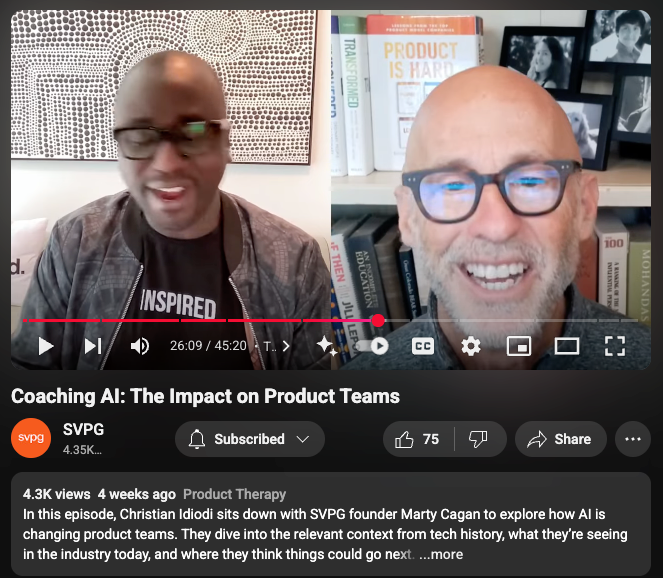
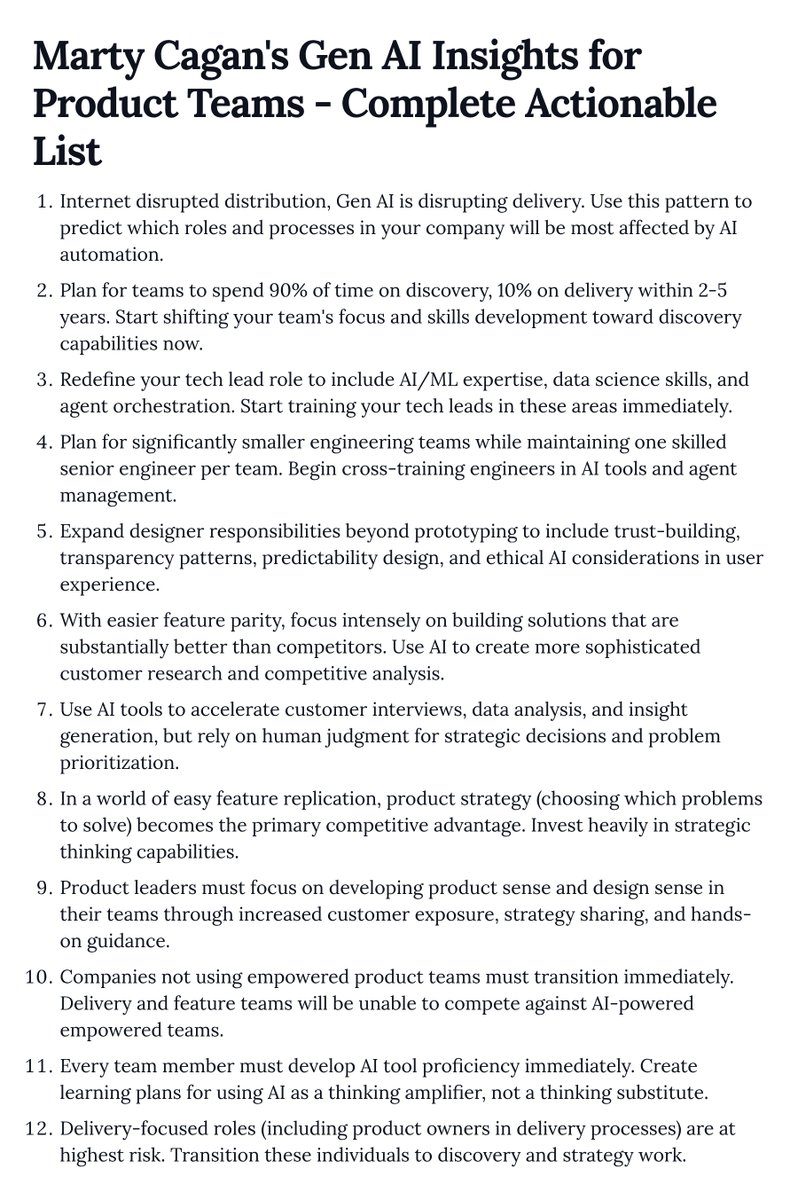
every PM and product leader needs to check this out Marty Cagan gives some great tips on how to prepare for AI as a product team I curated a short list of my own notes to help you (see full video below)
George from 🕹prodmgmt.world tweet mediaGeorge from 🕹prodmgmt.world tweet media
English
5
18
180
24.2K
Alvaro Cintas
Alvaro Cintas@dr_cintas·
This is one of the best AI tools I’ve tried. It’s called Typeless and I just push a button, talk, and it pastes the text transcript anywhere I want. It also removes filler words, auto formats, and even corrects mistakes. Here’s how to save hundreds of hours free:
English
26
22
187
30.3K