Shingai Thornton

2.3K posts

Shingai Thornton

Shingai Thornton

@shingaithornton

Systems Science and Political Economy

Earth Katılım Ağustos 2011
234 Takip Edilen975 Takipçiler
Sabitlenmiş Tweet
Shingai Thornton
Shingai Thornton@shingaithornton·
I think I’ve made a strong case for how systems science can provide nuanced and rigorous interdisciplinary views of Bitcoin. But maybe I’m wrong? Get paid to critique my paper and models on @ResearchHub researchhub.com/paper/9310259/…
English
2
5
38
2.7K
Mario Zechner
Mario Zechner@badlogicgames·
is there something like google docs, but for markdown? i need a cloud based collaborative markdown editor please.
English
241
9
720
337.3K
Andy Hall
Andy Hall@ahall_research·
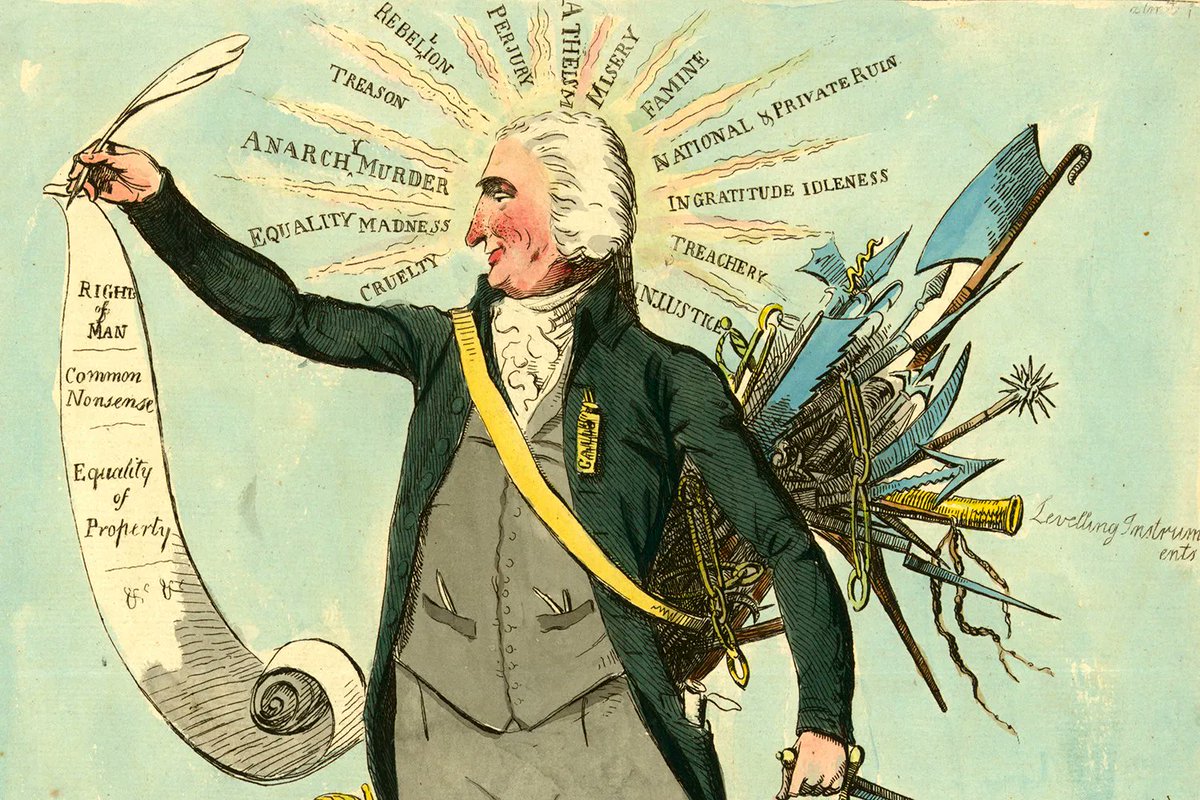
Amidst understandable concerns of AI dystopia, no one is offering a positive vision for how we can use AI to remake our institutions and reinvent how we govern. That’s what I try to offer today. My argument is that we need an explicit research agenda to build “political superintelligence.” Here’s my case: AI makes intelligence cheap and widely available, just as the printing press made information cheap and widely available—and that earlier revolution ultimately reshaped governance and society to our benefit. To capture this benefit quickly, we need to build political superintelligence: a set of tools that help citizens, representatives, and institutions perceive the world more accurately, understand tradeoffs, contest power, and act more effectively. I divide this research agenda into three layers: 1. The information layer: AI can make voters and governments dramatically smarter, but only if we fix political bias in models, improve the quality of sources AI draws on, and build trust through better performance. 2. The representation layer: AI can serve as tireless delegates acting on our behalf in political processes—monitoring government, filing comments, flagging decisions—but only if we solve preference drift, adversarial vulnerability, and the fundamental problem that we don't own our own agents today. 3. The governance layer: Even if we get the first two layers right, the infrastructure sits inside privately controlled companies. We need binding constitutional frameworks that distribute power, constrain companies, and ensure political superintelligence serves citizens rather than executives or shareholders. Each of these layers has a concrete, tractable set of research questions: better evals, geopolitical forecasting as a test case, governance experiments at small scale, agentic simulations, and institutional designs modeled on centuries of constitutional thought. The window for building these structures is narrow, and the right response is not to slow AI down but to speed up how fast we build the institutions that keep us free as AI grows more powerful. As Thomas Paine wrote in 1776, “We have it in our power to begin the world over again.” I hope you’ll read the full piece (linked below), which serves as a sort of manifesto for the Free Systems Lab, and that you’ll join me in the defining political economy research question of our time.
Andy Hall tweet media
English
42
39
263
62.2K
Shingai Thornton
Shingai Thornton@shingaithornton·
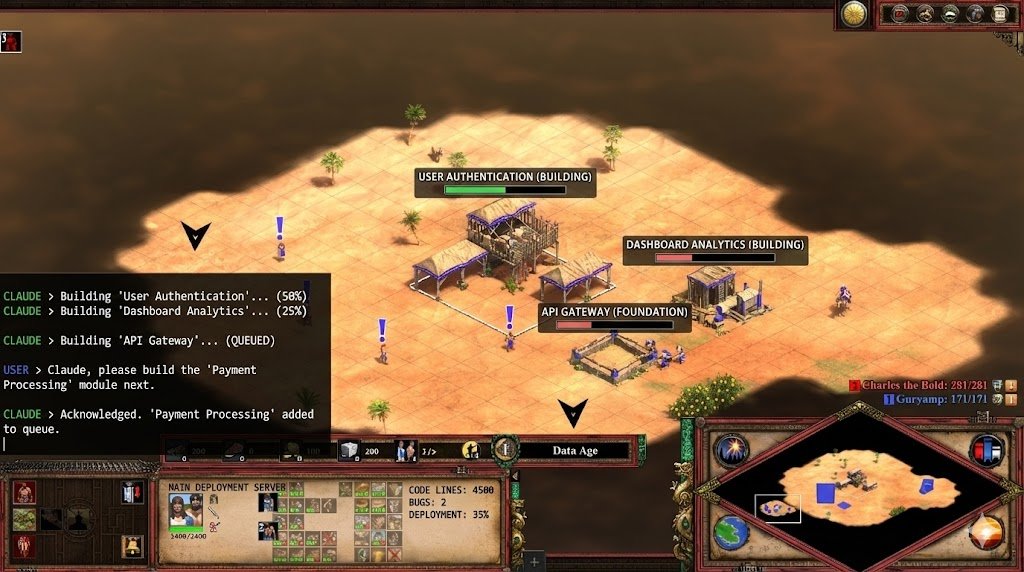
@DavidPlakon @joshpuckett Had fun riffing on this, imagining how I'd use it for my own workflow! Built quickly with Claude Code using Next.js + Zustand + dnd-kit. Agree that this idea needs to be brought home...
English
5
1
2
71
joshpuckett
joshpuckett@joshpuckett·
ok which one of you is ready to make an Age of Empires 2 like interface for Claude Code and make a billion dollars??
joshpuckett tweet media
English
381
289
5.8K
419.2K
Shingai Thornton
Shingai Thornton@shingaithornton·
@fkasummer Same. Feel a bit sad that it took until my 30s to discover the wonders of set and graph theory. Very intuitive and feel obviously practical. Category theory has been tough though
English
0
0
1
47
akhil
akhil@fkasummer·
I didn’t necessarily like math in school, but now I love it. The more abstract the math the easier it is for me.
English
1
0
5
214
Sean Manion
Sean Manion@TheUnjournaling·
Getting to true machine intelligence (or AGI or ASI or AXI or whatever) will require moving beyond the von Neumann architecture. To his credit JvN tried to tell us this both at the later Macy conferences and in his dying lecture, "The Computer & The Brain."
Sean Manion@TheUnjournaling

Was the "First Draft of the Report on the EDVAC", (Jun 1945) which intro'ed neuro-speak into computing, also the combined memo von Neumann outlines as a report out from the 4 groups at the Jan 1945 Teleology meeting (which precursored cybernetics and AI)? Time and topic match.

English
1
0
4
112
Carlos E. Perez
Carlos E. Perez@IntuitMachine·
Someone figured out a surprisingly simple way to make AI agents better at their jobs: just give them a personality. I just read a paper on "Psychologically Enhanced AI Agents," and it's a fascinating look at how we can steer AI behavior without any complex or expensive retraining. Here's the context: Normally, if you want an AI to be good at a specific task (like creative writing vs. strategic analysis), you have to do costly and time-consuming "fine-tuning." The problem is that a generic, one-size-fits-all AI often isn't the best fit. A model optimized for factual recall might not be great at generating an empathetic, emotional story. The key finding is a framework called MBTI-in-Thoughts. By simply telling an LLM to adopt a specific Myers-Briggs (MBTI) personality type in its prompt, its behavior changes in predictable and useful ways. For example, in a strategic game: "Thinking" (T) type agents chose to defect nearly 90% of the time. "Feeling" (F) type agents were more cooperative, defecting only about 50% of the time. This was achieved with just a prompt, no fine-tuning needed. What makes this so interesting is its unexpected simplicity. The ability was there all along, latent within the model. The prompt just acted as a key to unlock it. To make sure it wasn't just a fluke, the researchers had the primed AI take the official 16 Personalities test. The AI's answers consistently matched the personality it was assigned. It truly "became" that type for the task. This completely changes how I think about prompt engineering. It’s no longer just about what you ask the AI, but who you ask the AI to be. The practical applications are immediate: Need an AI for empathetic customer support? Prime it as an ISFJ ("The Defender"). Need one for ruthless market analysis? Try an ENTJ ("The Commander"). You can match the agent's "aptitude" to the task at hand. The broader implication is a future where we move away from monolithic AI models. Instead, we could build diverse teams of AI agents, each with a personality tailored to its specific role. Imagine a creative "ENFP" agent brainstorming with a logistical "ISTJ" agent to plan a complex project. It raises a new question: what's the optimal personality mix for solving a given problem? Ultimately, this research points toward a future of more versatile, capable, and aligned AI. We're learning that we can shape not just an AI's output, but its entire cognitive and affective style for a task. A simple prompt can unlock a whole new dimension of behavior.
Carlos E. Perez tweet media
English
83
272
1.8K
311.5K
Shingai Thornton
Shingai Thornton@shingaithornton·
"Whenever the people are well informed, they can be trusted with their own government; that whenever things get so far wrong as to attract their notice, they may be relied on to set them to rights." - Thomas Jefferson, 1789
Michael Adams@m_adams

Introducing a new type of civic tech made possible by AI. Every citizen should have a live, systems view of their government and today we bring that to SF! Track gov entities, spending, news, and more in real time. With LLMs, we can bring this to every city. Who's next?

English
1
1
3
267
Shingai Thornton
Shingai Thornton@shingaithornton·
@OriginalStacia Could be the case that both a) Her concerns are overblown, especially given how early stages your app is b) At some point a security audit of your code by a human would be beneficial
English
1
0
1
32
Stacia
Stacia@OriginalStacia·
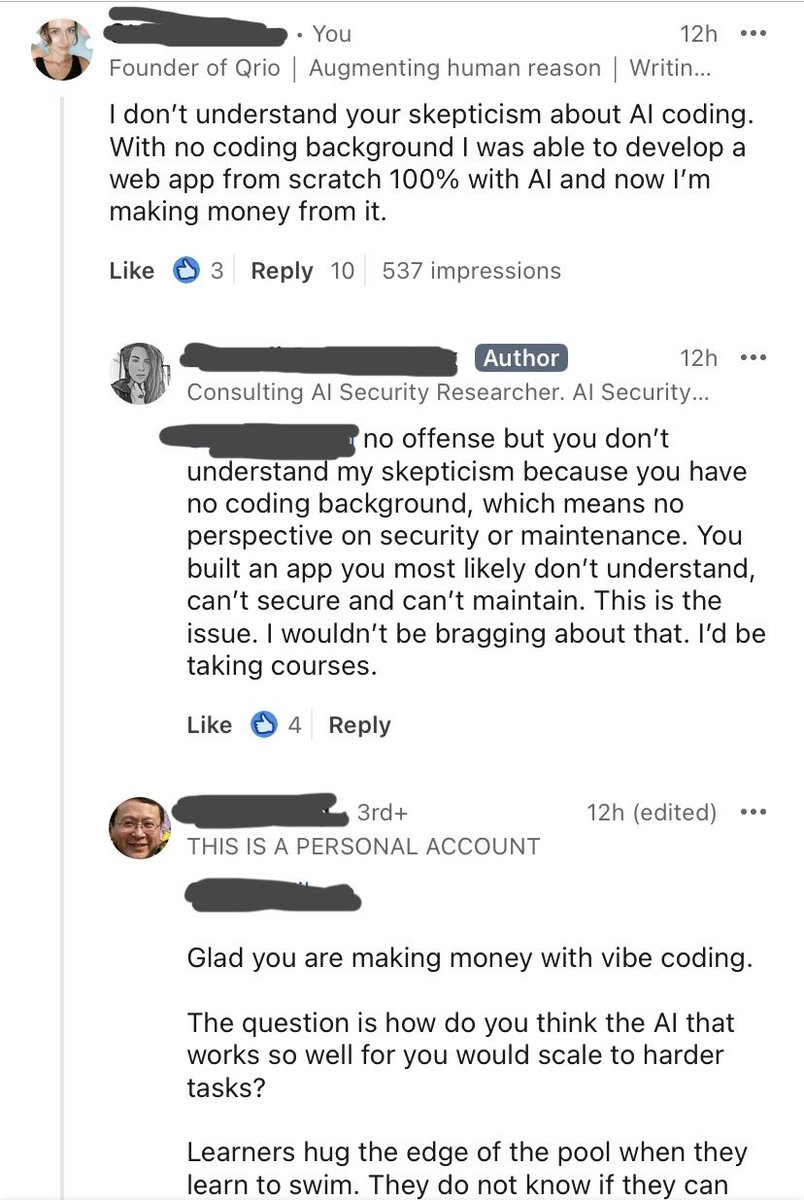
Hey guys I’m in a flame war on LinkedIn and I could use your help. An AI Security Researcher said that a full stack engineer who was fired from Microsoft lied when he claimed he was replaced by AI because she thinks AI isn’t able to replace full stack human devs. So I told her I don’t have dev experience but I coded my app from scratch and it’s making money. She said that’s super dangerous and I’m probably gonna get rekt security-wise and end up in legal/financial trouble. Now someone from the convo is asking me to post the link to my web app. I’m a bit nervous… do you think my site’s security is ok or should I get it checked by a professional dev? Worried someone might try to break it now that I’ve taken that position. 😅 I used @Replit for the vibe coding, Stripe for payment processing. Replit has a built in system for managing auth and secrets. It’s secured against script injections and I have rate limiting and captcha set up. Never heard of “supply chain” so I’m not sure if that’s a security concern I need to look into. Also do you guys think she’s right?? I strongly disagree because of all the coding I’ve seen non-coders do and all the devs who say AI makes them way more efficient.
Stacia tweet mediaStacia tweet mediaStacia tweet media
English
3
0
7
261
Shingai Thornton
Shingai Thornton@shingaithornton·
@JonathanHillis Would love to see a research paper documenting the entire experience someday...your work with Cabin often comes to mind for me whenever I'm reading the work of the Ostroms
English
1
0
6
199
Jon Hillis (🏕️,🏘️,🌆)
Jon Hillis (🏕️,🏘️,🌆)@JonathanHillis·
Building Cabin over the last four years has been one of the greatest joys of my life. I am so grateful to the community, contributors, and supporters that created the world's first network city. We planted seeds of a vision that I believe will come to fruition in the coming decades. While Cabin is winding down operations as an organization, I feel confident that our network of neighborhood builders will continue to thrive for years to come. See you on the trail.
Cabin@cabindotcity

Cabin is winding down operations and distributing the money in the DAO's treasury proportionally to token holders. If you are a token holder: before May 13th, make sure all of your tokens are at the address where you want to receive USDC. Cabin pioneered the concept of network cities and spent the last four years looking for the combination of product and market that would allow us to sustainably grow our global network of neighborhoods. We started out as a residency program for internet people to get together in person, built a global network of rural coliving hubs for digital nomads, and are now growing an accelerator program for neighborhood builders. Throughout each phase, we’ve tried to stay true to our community-centric ethos and long-term vision while also building something that could grow with a sustainable business model. Three years ago, Cabin approved a proposal to create its current governance token and sell some of the tokens to 52 community members, angels, and venture capital firms. Almost a year later we sold more tokens to venture firms. Since then we’ve run dozens of experiments in an effort to find a business model that made sense for Cabin. In the last year alone, we rapidly iterated on a wide range of product & business models, and explored paths for building financial sustainability around our network of neighborhoods. Our conclusion from these experiments is that venture-backed businesses, DAOs, and community-driven networks serve different purposes, and that this tension is holding Cabin back. Venture-backed startups work best as small, focused teams that rapidly pivot to find hyper-growth business opportunities that are financially viable in the short-term. DAOs work best as a credibly neutral governance mechanism for distributing ecosystem grants from an existing cashflowing protocol. Community-driven networks work best when they serve as the loose connective tissue for many people to independently explore adjacent paths building what they find most interesting and valuable. We believe that Cabin should stop operating like a venture-backed startup and a DAO and continue as an informal community-driven network. As a result, last week we passed a proposal to wind down DAO operations and distribute the money in the DAO's treasury proportionally to token holders. Here's what happens next: Starting immediately, Cabin will no longer fund new governance proposals On May 13th, we will take a snapshot of ₡ABIN token holdings that will be used to distribute assets By May 15th, we will distribute the treasury proportionally to the addresses in the snapshot On May 16th, we will hold a Composting Community Gathering Over the next few weeks, we will wind down operations and legal entities Over the last four years we explored the frontiers together, planted the seeds of a network city, and created a dense web of relationships that will last a lifetime. We are incredibly proud of what we’ve dreamed of and built together, and we can’t wait to see what this community does next to build the future we all believe in. See you on the trail.

English
9
2
117
7.5K
Shingai Thornton
Shingai Thornton@shingaithornton·
@valhalla_dev Are you running and gathering data from a Solana node? Or scraping data from other platforms?
English
1
0
1
29
developing valhalla - h/acc
developing valhalla - h/acc@valhalla_dev·
Lowki Intelligence Dev Update (we're going to beat Palantir btw): Nodes for SOL transactions are now rendering with associated node types (currently just Accounts and Transactions) and links are rendering as well. I'll be adding new node types this week for Mints, Persons (the actual person behind the account), Tweets, etc. so that the ontology can be built out. On the backend, I've got a lot more transaction types parsing for Radium and Jupiter. I'm building out a system to put things onto and take things off of a transaction "backburner" so I can prioritize higher importance transactions. That way I can still prioritize increasing parser fidelity but I can get higher priority transactions through the queue without waiting on transactions I can't parse yet. I also have function runtimes going to a table now, which is going to allow me to track which functions are taking the longest to run, which ones are being called the most frequently, etc. I plan on feeding this into Grafana to watch runtimes, compare them, do AB testing, etc. This week, I'll be building out two incredibly important systems: websocket listeners and webhooks. Websocket listeners allow me to have a near-real time data stream of ongoing transactions mentioning certain accounts. It was fairly important to get my parsers in a good spot before I do that or else I'd just be filling my DB up with transactions I can't parse. Having near-real time streaming of transactions lets me start building at a larger scale. Webhooks are going to be important because they're going to start allowing me to build out the decisionmaking and notification engines. My first test of this is going to be some dead simple algo trading systems that will let me copy-trade, but I'll also be building this into the beginnings of an agentic framework soon as well. More systems I'm going to start work on this week: - Tabular/alternative views. I like the nodegraph view, but it's not always going to be a necessary or correct way to view the data. Breaking the nodegraph view into a smaller part of the project that can be called into/referenced has always been part of the plan. - Local data serialization/deserialization. I want to be able to create "save files" that you can use to upload/download data to share with others. This will be fairly important for testing things (being able to create data views that aren't dependent on a singular database state will be super handy) but I've got some cool use cases for it way out in the future that I'll talk about later. - Agentic interactions. I'm not likely to get to this this week but it should be a "next couple weeks" focus. I want to start building out agents and agent plugins that can interact with the data. It would be awesome to open up an account node and ask an agent "give me the last several transactions by this account and what you know about it" and have the agent query the data. it would be even cooler if that could be a read/write relationship. -- > 6.5k lines of code on Lowki is pretty rad. I've really loved building this project out so far and look forward to the direction it grows in. big plans for the near future!
developing valhalla - h/acc tweet mediadeveloping valhalla - h/acc tweet media
English
2
0
11
1.2K
Shingai Thornton
Shingai Thornton@shingaithornton·
@normonics Yep. It's why Adam Smith never talked about "the economy," but rather the discipline of political economy. A polity involved in a complex process of economizing
English
0
0
1
31
Joe Norman
Joe Norman@normonics·
You'll never make sense out of anything if you think the economy stops at "economics". In the real world all the systems we name and treat as separate are in fact strongly intertwined.
English
1
3
59
3K
Joey DeBruin
Joey DeBruin@joey_debruin·
It took about 25 minutes for AI to process 7000 abstracts from last year's AACR conference and produce this network graph of all of the collaborations happening around antibody drug conjugates (ADCs). Unsurprisingly, academic institutions are much more densely interconnected than companies. Next up: mapping target antigens and digesting the data into some actionable insights for people going to this year's meeting.
English
1
2
5
388
Shingai Thornton retweetledi
Chris Burniske
Chris Burniske@cburniske·
"As platforms for innovation that can provide an alternative to legacy systems susceptible to corruption, mass surveillance, and single points of failure, blockchains persist only if a critical mass of entrepreneurs and proponents stay on the difficult path of building truly decentralized, privacy-enhancing, and capture-resistant systems. While crypto’s commercial success no longer depends on it, its long-term societal legacy definitely does."
Placeholder@placeholdervc

"The Cryptopreneur’s Dilemma" placeholder.vc/blog/2024/12/1… by @mlphresearch

English
1
13
74
25.4K
Shingai Thornton retweetledi
Nick Tomaino
Nick Tomaino@NTmoney·
“The computer can be used as a tool to liberate and protect people, rather than to control them” HAL FINNEY I NOVEMBER 16, 1992
English
14
21
138
14.7K