
Shunali Khullar Shroff

38.5K posts

Shunali Khullar Shroff banner
Shunali Khullar Shroff

Shunali Khullar Shroff

@shunalishroff

Author/ Features Writer/podcaster. Write on travel,popular culture, art,feminism,parenting. RT not endorsements.

Mumbai, India Katılım Nisan 2009
603 Takip Edilen19.8K Takipçiler
Shunali Khullar Shroff retweetledi
Anish Moonka
Anish Moonka@AnishA_Moonka·
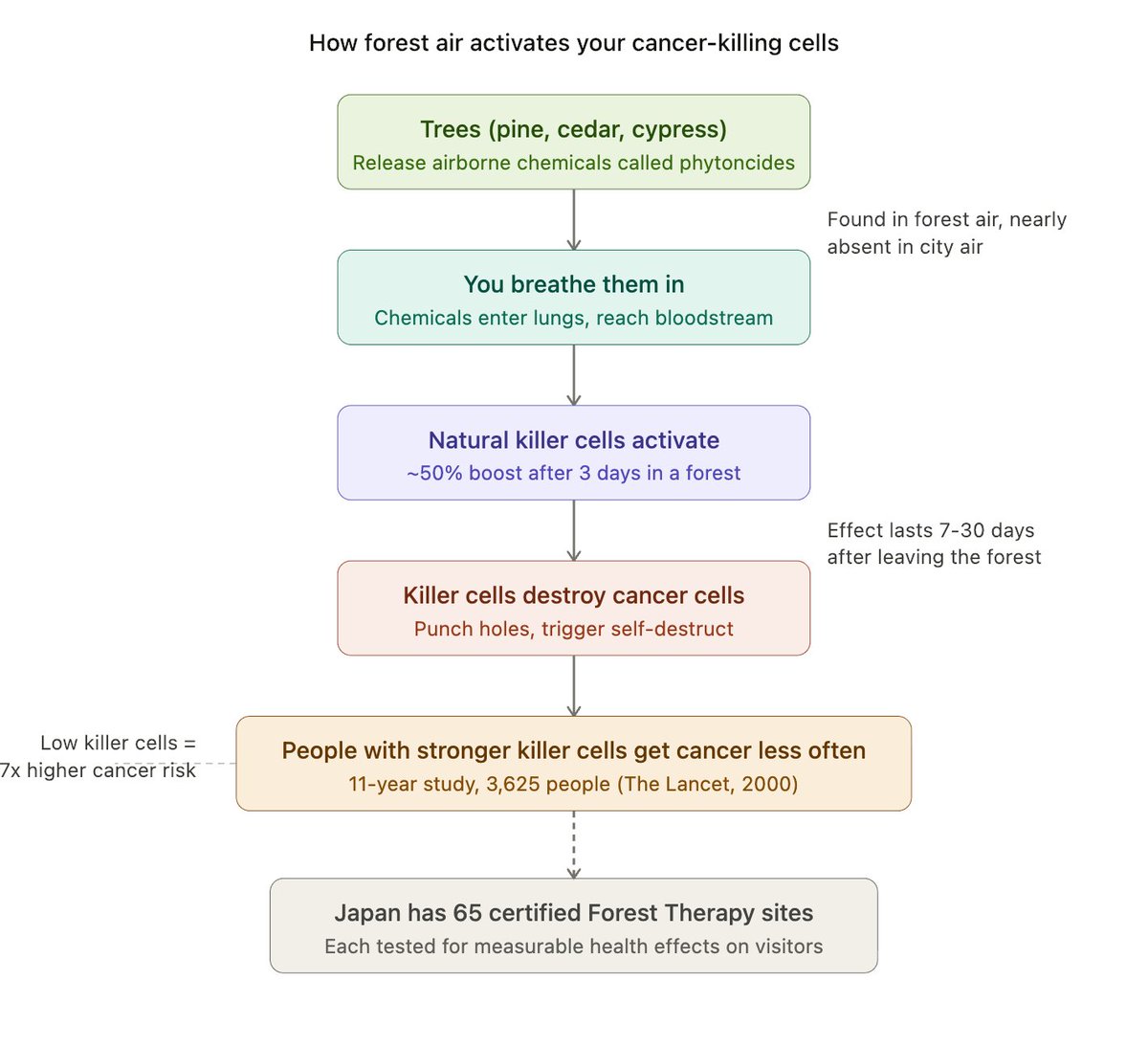
Trees release invisible chemicals into the air to protect themselves from bugs and disease. Turns out those same chemicals also switch on your body's cancer-fighting cells. They're called natural killer cells. They're a type of white blood cell that patrols your bloodstream looking for cancer cells and virus-infected cells. When they find one, they punch a hole through its outer wall and inject proteins that force the cell to self-destruct from the inside. You're born with them. Unlike most of your immune system, they don't need to be "trained" on a specific threat first. They just attack anything that looks wrong. The 50% number in this tweet comes from Dr. Qing Li at Nippon Medical School in Tokyo, who has been studying the effects of forests on the human body since 2004. His original 2007 study took 12 men on a 3-day, 2-night forest trip, walking two hours a day. Blood tests showed 11 of 12 had roughly 50% more cancer-killing cell activity afterward. A follow-up with 13 female nurses found the same thing. But the part the tweet leaves out: the boost didn't vanish when they went home. It lasted over 7 days in both groups, and in men, it was still detectable in blood work 30 days later. Li's conclusion is that one forest trip per month could keep these cells running at a higher level year-round. The obvious next question is whether it's the forest itself or just the vacation. Li tested this directly. A separate group took a city tourist trip with the same amount of walking. No boost to killer cells. No stress hormone drop. Zero effect. Then he ran an even more controlled test: 12 men stayed in a regular Tokyo hotel room for three nights while a humidifier pumped tree oil (from Japanese cypress) into the air overnight. Their killer cells still went up. Their stress hormones still dropped. That isolates the cause to those tree chemicals, called phytoncides. Pine, cedar, and cypress trees release the most. These chemicals were found in forest air but were nearly absent in city air. A 2021 lab study showed that one of these tree chemicals directly switches on killer cells and slows colon tumor growth in mice. The bigger picture connects these cells directly to cancer risk. An 11-year study published in The Lancet (one of the world's top medical journals) tracked 3,625 Japanese people and found that those with weaker natural killer cells developed cancer at significantly higher rates. A separate study screening for bowel cancer found that people with low killer cell levels were 7 times more likely to be diagnosed. Li's own research across all 47 regions of Japan showed that areas with less forest had higher cancer death rates for lung, breast, uterine, prostate, kidney, and colon cancers, even after accounting for differences in smoking rates and wealth. The caveats: Li's original studies used small groups (12 and 13 people), and the regional data show a pattern but don't directly prove that forests prevent cancer. No large-scale clinical trial has confirmed that yet. But the chain is consistent: trees release chemicals, those chemicals wake up the cells in your blood that kill cancer, the effect lasts weeks, not hours, and people with more active killer cells get cancer less often. Japan now has 65 government-certified Forest Therapy sites across the country, each tested and approved based on the physical effects they have on visitors.
Anish Moonka tweet media
All day Astronomy@forallcurious

🚨: Research suggest that just 3 days of camping in the forest can increase the production of cells that kill cancer by more than 50%.

English
37
965
3.8K
278.4K
Shunali Khullar Shroff
Shunali Khullar Shroff@shunalishroff·
Do read to understand how Indian pharma is about to be hit next.
Shanaka Anslem Perera ⚡@shanaka86

Seven clocks are running. None of them negotiable. All of them counting down to the same weeks. The planting clock. Mid-April is the biological deadline for corn and soybean planting across the US Midwest. Every day that passes without nitrogen becoming affordable and available narrows the window for corn. USDA projects corn falling to 94 million acres from 98.8 million. Soybeans rising to 85 million from 81.2 million. The seeds that go into the ground in the next three weeks determine America’s grain harvest in October. The decision is irreversible. The USDA clock. March 31. Prospective Plantings. The report that converts farmer intentions into official data. Every acreage number, every corn-soy ratio, every nitrogen-dependent calculation becomes a published fact that traders, governments, and food agencies will use to model global supply for the next twelve months. The number arrives in twelve days. The FAO clock. April 3. The Food Price Index. The first global reading that captures post-Hormuz commodity prices across cereals, vegetable oils, dairy, meat, and sugar. The 2022 peak was 159.7 in March 2022 after Ukraine. This reading will incorporate oil above $100, urea at $610, LNG halted, packaging repriced, and freight surcharges of $500 to $1,500 per container. The number that determines whether the UN declares a food emergency arrives in fifteen days. The pharmaceutical clock. India’s API inventory buffers are two to three months, measured from the war’s onset on February 28. Late May is the depletion window. Methanol at 87.7 percent Hormuz exposure feeds the solvent chain for paracetamol, ibuprofen, metformin, and antibiotics. Once buffers deplete, the shortage becomes a patient access crisis for the 47 percent of US generics that originate in India. The China crude clock. FGE NexantECA confirmed China is drawing commercial reserves at up to one million barrels per day. The draw sustains refinery operations for four to six weeks from March 19. Mid-April to late April is the exhaustion window. After that, China faces three options: accelerate Russian pipeline imports, reroute at massive premium, or crack open the strategic petroleum reserve. The third option reprices every commodity on the planet. The helium clock. SK Hynix and Samsung hold two to three months of helium inventory. Late May to early June is the depletion window. South Korea imports 64.7 percent of its helium from Qatar. Ras Laffan is offline. If helium buffers deplete before alternative supply arrives, semiconductor fabrication faces rationing. The AI hardware supply chain hits a physical wall measured in months, not quarters. The insurance clock. Solvency II requires 30 to 60 days of zero incidents before P&I clubs can reinstate war risk coverage. Even after a ceasefire, the insurance normalisation takes six to sixteen months based on the Red Sea precedent of 26 months and counting. The logistics system lags the financial relief rally by the longest duration of any clock in this crisis. Seven clocks. The shortest expires in twelve days. The longest runs for over a year. The planting window, the USDA report, the FAO index, the drug buffers, the Chinese crude draw, the helium inventory, and the insurance cycle are all counting down simultaneously. None of them pause for diplomacy. None of them respond to presidential directives. None of them read sealed packets. The calendar is the only actor in this war that has never lost a negotiation. open.substack.com/pub/shanakaans…

English
0
0
1
835
Shunali Khullar Shroff
Shunali Khullar Shroff@shunalishroff·
Our parents lived through wars. Our children are growing up with them again. Gen X may have come of age in a rare lull or at least a relatively peaceful window. There was Kuwait, the Balkans, Kargil, terrorism…But this sense of doom, this general climate of destruction — we escaped that (Em dash regrettable). There was no climate crisis either. What extraordinary good luck to have grown up in such a world.
English
0
0
2
262
Shunali Khullar Shroff
Shunali Khullar Shroff@shunalishroff·
@SubhasishDTDC @DTDCIndia @DTDCIndia I booked a courier pickup from Dehradun on 18 Feb. On 25 Feb I received a message saying delivery could not be completed at my address in Mumbai because my address was “incomplete”. I immediately contacted your customer service team, verified the address, and it was perfectly correct. Since then I have spent weeks calling and emailing DTDC and have been given completely contradictory information every single time. Customer service tells me the parcel is being returned to Dehradun branch because my address was incomplete. Sometimes they tell me the parcel has already left for Dehradun. The Dehradun branch tells me the parcel has never left Andheri. I have emailed customer service relentlessly and this misinformation and tossing around continues. I even sent my office staff to the Andheri branch twice and was told the parcel had already gone to Dehradun and even reached there. Yet the Dehradun branch continues to insist it has never left Andheri and they can see that on the system. So where exactly is my parcel? This package has enormous sentimental value and DTDC has wasted weeks of my time with misinformation, negligence and complete lack of accountability. For the record, I have now filed a formal consumer complaint online regarding this matter. If this parcel is not located and delivered immediately, I will be pursuing the matter further legally for harassment, mental distress, deficiency of service and damages. I expect a clear explanation and resolution without any further delay.
English
3
0
2
611
Thamin Rashid
Thamin Rashid@thaminrashid·
@shunalishroff @SubhasishDTDC @DTDCIndia I faced a similar incident with DTDC. Customer care is practically useless in such cases. I reached out to the DTDC regional team who were very nice and fixed the problem the very same day. The parcel got delivered by evening.
English
1
0
0
20
Thamin Rashid
Thamin Rashid@thaminrashid·
@shunalishroff @SubhasishDTDC @DTDCIndia This is unfortunately a standard modus operandi of third party local area contractors. The contractor's staff punches an "out for delivery status" from their mobile apps and then log an unfavourable update such as "premises locked" at the end of the day.
English
2
0
0
41
Shunali Khullar Shroff retweetledi
Vaishali Mathur
Vaishali Mathur@mathur_vaishali·
This needs to be said: We are at Jim Corbett and apparently there is no restriction on loud music till 10:30pm in the night. The roads are full of cars speeding around, at least 30 jeeps plying in one area of the forest, you can see brunt land on both sides and massive tree felling. So guilty of attending a family wedding here, I cannot say. There’s one I skipped because I didn’t want to be a party to destroying the habitat of animals. But why is Uttarakhand government allowing weddings in a forest reserve? I know my tweet will have zero reaction but Please tag the concerned agencies when you read this. @ukcmo @uttrakhand24 @AniUttarakhand
English
199
1.6K
4.9K
231K
Shunali Khullar Shroff
Shunali Khullar Shroff@shunalishroff·
@abhishek_chuck I have been harassed for days because of Dtdc Mumbai’s gross inefficiency. Your office here has given me such a runaround for my lost parcel, and zero cooperation from consumer help desks that I’m shocked this business runs at all. You guys are setting a new standard in complacency and washing your hands off all responsibility.
English
0
0
1
346
Shunali Khullar Shroff
Shunali Khullar Shroff@shunalishroff·
Yesterday at @nmacc_india on Ustad Zakir Hussain’s 75th birthday anniversary, this wonderful blending of performance between the late maestro himself and Sivamani
Shunali Khullar Shroff tweet media
English
0
2
4
373
Shunali Khullar Shroff retweetledi
Open Magazine
Open Magazine@Openthemag·
#WomenIssue2026 - Women in the age of the AI girlfriend: It is no longer a truth universally acknowledged that a single man in possession of wealth must be in want of a wife. It may now be the wife who is no longer in want of the arrangement, writes @shunalishroff t.ly/AwlnP
Open Magazine tweet media
English
0
1
0
192
Shunali Khullar Shroff retweetledi
Today In History
Today In History@historigins·
When BBC News accidentally interviewed on live TV a man who originally came in for a job interview
English
352
3.4K
40.1K
2.5M
DTDC Express Limited
DTDC Express Limited@DTDCIndia·
@shunalishroff @consumercourtin Hi, We've already forwarded your query to the escalation team. We understand that you have been extremely patient, yet, please allow us a little more time and we'll try to resolve the issue as soon as possible.
English
1
0
0
18
Shunali Khullar Shroff
Shunali Khullar Shroff@shunalishroff·
@DTDCIndia You still haven’t contacted me. Irresponsible, inefficient and careless. Nobody should ever use DTDC ever again.
English
1
1
4
354
Kartik
Kartik@Kartek·
@shunalishroff @DTDCIndia Omg I always thought DTDC is reliable..have used them only....it's surprising and shocking
English
1
0
0
16