Sergio Gorigoitia

33K posts

Sergio Gorigoitia

Sergio Gorigoitia

@sigorigo

Profesor, músico, cruzado.

Coquimbo, Chile Katılım Kasım 2010
2.8K Takip Edilen1.1K Takipçiler
Sergio Gorigoitia
Sergio Gorigoitia@sigorigo·
@mrhitchcok @ignaciobriones_ El problema fue el coro de ultrones que entre el estallido y la CC se obsesionó con tratar de fachos a lo que se moviera (del PS pa abajo) y de cancelar cualquier opinión divergente como "amarilla". Resultado: hoy tipos como Briones son irrelevantes y nos gobierna Kast.
Español
1
1
6
321
The Real Mr. Hitchcock
The Real Mr. Hitchcock@mrhitchcok·
Digan lo que digan. @ignaciobriones_ es un tipo decente. Lo juzgamos y castigamos mucho por las 65 lucas que ofreció al inicio de la pandemia como ministro de hacienda de Piñera. Y creo que se equivocó en ese momento. Pero en su favor diré que NADIE preveía en esa época lo que se venía con el Covid para delante. Yo NO concuerdo con muchas de sus posturas ideológicas, con algunas si. Pero más allá de eso, lo considero un buen político y un mejor ser humano.
Español
72
359
1.2K
32.7K
TioKirbo™
TioKirbo™@tiopipe39·
@Lautaro_Chile La gente no entiende. Ya hau 24 F35 comprados para el 2030 el centenario de la fach y creo que tres KC390. Falta saber si llegan mas KC135 o 330MRTT para reemplazar los 135R
Español
6
0
3
1.4K
Lautaro
Lautaro@Lautaro_Chile·
🇦🇶🇨🇱 | El Ministro de Defensa confirma que se esta evaluando el REEMPLAZO de los F-5E/F Tiger lll en el Mediano Corto Plazo. #Capacidades 😎
Español
92
224
1.3K
72.5K
CNN Chile
CNN Chile@CNNChile·
#CNNChileRadio | José Antonio Kast, presidente de la República: "No es necesario tener un buen líder, tenemos que tener buenos equipos. Estoy muy orgulloso del equipo que me acompaña en el Gobierno (...) si logramos buenos equipos en nuestro Gobiernos, vamos a recuperar la libertad de nuestros compatriotas".
Español
736
189
604
101.7K
Naty Luna
Naty Luna@NatyLuna_Luna·
Buenos días gente! El mio seria "Psicosis"
Naty Luna tweet media
Español
239
9
107
13.7K
Sergio Gorigoitia retweetledi
Marcelo Mena-Carrasco 🚲♻️ 🇨🇱
El conflicto de interés en Chile no exige haber recibido un peso. La Ley 20.880 lo define como la concurrencia de un interés particular, "sea o no de carácter económico", o de circunstancias que resten imparcialidad. Y el art. 12 N°1 de la Ley 19.880 obliga a abstenerse a quien tenga "interés personal" en el asunto. Como académico, el ministro firmó como autor un estudio de 2023, cofinanciado por Uber Chile, cuyas conclusiones hoy constituyen la base del reglamento que reescribe. Hay interés personal, académico, reputacional, intelectual, y circunstancias objetivas que restan imparcialidad. Es un interés que debió ser declarado, y es un interés que lo inhabilita de pronunciarse, actuar, o influir. No tiene nada de malo haberse desempeñado en estos roles como académico. Lo que es cuestionable es no declarar el interés. #LeyEAT
24 Horas@24HorasTVN

📌 #ENacional | Biministro @louisdegrange: "Yo nunca he recibido ningún peso de ninguna empresa de aplicación; mi rol ha sido netamente académico" 🖥 @tvnplay ➡️ tinyurl.com/2kek93hh 📡 En vivo ➡️ tinyurl.com/mtvfasyu

Español
28
828
1.5K
37.1K
Diego Rodriguez
Diego Rodriguez@DiegoRouruguay·
Faaaa y Yo que uso la misma para las patas, las axilas, la cabeza, la otra cabeza, el asterisco todo todo todo 😳
Español
261
914
14.4K
164.4K
Sergio Gorigoitia retweetledi
Ihtesham Ali
Ihtesham Ali@ihtesham2005·
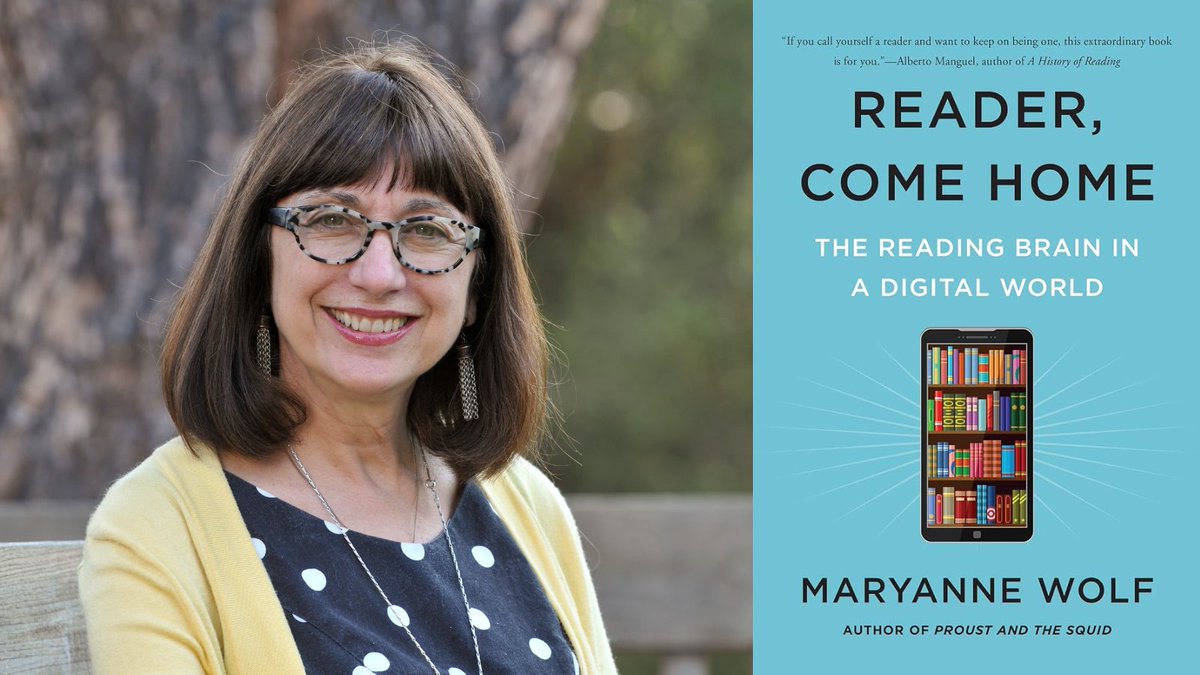
A neuroscientist who spent 20 years proving that reading on screens damages your brain sat down to read her favorite novel and discovered that the damage had already happened to her. Her name is Maryanne Wolf. She runs the Center for Dyslexia at UCLA and is one of the most cited reading scientists alive. The experiment she ran on herself is sitting inside a book she published in 2018. Here is the one fact that breaks how most people think about reading. Humans were never born to read. Yes, you read that right. There is no reading center in the brain. There is no gene for literacy. Every reader builds a custom circuit inside their own skull by repurposing brain regions that originally evolved for vision, language, and recognizing objects. Wolf calls it the reading brain circuit. The circuit is not a given. It is built by use. And because it is built by use, it can be unbuilt by disuse. The circuit she spent her career mapping is not the one that just turns letters into sounds. Sitting on top of that is something she calls the deep reading circuit. Both hemispheres firing. Multiple lobes coordinating. The visual system, the language regions, the memory centers, the emotional and motor systems all firing in a choreographed sequence that takes the brain a few seconds longer to run than skimming does. Those few extra seconds are where everything important happens. Background knowledge pulls up. Analogies form. Inferences fire. The mind takes the perspective of the character. Critical analysis runs in the background while emotion runs in the foreground. New thoughts get generated on top of the author's thoughts. The decoding is the entry ticket. The deep circuit is the show. Skimming does not fire this circuit. There is no time. In 2018 Wolf ran a private experiment on herself. She decided to reread Hermann Hesse's Magister Ludi, a dense novel she had loved as a young woman. She was the world's leading expert on the reading brain. She assumed her own circuit was intact. It was not. She opened the book and could not get through it. Her words, not mine. She wrote that she hated the book. The sentences felt like snakelike constructions that confuse meaning instead of revealing it. 6She described the experience as someone pouring thick molasses over her brain every time she picked it up. She wrote one sentence that should haunt anyone who reads it. "I now read on the surface and very quickly, in fact, I read too fast to comprehend deeper levels." The woman who built her entire career on the deep reading circuit had quietly lost access to her own. The mechanism is brutal in how simple it is. Eye-tracking research from Ziming Liu at San Jose State shows that when people read on screens, almost all of them fall into the same pattern. They read the first line. Then their eyes word-spot down the page in an F shape. They sample. They do not read. Whatever you stop using, your brain stops maintaining. The data is the part most people have never seen. In 2018 Pablo Delgado ran a meta-analysis of 54 studies covering more than 170,000 participants. Same text. Half on paper. Half on screen. The screen group lost by 0.21 standard deviations. Replicated by Clinton at 0.25. Replicated by Kong at 0.21. Researchers gave it a name. They call it the screen inferiority effect. The worst part is what happened over time. The gap has grown larger in studies done after 2010, not smaller. Digital natives do not outperform older readers. They underperform them on the same texts. More exposure makes it worse, not better. Screen readers are also more confident they understood than paper readers. They think they got more out of the text than they actually did. The skimmer does not know they are skimming. They believe they are reading. The stakes Wolf keeps coming back to are not academic. The deep reading circuit is the same circuit your brain uses to take another person's perspective. To weigh complex civic information. To read a contract, a ballot question, a medical disclosure and notice what is actually being said underneath what is written. If the circuit atrophies, those capacities go with it. Not metaphorically. Structurally. You are not getting dumber. You are not losing intelligence. You are quietly losing access to a specific circuit that takes longer to fire than your phone is willing to wait for. The expert who spent 20 years warning the world ran the experiment on herself and barely made it back. Most people are not running the experiment at all.
Ihtesham Ali tweet media
English
29
208
575
45.5K
Sergio Gorigoitia
Sergio Gorigoitia@sigorigo·
@T13 Otro zorrón clasista e incompetente que, entre tanto inútil que hay en el gobierno, pareciera ser el menos tonto del lote.
Español
0
0
0
29
T13
T13@T13·
El estilo que marcó Arrau al aterrizar en Seguridad y su misión ante recrudecimiento de violencia en La Araucanía t13.cl/774852-tw
Español
2
6
26
3.6K
T13
T13@T13·
Lincolao asegura estar en un proceso de adaptación a la política chilena: "Estoy tratando de aprender lo más rápido posible" t13.cl/774668-tw
Español
395
103
260
88.2K
Pedro L.
Pedro L.@PietroLoredan·
@dplatinoamerica Está desactualizado, Argentina va a jugar en grande con Cobre.
Español
3
0
4
1.4K
Diálogo Político
Diálogo Político@dplatinoamerica·
Litio, cobre y tierras raras: América Latina se vuelve clave para que EEUU y Europa reduzcan su dependencia de China en minerales críticos para la transición energética y digital. ✍️ Yannic Fricke
Español
137
1.3K
3.9K
4M
Werne Núñez B.
Werne Núñez B.@elwerne·
Paseo Ahumada, 1989. Un amigo me avisó que aparezco en el minuto 1:34. Sí, estoy llorando. 3ro medio, Instituto Nacional. Sigo llorando
Español
100
123
1.1K
92.9K
Poirot Escovedo
Poirot Escovedo@poirotes·
“No vamos a hablar”: La Ministra Ximena Lincolao se retiró en silencio de la Comisión de Ciencias del Senado, ante las consultas sobre lobby no registrado, patrimonio omitido y denuncia del exsubsecretario Araos de un plan para concretar despidos masivos. @24HorasTVN
Español
268
1.3K
2.4K
116.3K
Sergio Gorigoitia retweetledi
Mehdi (e/λ)
Mehdi (e/λ)@BetterCallMedhi·
je me demande sincèrement si vous mesurez l'ampleur du massacre cognitif silencieux qu'on est en train d'assister collectivement une génération entière déjà fragile cognitivement transfère ce qui restait de sa pensée à chatgpt pour 20 euros par mois et appelle ça une révolution, le pire c'est que ces gens publient des threads dont ils ne maîtrisent ni le contenu ni les sources, incapables de distinguer le réel de l'hallucination dans ce que le modèle leur sort et ils inondent le débat public avec des fake news bien tournées qui circulent uniquement parce que la forme est léchée c'est exactement ça l'illusion du savoir au 21e siècle, des phrases parfaitement structurées sur la forme et complètement vides sur le fond, des gens qui croient avoir une opinion alors qu'ils ont juste impressionné une audience pendant 10 secondes avec du langage cosmétique généré par une machine qu'ils utilisent sans rien comprendre et le drame c'est qu'eux-mêmes finissent par croire qu'ils pensent réellement parce que le texte sort en français correct alors que leur cerveau a juste sous-traité l'opération cognitive la plus précieuse de l'humanité qui est de structurer une pensée perso j’ai envie de dire ce qu’ils croient gagner en clarté ils le perdent en profondeur mais ce qu'ils ne réalisent pas c'est que la capacité à structurer sa propre pensée EST JUSTEMENT l'accès au savoir, c'est ce qui permet d'articuler ses idées, de déconstruire les dogmes de remonter aux premiers principes et de démonter les arguments des autres avec précision, sous traiter cette compétence à un LLM c'est exactement comme sous traiter sa propre digestion à une machine, vous ne nourrissez plus votre cerveau vous nourrissez juste l'illusion d'avoir mangé la question terrifiante que personne pose c'est quelle sera la valeur économique d'un humain en 2035 dont le cortex a passé 10 ans à attendre que la machine finisse sa pensée et pour moi le calcul est implacable, quand 4 milliards de personnes ont accès à la même intelligence pour 20 euros par mois la seule prime de valeur portera sur les humains qui ont gardé un cortex capable de produire du signal original et sachez que ce type de cortex se construit avec 15 ans de lecture profonde, d'écriture lente, de doute méthodique et de pensée silencieuse (ce que je ne cesse de pousser/recommander ici à travers mes différents threads) et c’est exactement le contraire de ce qu'enseigne l’IA générative à la population générale aujourd'hui
Français
237
965
4K
258.6K
Sergio Gorigoitia retweetledi
Ihtesham Ali
Ihtesham Ali@ihtesham2005·
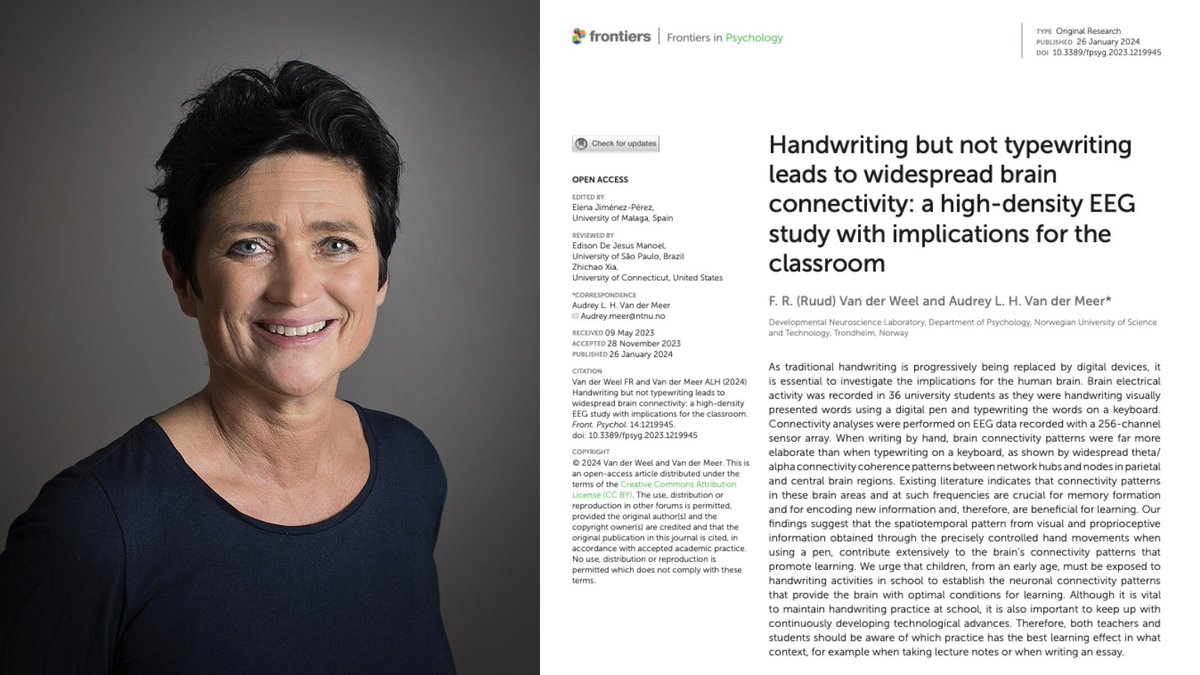
A Norwegian neuroscientist spent 20 years proving that the act of writing by hand changes the human brain in ways typing physically cannot, and almost nobody outside her field has read the paper. Her name is Audrey van der Meer. She runs a brain research lab in Trondheim, and the paper that closed the argument was published in 2024 in a journal called Frontiers in Psychology. The finding is brutal enough that it should have changed every classroom on Earth. The experiment was simple. She recruited 36 university students and put each one in a cap with 256 sensors pressed against their scalp to record brain activity. Words flashed on a screen one at a time. Sometimes the students wrote the word by hand on a touchscreen using a digital pen, and sometimes they typed the same word on a keyboard. Every neural response was recorded for the full five seconds the word stayed on screen. Then her team looked at the part of the data most researchers had ignored for years, which is how different parts of the brain were communicating with each other during the task. When the students wrote by hand, the brain lit up everywhere at once. The regions responsible for memory, sensory integration, and the encoding of new information were all firing together in a coordinated pattern that spread across the entire cortex. The whole network was awake and connected. When the same students typed the same word, that pattern collapsed almost completely. Most of the brain went quiet, and the connections between regions that had been alive seconds earlier were nowhere to be found on the EEG. Same word, same brain, same person, and two completely different neurological events. The reason turned out to be something nobody had really paid attention to before her work. Writing by hand is not one motion but a sequence of thousands of tiny micro-movements coordinated with your eyes in real time, where each letter is a different shape that requires the brain to solve a slightly different spatial problem. Your fingers, wrist, vision, and the parts of your brain that track position in space are all working together to produce one letter, then the next, then the next. Typing throws all of that away. Every key on a keyboard requires the exact same finger motion regardless of which letter you are pressing, which means the brain has almost nothing to integrate and almost no problem to solve. Van der Meer said it plainly in her interviews. Pressing the same key with the same finger over and over does not stimulate the brain in any meaningful way, and she pointed out something that should scare every parent who handed their kid an iPad. Children who learn to read and write on tablets often cannot tell letters like b and d apart, because they have never physically felt with their bodies what it takes to actually produce those letters on a page. A decade before her, two researchers at Princeton ran the same fight using a completely different method and ended up at the same answer. Pam Mueller and Daniel Oppenheimer tested 327 students across three experiments, where half took notes on laptops with the internet disabled and half took notes by hand, before testing everyone on what they actually understood from the lectures they had watched. The handwriting group won by a wide margin on every question that required real understanding rather than surface recall. The reason was hiding in the transcripts of what the two groups had actually written down. The laptop students typed almost word for word, capturing more total content but processing almost none of it as they went, while the handwriting students physically could not write fast enough to transcribe a lecture in real time, which forced them to listen carefully, decide what actually mattered, and put it in their own words on the page. That single act of choosing what to keep was the learning itself, and the keyboard had quietly skipped the choosing and skipped the learning along with it. Two studies. Two countries. Same answer. Handwriting makes the brain work. Typing lets it coast. Every note you have ever typed instead of written went into your brain through a thinner pipe. Every meeting, every book highlight, every idea you captured on your phone instead of on paper was processed at half depth. You did not forget those things because your memory is bad. You forgot them because typing never woke the part of the brain that would have made them stick. The fix is the thing your grandmother already knew. Pick up a pen. Write the thing down. The slower road is the faster one.
Ihtesham Ali tweet media
English
2.5K
44.8K
121K
10.3M