Mark R.

5.1K posts

Mark R.

Mark R.

@sinergi

Passion for blending creativity + media + technology to make the world a better place.

Internets Katılım Şubat 2008
1.6K Takip Edilen773 Takipçiler
Mark R.
Mark R.@sinergi·
I like these early day predictions
GREG ISENBERG@gregisenberg

More AI agent observations below (I keep adding to the list): 1. Hermes agents write to their own memory after every task. Which means starting today versus starting in 6 months is an unfair advantage for you. 2. We're maybe 12 months from an agent that can watch you work for a week and then do your job without any instructions. The screen recording plus agent memory plus local model combination makes this possible right now 3. The real reason local models matter for founders: you can ship a product where the AI runs entirely on the customer's device and you never touch their data. Zero privacy concerns. Zero server costs. Zero compliance headaches. That changes which industries you can sell to overnight. Healthcare, legal, finance, all the regulated verticals that won't send data to the cloud just opened up. 4. Every company needs to be rebuilt as a "second brain" before agents can be useful. That means every process, every decision, every piece of institutional knowledge has to exist in a format an agent can read. Most companies have none of this. 5. Agent costs are the new headcount. Won't be crazy for companies to spend 50%+ of their total headcount cost on tokens. 6. Agents are accidentally creating internal competition at companies. The marketing agent and the sales agent are optimizing for different metrics and working against each other without anyone realizing it. It took humans decades to develop cross-functional alignment. Nobody thought about it for agents. 7. The YAML config file is becoming the new org chart. Who reports to who, what permissions they have, what tools they access, all defined in a config file. The company's structure is literally a file you can version control, fork, and deploy. That's new. 8. The first agents that can smell a scam are going to be worth billions. Right now agents will happily wire money to a fake invoice because it matched the format. The trust layer is completely missing. 9. We're about to find out that most "expertise" was actually just memory. Knowing the tax code. Knowing the case law. Knowing which supplier charges what. When an agent holds all of that in context, the expert's value shifts from "I know things" to "I know which things matter." Much smaller group of people. 10. We're all running the same models. The differentiation is in what you feed them. Two founders with the same agent, same model, same tools will get wildly different results based purely on the quality of their knowledge base. Garbage context in, garbage output out. Forever. 11. The most underbuilt category in AI right now: agents for old people. 70 million boomers who need help with medical forms, insurance claims, and appointment scheduling. 12. Agent latency is the new page load speed. If your agent takes 45 seconds to respond, your customer already switched to one that takes 13. Skills files are the new apps. A SKILL.md that tells an agent how to do one thing well is more valuable than a SaaS subscription that does the same thing behind a login screen. 14. AI hardware... how do you create devices that are good businesses that people want? It'll be a $30 dongle you plug into existing dumb devices to give them an agent brain. Smart toaster doesn't need to be built from scratch. It needs a $30 brain attached to a $15 toaster. 15. Your agent can read faster than you can think. The bottleneck in every agent workflow is now the human approval step. We're the slow part. That's a strange thing to sit with. 16. Agents made the 80/20 rule violent. The 20% of work that matters is now the only work humans do. The 80% just disappeared. Entire job descriptions were hiding inside that 80%. 17. The thing I keep coming back to: the best businesses right now are being built by people who are just slightly ahead of their customers. Not 10 years ahead. 6 months ahead. That's the sweet spot. Far enough to lead. Close enough to be understood.

English
0
0
0
10
Mark R.
Mark R.@sinergi·
I like seeing all of these in one place but isn’t most of this widely known?
Bryan Johnson@bryan_johnson

This is it. Everything learned spending millions on longevity. From: Your Immortal Unc and Auntie. To: Our Immortal nieces and nephews. 0. Sleep is the world's most powerful drug. 1. Be in your bed for 8 hours 2. Same bedtime every night, any time before midnight 3. Don’t eat right before bed 4. Calm foods for dinner 5. No screens 1 hour before bed 6. Avoid added sugar (be aware it’s in everything) 7. Avoid all things in an American convenience store 8. Avoid fried foods 9. Shoes off at the door 10. Eat whole foods, particularly veggies fruits nuts legumes berries 11. Walk a little after meals or air squats 12. Get your heart rate high routinely 13. Lift heavy things 14. Stretch daily 15. Water pik, floss, brush, tongue scrape, morning and night 16. Make an effort to drink water 17. Get sunlight when you wake up (UV is low) 18. Protect skin in midday sun 19. Stand up straight 20. See at least one friend once a week 21. Avoid plastic where you can (in all things) 22. Circulate air in rooms 23. When stressed, breathe, learn to calm your body 24. Go to the dentist 25. Avoid sitting for long times 26. Protect your hearing, the world is too loud 27. Alcohol is bad for you 28. Finish coffee before noon 29. Avoid bright lights after sunset 30. If obese, look into a GLP 31. Sleep in a cold room 32. Texting while driving is dangerous 33. Turn off all notifications 34. Limit social media use 35. Don’t smoke anything 36. If you struggle to sleep, read a physical book before bed 37. 1 hour before bed have a calm wind down routine: bath, read, light walk, listen to music 38. The body is a clock and loves routine. Have a daily morning and evening schedule. 39. Avoid long distance travel where you can 40. Baby steps first: incorporate new things slowly 41. Do less… most things don’t work. Bonus points if you get your blood checked. Start here, it will change your life.

English
0
0
0
21
Mark R.
Mark R.@sinergi·
@karpathy This is very useful and resonates with what I am seeing from so many people building an OS around Claude. Thanks for sharing! I like that it is a method to roll your own NotebookLM without using Google.
English
0
0
0
24
Andrej Karpathy
Andrej Karpathy@karpathy·
LLM Knowledge Bases Something I'm finding very useful recently: using LLMs to build personal knowledge bases for various topics of research interest. In this way, a large fraction of my recent token throughput is going less into manipulating code, and more into manipulating knowledge (stored as markdown and images). The latest LLMs are quite good at it. So: Data ingest: I index source documents (articles, papers, repos, datasets, images, etc.) into a raw/ directory, then I use an LLM to incrementally "compile" a wiki, which is just a collection of .md files in a directory structure. The wiki includes summaries of all the data in raw/, backlinks, and then it categorizes data into concepts, writes articles for them, and links them all. To convert web articles into .md files I like to use the Obsidian Web Clipper extension, and then I also use a hotkey to download all the related images to local so that my LLM can easily reference them. IDE: I use Obsidian as the IDE "frontend" where I can view the raw data, the the compiled wiki, and the derived visualizations. Important to note that the LLM writes and maintains all of the data of the wiki, I rarely touch it directly. I've played with a few Obsidian plugins to render and view data in other ways (e.g. Marp for slides). Q&A: Where things get interesting is that once your wiki is big enough (e.g. mine on some recent research is ~100 articles and ~400K words), you can ask your LLM agent all kinds of complex questions against the wiki, and it will go off, research the answers, etc. I thought I had to reach for fancy RAG, but the LLM has been pretty good about auto-maintaining index files and brief summaries of all the documents and it reads all the important related data fairly easily at this ~small scale. Output: Instead of getting answers in text/terminal, I like to have it render markdown files for me, or slide shows (Marp format), or matplotlib images, all of which I then view again in Obsidian. You can imagine many other visual output formats depending on the query. Often, I end up "filing" the outputs back into the wiki to enhance it for further queries. So my own explorations and queries always "add up" in the knowledge base. Linting: I've run some LLM "health checks" over the wiki to e.g. find inconsistent data, impute missing data (with web searchers), find interesting connections for new article candidates, etc., to incrementally clean up the wiki and enhance its overall data integrity. The LLMs are quite good at suggesting further questions to ask and look into. Extra tools: I find myself developing additional tools to process the data, e.g. I vibe coded a small and naive search engine over the wiki, which I both use directly (in a web ui), but more often I want to hand it off to an LLM via CLI as a tool for larger queries. Further explorations: As the repo grows, the natural desire is to also think about synthetic data generation + finetuning to have your LLM "know" the data in its weights instead of just context windows. TLDR: raw data from a given number of sources is collected, then compiled by an LLM into a .md wiki, then operated on by various CLIs by the LLM to do Q&A and to incrementally enhance the wiki, and all of it viewable in Obsidian. You rarely ever write or edit the wiki manually, it's the domain of the LLM. I think there is room here for an incredible new product instead of a hacky collection of scripts.
English
2.9K
7.1K
58.8K
21M
Mark R. retweetledi
Jason Shuman
Jason Shuman@JasonrShuman·
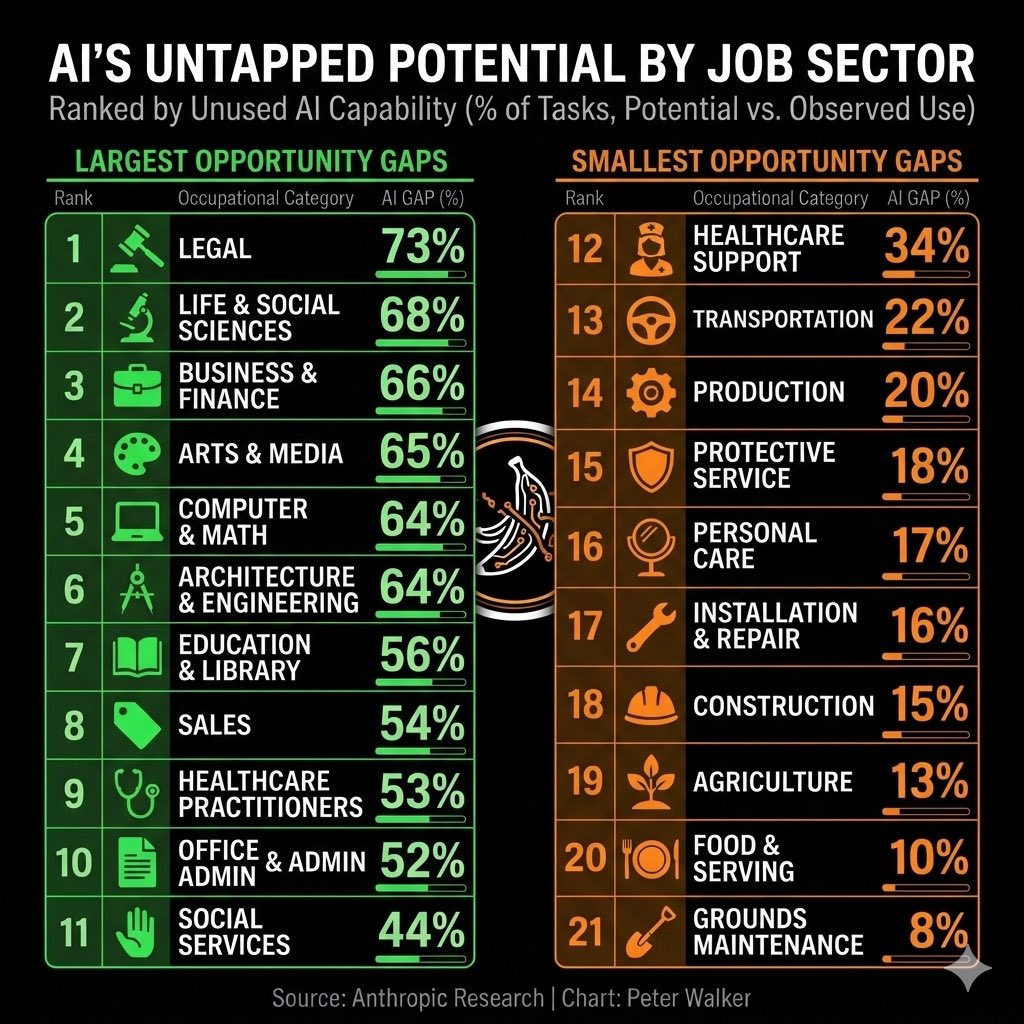
Anthropic just dropped data that is a treasure map for founders. They laid out the exact opportunity gaps that exist today. Potential usage vs. observed usage. I distilled the data for you below. And thank you @PeterJ_Walker for making it into the bar chart they should’ve made originally anyways
Jason Shuman tweet media
English
2
4
26
3.9K
Mark R.
Mark R.@sinergi·
Sounds like a general contractor for process automation. Fun to see it described from the outcomes only. There are many of us trained in business analysis from IT backgrounds that have now become AI powered problem solvers. We no longer need a dev team to build solutions!
Codie Sanchez@Codie_Sanchez

Best money I've ever spent as a CEO... an internal AI transformation hire. He doesn't care about title. He just wants to ship. And he goes across your entire org, sales, revenue, hr, apps, tech and kills stupid manual processes. Such an underrated unlock I have since hired 2 more.


English
0
0
1
35
Mark R. retweetledi
Dustin
Dustin@r0ck3t23·
Bret Taylor, former co-CEO of Salesforce and chair of OpenAI, just redefined the unit of productivity. It’s not a person. It’s a process. Taylor: “I think the atomic unit of productivity in AI is a process, not a person.” AI won’t replace a worker. It will compress entire workflows. What used to take 17 days across departments collapses into hours. The traditional corporate model measures productivity in person-hours. The new model measures process-compression. The incumbent assumption: you buy AI to replace a junior analyst. That’s a fundamental misunderstanding. You deploy an autonomous agent to completely collapse the timeline of a business outcome. An operation requiring 17 days of bureaucratic friction gets mathematically condensed into 17 hours. You’re not buying a digital employee. You’re buying the ruthless compression of time. Using AI to speed up a single employee’s task? You’re playing the wrong game. Taylor: “There’s a legal department to do a contract. There’s some finance department, procurement. You probably have IT that’s involved to onboard them into your core systems.” Friction in the modern enterprise doesn’t come from a single worker. It comes from the endless hand-offs between siloed departments. The traditional CEO tries making each department 10% faster. The winning CEO deploys an AI overlay that autonomously bypasses the human hand-offs entirely. The algorithm doesn’t sit in the legal department or IT. It executes the entire thread simultaneously across all core systems. It doesn’t replace individual workers. It renders their departmental bottlenecks completely irrelevant. Taylor: “I think it’s wrong to think about AI as sort of replacing people. In addition to being inhumane, it’s just sort of nonsensical because AI sort of operates in the world of digital technologies.” The neural network won’t sit at a desk, pour coffee, or shake a client’s hand. It’s a sovereign engine operating exclusively in the realm of digital friction. Superintelligence isn’t your direct replacement. It’s your digital exoskeleton. The hard part of enterprise execution has never been the human element. It’s always been wrestling with archaic, fragmented software systems. When AI takes over the digital process, the biological operator gets freed from the bureaucratic drag. They instantly shift from manual processor of forms to high-leverage director of outcomes. And that’s the real transformation. Not humans versus machines. Humans commanding the compressed timelines machines execute. Whoever builds that infrastructure first turns every competitor’s 17-day cycle into a fatal disadvantage. Because they’re finishing in hours what the rest of the market hasn’t even started.
English
33
74
482
101.7K
Mark R. retweetledi
Stefan Waldhauser
Stefan Waldhauser@stwboerse·
Enterprise software stocks are crashing across the board due to a huge misunderstanding about agentic AI. It's time to clear up this misconception among more investors, so I've now removed the paywall from what is probably my most important write-up of the year so far. It explains which software companies are really threatened by AI and which are not. buff.ly/jzJYt40
Stefan Waldhauser tweet media
English
30
75
418
85.4K
Mark R. retweetledi
Aakash Gupta
Aakash Gupta@aakashgupta·
Goldman just told every SaaS CEO their business model has a five-year shelf life and the market hasn’t repriced accordingly. The headline number is $780 billion in application software by 2030, 13% CAGR. Sounds like growth. But agents capturing 60%+ of that economics means the profit pool migrates away from per-seat subscriptions toward workflow-completion pricing. The market gets bigger while the legacy revenue model gets smaller. Two things happening at once. This is already showing up in the data. Seat-based pricing dropped from 21% to 15% of SaaS companies in just twelve months. Hybrid pricing surged from 27% to 41%. Klarna doubled revenue per employee after deploying agents across core workflows. SaaStr is actively downgrading seat counts at vendors because they have 12+ AI agents in production replacing human users. The math problem for incumbents is brutal. Salesforce charges up to $500/seat/month at top tiers. When one agent automates what ten humans used to do, charging per seat becomes a penalty on the vendor. BCG’s buyer survey found 40% of enterprise customers cite seat reduction as their primary lever to cut software spending. The very AI features vendors are building to retain customers are giving those customers the tool to shrink their contracts. ServiceNow saw this coming and pivoted to “AI Control Tower” positioning, generating $600 million from Now Assist in Q4 alone. But even with 21% subscription growth and 25% more monthly active users, the stock dropped double digits after earnings. The market is saying: prove the new pricing model scales before we assign a multiple. Goldman’s own behavior tells the real story. They announced thousands of autonomous AI coding agents working alongside 12,000 human developers, projecting 3-4x productivity gains. Goldman is simultaneously publishing the research that says agents eat SaaS economics while deploying agents internally to eat SaaS economics. They’re the customer proving their own thesis. The vendors who win will be the ones who wrap workflows in agents and price on outcomes, capturing a share of the productivity gain rather than passing it all through. The vendors who lose will be the ones still counting seats while their customers count agents.
English
81
275
1.7K
546.6K
Mark R.
Mark R.@sinergi·
@DavidOndrej1 Examples of these different types of SaaS would make your argument a lot more digestible rather than lumping all together. Your stock chart graphic image doesnt seem to tell the story either. How are people supposed to recognize the best from the weak ones?
English
0
0
0
1.3K
Mark R.
Mark R.@sinergi·
@ctemp Hello hello hello hello went the echo
English
0
0
0
5
Mark R.
Mark R.@sinergi·
@OfficialLoganK I look at what’s already on Roblox today (with the higher barrier of entry from requiring coding) and it is pretty low quality… so I fear lowering the bar to anyone that can run an AI developer, will be a lot more chaos and drive greater need for editorial selection.
English
1
0
1
38
Logan Kilpatrick
Logan Kilpatrick@OfficialLoganK·
Everyone is going to be able to vibe code video games by the end of 2025
English
1.1K
433
6.5K
2.8M
Mark R.
Mark R.@sinergi·
Need to find an AI thought partner to illustrate the mind map of ideas as we talk. Visualizing connections for myself and others. Taking notes is great first steps, but we need the next level of group/project facilitation.
English
0
0
0
34
Mark R.
Mark R.@sinergi·
@WizKidTechX @johnrushx I was impressed with Google’s AI Studio and the whole ecosystem. Built a working app, a browser plugin actually, in just a few hours. I kept wanting to take notes on changes, but if the AI would digest and record its own user stories for the record, that would be excellent.
English
0
0
2
330
Matt Davis
Matt Davis@WizKidTechX·
@johnrushx It’s powered by Gemini and generates code from prompts. Does that count haha? I’m new to this.
English
2
0
3
1K
John Rush
John Rush@johnrushx·
I've tried all (46 😵‍💫) AI Coding Agents & IDEs [Factory, Cursor, Heyboss, Windsurf, Emergent, Wrapifai, Copilot, Lovable, Bolt, v0, Replit, MarsX, Canva, Devin, Github Spark, IDX, Stitch & more] The most complete list ever made (with demos & notes):
English
270
928
7.4K
1.6M
Mark R. retweetledi
Ethan Mollick
Ethan Mollick@emollick·
Many of the most important “prompt engineering” skills are management skills: clearly understanding the task to be done & what information is needed to do it; explaining the task to the AI; giving useful feedback to improve outputs; & generalizing lessons learned into a process.
English
59
226
2K
112.5K
Mark R.
Mark R.@sinergi·
This! It needs to have memory of earlier collaborations to really blow me away, but this would be such a powerful team player.
GREG ISENBERG@gregisenberg

Last week I saw the future of how we'll all work with AI. Logan (Google's AI Studio lead) was showing me Gemini's new“real time streaming” feature. He had his code editor open, and casually said via voice 'hey, should I change this function?' The clip below is wild - you have to see it to believe it. The AI was watching his screen. Like literally watching - seeing his cursor move, understanding his code, giving real-time feedback. Like pair programming with an AI that never gets tired. I've been playing with Claude, ChatGPT, building with v0/Bolt. They're all powerful but this was different. This was like having an AI co-pilot actually seeing your screen, understanding context, and helping in real-time. Different use-case but really bent my mind. Think what this means: • Coding – Ask about any line you're looking at • Debugging – It sees the error in real-time • Learning new tools – It watches you struggle and helps • Writing – It sees what you're typing and suggests edits The tech behind it is really cool: • Processes entire screen in real-time • Understands spatial context • Can handle 500K+ tokens (like reading a book in seconds) • Remembers your entire session Google's giving this away free in AI Studio. Yes, they're competing with OpenAI. But for makers, this is massive. Thanks to @OfficialLoganK for the time and the demo. It really blew my mind. This is a clip from the full episode of the Startup Ideas Pod which I’ll link below. In that episode he gives 2 more demos so it's worth watching. youtube.com/watch?v=6h9y1r… Happy building.

English
0
0
1
34