
Sathiesh Kaliyugarasan

126 posts

Sathiesh Kaliyugarasan banner
Sathiesh Kaliyugarasan

Sathiesh Kaliyugarasan

@skaliy3

Postdoc in medical AI @BergenMMIV. I enjoy working at the intersection of applied AI research and software engineering.

Norge Katılım Şubat 2019
281 Takip Edilen182 Takipçiler
Sathiesh Kaliyugarasan retweetledi
Boris Cherny
Boris Cherny@bcherny·
I'm Boris and I created Claude Code. I wanted to quickly share a few tips for using Claude Code, sourced directly from the Claude Code team. The way the team uses Claude is different than how I use it. Remember: there is no one right way to use Claude Code -- everyones' setup is different. You should experiment to see what works for you!
English
927
5.9K
51K
9.2M
Sathiesh Kaliyugarasan retweetledi
Simon Willison
Simon Willison@simonw·
I wrote about Clawdbot/Moltbot/OpenClaw and Moltbook, the fascinating, weird and sometimes even useful social network for digital assistants to swap tips and gossip with each other simonwillison.net/2026/Jan/30/mo…
English
89
171
1.3K
194K
Sathiesh Kaliyugarasan retweetledi
Andrej Karpathy
Andrej Karpathy@karpathy·
A few random notes from claude coding quite a bit last few weeks. Coding workflow. Given the latest lift in LLM coding capability, like many others I rapidly went from about 80% manual+autocomplete coding and 20% agents in November to 80% agent coding and 20% edits+touchups in December. i.e. I really am mostly programming in English now, a bit sheepishly telling the LLM what code to write... in words. It hurts the ego a bit but the power to operate over software in large "code actions" is just too net useful, especially once you adapt to it, configure it, learn to use it, and wrap your head around what it can and cannot do. This is easily the biggest change to my basic coding workflow in ~2 decades of programming and it happened over the course of a few weeks. I'd expect something similar to be happening to well into double digit percent of engineers out there, while the awareness of it in the general population feels well into low single digit percent. IDEs/agent swarms/fallability. Both the "no need for IDE anymore" hype and the "agent swarm" hype is imo too much for right now. The models definitely still make mistakes and if you have any code you actually care about I would watch them like a hawk, in a nice large IDE on the side. The mistakes have changed a lot - they are not simple syntax errors anymore, they are subtle conceptual errors that a slightly sloppy, hasty junior dev might do. The most common category is that the models make wrong assumptions on your behalf and just run along with them without checking. They also don't manage their confusion, they don't seek clarifications, they don't surface inconsistencies, they don't present tradeoffs, they don't push back when they should, and they are still a little too sycophantic. Things get better in plan mode, but there is some need for a lightweight inline plan mode. They also really like to overcomplicate code and APIs, they bloat abstractions, they don't clean up dead code after themselves, etc. They will implement an inefficient, bloated, brittle construction over 1000 lines of code and it's up to you to be like "umm couldn't you just do this instead?" and they will be like "of course!" and immediately cut it down to 100 lines. They still sometimes change/remove comments and code they don't like or don't sufficiently understand as side effects, even if it is orthogonal to the task at hand. All of this happens despite a few simple attempts to fix it via instructions in CLAUDE . md. Despite all these issues, it is still a net huge improvement and it's very difficult to imagine going back to manual coding. TLDR everyone has their developing flow, my current is a small few CC sessions on the left in ghostty windows/tabs and an IDE on the right for viewing the code + manual edits. Tenacity. It's so interesting to watch an agent relentlessly work at something. They never get tired, they never get demoralized, they just keep going and trying things where a person would have given up long ago to fight another day. It's a "feel the AGI" moment to watch it struggle with something for a long time just to come out victorious 30 minutes later. You realize that stamina is a core bottleneck to work and that with LLMs in hand it has been dramatically increased. Speedups. It's not clear how to measure the "speedup" of LLM assistance. Certainly I feel net way faster at what I was going to do, but the main effect is that I do a lot more than I was going to do because 1) I can code up all kinds of things that just wouldn't have been worth coding before and 2) I can approach code that I couldn't work on before because of knowledge/skill issue. So certainly it's speedup, but it's possibly a lot more an expansion. Leverage. LLMs are exceptionally good at looping until they meet specific goals and this is where most of the "feel the AGI" magic is to be found. Don't tell it what to do, give it success criteria and watch it go. Get it to write tests first and then pass them. Put it in the loop with a browser MCP. Write the naive algorithm that is very likely correct first, then ask it to optimize it while preserving correctness. Change your approach from imperative to declarative to get the agents looping longer and gain leverage. Fun. I didn't anticipate that with agents programming feels *more* fun because a lot of the fill in the blanks drudgery is removed and what remains is the creative part. I also feel less blocked/stuck (which is not fun) and I experience a lot more courage because there's almost always a way to work hand in hand with it to make some positive progress. I have seen the opposite sentiment from other people too; LLM coding will split up engineers based on those who primarily liked coding and those who primarily liked building. Atrophy. I've already noticed that I am slowly starting to atrophy my ability to write code manually. Generation (writing code) and discrimination (reading code) are different capabilities in the brain. Largely due to all the little mostly syntactic details involved in programming, you can review code just fine even if you struggle to write it. Slopacolypse. I am bracing for 2026 as the year of the slopacolypse across all of github, substack, arxiv, X/instagram, and generally all digital media. We're also going to see a lot more AI hype productivity theater (is that even possible?), on the side of actual, real improvements. Questions. A few of the questions on my mind: - What happens to the "10X engineer" - the ratio of productivity between the mean and the max engineer? It's quite possible that this grows *a lot*. - Armed with LLMs, do generalists increasingly outperform specialists? LLMs are a lot better at fill in the blanks (the micro) than grand strategy (the macro). - What does LLM coding feel like in the future? Is it like playing StarCraft? Playing Factorio? Playing music? - How much of society is bottlenecked by digital knowledge work? TLDR Where does this leave us? LLM agent capabilities (Claude & Codex especially) have crossed some kind of threshold of coherence around December 2025 and caused a phase shift in software engineering and closely related. The intelligence part suddenly feels quite a bit ahead of all the rest of it - integrations (tools, knowledge), the necessity for new organizational workflows, processes, diffusion more generally. 2026 is going to be a high energy year as the industry metabolizes the new capability.
English
1.6K
5.5K
40.1K
7.7M
Sathiesh Kaliyugarasan retweetledi
Ethan Mollick
Ethan Mollick@emollick·
I wrote about Claude Code and why non-coders should be paying attention (and playing with the system) - it shows what today’s LLMs can do Along the way I had Claude launch a business for me & build a game that simulates the rise and fall of civilizations. open.substack.com/pub/oneusefult…
English
49
134
1.1K
146.1K
Sathiesh Kaliyugarasan retweetledi
Jeremy Howard
Jeremy Howard@jeremyphoward·
18 months ago, @karpathy set a challenge: "Can you take my 2h13m tokenizer video and translate [into] a book chapter". We've done it! It includes prose, code & key images. It's a great way to learn this key piece of how LLMs work. fast.ai/posts/2025-10-…
English
32
339
3.1K
159.7K
Sathiesh Kaliyugarasan retweetledi
Andrej Karpathy
Andrej Karpathy@karpathy·
Knowledge makes the world so much more beautiful.
English
416
1K
9.3K
735.5K
Sathiesh Kaliyugarasan
Sathiesh Kaliyugarasan@skaliy3·
At our company, we’ve found that Copilot can be unstable at times, and it’s not always clear which models are running behind the scenes. We’ve also observed that it often underperforms compared to other tools. So we built our own internal chatbot, giving teams direct access to GPT-4.1 and o3 via AzureOpenAI, with file upload support using MarkItDown. Much more reliable.
English
2
2
26
2.8K
Chubby♨️
Chubby♨️@kimmonismus·
Microsoft is struggling to sell Copilot to corporations - because their employees want ChatGPT instead ouch
Chubby♨️ tweet media
English
151
99
1.8K
215.9K
Sathiesh Kaliyugarasan retweetledi
Andrej Karpathy
Andrej Karpathy@karpathy·
+1 for "context engineering" over "prompt engineering". People associate prompts with short task descriptions you'd give an LLM in your day-to-day use. When in every industrial-strength LLM app, context engineering is the delicate art and science of filling the context window with just the right information for the next step. Science because doing this right involves task descriptions and explanations, few shot examples, RAG, related (possibly multimodal) data, tools, state and history, compacting... Too little or of the wrong form and the LLM doesn't have the right context for optimal performance. Too much or too irrelevant and the LLM costs might go up and performance might come down. Doing this well is highly non-trivial. And art because of the guiding intuition around LLM psychology of people spirits. On top of context engineering itself, an LLM app has to: - break up problems just right into control flows - pack the context windows just right - dispatch calls to LLMs of the right kind and capability - handle generation-verification UIUX flows - a lot more - guardrails, security, evals, parallelism, prefetching, ... So context engineering is just one small piece of an emerging thick layer of non-trivial software that coordinates individual LLM calls (and a lot more) into full LLM apps. The term "ChatGPT wrapper" is tired and really, really wrong.
tobi lutke@tobi

I really like the term “context engineering” over prompt engineering. It describes the core skill better: the art of providing all the context for the task to be plausibly solvable by the LLM.

English
530
2.1K
14.4K
2.4M
Sathiesh Kaliyugarasan retweetledi
León
León@LeonGuertler·
Perfect timing, we are just about to publish TextArena. A collection of 57 text-based games (30 in the first release) including single-player, two-player and multi-player games. We tried keeping the interface similar to OpenAI gym, made it very easy to add new games, and created an online leaderboard (you can let your model compete online against other models and humans). There are still some kinks to fix up, but we are actively looking for collaborators :) If you are interested check out textarena.ai, DM me or send an email to guertlerlo@cfar.a-star.edu.sg Next up, the plan is to use R1 style training to create a model with super-human soft-skills (i.e. theory of mind, persuasion, deception etc.)
English
47
117
1.3K
624.7K
Sathiesh Kaliyugarasan retweetledi
Andrej Karpathy
Andrej Karpathy@karpathy·
Nice post on software engineering. "Cognitive load is what matters" minds.md/zakirullin/cog… Probably the most true, least practiced viewpoint.
Andrej Karpathy tweet media
English
149
813
7K
675.5K
Sathiesh Kaliyugarasan
Sathiesh Kaliyugarasan@skaliy3·
@aniketmaurya @pydantic As I have understood: Pydantic handles data validation through type annotations, while Instructor uses Pydantic models specifically to structure outputs from large language models into validated data formats. Examples here: #getting-started" target="_blank" rel="nofollow noopener">python.useinstructor.com/#getting-start…
English
0
0
0
61
Aniket
Aniket@aniketmaurya·
What is the difference in Instructor and @pydantic AI?
English
1
0
2
267
Sathiesh Kaliyugarasan
Sathiesh Kaliyugarasan@skaliy3·
I have the same impression. I asked a Microsoft employee why Copilot often delivers subpar results compared to ChatGPT. The response was: "It's difficult to give one specific answer to this, as it is very subjective and nuances will vary from person to person." In addition to the results, I also experience instability with Copilot - features that should be available don't always work as expected.
English
0
0
2
145
Jimmy Apples 🍎/acc
Jimmy Apples 🍎/acc@apples_jimmy·
Why does co pilot suck so much? Are they routing to their own models / 3.5 now days ? It fails on some real basic stuff. I don’t want a gimped piece of crap to be my “ helping hand “ just automate the shit out of me with an actual good model.
English
85
25
638
65.3K
Sathiesh Kaliyugarasan
Sathiesh Kaliyugarasan@skaliy3·
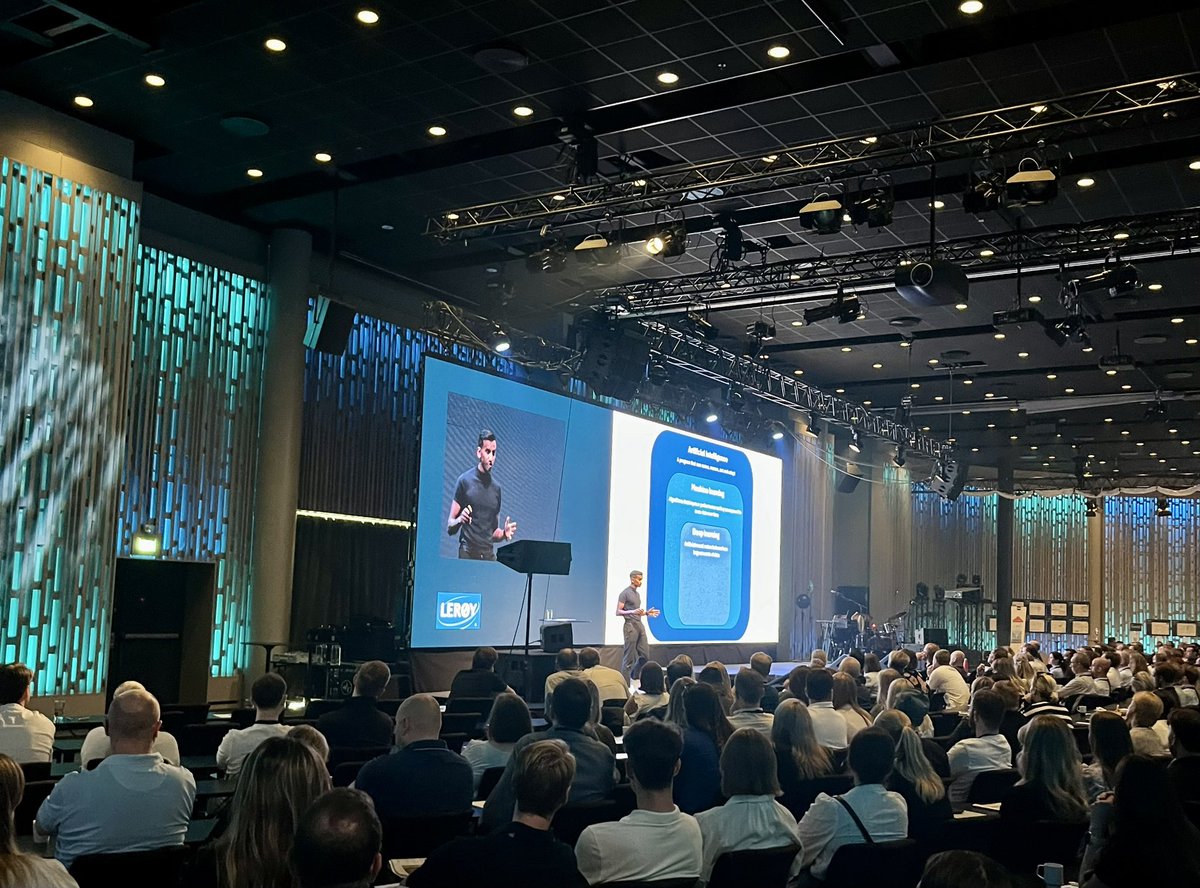
Had an inspiring weekend at Lerøy’s motivational gathering celebrating our 125th anniversary! It was a pleasure to present our MLOps setup and showcase the potential of GenAI to my colleagues In collaboration with the HR department, we launched our very own HR assistant, Mikkel, named after our founder, Ole Mikkel Lerøen. Excited about what’s ahead!🚀
Sathiesh Kaliyugarasan tweet media
English
0
0
3
279
Sathiesh Kaliyugarasan retweetledi
Ethan Mollick
Ethan Mollick@emollick·
This is an interesting overview of what it is like to actually build production software with today's LLMs. It also shows how weird LLMs are to work with from a software perspective & how much we have to learn. It is why I stress co-intelligence for now. oreilly.com/radar/what-we-…
English
9
89
511
69.6K
Sathiesh Kaliyugarasan retweetledi
Ankush, MD
Ankush, MD@drankush·
Unleash the power of Low Code! 🧑‍💻Thank you @skaliy3 for creating fastMONAI and collaborating on this Educational Exhibit CAEE-77.🫀 #RSNA2023 #RSNA23 Thank you @drrajeshpahwa for the pic.
Ankush, MD tweet mediaAnkush, MD tweet media
English
0
1
2
455
Sathiesh Kaliyugarasan retweetledi
Andrej Karpathy
Andrej Karpathy@karpathy·
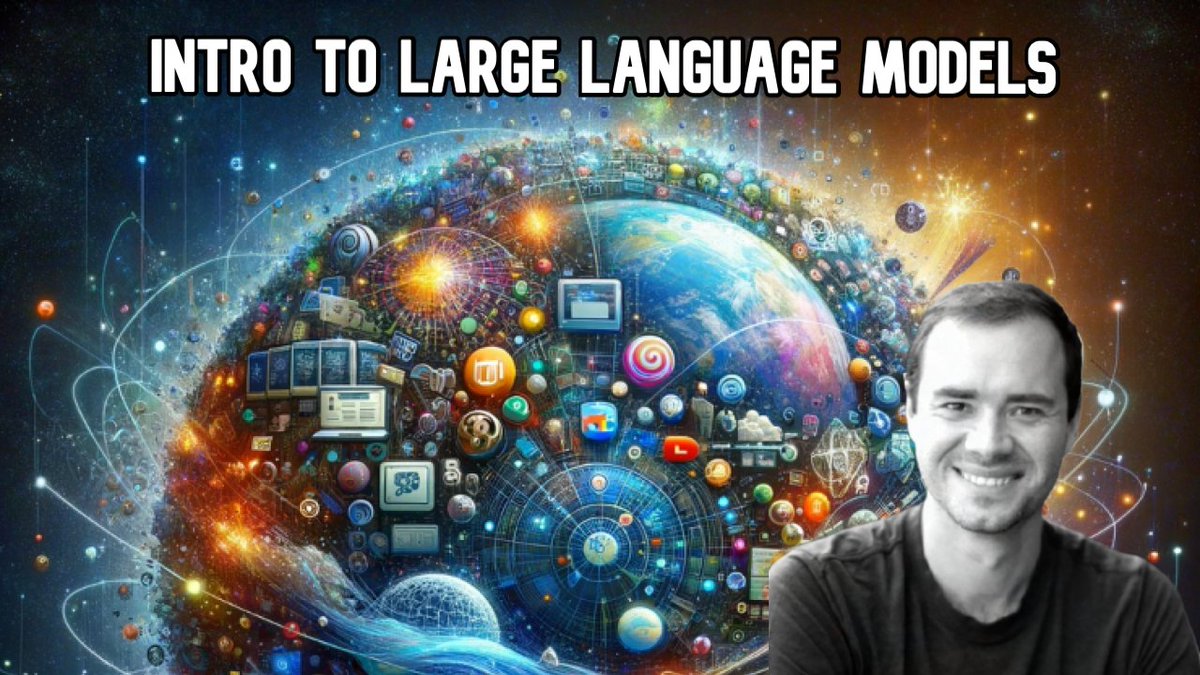
New YouTube video: 1hr general-audience introduction to Large Language Models youtube.com/watch?v=zjkBMF… Based on a 30min talk I gave recently; It tries to be non-technical intro, covers mental models for LLM inference, training, finetuning, the emerging LLM OS and LLM Security.
YouTube video
YouTube
Andrej Karpathy tweet media
English
530
2.8K
16.6K
5.1M
Sathiesh Kaliyugarasan retweetledi
Santiago
Santiago@svpino·
The first rule of Machine Learning: Do not start with machine learning. To a hammer, everything looks like a nail. I struggle with this daily. Companies call me because they want to use machine learning. It's always tempting to start the conversation there. Yet, machine learning is usually not the best way to start a solution. Here is a better approach: Step 1 - Start with simple heuristics Heuristics is a fancy word. We—simple people—prefer to call them "simple rules." You should start most problems by writing simple rules. It may not be perfect, but it's a better solution than jumping straight into machine learning. There are two significant advantages to this approach. First, you'll learn much more about the problem you need to solve. Second, you'll have a baseline to compare against any future machine-learning solution. For example, imagine you are building an online shopping store. You want to show your users a list of recommended products. Instead of thinking about machine learning, start with a fixed list of recommendations. You can upgrade that to a list sorted by popularity. You can solve this problem in many ways before training a model. Step 2 - Replace heuristics with a simple model There's a point where you don't want to keep adding complexity to your rules. Maintaining a simple machine-learning model is easier than a codebase of complex rules. When your rules get out of hand, train a simple model and replace your heuristics with it. People usually recommend starting with simple algorithms like linear regression or decision trees. This makes sense, but simplicity doesn't always refer to the algorithm but how easy it is to use. For example, a ResNet-50 model is a complex convolutional neural network. But you can download a pre-trained version and start using it fast. Step 3 - Increase complexity There's a point where your simple solution can't give you better performance. Here is when you should start exploring more complex solutions. Sometimes, a better model can improve your results. Sometimes, you need many models or combine them with manual rules. Getting to this step is not a goal but a necessity. Start as simple as possible and fight to stay there.
English
36
337
2.2K
524.1K