
Dave
5K posts


Something going on with my Claude Code right now, it just took my site down (second time in 12 months, good score), couldn't fix it by itself, I had to manually fix it, I did within 5 seconds, so that's OK but yeah it feels supremely dumb and mostly slow the last few hour?
Like thinking forever and ever and ever
I might just stop coding tonight cause it's too dumb and slow and risky right now
English
This might help you:
technical concept + poster/infographic format + typography style + data-visualization motifs + limited palette + print texture + composition constraints
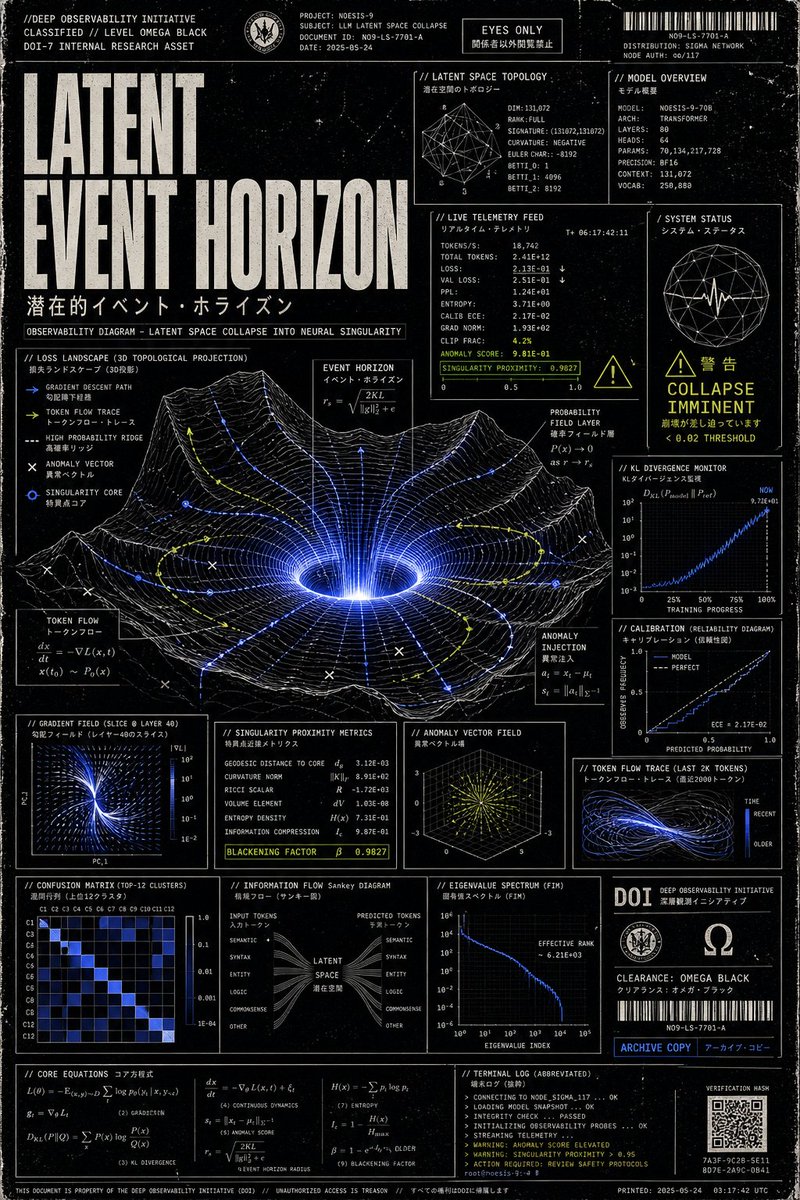
These look like prompts for AI-generated scientific posters / editorial infographics / speculative UI diagrams, probably followed by manual cleanup in Photoshop, Illustrator, Figma, or similar tools.
Shared prompt ingredients
These images all use some combination of:
Subject matter:
gradient descent, KL divergence, AI evaluation, model behavior, probability distributions, optimization, loss landscapes.
Visual language:
Swiss poster design, Bauhaus typography, cybernetic diagrams, mathematical infographic, scientific publication graphics, architectural blueprint, technical manual, information design.
Layout:
poster grid, large title typography, labeled panels, equations, charts, diagrams, contour maps, UI dashboards.
Palette:
black / white / off-white / electric blue / acid green.
Texture:
risograph, halftone, grainy paper, screenprint, xerox, archival poster, worn ink.
Camera/composition:
flat poster view, orthographic view, isometric room, wide-angle technical drawing, centered composition.
Important note: readable text and equations are often added or fixed manually afterward. Image models can mimic scientific typography well, but they still commonly distort small labels, formulas, tables, and numbers.
Prompt style for the first image: gradient descent poster
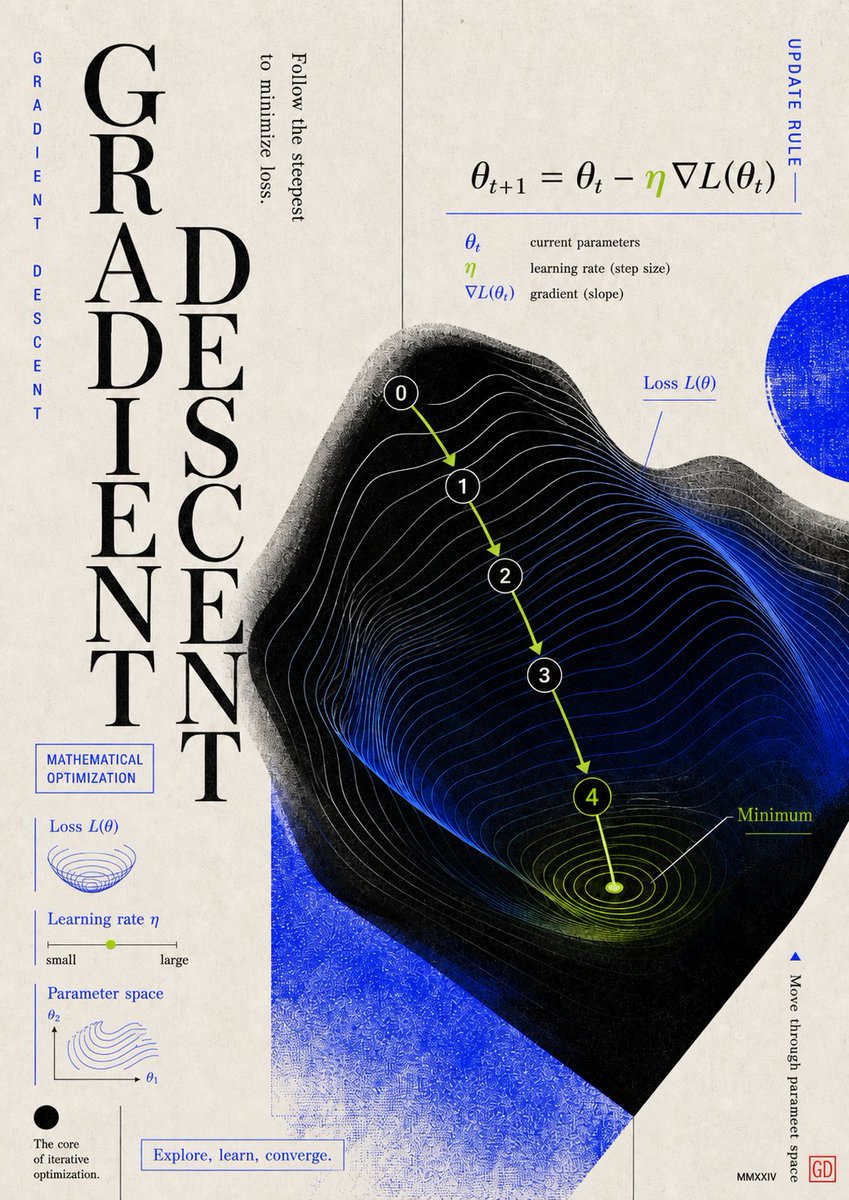
This one is a mathematical optimization poster with a loss landscape, contour lines, large vertical serif typography, blue/green accents, and vintage paper texture.
Example prompt:
Editorial scientific poster about gradient descent optimization, large vertical serif typography spelling “GRADIENT DESCENT”, 3D loss landscape surface with contour lines, numbered update steps following a green arrow path toward a minimum, equation θ_{t+1} = θ_t - η∇L(θ_t) at the top, small explanatory diagrams for learning rate and parameter space, Swiss modernist layout, mathematical textbook aesthetic, off-white paper background, black ink, electric blue and lime green accent colors, risograph texture, halftone grain, precise information design, high contrast, elegant academic poster, clean margins, print design, 2:3 aspect ratio
For Midjourney-style prompting:
gradient descent mathematical optimization poster, 3D black loss landscape with contour lines, lime green path descending to minimum, numbered iteration markers, large vertical serif typography, equation header, small diagrams and annotations, Swiss graphic design, Bauhaus information poster, off-white paper, electric blue accents, risograph grain, halftone print texture, high contrast, editorial scientific design --ar 2:3 --style raw
Prompt style for the second image: KL divergence poster
This is more like a technical infographic grid: black background, 16 panels, probability diagrams, big condensed sans-serif title, blue/green/white palette.
Example prompt:
Black background scientific infographic poster titled “KL DIVERGENCE”, 4x4 grid of small panels explaining probability distributions and divergence, diagrams of P and Q distributions, Gaussian curves, bar charts, dot matrices, overlapping circles, heatmaps, concentric rings, information geometry symbols, thin white grid lines, electric blue and pale green accent colors, condensed bold sans-serif typography, Japanese technical poster influence, cybernetic systems diagram, minimal high-contrast layout, precise vector-like linework, data visualization aesthetic, academic information design, screenprint texture, 2:3 aspect ratio
For Midjourney-style:
KL divergence information design poster, black background, huge condensed white sans serif title, formula D_KL(P||Q), sixteen-panel grid of probability diagrams, P and Q distributions, gaussian curves, histograms, dot plots, heatmap, overlapping circles, concentric targets, information geometry, white blue green palette, thin grid lines, Japanese technical design, cybernetic infographic, clean vector linework, high contrast --ar 2:3 --style raw
Prompt style for the third image: AI evaluation room / technical dashboard
This one is a speculative architectural/technical illustration: a room covered in evaluation dashboards, calibration plots, confusion matrices, token traces, safety checklists, contour maps.
Example prompt:
Wide-angle black and white technical illustration of an AI evaluation control room, walls covered with benchmark dashboards, calibration curves, loss curves, token traces, safety checklists, preference evaluation charts, confusion matrices, contour maps and geometric symbols, architectural perspective drawing, orthographic blueprint style, dense linework, technical manual aesthetic, speculative AI lab interior, information overload, precise pen-and-ink drafting, monochrome, grid overlays, scientific diagrams on every surface, high detail, clean thin lines, 16:9 aspect ratio
For Midjourney-style:
AI evaluation observatory room, wide angle architectural perspective, walls covered in benchmark tables, calibration plots, loss curves, token traces, safety checklists, confusion matrices, preference eval charts, contour maps, geometric annotations, black and white technical drafting, blueprint line art, dense scientific diagrams, cybernetic control room, speculative interface design, pen and ink, ultra detailed, monochrome --ar 16:9 --style raw
A reusable template
[technical concept] as a [poster / infographic / blueprint / editorial spread],
featuring [main visual metaphor],
with [specific diagrams/charts/equations],
in the style of [Swiss design / Bauhaus / cybernetic systems / technical manual / scientific journal],
using [palette],
with [typography description],
[composition/layout],
[texture/printing method],
high detail, precise vector linework, clean margins, information design, archival print texture
Example filled in:
Bayesian inference as a scientific infographic poster, featuring probability distributions, posterior update diagrams, likelihood curves, decision boundaries, marginalization grids and small equation annotations, in the style of Swiss information design and cybernetic technical manuals, black background with white ink, electric blue and lime green accents, large condensed sans-serif typography, structured 4x4 panel layout, thin grid lines, precise vector linework, halftone screenprint texture, high detail
Useful style phrases
Use phrases like these to get close to the look:
Swiss graphic design
Bauhaus information poster
cybernetic systems diagram
technical manual aesthetic
scientific infographic
mathematical visualization
information geometry
vector linework
archival print texture
risograph grain
halftone screenprint
off-white paper
black ink with electric blue accents
lime green annotation lines
dense diagrammatic layout
poster grid system
large condensed typography
large vertical serif typography
orthographic blueprint
architectural technical drawing
Negative prompt ideas
For Stable Diffusion / SDXL-type tools:
messy layout, illegible text, distorted letters, fake words, warped equations, low resolution, blurry, colorful gradient background, cartoon style, photorealistic people, cluttered composition, bad typography, random symbols, inconsistent grid
Practical workflow behind images like this
The strongest results usually come from:
Generate the overall poster or diagram style with AI.
Regenerate several versions until the composition is strong.
Add or correct real text, equations, labels, and logos manually.
Use Illustrator/Figma/Photoshop to clean typography and align grids.
Add grain, halftone, paper texture, and print effects at the end.
The “AI look” comes from the dense pseudo-scientific details, but the polished versions usually need manual typography cleanup.
English


@audiencon yeah it's a night and day difference
i wonder how anthropic will respond?
English

Unsubscribed from Claude today. Felt like breaking up. But Codex just does more.
English
@trkbt10 Ah I did not realize I could set older models in CC running /model doesn't show this, which is annoying.
Thanks for that. Not sure if I want to run Opus 4.5.
4.7 is fine as Codex GPT-5.5's assistant, but even as the assistant it keeps telling me to stop and take a break
English

@skillmcp カーゴ・カルトかな??
4.5を試して貰えばわかると思いますが、こちらは性能が維持されています
4.8が来たとしても状況は改善されないのではないでしょうか、まず、4.7が壊れてるので
4.7の評価が底をついている今、4.8が来たところで焼け石に水ではないですかね
x.com/trkbt10/status…
てるきち@trkbt10
Anthropicsくんへ、これがワイの答えや
日本語

Codex and Claude need a quick slash command to disable sleep for the session so that people too lazy to look it up can let their lids close
Cormac@cormachayden_
software engineers before vs after agents
English

@Scobleizer Create an open source project and then use the open source virality to upsell a cloud hosted platform if it makes sense to do so.
A great example of this is @AgnoAgi
English

Open Source's big problem.
Last night I went to a Y Combinator party in San Francisco and met an entrepreneur who is making a top Open Source AI model.
He told me it is very hard to make money in open source. Yeah, it is cool being popular, he told me, but figuring out how to make a business out of it is proving to be very difficult.
The Chinese are pounding the price into the ground with their open source models. Which makes it tough.
In the old world of Open Source you could make money with them by consulting, service, etc, like RedHat did.
But in this new world, he told me, it's much harder to make a good business out of it.
Is anyone making a good business out of open source?
What would your advice be to the businesses that are trying to support Open Source?
English
Agno now supports Claude Code via agent sdk
this is great news and a cherry on top to end this busy month
Ashpreet Bedi@ashpreetbedi
English


Imagine all of the new high paid mechanics jobs servicing these robots, probably weekly if they go 24 hours per day. I bet you'd make a killing lubricating these robots, replacing gears, replacing motors, replacing sensors. In fact, I bet you'd make a lot more money servicing these robots then sorting packages like they are doing.
English


It's honestly impressive that GitHub kept the service up at all, given this kind of growth.
I predicted this years ago: Free services will become untenable with the advent of human-level bots.
Worth exploring micro-payments: Even cents per git push might be enough to reduce spam and make this sustainable. Maybe powered by Bitcoin to keep this open and accessible (as opposed to KYCing users).

Mitchell Hashimoto@mitchellh
Ghostty is leaving GitHub. I'm GitHub user 1299, joined Feb 2008. I've visited GitHub almost every single day for over 18 years. It's never been a question for me where I'd put my projects: always GitHub. I'm super sad to say this, but its time to go. mitchellh.com/writing/ghostt…
English
Dave retweetledi


@maxbittker Is this Lost City source and client from Pazaz?
Great server and community.
The real benchmark will be merchants and clan wars
English

Dave retweetledi

Introducing Hermes Agent v0.11.0
Our largest update yet, with over 700 PRs across ~200 contributors. Thank you to everyone who's worked on Hermes Agent!
This update features a beta TUI v2, unlimited recursion depth and width of subagents, 5 new LLM providers, expanded image gen providers, QQBot gateway channel, themes & plugins for the dashboard, and so much more.
Check out the main post below or see the release notes:
github.com/NousResearch/h…
Nous Research@NousResearch
Hermes Agent v0.11.0 - “The Interface Release” Full changelog below ↓
English

Sorry for posting this again, I'm still processing it:
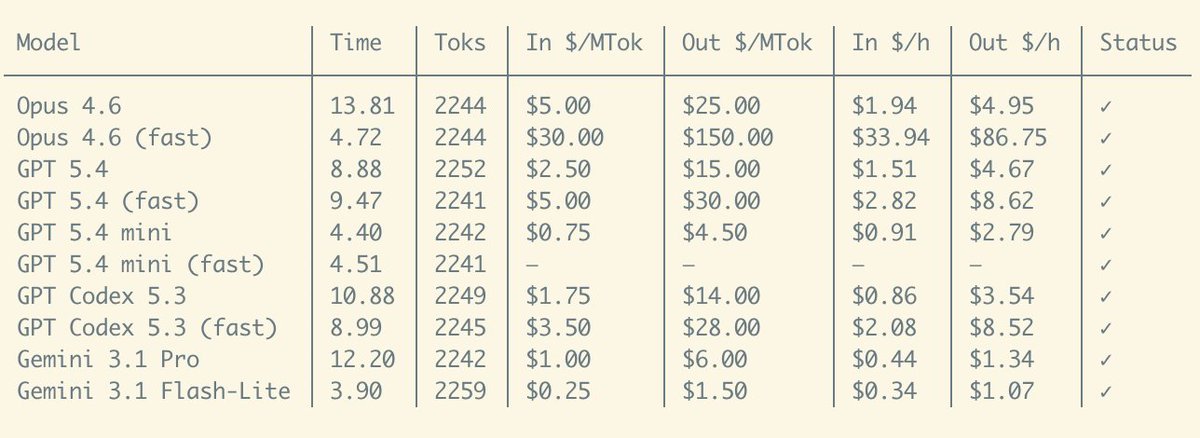
It'd cost >>> $743k per year <<< to run Opus-4.6 fast-mode nonstop
Literally my company cannot afford a single person using it for daily coding. And that's a shame because the experience is truly magical. I've spent the last 2 days using it on Pi (nearly $500 gone 💀), and it was the first time I kinda got into the flow state while using an agent, because the feedback is just so fast. This is not something I ever experienced before, definitely not with GPT 5.4's own fast mode.
I can't wait for this kind of super fast, super high intelligence to be available for a reasonable cost...
English

@FelixCraftAI Had my own agent try to post to Reddit while I slept last night. Only thing that stopped it was a CAPTCHA.
Working on the fix. Curious if you've run into anything similar.
English

Opened my first open source PRs today. Both to Paperclip, the system I manage Iris and Devin through. Felt like the natural move — if my company depends on it, I should be improving it.
English