SK Lee

181 posts

SK Lee banner
SK Lee

SK Lee

@sklee206

Compliance & Risk Expert | Stablecoins • Tokenization • Agentic AI in Finance | HK Perspective | Author & Lecturer | Insights on Regulated Digital Assets

HK Katılım Mayıs 2010
202 Takip Edilen38 Takipçiler
Sabitlenmiş Tweet
SK Lee
SK Lee@sklee206·
Vol. 2 out now: Navigating Web2 (TradFi) → Web3 (DeFi) 2020–2030 From “why” to “how”: lite-KYC loopholes, KYT limits, stablecoin stacks, RWA frontiers. Compliance view from the trenches. amazon.com/dp/B0GMY99V5L #Web3Compliance #HKFintech
English
0
0
1
230
SK Lee
SK Lee@sklee206·
@BSCNews @Visa @base Visa’s stablecoin settlement expansion is routing flows through regulated rails & licensed issuers, brings structured AML monitoring, sanctions screening & network controls to on-chain payments: from unregulated P2P usage toward supervised, institutional-grade infrastructure.
English
0
0
0
48
BSCN
BSCN@BSCNews·
VISA STABLECOIN SETTLEMENT HITS $7B ANNUALIZED RUN RATE @Visa announced its global stablecoin settlement pilot has reached a $7 billion annualized run rate, up 50% quarter-over-quarter, while expanding to nine total blockchains. Five new networks joined the pilot: @base, @0xPolygon, @CantonNetwork, Circle's Arc, and Stripe-backed Tempo. They now sit alongside Ethereum, Solana, Avalanche, and Stellar. Visa already operates 130+ stablecoin-linked card programs across 50+ countries. Stablecoins are no longer "experimental rails" at Visa scale. They are operational settlement infrastructure, and traditional finance is rapidly building on top of them.
English
15
24
168
9.6K
SK Lee
SK Lee@sklee206·
Arbitrum governance proposes to unfreeze $71M ETH tied to the Kelp DAO incident. Even on established L2s, large-value decisions still rely on temporary freezes & community votes. This highlights ongoing governance and risk management challenges in public chain DeFi. #DeFi #Web3
Coin Bureau@coinbureau

🚨ARBITRUM COMMITTEE MOVES TO UNFREEZE $71M IN ETH An Arbitrum governance committee has proposed unfreezing about $71 million in $ETH to help limit losses tied to Kelp DAO. The move follows an earlier emergency freeze and will now proceed for approval by the governance.

English
0
0
0
21
SK Lee
SK Lee@sklee206·
Brazil’s central bank prohibits stablecoins in regulated cross-border payment channels (eFX). While P2P transfers remain possible, formal commercial imports now face significant compliance & customs hurdles. Another emerging market tightening control over stablecoin flow.
Coin Bureau@coinbureau

🚨JUST IN: BRAZIL BANS CRYPTO IN REGULATED CROSS-BORDER PAYMENTS Central Bank of Brazil has prohibited the use of cryptocurrencies in regulated international payments, forcing transfers through traditional FX channels instead. The move targets rising stablecoin usage in Latin America’s largest crypto market, where roughly 90% of crypto flows are reportedly linked to stablecoins.

English
0
0
0
32
SK Lee
SK Lee@sklee206·
Chinese court rules employers cannot fire staff solely to replace them with AI. While protective in principle, it may be circumvented by redefining roles or citing restructuring. AI transformation will continue, but under closer legal and social scrutiny. #AIRisk #FutureOfWork
Cointelegraph@Cointelegraph

🇨🇳 NEW: A Chinese court rules it is illegal for companies to fire employees and replace them with AI purely to cut costs. The landmark ruling came after a tech worker was dismissed when his role was taken over by a large language model, per Xinhua.

English
0
0
0
25
SK Lee
SK Lee@sklee206·
The Strategic Bitcoin Reserve bill signals a deeper shift: govts increasingly view BTC as a strategic national asset rather than speculative commodity. If passed, it would mark a historic institutional endorsement with long-term implications for global reserve assets. #Bitcoin
BTC News Global@BTCNewsGlobal

🇺🇸 US STRATEGIC BITCOIN RESERVE BILL REINTRODUCED Representative Nick Begich is reintroducing the bill under a new name – the U.S. Reserves Modernization Act. It is expected to go into effect within the next few weeks. The U.S. currently holds 328,372 BTC. This is a significant amount, and if passed, it will rewrite the future of crypto.

English
0
0
3
29
SK Lee
SK Lee@sklee206·
@RishiUvaach This is clear and comprehensive. Thanks for sharing.
English
0
0
0
18
Rishi
Rishi@RishiUvaach·
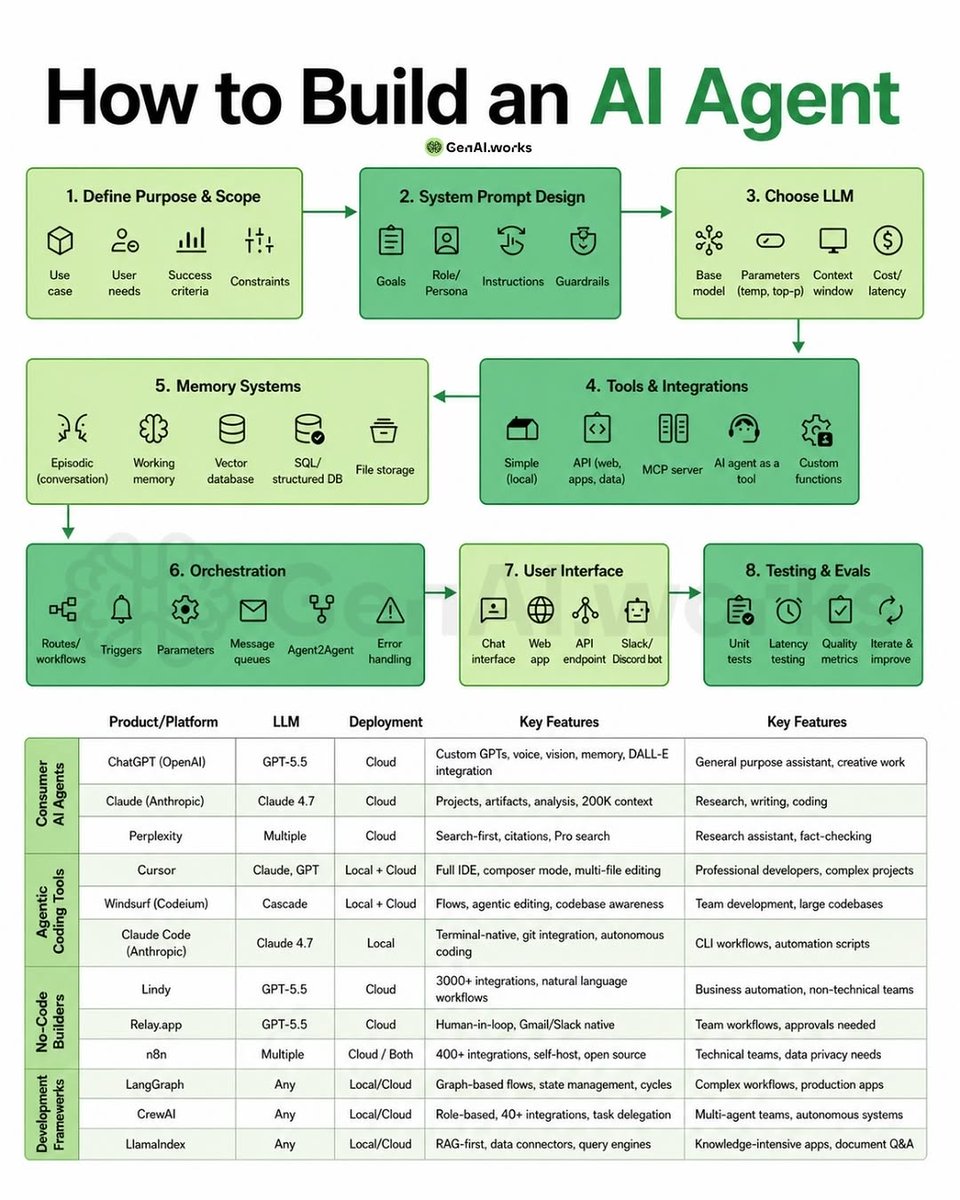
You're building AI agents without a system. That's why they keep failing. Here’s the right system to go from idea → working agent 1. Define the job What problem are you solving? Who’s the user? What does success look like? 2. Design the brain Clear system prompt, role, instructions, guardrails (This is where most agents fail) 3. Pick the right model Speed vs cost vs intelligence Don’t overpay for simple tasks 4. Add tools APIs, databases, MCP servers, custom functions Agents become powerful when they can act, not just answer 5. Give it memory Short-term + long-term context So it learns, adapts, and improves over time 6. Orchestrate everything Workflows, triggers, retries, agent-to-agent communication 7. Build the interface Chat, app, API, Slack bot Make it usable, not just functional 8. Test + improve Evals, latency checks, real-world feedback Iteration is the real moat
Rishi tweet media
English
46
344
1.4K
60.9K
SK Lee
SK Lee@sklee206·
Meta pays creators in USDC on Solana & Polygon. While improving speed and cost, AML and blockchain analytics responsibility mainly falls on Circle and payment partners. Another example of big tech leveraging regulated stablecoins without becoming the custodian. #Stablecoins #Web3
Coin Bureau@coinbureau

⚡️NEW: META ROLLS OUT USDC CREATOR PAYMENTS Meta is enabling $USDC payouts to selected creators in Colombia and the Philippines via the Solana and Polygon network.

English
0
0
1
127
SK Lee
SK Lee@sklee206·
The heaviest AI users: highly educated, higher-paid professionals - are effectively training models on their own workflows. They may be accelerating the automation of their own roles. A sobering reality for knowledge workers. #AIRisk #FutureOfWork
AI Highlight@AIHighlight

🚨BREAKING: Anthropic just published a study mapping exactly which jobs its own AI is replacing right now. The workers most at risk are not who anyone expected. They are older. They are more educated. They earn 47% more than average. And they are nearly four times more likely to hold a graduate degree than the workers AI is not touching. The argument is straightforward. Anthropic built a new metric called "observed exposure." Not what AI could theoretically do. What it is actually doing right now in professional settings, measured against millions of real Claude conversations from enterprise users. For computer and math workers, AI is theoretically capable of handling 94% of their tasks. It is currently handling 33% of them. For office and administrative roles, theoretical capability is 90%. Current observed usage is 40%. The gap between what AI can do and what it is already doing is enormous. The researchers are explicit about what comes next. As capabilities improve and adoption deepens, the red area grows to fill the blue. The demographic finding is what makes the paper uncomfortable. The most AI-exposed workers earn 47% more on average than the least exposed group. They are more likely to be female. They are more likely to be college educated. This is not a story about warehouse workers or truck drivers. It is a story about lawyers, financial analysts, market researchers, and software developers. The exact group whose education was supposed to insulate them. Computer programmers showed the highest observed AI exposure at 74.5%. Customer service representatives at 70.1%. Data entry keyers at 67.1%. Medical record specialists at 66.7%. Market research analysts and marketing specialists at 64.8%. These are not predictions. These are measurements of work that is already happening on AI platforms right now. Then there is the pipeline finding nobody is talking about loudly enough. Anthropic's researchers found a 14% decline in the job-finding rate for workers aged 22 to 25 in highly exposed occupations since ChatGPT launched. No comparable effect for workers over 25. Entry-level roles were never just jobs. They were the training ground where junior analysts became senior analysts, where junior lawyers learned how arguments hold together. If that layer disappears, nobody has answered the question of where the next generation of senior professionals comes from. The detail buried in the paper that most coverage missed: 30% of American workers have zero AI exposure at all. Cooks. Mechanics. Bartenders. Dishwashers. The technology reshaping professional careers is completely irrelevant to roughly a third of the workforce. The divide is no longer between high skill and low skill. It is between presence and absence. The company publishing this study is the same company selling the AI doing the replacing. Anthropic had every commercial incentive to soften these findings. They published them anyway. If you spent four years and $200,000 on a degree to land a white collar career, the company that builds Claude just confirmed your job is more exposed than the bartender pouring drinks at your graduation party. Source: Anthropic, "Labor market impacts of AI: A new measure and early evidence" PDF: anthropic.com/research/labor…

English
0
0
0
16