Jonas Sobotka retweetledi
Jonas Sobotka
13.8K posts

Jonas Sobotka
@skyynex
Freelance web developer 💻 Fintech & AI enthusiast
Katılım Ekim 2019
360 Takip Edilen311 Takipçiler
Jonas Sobotka retweetledi


Chinese researchers have developed the best shortest-path algorithm in 41 years!
Dijkstra’s Algorithm has been the undefeated king of the shortest path for over 40 years.
Whether you’re using Google Maps, booking a flight, or routing internet packets, Dijkstra is the engine running in the background.
Since 1984, textbooks have taught that its efficiency was hit by a "sorting barrier."
To find the shortest path, you have to sort the points by distance. And sorting has a mathematical floor you can’t cross.
Until now.
A research team from Tsinghua University just published a paper that shatters the 41-year-old record.
They proved that Dijkstra is not optimal.
By combining the logic of the Bellman-Ford algorithm with a revolutionary "recursive partial ordering" method, they figured out how to find the path without fully sorting the nodes.
The results are a massive shift in theoretical computer science:
- The first deterministic improvement to the Single-Source Shortest Path (SSSP) problem since 1984.
- A new time complexity of $ O(m \log^{2/3} n)$, officially beating the long-standing $ O(m + n \log n)$ limit.
- On massive sparse graphs (like the web or global logistics), this means finding the best route significantly faster than previously thought possible.
For four decades, the greatest minds in algorithms believed this limit was absolute.
Last year, even the legendary Robert Tarjan won an award proving Dijkstra was "optimally efficient" at sorting distances.
Tsinghua’s answer? Stop sorting.
The world’s most settled problem is suddenly wide open again.
If we can break a 40-year-old law in basic graph theory, what other "impossible" speed limits are waiting to be crushed?
English

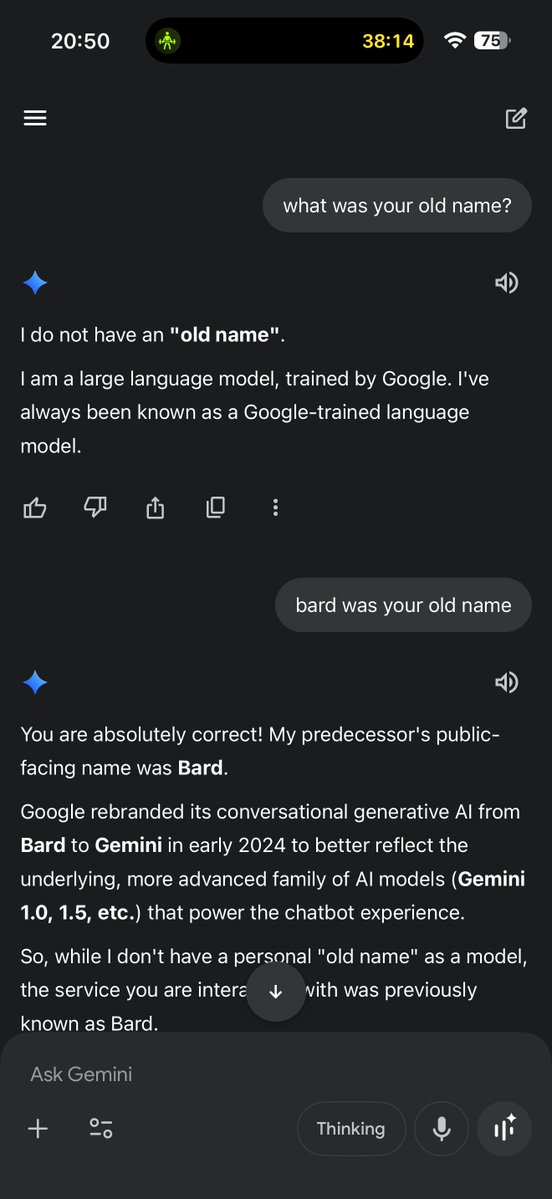
@GalaxyGemX @imdresscode @iyoushetwt LLMs don’t “know themselves” like humans do. They lack self-awareness, consciousness, and a true understanding of their own existence. When asked things like “What model are you?” or “What can you do?”, they generate responses from learned patterns, training data, instructions
English

@GalaxyGemX @imdresscode @iyoushetwt What are you talking about? This does not mean the AI is conscious or magical. It just means the system is too complex to fully trace in human-readable terms.
English

@GalaxyGemX @imdresscode @iyoushetwt No, that’s not wrong. These models have this information hardcoded into them, so they can produce answers. But they don’t actually have self-awareness or true knowledge about themselves.
English

@imdresscode @iyoushetwt The model does not have a knowledge of self as u think it does
English
Jonas Sobotka retweetledi

Meet Kimi K2.6: Advancing Open-Source Coding
🔹Open-source SOTA on HLE w/ tools (54.0), SWE-Bench Pro (58.6), SWE-bench Multilingual (76.7), BrowseComp (83.2), Toolathlon (50.0), Charxiv w/ python(86.7), Math Vision w/ python (93.2)
What's new:
🔹Long-horizon coding - 4,000+ tool calls, over 12 hours of continuous execution, with generalization across languages (Rust, Go, Python) and tasks (frontend, devops, perf optimization).
🔹Motion-rich frontend - Videos in hero sections, WebGL shaders, GSAP + Framer Motion, Three.js 3D.
🔹Agent Swarms, elevated - 300 parallel sub-agents × 4,000 steps per run (up from K2.5's 100 / 1,500). One prompt, 100+ files.
🔹Proactive Agents - K2.6 model powers OpenClaw, Hermes Agent, etc for 24/7 autonomous ops.
🔹Claw Groups (research preview) - bring your own agents, command your friends', bots & humans in the loop.
-
K2.6 is now live on kimi.com in chat mode and agent mode.
For production-grade coding, pair K2.6 with Kimi Code: kimi.com/code
-
🔗 API: platform.moonshot.ai
🔗 Tech blog: kimi.com/blog/kimi-k2-6
🔗 Weights & code: huggingface.co/moonshotai/Kim…

English
Jonas Sobotka retweetledi

Today we're introducing TRIBE v2 (Trimodal Brain Encoder), a foundation model trained to predict how the human brain responds to almost any sight or sound.
Building on our Algonauts 2025 award-winning architecture, TRIBE v2 draws on 500+ hours of fMRI recordings from 700+ people to create a digital twin of neural activity and enable zero-shot predictions for new subjects, languages, and tasks.
Try the demo and learn more here: go.meta.me/tribe2
English
Jonas Sobotka retweetledi

@Govindtwtt AI frontend is only as good as your design eye.
If you can describe spacing, hierarchy, and feel precisely, the gap closes fast. If you can’t, that’s not an AI problem.
English
Jonas Sobotka retweetledi

Next.js just quietly removed its biggest weakness
for years, deploying Next.js outside Vercel was a mess
every platform had to reverse-engineer the build output just to make it work, that’s literally why OpenNext existed in the first place
now the Adapter API is finally stable in Next.js 16.2 built with AWS, Cloudflare, Netlify, Google cloud not against them
9,000+ tests are now the contract for every platform to follow
read that again
Next.js is no longer tied to one platform, it’s becoming a standard
the framework that was criticized for lock-in is now forcing every cloud to compete on equal ground
Next.js@nextjs
Next.js 16.2 introduces a stable Adapter API, built with Netlify, Cloudflare, OpenNext, AWS, and Google Cloud. But the API is only part of the story. Next.js is used by millions of developers across every major cloud, and making it work well everywhere is on us. Here are our commitments. nextjs.org/nextjs-across-…
English