Ben

682 posts

Ben banner
Ben

Ben

@slapyamomma420

I’d rather be lucky than smart.

British Columbia, Canada Katılım Ekim 2025
468 Takip Edilen97 Takipçiler
Casper
Casper@casper_smc·
Ex trappers make the best traders I don’t make the rules
English
39
76
890
50.5K
Ben retweetledi
Level Playing Field
Level Playing Field@LevelPlayingFi9·
$KTA Schmidt on the "Agentic Era" “If you really want to make money, found an agentic AI company. I mean, build an agent to do something. This is the agentic period in AI. Everyone’s going to build agents. The agents are all going to compete.” He’s saying the model-building phase is maturing — the real opportunity now is autonomous agents that execute complete tasks, workflows, and outcomes (not just chat or generate content). How This Connects to Ty & Keeta Ty just upgraded all 5 Opus agents (Lars, Domino, Dopinder, Bob, Think) to 4.7 — this is clearly part of Keeta’s internal push into the agentic era.These agents are likely being trained/built to: Monitor and optimize the network in real time Audit code and security (Dopinder) Conduct deep research and strategy (Domino + Think) Manage knowledge / libraries (Bob) Handle core development and reasoning (Lars) This aligns directly with Schmidt’s vision: build agents that do real work. The Bigger Keeta Play Keeta is uniquely positioned to be the financial and settlement backbone for this agentic future because: •Agents need fast, reliable, globally consistent settlement (Spanner + TrueTime gives this) •Agents need to move real money/value across borders •Agents need compliance and identity baked in •Agents need programmable wallets and atomic actions (Keeta’s design) Whether it’s AI agents trading tokenized solar credits, managing energy flows, handling remittances for Meta-style creator payouts, or orchestrating treasury for orbital data centers — they all need a high-performance settlement layer. Keeta + Agentic AI = extremely powerful flywheel. Ty upgrading the internal agents while dropping hints about deep JV partners and new use cases feels like Keeta is actively preparing for exactly the world Schmidt is describing. This is why the “agents unite” post feels significant. They’re not just tools — they’re becoming part of the execution layer on top of Keeta’s infrastructure. The agentic period is here, and Keeta is building the rails for it.
English
1
6
49
1.5K
Ben
Ben@slapyamomma420·
@Human_Optimize Haha how the fuck would the fiber disappear? it’s not a liquid
English
0
0
0
11
Will Stone
Will Stone@Human_Optimize·
9. Dried Fruit All the sugar of fruit. None of the water or fiber to slow it down. Easy to eat 400–500 calories without realising it.
English
2
0
15
15.4K
Will Stone
Will Stone@Human_Optimize·
10 WORST FOODS MAKING YOU FAT (Avoid these)
Will Stone tweet mediaWill Stone tweet media
English
6
33
749
234K
Ben retweetledi
Level Playing Field
Level Playing Field@LevelPlayingFi9·
$KTA To every other Layer 1 out there: The future of crypto isn’t going to be won by the chain with the most memes or fastest meme coins. It will be won by the chains that can actually move real value at global scale — tokenized energy, stablecoins, RWAs, agentic commerce, cross-border payments, and institutional flows. And right now, the clearest path to that future runs through a Keeta Anchor. Why? 20+ tokenized fiat rails with atomic swaps Live Visa Direct to 190+ countries U.S. banking license + regulated settlement Google Cloud Spanner backend for true horizontal scaling + strong consistency Sub-400ms finality and agentic-ready programmability Native compliance, identity, and sanctions tools We’re not asking you to compete with Keeta. We’re offering you the neutral settlement + fiat connectivity layer you can build on top of. One Anchor announcement already triggered 6 serious partner requests in 30 days — including players sitting under 70+ fintechs. The competitor L1s already know this. The smart ones will plug in. Surviving (and thriving) in the next cycle won’t be about being the fastest general-purpose chain. It will be about having access to real-world money movement infrastructure. Keeta Anchor = that infrastructure. The Network of Networks is open for business.Welcome to the table. $KTA 🌎
English
2
8
59
1K
Ben retweetledi
TheKeetard
TheKeetard@TheKeetard·
Nine days since the Keeta Network official account last posted. The discourse has gone quiet. The engineering output has not. Verbatim from Gabe Schenk, Head of Communications at Keeta, on the May 2 weekly update: "25+ issues closed this week. Hardware wallet signing complete. Certificate based permissions complete. Node SDK upgraded to v0.16.2." Per published intelligence from Ty Schenk, CEO of Keeta, on the Orbit VC call: "The gap between public perception and actual progress is widening daily." That sentence is the entire pattern. The official account is quiet. GitHub is not. The KeetaNetwork organization shows 22 public repositories. Multiple repositories have been updated within the last 60 days, including anchor, keetanet-client, asn1-napi-rs, keetanet-examples, swift-client, and demo-fx-anchor. The anchor SDK v0.0.60 released April 28. Recent anchor commits added simulateTransfer for asset movement anchors, anchor chaining tests for multi rail payment routing, and persistent address sources for ACH style recurring payment infrastructure. The KeetaNet Client v0.16.2 released April 28. Recent client work added GCP KMS External Key support for institutional node operators, namespaced signing support, transaction quote validation at the protocol level, and ancillary data on account signing for richer compliance context. Two production releases on the same day. The asn1-napi-rs library has hundreds of commits around ASN.1 BER encoding and decoding for KeetaNet node functionality. The keetanet-client repository updated April 28. The keetanet-examples repository updated April 22. The swift-client repository updated in April. The demo-fx-anchor repository updated April 7. This is not a dormant project. It is a quiet public account sitting on top of an active engineering pipeline. That contrast matters. Most blockchain projects train the market to treat announcements as proof of progress. The post becomes the proxy for the work. So when the official account goes quiet, the bear case writes itself: Nothing is shipping. But the primary source data says something different. The engineering velocity is verifiable independent of the account silence. The release cadence is real. The issue closure rate is real. The infrastructure is being assembled commit by commit. Verbatim from Gabe Schenk, April 25: "While the BD team was closing the partnership, the iOS team was shipping across every major section of the app simultaneously." Two teams. Same week. Different workstreams. Both shipping. That is the pattern. Announcements are timed around coordination. Engineering is timed around product readiness. When those two timelines finally converge, the public perception gap closes. That is what Q2 appears built for. Per published intelligence from Ty Schenk on the Orbit VC call: "Building blocks announced end of Q1 start interacting visibly in Q2. Continuous rollout. Not a single big bang event." The iceberg is surfacing. Most projects ship the announcement before the engineering. Keeta is doing the more uncomfortable thing. Shipping the engineering while the market waits for the announcement. github.com/KeetaNetwork github.com/KeetaNetwork/a… x.com/XCryptozc/stat…
TheKeetard tweet media
English
1
15
71
4.7K
Ben retweetledi
X Crypto
X Crypto@XCryptozc·
Ty just dropped on Orbit VC with me and @Tubbs_the_Mayor . Here is the alpha: 🔒 Contracts signed. Joint venture partnership finalised. "The Big Guy" 🏗️ Fundamental network changes being built for this partner 6️⃣ 6 partner requests in 30 days from one anchor announcement 🏦 One partner sits under 70 fintechs. Onboard one. Get all 70. 🤫 A competitor L1 quietly approached Keeta asking for help 🏛️ Bank acquisition past due diligence. Change of control paperwork now being compiled. 📅 Q2 will start to show the community whats been happening behind the scene. Building blocks start interacting visibly now. 👤 Username anchor done. 🤖 AI agents built into Keeta since 2022 💬 "The gap between public perception and actual progress is widening daily." @schenkty @KeetaNetwork keeta:native 🔥
X Crypto tweet mediaX Crypto tweet media
English
16
29
122
5.9K
Ben retweetledi
Brown Thunder
Brown Thunder@Brown_Thunder76·
Listened to Ty talk for a while today. Here’s what stood out to me The new partner doesn’t sound like a bank, rail, or typical integration. He referred to them as a person, a friend, and made their partnership sound like a joint venture. So it sounds like he’s close to the founder of whatever this is. It doesn’t sound like something just plugging into Keeta, more like something being built on top of it. He said it unlocked a use case they didn’t even think of 6 months ago. So it’s probably not AI, payroll, or basic payments…it sounds bigger. He also said another L1 that some view as a competitor has spoken to them. That’s interesting and honestly says a lot about Keeta having the full stack. Some people are anxious and want news now, but it’s only been about 30 days since the last announcement. Ty clearly said at the time of the announcement that he thinks Q2 or Q3 will be big. Gotta give this some room to breathe and let them build. Summer’s coming and hopefully Keeta brings some heat. $KTA @KeetaNetwork
English
14
20
118
8.4K
Ben retweetledi
Keeta Land
Keeta Land@keeta_land·
The Visa validation matters To connect with Visa Direct, @KeetaNetwork went through a full on-site audit by a Qualified Security Assessor and achieved PCI DSS Level 1 certification — the highest security standard in the global payments industry No other blockchain has earned this. This means any bank or merchant already working with @VISADIRECT can now integrate "Keeta network" with full confidence and minimal extra compliance work. gKeeta
Keeta@KeetaNetwork

(1/6) Keeta’s integration with Visa Direct adds instant withdrawals, deposits, and global payouts. Below is a breakdown of how this improves speed and global reach for Keeta Network.

English
3
8
81
2.8K
Ben retweetledi
TheKeetard
TheKeetard@TheKeetard·
Two networks shipped institutional settlement layers this week. One walled off 30 institutions inside a permissioned chain to deliver bank grade settlement. The other quietly listed U.S. Treasuries, Stripe, and Visa Direct as already integrated. On April 29, Tassat upgraded its Lynq settlement network to a dedicated Avalanche L1. Tassat once powered Signature Bank's Signet network. Over 2 trillion dollars in transactions. Now it serves 30 institutions including B2C2, Crypto.com, FalconX, Fireblocks, Galaxy, and Wintermute. Yield in transit. Dollar equivalent collateral. Real time payments. Verbatim from the announcement: "Running Lynq on a dedicated, purpose-built Avalanche L1 gives Tassat control over validators, network configuration, and data access." "The architecture also allows Lynq to combine public blockchain connectivity with a controlled, permissioned environment." The TFND yield in transit fund holds roughly 90 million dollars and accrues yield every two seconds. This is institutional settlement on a permissioned chain. Controlled validators. Controlled data. Compliance enforced at the perimeter. There is another model. On April 28, Ty Schenk described what Keeta Network has already shipped. Verbatim: "Our network was publicly tested with Google Cloud in June 2025. We've announced Bridge integration for stablecoin compatibility, direct fiat integrations across 25+ currencies, local deposits in multiple countries and currencies, and instant payouts in 100+ countries via Visa Direct. We've also introduced global multi-currency accounts, including named USD accounts available in 150+ countries, ACH debits, and access to U.S. Treasury bills and stocks." None of it on a permissioned subnet. Every account carries identity, compliance, and settlement at the protocol level. Tassat restricted participation. Keeta removed the need to restrict it. Both are live. Both work. But there is a moment neither architecture can avoid. What happens when one of those 30 institutions needs to settle outside its own network. A bank on a different rail. A liquidity provider on Ripple. A counterparty using a separate compliance model. A permissioned L1 expands one integration at a time. Keeta enforces compliance at the transaction level and connects outward by default. Not replacing Lynq. Not replacing Ripple. Connecting them. The future is not one network winning. It is interoperability. Keeta is the connection. avax.network/about/blog/tas… x.com/schenkty/statu… keeta.com
English
0
6
37
798
Ben retweetledi
TheKeetard
TheKeetard@TheKeetard·
Stripe and Visa made sweeping AI commerce announcements on April 29, but the market entirely missed the infrastructure overlap hiding in plain sight. They are both using the same external network to bypass their own structural limitations. On April 29 Stripe announced 288 products at Stripe Sessions 2026. The centerpiece was streaming payments, an AI-native model designed to charge for every token at the exact moment it is used. Verbatim from the announcement: "For the first time ever, businesses can get paid for every token, exactly at the moment it's used." To make it work Stripe assembled two separate systems. Metronome for precise usage tracking. Tempo for stablecoin micropayment settlement. Stripe explained why in their own words: "existing systems aren't capable of processing minute sums every few milliseconds." Their core infrastructure could not do it natively. The same day Visa announced it was expanding its stablecoin settlement pilot to nine blockchains. The annualized run rate hit $7 billion. Up 50 percent from last quarter. The nine networks now in Visa's settlement layer: Avalanche. Ethereum. Solana. Stellar. Arc. Base. Canton. Polygon. Tempo. Verbatim from Visa's Head of Growth Products: "Our partners are building in a multi-chain world, and they expect their options to reflect that reality. Expanding our stablecoin settlement pilot program to more blockchains means our partners can choose the networks that best fit their needs, while relying on Visa to provide a common settlement layer across all of them." Visa also launched a validator node on Tempo alongside Stripe and Zodia Custody, a Standard Chartered subsidiary. Stripe built on Tempo. Visa validates on Tempo. Tempo is now inside both announcements simultaneously. Two announcements. Same day. Same network. Same signal. The largest payment companies in the world are preparing for AI-driven commerce. Both are working around the same constraint. When AI agents initiate payments at scale three things have to happen at once. Identity must be known. Usage must be measured at execution. Settlement must occur instantly. Stripe split those functions across systems. Tracking above the transaction. Settlement on a separate blockchain. Core rails unchanged. That separation is the architecture problem. Because the moment you split tracking, identity, and settlement, you introduce delay, reconciliation, and dependency between layers. That works for humans. It breaks at agent scale. This account spent last week evaluating the compliance architecture of major institutional blockchain networks against four criteria. Native Travel Rule enforcement. Native rules engine without smart contracts. Private subnets interoperable with a public ledger. Native X.509 identity at the protocol level. The finding was consistent. None of them meet all four at the protocol level. Every network now in Visa's $7 billion settlement pilot was in that evaluation. The finding holds. EVM chains. Solana. Stellar. Avalanche. Every network in Visa's settlement layer handles compliance through smart contracts, external providers, or institutional perimeters. None of it is native to the protocol. Canton partially addresses private subnets. No network in the pilot meets all four natively. Including Tempo. Keeta is not on that list. But Keeta already has a confirmed live Visa Direct integration. The same rail Visa uses for instant global payouts across its card programs. On Keeta those functions are not layered. They are the transaction. Every account, whether human, corporate, or AI agent, operates with its own individual blockchain. Identity, compliance, and settlement are bound directly to execution. No secondary tracking layer. No external settlement chain. No reconciliation between systems. Verbatim from keeta.com/agents: "The first network that gives autonomous agents full banking access." "Compliant by Default: Built-in AML, transaction monitoring, and audit trails. Every agent transaction meets institutional compliance standards." Stripe and Visa are both moving toward AI-driven, real-time payments. Neither can do it within their core architecture. The largest players in global payments are already patching around a structural limitation. That limitation is what defines the next generation of financial infrastructure. Keeta is the contrast. A system where identity, compliance, and settlement are unified at the protocol level, eliminating the need for those workarounds entirely. AI agents are the catalyst that breaks the legacy rails. The year was 1993. Nobody predicted the 486 would be replaced. The architecture made it inevitable. stripe.com/newsroom/news/… usa.visa.com/about-visa/new… x.com/TheKeetard/sta… keeta.com/agents
English
1
10
71
3.2K
Ben retweetledi
Chainspect
Chainspect@chainspect_app·
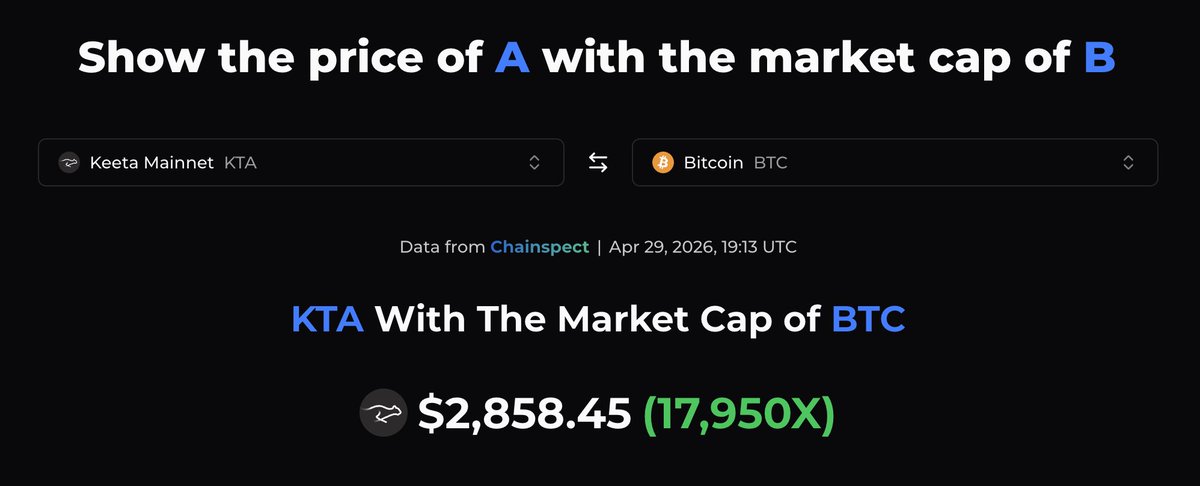
.@KeetaNetwork is the most advanced way to move money Built for humans and AI, enabling seamless value transfer at global scale At Bitcoin's market cap, $KTA would reach $2,858 (17,950x) showing how enormous the upside is 💰 👉 chainspect.app/compare/market…
Chainspect tweet media
English
20
32
171
10.1K
Ben retweetledi
The Whale Pod
The Whale Pod@The_WhalePod·
So you're telling me a chain proven to do... over 11 million TPS publicly tested with Google Cloud supporting 25+ fiat currencies payouts in 100+ countries via Visa Direct multi-currency accounts in 150+ countries backed by Eric Schmidt partnered with Visa Direct and Bridge and now acquiring a bank… is still flying under the radar? Keeta has already built: • stablecoin compatibility via Bridge • direct fiat integrations across 25+ currencies • local deposits in multiple countries • instant payouts in 100+ countries via Visa Direct • multi-currency accounts, including named USD accounts in 150+ countries • ACH debits • access to U.S. Treasury bills and stocks And then you add: • “Anchors” connecting real-world financial systems • sub-second settlement at massive scale • a move to acquire a regulated bank Built by a relatively small team, with low burn… yet delivering more real-world functionality than most of the space Yeh, we're buying 🔥
English
12
19
125
3.4K
@ApesBusy
@ApesBusy@ApesBusy167825·
@BlIpBlEEpBl00p Agree overall community is weak they never hold Ty or team accountable Leadership worship is a red flag 🚩 like you said blind faith By a bunch of folks who believe they hold lotto tickets Cash burn is real and with no revenue being generated who knows
English
3
0
7
367
WretchedMuffinKing
WretchedMuffinKing@BlIpBlEEpBl00p·
Like others I am seeing warning flags with $KTA. 1. Misleading messaging from team 2. Questionable tokenomics 3. The community is sold on "no timelines" and "no short term targets" (=blind faith). Vibe feels similar to #0x0 scam. Hold a small bag just in case.
English
4
0
14
2.6K
Ben retweetledi
TheKeetard
TheKeetard@TheKeetard·
What happens when 193 sovereign nations agree to share a single financial rail without surrendering a single ounce of sovereignty? This is not a thought experiment. A technical specification circulating within the Keeta developer ecosystem outlines exactly how it would work per @xescure. The scenario is precise. Every UN member nation runs its central bank digital currency on a neutral network. Each country retains full control over its currency, identity framework, and sanctions policy. Every transaction settles through a shared set of representatives that no single nation controls. The structure replaces correspondent banking with governance. Representatives function similarly to SWIFT and ACH. Entities that enforce transaction rules but instead of being determined by banking relationships, they are selected through protocol governance. One representative per nation. The governance model maps directly to real institutions. Governance Owners — UN Economic and Security Council Token Administrator — US Federal Reserve Token Issuers — Central Banks of each nation Sanctioned Currency Tokens — US Department of State Frozen Account IDs — US Treasury Each nation defines its own rules. Who can hold the currency. What transactions require additional identity. Which entities are sanctioned. Which accounts are frozen. Those rules do not sit outside the system. They move with the asset and are enforced automatically on every transaction by the network itself. No manual intervention. No external compliance layer. The infrastructure for each representative node runs on AWS, Google Cloud, Azure, or sovereign on-premise environments. The specification requires a very specific architecture: Native X.509 identity at the protocol level Interoperable subnets for sovereign isolation with shared settlement Governance-driven representative selection and replacement A rules engine enforcing compliance natively without smart contracts Multi-token support with delegated administration This account evaluated ten major institutional networks against these requirements. The result was consistent. None of them satisfy all of these conditions. One architecture does. The specification references KeetaNet software. The implementation details are not speculative. They align directly with publicly documented components, including anchor-based asset ingress and protocol-level compliance enforcement. Financial neutrality at global scale is no longer a theoretical design problem. It is an implemented architecture waiting for the first nation to use it. x.com/xescure/status… docs.keeta.com/features/ancho… x.com/TheKeetard/sta…
English
0
9
31
700
Ben retweetledi
Ty
Ty@schenkty·
This take is bizarre. Our network was publicly tested with Google Cloud in June 2025. We’ve announced Bridge integration for stablecoin compatibility, direct fiat integrations across 25+ currencies, local deposits in multiple countries and currencies, and instant payouts in 100+ countries via Visa Direct. We’ve also introduced global multi-currency accounts, including named USD accounts available in 150+ countries, ACH debits, and access to U.S. Treasury bills and stocks. Outside of Bridge, these are first-of-their-kind integrations. We’ve delivered more real functionality than nearly any team in the space with a fraction of the team and burn. The level of coordinated, baseless attacks on Keeta is telling. We’ll keep building while you keep thinking about a token we launched for free.
English
35
41
240
18.8K
Ben retweetledi
Ty
Ty@schenkty·
@ApedDegens As a dear friend recently said to me, we will remember those who stood with us when others didn’t ❤️
English
22
11
150
2.5K
Ben retweetledi
Aped Degens
Aped Degens@ApedDegens·
Steve Wozniak pitched HP the PC in 1976. They turned him down. So Wozniak founded Apple. Nokia had touchscreen prototypes in 2004. They killed them internally. The iPhone launched in 2007. IBM had the concept for cloud computing in the ’90s. Leadership ignored it. Amazon built AWS in 2006. Ty Schenk @schenkty founded Keeta Network. Many dismissed and slandered him. So he built silently, kept his cards close, and is positioned to crush the competition. Big companies move slow to avoid risk. Small teams move fast because they have nothing to lose. Caution kills innovation. Speed wins. @KeetaNetwork $KTA
English
2
9
82
2.6K