Did you know that one of the most important discoveries in mathematical history happened because a scientist was bored during a meeting in 1963?
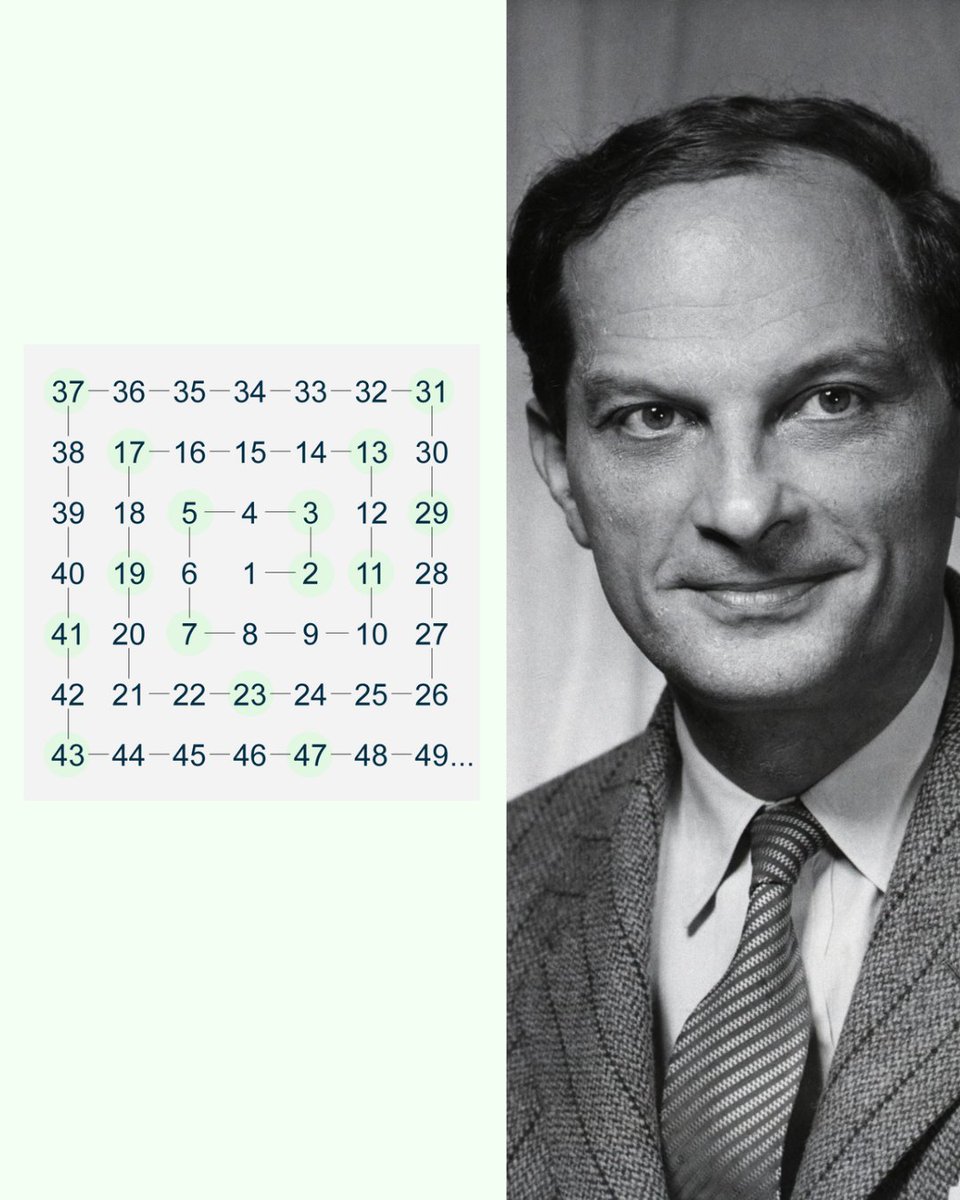
Stanisław Ulam was sitting through a dull lecture when he began doodling on graph paper.
He wrote the number 1 in the center, then spiraled outward—2, 3, 4, 5, and so on—simply to pass the time.
But then he did something remarkable: he circled all the prime numbers—2, 3, 5, 7, 11, 13...
What he saw next was astonishing.
The primes were not scattered randomly as everyone had assumed.
Instead, they formed striking diagonal lines across the spiral—like hidden highways running through the numbers. This seemed impossible.
Prime numbers are supposed to be irregular and unpredictable, yet here they were, aligning in beautiful patterns no one had noticed before.
When Ulam showed his discovery to other mathematicians, they were amazed.
What began as a simple doodle revealed deep and mysterious structures within numbers—patterns that, even today, we do not fully understand.
Who knew your morning coffee run could hold the secret to a thriving spring garden? ☕️🌱
Jug Sowing is the ultimate low-budget greenhouse hack. It’s cheap, it’s eco-friendly, and it gives your flowers, lettuce, and onions a massive head start while it’s still chilly outside.
How to get growing:
Source your jugs: Check local coffee shops for empty milk jugs! Give them a quick rinse and reinflate if they’re a bit squished.
Drill for drainage: Add 4 holes on the bottom and a few on the sides (just in case!). Don’t forget one extra hole to start your cut.
Make the "hinge": Cut around the middle, leaving a small section intact so it opens like a lid.
Prep the soil: Fill with dirt, tamp it down, and water deeply to create that essential "greenhouse effect."
Seed & Seal: Plant your seeds (don't be afraid to go heavy!), add a thin layer of soil on top, and seal the middle with duct tape.
Label & Relax: Write the plant name on the side and watch your garden grow!
It’s that easy. Ready to ditch the expensive greenhouse setup? Let's get sowing! 🪴✨
The story of FCKGW-RHQQ2-YXRKT-8TG6W-2B7Q8
It wasn’t a hack. It was a leaked Windows XP volume license key.
Because it was whitelisted, XP skipped activation entirely no phone-home, no timer, no watermark. Once the volume install media leaked too, XP could be distributed “pre-activated” and fully functional.
One of the biggest piracy moments ever, caused by trust in early DRM not cracking.
METEOR HUNTERS in Houston — we now have a map of where meteorite fragments MAY be found! This is from NASA.
So far there ARE reports of at least one medium-sized one being recovered (and, unfortunately, causing damage).
This is on the northwest side of the Houston Metro northwest of Houston Bush Intercontentinal Airport. Your best chance is between Highway 1960 and Highway 99, especially near Kohrville, Klein and along Louetta Road.
That’s a heavily-commercialized, busy urban area, so folks there should check their backyards too.
Dark red is where 20 pound meteorites landed IF they were produced, then 2 pound (red), 0.2 pounds (dark orange), 0.02 pound (light orange) and 0.02 pound (yellow).
Any recovered meteorites may be magnetic AND feel extremely dense (“too heavy” for an ordinary rock of its size).
Saturday’s meteor was likely about 3 feet across and weighed a ton before it exploded overhead at 4:39 p.m. NASA’s Meteoroid Environment Office says the explosion, which produced a sonic boom, released an amount of energy equivalent to 26 tons of TNT.
@slgan@FOX26Houston Hi @slgan I hope you’re well? I’m with ABC News. Please can you follow me back so I can send you a direct message? Thank you and best wishes
Following reports of a loud "boom" and houses shaking the Houston area on Saturday, a woman says a potential piece of the answer may have been what crashed through her roof. fox26houston.com/news/houston-m…
Poor sleep really does let waste build up.
Boston University study shows the process - during deep non-REM sleep, cerebrospinal fluid flows between neurons in waves, removing metabolic waste, "refreshing the system" for next day’s thinking and learning
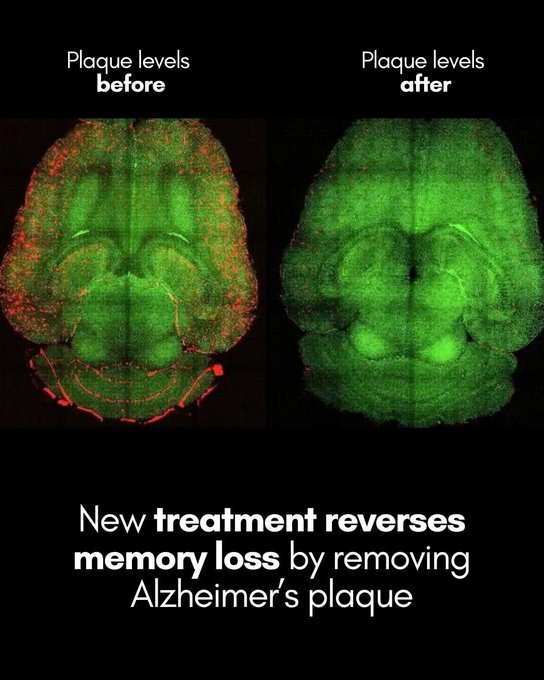
Researchers from Spain and China achieved a significant advance in Alzheimer’s research by developing nanoparticles that clear toxic brain plaque, a key contributor to the disease, and reverse memory loss in mice.
Published in Signal Transduction and Targeted Therapy, the study showed that three injections of these nanoparticles reduced harmful amyloid beta proteins in the brain by up to 60% within an hour.Remarkably, mice with severe memory and cognitive impairments regained normal behavior within six months.
The treatment not only cleared brain plaque but also repaired the blood-brain barrier (BBB), which protects the brain and clears waste but becomes impaired in Alzheimer’s, allowing harmful substances to accumulate.
Acting as a “supramolecular drug,” the nanoparticles restore the brain’s natural waste-clearing system by activating the LRP1 protein. This improved blood flow, reduced inflammation, and supported brain healing. While still in animal testing, this approach suggests a new path for Alzheimer’s treatment, focusing on enhancing the body’s defenses rather than just targeting toxic proteins.
If successful in humans, it could transform the fight against Alzheimer’s and other neurodegenerative diseases.