

Slight86
118 posts

Slight86
@slight2277
Reddit community manager for Cardano and Midnight
Katılım Aralık 2025
127 Takip Edilen53 Takipçiler

LFG
alphagrowth@alphagrowth1
It's time. The @Cardano PRIME proposal is now live on-chain for community vote. A 12-month AlphaGrowth-run program to strengthen Cardano DeFi: protocol readiness, responsible incentives, durable on-chain growth. This one belongs to the community. So let's talk about it - together.
QST

Sooo Cardano.
ETH wants to become more like Cardano.
Got it.
Toni Wahrstätter ⟠@nero_eth
Native UTXOs on Ethereum. Payments should be one-shot objects, not permanent state. Bitcoin got this right. Ethereum can bring the same idea to payments: prove existence from history, keep only a spent bit in state, and reduce permanent state by ~99.8%. Check out the blog post for details. ethresear.ch/t/native-utxos…
English
@nufiwallet Excellent initiative. Hardware wallets are so incredibly important. Regards from the Netherlands 🇳🇱
English
Slight86 retweetledi

🚨EU Crypto Users: The MiCA deadline hits July 1st.
With major CEXs like Binance winding down or restricting services across the EU, it’s time to move your crypto somewhere SAFE. 🔒
To help you switch to self-custody, we’re giving away 3 x Trezor Safe 7 hardware wallets! 🎉
Entry details below 👇 (1/4)
English
@CardanoJones @ourodexfinance This needs further clarification. At present, it's your word against theirs. The on-chain evidence you've provided does not, by itself, conclusively support your claim.
English

1. Another scam is going on in Cardano, this time by courtesy of aggregator @ourodexfinance. Don't be a fool like me and stop interacting with their dapp. Here is the visual proof

English


@CardanoRami I don't see it on the stablecoin dashboard in Cexplorer. Where can I find on-chain verification of this?
English
Slight86 retweetledi

Over the years, @Cardano has done the hard work of building the rails.
Smart contracts. eUTxO. USDCx. LayerZero v2. Pyth. Dune.
The foundation is strong. The infrastructure is closer to parity.
Now comes the next step: competitive depth.
Enter Cardano PRIME.

English

@SebastienGllmt @P3b7_ Unrelated, but made me chuckle to see Mr. Guillemot reply to Mr. Guillemet
English

After the signing bug exposed users' keys, attackers drained wallets. Then SecondFi swept the rest itself into a custodian and called it a rescue.
We have seen exit scams, exchange seizures, protocols clawing funds back. A self custody wallet provider moving live customer funds with the users' own leaked keys, framed as protection, is a new shape. First time at this scale, to my knowledge.
The hard part now is refunding. Once a key can be rebuilt from a public signature, the key identifies no one: owner, attacker, and chain scraper all hold it. So "sign to prove ownership" is dead here. A scammer signs as well as the victim. And some users may have self drained to a fresh wallet, then queued for a refund anyway.
The one secret that survived is the seed. Derivation is one way: the leak exposed a derived key, not the 24 words, and you cannot climb back to them. Only the real owner knows the seed.
So prove the seed, not the key, in zero knowledge. The user proves "I know a seed that derives to this address" without revealing it: the circuit recomputes mnemonic to seed to keys to address, and outputs a proof the verifier checks in milliseconds. The seed never leaves the device. A scammer with only the key cannot produce it.
One honest limit: this proves ownership, not loss. A self drainer passes too. So refunds still need on chain accounting, what actually left each address, netted against what the owner already recovered. Proof plus accounting.
Cryptography or human judgment. Human judgment is slow, gameable, and exactly the trust you tried to remove. The bug turned every signature into a key disclosure. The fix should turn every claim into a proof.
Stay safe.
Charles Guillemet@P3b7_
🚨SecondFi: more than $20M stolen, or taken hostage - When the nonce is predictable, the key is public. Last Tuesday, SecondFi wallets were drained at scale. Users were doing nothing exotic, just signing transactions like any other day. Then the funds were gone. ▶️What happened. Two waves. First, external attackers drained wallets: ~16M ADA plus NFTs, around $2.5M. Then a much larger move: ~129M ADA, around $20M, swept by SecondFi itself to a third party custodian, "to keep it safe." Users were robbed by attackers, and users were swept by the platform!! ▶️The bug. Every signature scheme in this family uses a per signature secret number, the nonce. The one rule: it must be secret and unpredictable. EdDSA (Ed25519, what Cardano uses) makes it deterministic on purpose, derived from the private key and the message together. Deterministic, but secret. The secret input is the whole point. SecondFi's implementation derived it from public data alone. The nonce stopped being secret. Public in, public out. ▶️Why it is fatal. Call it what it is: worse than nonce reuse. Reuse needs two signatures from the same key to recover it. Here the nonce can be recomputed by anyone from data already on chain, so a single signature is enough to reconstruct the private key. Every transaction a user ever signed is a public disclosure of their key. I pulled signatures off chain and rebuilt the keys to confirm. One signature, every time. The chain was not attacked. It was read. ▶️The "rescue." The second wave was the platform sweeping ~129M ADA to a custodian, framed as protection. The fix for "your keys are cryptographically exposed" was "trust us to give it back." A cryptographic failure patched with a social promise. "We will return the funds" is not "we are cryptographically incapable of keeping them." The incident did not create that gap. It made it visible. ▶️The ownership trap. Once a key is publicly reconstructible, holding it proves nothing. Attacker, custodian, original user: three parties, same cryptographic claim. So how does a real owner prove it? The elegant exit is a zero knowledge proof of knowledge of the 24 words, the seed, without revealing it. Knowledge of the mnemonic is the one thing a chain scraper does not have. Prove the preimage, not the key. ▶️ How did it get in? Honest mistake, or planted? Dropping a single secret input from the nonce is a tiny change. Exactly what a tired engineer ships, and exactly what a supply chain or insider attacker plants, because it is deniable and pays out silently to whoever reads the chain. I do not know which one this was. The commit history will tell. Cryptography does not care about good intentions. It enforces what you built. SecondFi built a scheme where the nonce was predictable, so the keys were public, so the funds were anyone's. The rest is just who read the chain first. Stay safe. -- (obv, Ledger users are not affected. Nonce and signatures are computed inside the secure element)
English
@A3Cpool_Shawn @P3b7_ @JoriPLevy It's due to the nature of the exploit: only certain UTXOs were exposed, rather than entire wallets.
English
@P3b7_ @JoriPLevy Riddle me this, why was my friends wallet which had 35k ADA + approx 6k ADA worth Defi + Many NFTs only drained of 25k ADA?
Txid:
29f4108e4ad86e63c2888474f3d9c2085e1ea3fba6ee3f0e38454b8190a486ec
English
@1Exit_Liquidity Then who did I just buy ADA from? Must be paper hands.
English


@se7en_labs @IOGroup I'm so happy that Daedalus is relevant again. It went from being legacy to essential really quickly, thanks to se7en labs.
English

Daedalus: Cardano’s only full node desktop wallet. Your keys. Your node. Trustless.
SE7EN Labs has submitted a treasury proposal to maintain and improve Daedalus through 2027 while continuing collaboration with IO.
Self sovereign security is not something you bolt on later. It is foundational.
Real security. Openly verifiable. Built for Cardano.

English

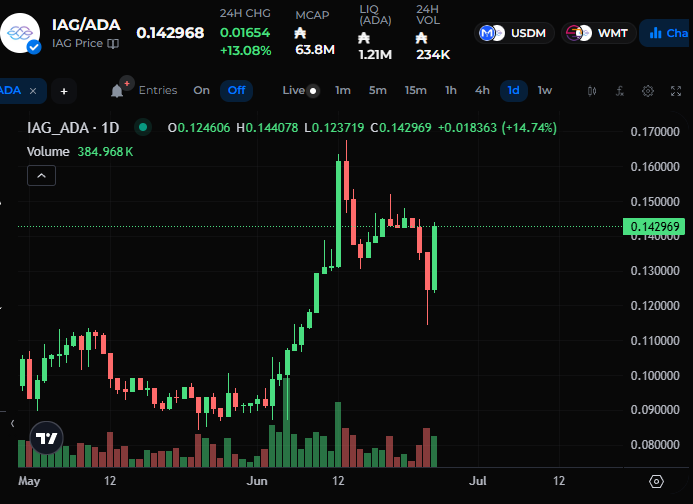
$IAG is up 13% in the past 24 hours
Is Cardano about to have a new runner?👀
English
@Quantumplation Never a good time when Pi is called in for forensics. It means shit really hit the fan. But at least we know the analysis will be done thoroughly. I reluctantly look forward to reading your report.
English

The larger the audience, the less capacity for nuance.
There's a lot of armchair speculation regarding this SecondFi issue floating around from people on the outside.
This is understandable: absent any other lever, I can understand why people want to speculate and try to get to the bottom of the issue.
However, much of it is incorrect, myopic, and uninformed. Please keep that in mind as you read what people have to say and form your own opinion or act hastily.
Myself and others have been asked to help with the forensics. I'm limiting what I say publicly until we have a complete picture, but rest assured, I will write an independent after action report that attempts to make everything crystal clear, similar to what I wrote for the pig-chain incident last year.
This incident will certainly need to be paired with acute accountability; but accountability and pitchforks are not the same thing.
English

I am sad to see so many builders, influencers, SPOs, and DReps leaving the ecosystem.
The reasons may be the falling price of ADA, low ecosystem support, and incentives.
Catalyst is gone, staking rewards are falling, and governance is completely de-incentivized.
It is a shame that proposals that could have supported the ecosystem, including our Innovation & Growth DAO, did not receive support.
I appreciate the effort to change the staking parameters, but unfortunately, it comes too late for many SPOs.
The last few months have probably discouraged many DReps. Processing 100 proposals was a huge challenge. It is still not over. On-chain proposals will be submitted.
Although Cardano’s fundamentals remain strong and Leios is literally around the corner, it is necessary to address these issues as soon as possible. Otherwise, even strong fundamentals will not keep Cardano in the top 20.
To be clear, I am not leaving. I will continue to be a DRep, I will continue to be an SPO, and I will continue to try to get support for builders.
English
@Zylo_BTC @angrycryptoshow Congratulations, you passed the reading comprehension checkpoint most people clear in elementary school.
English

@angrycryptoshow "I held for 3 years"
Held is past tense. Implies he sold at some point.
English

UPDATE: Charles Hoskinson says "if it was about money, I would have sold my $ADA at the beginning. I was a billionaire in 2017—I had no legal requirements to vest. I held for 3 years and didn't sell a single $ADA. I carried it all the way through till today, and I'm still here."
English
Slight86 retweetledi

After 5 years, I’ve made the tough decision to shut down the MALU Stake Pool and retire as a DRep.
To everyone who supported the pool, or trusted me with their votes - THANK YOU!
Together we minted 7419 blocks and supported 30+ ISPOs and projects.
It’s been a fun ride and I’m incredibly grateful for the support that came from this community.
Please redelegate your ADA asap!
Thank you for everything 💙

English
@CashAnvil @IOHK_Charles Charles can't be claiming responsibility for bull markets while putting bear markets on the community. I rolled my eyes at that remark. That's just BS. But let's focus on the good that was said. Let's make this happen.
English

I hear a lot of good in this.
Unfortunately, also a lot of stuff in here that is just as unnecessary as all the stuff you call out.
There's a major lack of accountability in this video.
"The price went from .02 to $3 under us" yes it also went back down to .25c so this is irrelevant. Like why even bring that up? The last thing we should be doing right now is comparing accolades and merits.
The unfortunate reality is we live in a 'what have you done for me lately' culture. A lot of your haters want exactly this, an angry, high cortisol video. Then they take it and clip farm you, furthering the narrative that you are vehemently trying to suppress.
Simply put, you are far too available to the people who hate you and hardly ever available for the ones who support you.
Again, not trying to shit in your cereal but someone needs to tell you it straight with no fluff. I think you should start doing some one on ones with community members.
Hope you can figure it out, i know you aren't the leader of Cardano you say you once were, but the reality is you are responsible for half the NCL funding, so you really are king still.
Let's push forward. I agree that there is no plan in place and its alarming. Too many people pushing in too many different directions. Although its a decentralized blockchain, its still a top down effort imo. People will listen to you. I will join Discord and this will be my last effort to be heard. Hope this is received well, i just want us all to win and be happy.
English