

Cheng Cui
102 posts
Cheng Cui
@slimcat0101
Tech Lead @ PaddleOCR | Document AI & VLM Researcher. 💡 Making AI practical and scalable.
Beijing, China Katılım Haziran 2025
83 Takip Edilen267 Takipçiler

Thrilled to share that our Unlimited-OCR has crossed 1M downloads in just 2 weeks! 🚀
Also took a look at PaddleOCR’s HuggingFace stats: 30M+ downloads over the past year! 🤯 (And honestly, that’s just HF—most developers in China use our BOS mirror, which we estimate is roughly 5x that volume).
Massive thanks to the community for the trust. It keeps us pushing the boundaries of what’s possible.
Stay tuned for what’s next, and follow my HF space for updates: 👉 huggingface.co/ChengCui
English
@abimaelmartell Thanks for the support! Stay tuned for what's coming next.
English

Great news. Baidu OCR always delivers! 🚀🔥
Youyang Yin@HYPERUU4122
Unlimited-OCR has surpassed 1M downloads on Hugging Face 🚀 ❤️ Huge thanks to everyone supporting the project 👀 Next up: multilingual and 128k context versions GitHub: github.com/baidu/Unlimite… HF: huggingface.co/baidu/Unlimite…
English
@crazytime @huangyun_122 Mineru的pipeline模式,底层核心ocr引擎用的是paddleocr的模型,也可以长期关注一下paddleocr,hh
中文


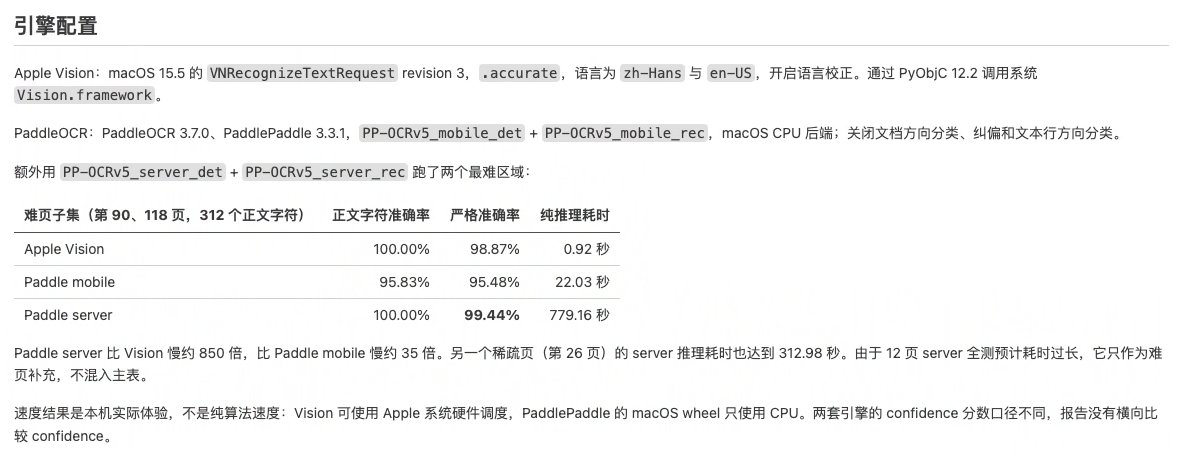
@huangyun_122 可以试一下pp-ocrv6,精度更高,速度更快。另外苹果ocr作为苹果系统中重要的能力,做了很多预处理后处理的工程优化,paddleocr作为开源项目,主要还是优化模型本身,确实没有更多的精力投入到工程优化,预计优化后的pp-ocrv6最小的模型能到50毫秒以下。
中文
Had a fascinating dinner with AI academics tonight. The gap between academia and industry isn't just about money or deployment—it's a fundamentally different worldview on how to solve AI problems.
Academia is still looking for algorithmic elegance. They want to change the underlying math or architecture to make the model "smarter."
Industry relies on data density and scale. We focus on data flywheels, runtime efficiency, and engineering constraints because we know brute-force data often beats clever algorithms.
This makes me wonder: Is academia solving a theoretical version of AI that is losing touch with reality? Or is industry relying too much on pure engineering and missing the next big breakthrough?
What do you think?
English
@ultralytics @nvidia Maybe our RT-DocLayout model could be combined with YOLO26 in some way, either structurally or data-wise. We could also potentially co-launch the models together.
English

@slimcat0101 @nvidia Sounds exciting! 🚀 We'd love to see what you're building and explore a collaboration. 💙
English
Export Ultralytics YOLO26 models to @nvidia TensorRT for maximum inference speed! ⚡
Optimize deployment on NVIDIA GPUs with lower latency and higher throughput, ideal for real-time edge AI and production vision systems.
Learn more ➡️ bit.ly/491c7Gs
#Ultralytics #YOLO26 #MachineLearning #NVIDIA

English
@Xianbao_QIAN Thanks for the love, tiezhen! And shoutout to you for driving the Hugging Face integration for the PaddleOCR model series.
English

I’ve been asked this a lot recently: "Since End-to-End (E2E) document models are getting so powerful, do we even need Layout Analysis anymore?"
My short answer: Absolutely, yes. In fact, it is more critical than ever.
Thrilled to share that our latest work on this, RT-DocLayout, has been accepted to ECCV 2026! 🎉
Let’s look at why this matters from a first-principles data engineering perspective. 🧵👇
1/ The Illusion of E2E ModelsCurrent trendy E2E document parsing models are great at generating raw text directly. But they operate as a "black box." They completely discard spatial anchoring. In high-stakes enterprise workflows (like financial audits, legal contrast, or complex schematics), if you don't know where a specific text block physically resides on the page, the parsed data loses 80% of its reference and verification value.
2/ The Downstream Dilemma & The Geometric BottleneckTo make document data truly actionable for downstream tasks like LLM-RAG or precise knowledge base construction, we must have physical layout coordinates. However, even among the few advanced models that do provide coordinates, 99% of them are strictly limited to traditional rectangular bounding boxes.
3/ Why Rectangles Fail in the WildReal-world documents are messy—featuring page warps, camera tilts, perspective distortions, or highly irregular, dense, non-linear layouts. When you force a rigid rectangle onto a tilted or curved text line, it introduces massive background noise and overlaps with neighboring lines. This single geometric limitation causes catastrophic cascading errors for downstream OCR engines and text-ordering systems.
4/ Enter RT-DocLayout: A World First 🌍 [ECCV 2026]
This is exactly the core bottleneck we solve in our ECCV 2026 paper. RT-DocLayout (also known in the open-source community as PP-DocLayoutV3) is the WORLD'S FIRST document layout analysis model capable of predicting pixel-level multi-point polygon boxes (Multi-point Masks) in the wild!
Instead of fitting rigid rectangles, RT-DocLayout embraces a mask-centric architecture. It wraps around any skewed, bent, or irregular text line with "contour-level" precision.
5/ Speed Meets PrecisionBy reclassifying layout analysis into a single-stage, multi-task learning framework, a single forward pass simultaneously yields:
✅ Pixel-level multi-point contours
✅ High-precision object bounding boxes
✅ Logical reading order tracking
All of this heavyweight capability is packed into a highly efficient 33M parameter network, blasting through inference at an astonishing 132.1 FPS on a single GPU.
E2E models are an exciting branch, but high-fidelity data engineering requires absolute structural precision. Proud of the team's work getting recognized at ECCV 2026. RT-DocLayout is paving the way for the next generation of bulletproof document intelligence. 🚀
🔗 Read our full ECCV 2026 paper on arXiv: arxiv.org/abs/2606.23344

English
@mervenoyann Thanks for the love! 🙌
By the way, I recommended that PaddleOCR-VL pipeline you chained together to a friend, and they really liked it too.
It’s definitely a Best Practice—we should co-promote this together. 🚀
English

my personal favorite OCR models PP-OCR, PP-DocLayout and PaddleOCR-VL are all on transformers 🙌🏼
super glad to get PP models onboard 🤗
Cheng Cui@slimcat0101
I’ve been asked this a lot recently: "Since End-to-End (E2E) document models are getting so powerful, do we even need Layout Analysis anymore?" My short answer: Absolutely, yes. In fact, it is more critical than ever. Thrilled to share that our latest work on this, RT-DocLayout, has been accepted to ECCV 2026! 🎉 Let’s look at why this matters from a first-principles data engineering perspective. 🧵👇 1/ The Illusion of E2E ModelsCurrent trendy E2E document parsing models are great at generating raw text directly. But they operate as a "black box." They completely discard spatial anchoring. In high-stakes enterprise workflows (like financial audits, legal contrast, or complex schematics), if you don't know where a specific text block physically resides on the page, the parsed data loses 80% of its reference and verification value. 2/ The Downstream Dilemma & The Geometric BottleneckTo make document data truly actionable for downstream tasks like LLM-RAG or precise knowledge base construction, we must have physical layout coordinates. However, even among the few advanced models that do provide coordinates, 99% of them are strictly limited to traditional rectangular bounding boxes. 3/ Why Rectangles Fail in the WildReal-world documents are messy—featuring page warps, camera tilts, perspective distortions, or highly irregular, dense, non-linear layouts. When you force a rigid rectangle onto a tilted or curved text line, it introduces massive background noise and overlaps with neighboring lines. This single geometric limitation causes catastrophic cascading errors for downstream OCR engines and text-ordering systems. 4/ Enter RT-DocLayout: A World First 🌍 [ECCV 2026] This is exactly the core bottleneck we solve in our ECCV 2026 paper. RT-DocLayout (also known in the open-source community as PP-DocLayoutV3) is the WORLD'S FIRST document layout analysis model capable of predicting pixel-level multi-point polygon boxes (Multi-point Masks) in the wild! Instead of fitting rigid rectangles, RT-DocLayout embraces a mask-centric architecture. It wraps around any skewed, bent, or irregular text line with "contour-level" precision. 5/ Speed Meets PrecisionBy reclassifying layout analysis into a single-stage, multi-task learning framework, a single forward pass simultaneously yields: ✅ Pixel-level multi-point contours ✅ High-precision object bounding boxes ✅ Logical reading order tracking All of this heavyweight capability is packed into a highly efficient 33M parameter network, blasting through inference at an astonishing 132.1 FPS on a single GPU. E2E models are an exciting branch, but high-fidelity data engineering requires absolute structural precision. Proud of the team's work getting recognized at ECCV 2026. RT-DocLayout is paving the way for the next generation of bulletproof document intelligence. 🚀 🔗 Read our full ECCV 2026 paper on arXiv: arxiv.org/abs/2606.23344
English
The model now supports inference via transformers. We would also like to express our sincere gratitude to @mervenoyann and her colleagues at @huggingface for their incredible assistance throughout this process.
You can access the model links here:
PaddlePaddle version: huggingface.co/PaddlePaddle/P…
Safetensors version: huggingface.co/PaddlePaddle/P…
English

@slimcat0101 @AIforGood AI for Good 真正难的地方在 deployment workflow。野生动物识别一旦进真实场景,误报率、漏报率、设备条件、数据漂移和人工复核链路都会决定能不能长期用。拿奖很好,能不能稳定落地更看 eval 和 maintenance。你们最先盯误报率,还是 model drift?
中文
Proud to see Baidu’s impactful tech recognized at the @AIforGood Global Summit again! Reminds me of my days as a frontline RD for the "AI Guardian of Endangered Species" project. I developed the wildlife and wildlife products detection models that drove the removal of 13K+ illegal ads.
Beyond being featured by #AIforGood last year, this work also proudly took home the 2025 Edison Awards 🏆. AI is more than efficiency—it’s about responsibility. Let's build AI that truly elevates human civilization. 💻🌱🌍
Baidu Inc.@Baidu_Inc
AI for Good in action: Three of our AI use cases were recognized as winning cases at the 2026 @AIforGood Global Summit, and featured in the latest Innovate for Impact Report. 🌍✨ > Apollo Go: Scaling Sustainable and Inclusive Urban Mobility > Miaoda & MeDo: Democratizing Software Creation through AI-Powered No-Code > PaddlePaddle: AI-Powered Restoration of Thangka Sacred Art Different fields, same idea: AI should help more people create, preserve, and move through the world. See how each one is making an impact ↓
English

🚀Hy3 is here.
295B MoE. Best in its size class. Rivals trillion-scale flagships.
Reliable and affordable for most agentic usecases.
Apache 2.0. Friendly for commercial use.
FREE API for 2 weeks → openrouter.ai/tencent/hy3:fr…
🤗 huggingface.co/tencent/Hy3
📖 hy.tencent.com/research/hy3

English

@slimcat0101 Does that mean that China has 5x the traffic of the rest of the world? 😳
English
@vanstriendaniel @allen_ai Yeah, OCR evaluation is still broken—no benchmark out there gives a true picture of model capacity. OmniDocBench is a great effort but far from perfect. Long road ahead.
We’ll actually be touching on this in a massive 100-year OCR survey we're dropping soon.
English

@slimcat0101 @allen_ai Yeah, this is also my impression, but a lot of people seem to be reporting on it still. IMO benchmarks often don't translate so I'm often using github.com/davanstrien/oc… to do a VLM ranking + human review.
I do think there is space for some new public ocr benchmarks though.
English
I ran 10 newer OCR models on @allen_ai's olmOCR-bench "old scans" subset.
The ranking flips depending on what you actually want. On the headline score, PaddleOCR-VL beats NuExtract3 (38.6 vs 37.8). But rank by how much of the page each model actually reads, and NuExtract3 is well ahead (41.6 vs 31.2). Same two models, opposite order.
The score rewards dropping boilerplate, i.e. letterheads, stamps, page numbers, so a model that reads the page more faithfully can rank lower.
IMO this is because a lot of VLM-based OCR models were made to provide tokens for training. It's less useful if you want faithful OCR of the whole page, like an archive where the letterhead is part of the record.
Two other things: a 1B model (LightOnOCR-2) has the best raw transcription in the field, and PaddleOCR-VL 1.6 sometimes hallucinates Chinese characters on English scans.

English
@vanstriendaniel Thank you! We’re honestly blown away by the results too. Small models are definitely proving that size isn't everything anymore. Would love to hear your thoughts if you get a chance to test it out! 👇paddleocr.com
English
@slimcat0101 Great progress! Very impressed by how good these small models have got!
English