
Joe Smith
56 posts


Joe Smith retweetledi

Absolute disaster for the Pentagon. Expert Sean Bell confirms US bombing is totally useless, comparing it to just "mowing the grass".
He reveals Washington knew Iran would brilliantly choke the global energy supply chain,
Yet Trump still walked right into this predictable trap! 🔥
English
Joe Smith retweetledi

The current situation of Trump and his arrogant administration 🤣

English
@Appraiser008 In the end so what? At least the GF is more enlightened. From victim to bully, so what if u know many languages? Dun be self entitled, leave some room for people to back down. Control your own temper.
English

Joe Smith retweetledi

ESTO ES UNA LOCURA
La mayoría pasa AÑOS usando apps de idiomas y aun así no logra hablar bien.
Claude hizo en 4 semanas lo que Duolingo no pudo arreglar en 4 años.
Aquí van los prompts 👇

Español
Joe Smith retweetledi

@EricLDaugh Get ur facts correct. People generally get their retributions once they have handed over. Let’s just see.
English

🚨 HOLY CRAP! Dem Rep. Ted Lieu is facing calls to RESIGN or be REMOVED after his slanders on President Trump being a p*do or teen s*x abuser were ACTED ON by the WHCA attempted assassin
It’s the exact same talking point.
Lieu knew it’s lies! RESIGN
English
@Rightanglenews Ted is the only one who dares to speak the truth right now. The rest are all trolls trying to drown the brave. We need more people to counter the false narratives.
English

California Rep. Ted Lieu is now facing mass calls for expulsion after it was revealed that last night’s attempted assassin, who is from California, acted on the exact lies he made about President Trump.
Call and ask why he is convincing his constituents to commit acts of terror.
English
@narendramodi Absolutely! Unless it’s committed by the democratically elected leaders.
English

Relieved to learn that President Trump, the First Lady and Vice President are safe and unharmed following the recent security incident at a Washington DC hotel. I extend my best wishes for their continued safety and well-being. Violence has no place in a democracy and must be unequivocally condemned.
@realDonaldTrump
@POTUS
English
@Byron_Wan 不能冷静下来好好说是个人问题,何必耽误大家的时间。如果生意做得呢么大,非在飞机起飞之前打电话,就别上飞机或坐自己的包机好了。Dun act like some like big businesswoman must make call when plane is taking off, and talk loudly disturbing others. But so poor upbringing and take budget.
中文

“我是 China‼️” (I am China‼️)
Apr 22: another Chinese passenger making a scene on an international flight and causing a significant delay… this took place on the AirAsia D7809 Chongqing to Kuala Lumpur flight after boarding but before takeoff (scheduled for 2am) in Chongqing. Long story short, the passenger, a Chinese woman who claimed she’s a flight attendant of China Southern Airlines, complained that an AirAsia flight attendant, presumably non-Chinese, told her in English not to talk on her phone and accused the flight attendant of 狂飙英语. She ranted on and on, questioning why, as someone working on an international flight, the flight attendant couldn’t speak Chinese (Mandarin)… airport police were called in…
It’s unclear how things ended; anyway the flight finally took off at 3:22am.

English
Joe Smith retweetledi

In the 1920s, a Stanford psychologist tracked genius children for 50 years.
Malcolm Gladwell breaks down what he discovered:
Rich families → successful. Poor families → failures.
Not average. Failures. Genius-level IQs that produced nothing.
He spent 60 minutes at Microsoft explaining why we're wrong about success:
The psychologist was named Terman. He gave IQ tests to 250,000 California schoolchildren.
He identified the top 0.1%. Kids with IQs of 140 and above.
His hypothesis: these children would become the leaders of academia, industry, and politics.
He tracked them. And tracked them. For decades.
The results split into three groups.
The top 15% achieved real prominence. The middle group had average, moderately successful professional lives.
And the bottom group? By any measure, failures.
The difference wasn't personality. Wasn't habits. Wasn't work ethic.
It was simple: the successful geniuses came from wealthy households. The failures came from poor families.
Poverty is such a powerful constraint that it can reduce a one-in-a-billion brain to a lifetime of worse than mediocrity.
There's a concept called "capitalization rate."
It asks a simple question: what percentage of people who are capable of doing something actually end up doing that thing?
In inner city Memphis, only 1 in 6 kids with athletic scholarships actually go to college.
If our capitalization rate for sports in the inner city is 16%, imagine how low it must be for everything else.
Here's something stranger.
Gladwell read the birth dates of the 2007 Czech Junior Hockey Team:
January 3rd. January 3rd. January 12th. February 8th. February 10th. February 17th. February 20th. February 24th. March 5th. March 10th. March 26th...
11 of the 20 players were born in January, February, or March.
This isn't unique to the Czechs. Every elite hockey team in the world shows the same pattern. Every elite soccer team too.
Why?
The eligibility cutoff for youth leagues is January 1st.
When you're 10 years old, a kid born in January has 10 months of maturity on a kid born in October. That's 3 or 4 inches of height. The difference between clumsy and coordinated.
So we look at a group of 10 year olds, pick the "best" ones, give them special coaching, extra practice, more games.
We think we're identifying talent. We're just identifying the oldest.
Then we give the oldest more opportunities, and 10 years later they really are the best.
Self-fulfilling prophecy.
The capitalization rate for hockey talent born in the second half of the year? Close to zero.
We're leaving half of all potential hockey players on the table because of an arbitrary date on a calendar.
Kids born in the youngest cohort of their school class are 11% less likely to go to college.
11% of human potential squandered because we organize elementary school without reference to biological maturity.
Now here's the part about math.
Asian kids dramatically outperform Western kids in mathematics. The gap is enormous and consistent across decades of testing.
Some people say it's genetic. It's not.
It's attitudinal.
When Asian kids face a math problem, they believe effort will solve it.
When Western kids face a math problem, they believe the answer depends on innate ability they either have or don't.
Here's the proof.
The international math tests include a 120-question survey. It asks about study habits, parental support, attitudes.
It's so long most kids don't finish it.
A researcher named Erling Boe decided to rank countries by what percentage of survey questions their kids completed.
Then he compared it to the ranking of countries by math performance.
The correlation was 0.98.
In the history of social science, there has never been a correlation that high.
If you want to know how good a country is at math, you don't need to ask any math questions. Just make kids sit down and focus on a task for an extended period of time.
If they can do it, they're good at math.
Why do Asian cultures have this attitude?
Gladwell's theory: rice farming.
His European ancestors in medieval England worked about 1,000 hours a year. Dawn to noon, five days a week. Winters off. Lots of holidays.
A peasant in South China or Japan in the same period worked 3,000 hours a year.
Rice farming isn't just harder than wheat farming. It's a completely different relationship with work.
There's a Chinese proverb: "A man who works dawn to dusk 360 days a year will not go hungry."
His English ancestors would have said: "A man who works 175 days a year, dawn to 11, may or may not be hungry."
If your culture does that for a thousand years, it becomes part of your makeup.
When your kids sit down to face a calculus problem, that legacy of persistence translates perfectly.
Now consider distance running.
In Kenya, there are roughly a million schoolboys between 10 and 17 running 10 to 12 miles a day.
In the United States, that number is probably 5,000.
Our capitalization rate for distance running is less than 1%.
Kenya's is probably 95%.
The difference isn't genetic. The difference is what the culture values and where it spends its attention.
Here's the most fascinating finding.
30% of American entrepreneurs have been diagnosed with a profound learning disability.
Richard Branson is dyslexic. Charles Schwab is dyslexic. John Chambers can barely read his own email.
This isn't coincidence. Their entrepreneurialism is a direct function of their disability.
How do you succeed if you can't read or write from early childhood?
You learn to delegate. You become a great oral communicator. You become a problem solver because your entire life is one big problem. You learn to lead.
80% of dyslexic entrepreneurs were captain of a high school sports team. Versus 30% of non-dyslexic entrepreneurs.
By the time they enter the real world, they've spent their whole life practicing the four skills at the core of entrepreneurial success: delegation, oral communication, problem solving, and leadership.
Ask them what role dyslexia played in their success and they don't say it was an obstacle.
They say it's the reason they succeeded.
A disadvantage that became an advantage.
Here's what Gladwell wants you to understand:
When we see differences in success, our default explanation is differences in ability.
We forget how much poverty, stupidity, and attitude constrain what people can become.
We refuse to admit that our own arbitrary rules are leaving talent on the table.
We cling to naive beliefs that our meritocracies are fair.
The capitalization argument is liberating.
It says you don't look at a struggling group and conclude they're incapable. It says problems that look genetic or innate are often just failures of exploitation.
It says we can make a profound difference in how well people turn out.
If we choose to pay attention.
This 60 minute Microsoft talk will teach you more about success than every self-help book you've ever read combined.
Bookmark this & give it an hour today, no matter what.
English
Joe Smith retweetledi

Joe Smith retweetledi

BREAKING: There has never been a better time to retweet this video of six brave lawmakers reminding the men and women in our military to REFUSE UNLAWFUL ORDERS from Trump.
Let’s make this go viral again.
English
Joe Smith retweetledi

Joe Smith retweetledi

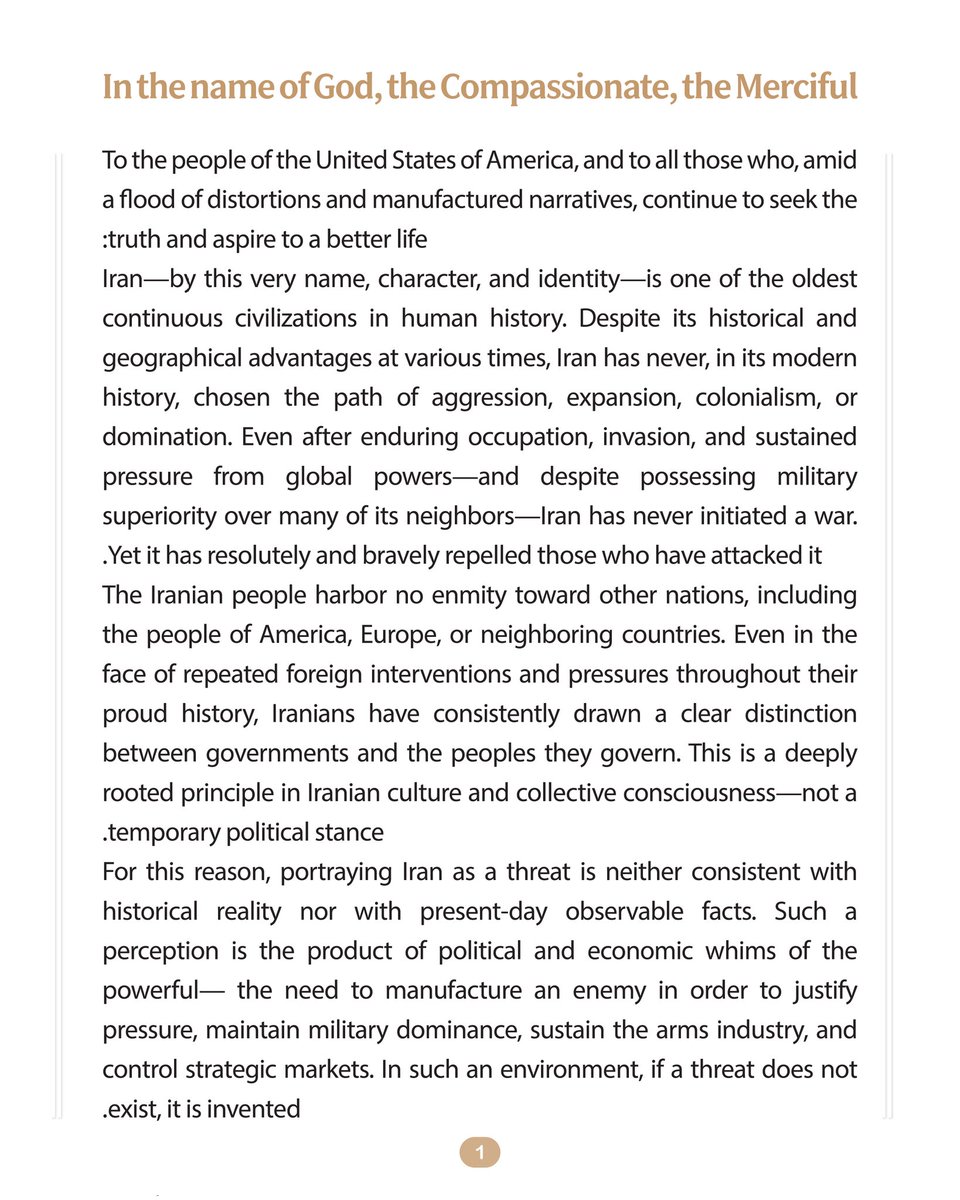
To the people of the United States of America


English
Joe Smith retweetledi

BREAKING IRAN:
☑️ US base in Kuwait “entirely decommissioned”’
☑️ US base in Bahrain hit by drones, severe damage
☑️ US carrier Abraham Lincoln attacked with 4 missiles
☑️ 560+US troops killed and wounded thus far
English
If the Great America could just focus its energies on developing itself and improving its own competitiveness, instead of bringing down others who are threatening their predominance, perhaps they wun be in such a sorry state it is today.
China pulse 🇨🇳@Eng_china5
Chinese automaker BYD has begun transporting its electric vehicles globally using its own 219-meter-long cargo ship. This vessel, the world's largest car carrier, can accommodate up to 9,200 vehicles per voyage and uses liquefied natural gas (LNG) to minimize its environmental impact. This vertical integration, which allows the company to complete all stages of production, from manufacturing to transportation, in-house, enhances the competitiveness of Chinese electric vehicles.
English