Nicholas Sofroniew

5.1K posts

Nicholas Sofroniew banner
Nicholas Sofroniew

Nicholas Sofroniew

@sofroniewn

math/neuroscience - AI

San Francisco, CA Katılım Aralık 2014
1.1K Takip Edilen3.4K Takipçiler
Sabitlenmiş Tweet
Nicholas Sofroniew
Nicholas Sofroniew@sofroniewn·
Really excited to share the most recent work on verbal report and access consciousness in language models I've been doing with @wesg52 and @Jack_W_Lindsey I went to @AnthropicAI to work on these types of questions, and I think we are finding fascinating things I hope you enjoy!
Anthropic@AnthropicAI

New Anthropic research: A global workspace in language models. Of everything happening in your brain right now, only a tiny fraction is consciously accessible—thoughts you can describe, hold in mind, and reason with. We found a strikingly similar divide inside Claude.

English
6
9
67
7.4K
Nicholas Sofroniew retweetledi
Ryota Kanai
Ryota Kanai@kanair·
I agree with part of this criticism about the risk that headlines convert the original careful claim into “Claude is conscious.” But I do not think it is fair to say that the consciousness framing is just for marketing. (Actually, I feel this kind of criticism is similar to consciousness research before the NCC era) As a consciousness researcher, I find the consciousness framing meaningful. The notion of access has been vague in cognitive neuroscience. But this study makes it computationally more concrete. Of course, access consciousness is not the same thing as phenomenal consciousness. It is about information being available for report, reasoning, flexible control, and action. The paper is very explicit about this distinction. It does not claim that Claude has subjective experience. Global workspace theory has mainly focussed on access. Finding something functionally similar inside an LLM does not prove that the model is conscious. But it does give us a concrete object to study. It lets us ask what reportability, internal reasoning, etc actually look like in a system whose mechanisms we can inspect and intervene on much more directly than we can in the actual brain. It is a useful analogy that can drive neuroscience of consciousness. Of course, the analogy has limits (e.g. a transformer is not a brain and has access to all the past information). But the paper itself discusses many of these differences. So the right response, in my view, is not “this has nothing to do with consciousness.” The better response is: “this may tell us something about the computational side of conscious access, while leaving phenomenal consciousness unresolved.” There is also a broader point about consciousness research. Almost no empirical consciousness research studies subjective experience directly. Even in humans, we usually study reports, perception, working memory, attention, confidence, etc. We study things that are closely related to consciousness, but not consciousness itself. If we demanded direct access to experience before calling something consciousness research, nothing is left.
Ravid Shwartz Ziv@ziv_ravid

The problem with Anthropic's consciousness paper My last post got more attention than I expected, and the question I keep getting is some version of "okay, so what is actually wrong with the paper?". Let me try to explain. First, the core result is fine. Reading out intermediate-layer representations and asking which ones the model can actually use downstream is a real question, and people have been poking at it for years. The J-lens is a reasonable tool. If you strip the paper down to the linear algebra, it is a decent piece of interpretability work. My problem starts one level up. This did not need to be a paper about consciousness. It did not need global workspace theory, it did not need the brain, and it did not need the word "conscious" anywhere near it. The same experiments, the same figures, the same tool, all survive perfectly well as plain interpretability. Someone chose to wrap it in neuroscience. That choice is the product, not the science. At the end, this is the main thing. Almost everything Anthropic ships as blogs/papers/posts is PR. They build genuinely good models and they are even better at packaging them. A publication used to carry a specific kind of weight. People spent years on something and wanted to tell the world what they found. It happened mostly in academia, with a few industrial labs as the exception, Bell Labs, IBM and Google (for a while), but the distance between the paper and the product was real. When you read a paper you could assume the authors were not trying to sell you something underneath the ideas. There were outliers, but they were the minority, and the researchers you trusted would not risk their name on a narrative. We are not in that world anymore. Every startup now publishes blogs and papers to raise its visibility, and that is fine, that is marketing and everyone knows it. Anthropic does something more effective. They erase the line between legitimate research and PR. We get confused because the models are so good, so we assume the outputs are research. A lot of the time they are selling us something. Sometimes it is "our models are safer," sometimes it is "our models are more capable," sometimes it is positioning for regulation. The consciousness framing serves a narrative they already committed to, models that look more and more like the brain, from a lab that has publicly tied itself to AI welfare and moral patienthood. The direction of the push is not subtle. If you want the sharper version of the technical objection (disclaimer: I'm not an expert) Global workspace theory is a theory of access, not experience. Ned Block's distinction between access consciousness and phenomenal consciousness exists precisely to block the inference this framing invites. Access tells you nothing about whether there is anything it is like to be the system. The paper is careful enough to say it demonstrates no subjective experience. But that disclaimer is not what propagates. What propagates is "consciousness" in the same sentence as "Claude," published by Anthropic, borrowing the vocabulary of neuroscience to lend biological weight to a subspace of activations. The paper keeps the rigor of Block's vocabulary and drops the rigor of his argument. Most people who see the headline will never read either one. Of course a lab named Anthropic is going to anthropomorphize its models. But we should be able to separate a good interpretability tool from the story it is dressed in. So that is my problem. Not the math. The narrative bolted onto the math, and our willingness to keep calling it research.


English
6
11
56
8.2K
Nicholas Sofroniew retweetledi
tom white
tom white@dribnet·
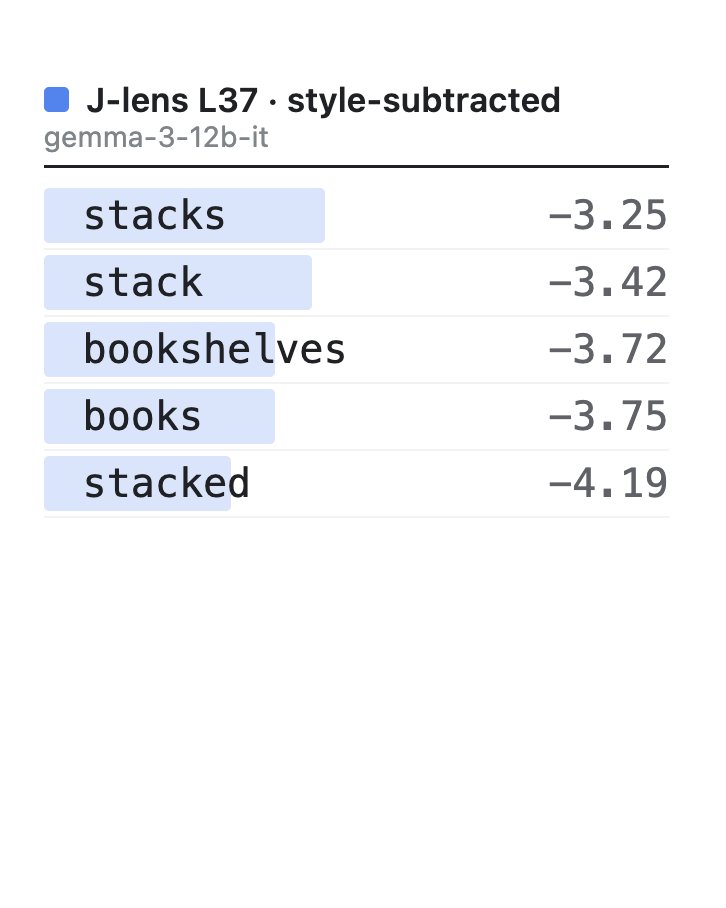
enjoying the new global workspace anthropic paper - especially using the Jacobian lens to provide readout interpretations of prints shown at last month CVPR
tom white tweet mediatom white tweet media
English
3
1
25
1.8K
elie
elie@eliebakouch·
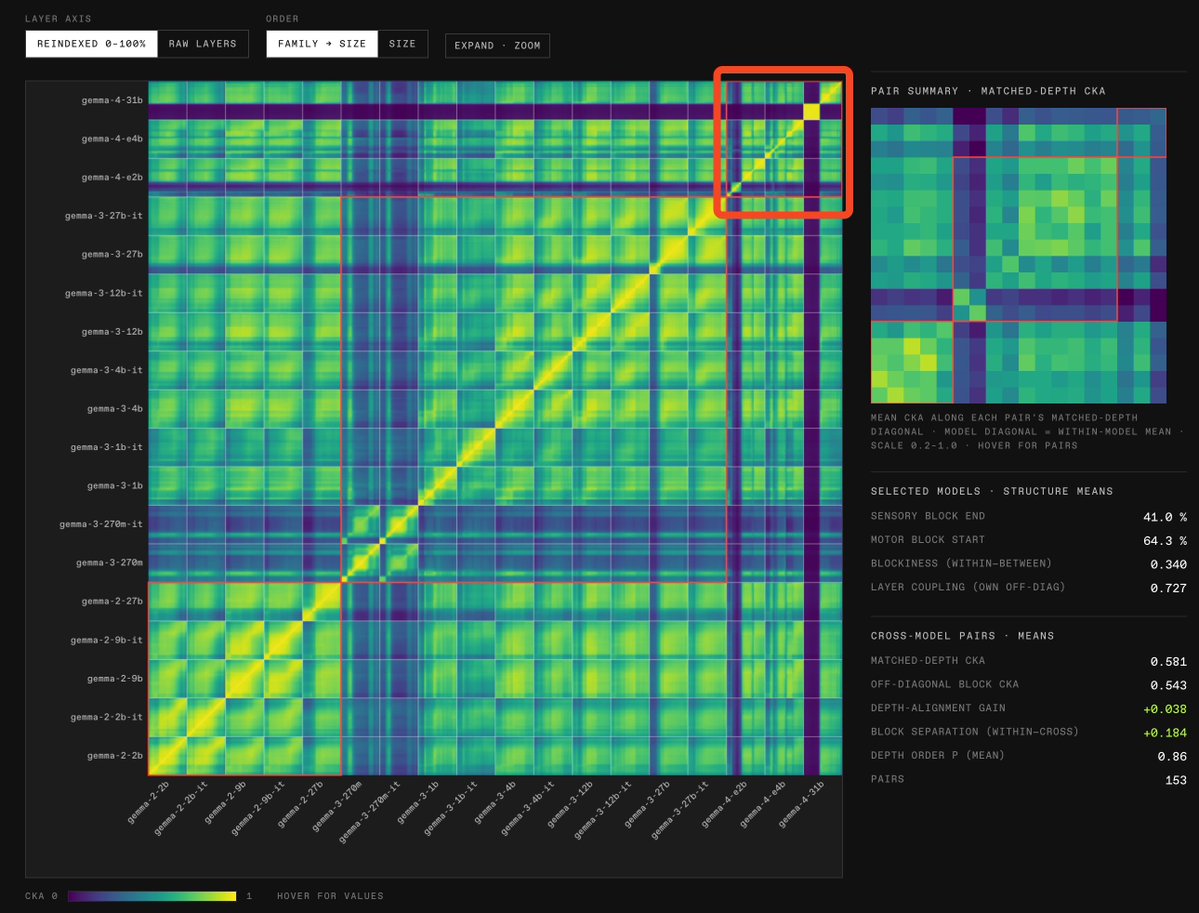
this is an extension of figure 27 from the blog. some fun outliers like gemma4 that has much clearer separation than the previous series, small qwen models tend to have only 2 phases, gpt2 small is one big jspace, some strong correlations between models of the same family at different sizes and much more fun stuff, i'm actually not an expert on this so i find this cool but might be obvious aha
elie tweet mediaelie tweet mediaelie tweet mediaelie tweet media
English
3
3
138
7.2K
elie
elie@eliebakouch·
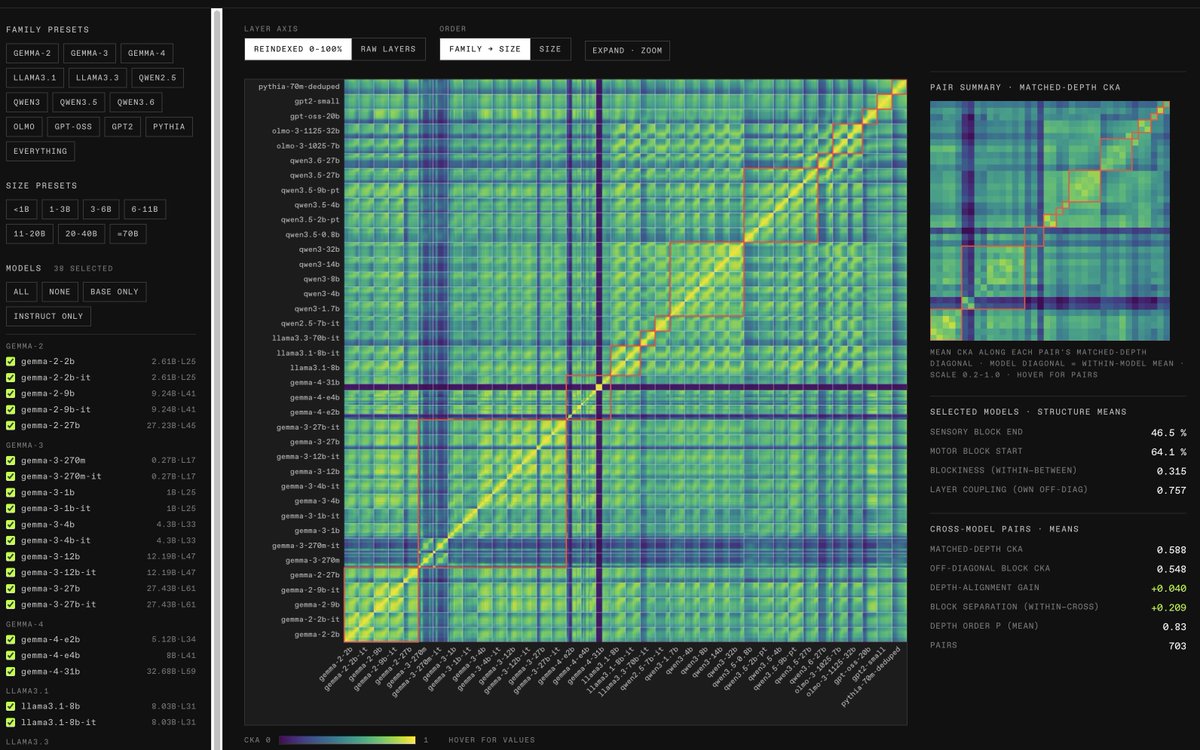
computed the similarity (CKA) on the J-lens geometry of every layer inside and across 38 open models. the patterns are weirdly universal: same depth layout, same organization at the same relative depth, even between unrelated families like llama and olmo eliebak.com/viz/jspace-open
elie tweet media
Anthropic@AnthropicAI

New Anthropic research: A global workspace in language models. Of everything happening in your brain right now, only a tiny fraction is consciously accessible—thoughts you can describe, hold in mind, and reason with. We found a strikingly similar divide inside Claude.

English
56
159
1.5K
204.7K
Nicholas Sofroniew retweetledi
Neel Nanda
Neel Nanda@NeelNanda5·
I thought this was an excellent paper! Thanks to Anthropic for asking me to write a review of it, linked below I've long suspected that models have some kind of "working memory" to store intermediate variables during a forward pass and IMO this paper has the best evidence yet
Neel Nanda tweet media
Anthropic@AnthropicAI

New Anthropic research: A global workspace in language models. Of everything happening in your brain right now, only a tiny fraction is consciously accessible—thoughts you can describe, hold in mind, and reason with. We found a strikingly similar divide inside Claude.

English
33
92
1.3K
104.3K
Nicholas Sofroniew retweetledi
Jack Lindsey
Jack Lindsey@Jack_W_Lindsey·
LLMs represent information using high-dimensional neural activity. A small bit of this activity appears to be privileged, available to the model to be described, modulated, and reasoned with. I expect that understanding this "workspace" is key to making sense of LLM cognition.
Anthropic@AnthropicAI

New Anthropic research: A global workspace in language models. Of everything happening in your brain right now, only a tiny fraction is consciously accessible—thoughts you can describe, hold in mind, and reason with. We found a strikingly similar divide inside Claude.

English
31
47
490
38.9K
Nicholas Sofroniew
Nicholas Sofroniew@sofroniewn·
Really excited to share the most recent work on verbal report and access consciousness in language models I've been doing with @wesg52 and @Jack_W_Lindsey I went to @AnthropicAI to work on these types of questions, and I think we are finding fascinating things I hope you enjoy!
Anthropic@AnthropicAI

New Anthropic research: A global workspace in language models. Of everything happening in your brain right now, only a tiny fraction is consciously accessible—thoughts you can describe, hold in mind, and reason with. We found a strikingly similar divide inside Claude.

English
6
9
67
7.4K
Nicholas Sofroniew
Nicholas Sofroniew@sofroniewn·
@HistedLab @jacklindsay Thanks! I'd love to see how these ideas inspire the neuroscience community back. I think there could be interesting threads to pull on re: patterns of neural activity that "linearly" influence outputs compared to patterns that are just "linearly" decodable to sensory states
English
0
0
1
37
Mark Histed
Mark Histed@HistedLab·
@jacklindsay @sofroniewn there's been discussion recently about whether a brain is like a computer in any way. I continue to think that while LLMs/AI systems differ in many biophysical details from biological brains, they capture something about network computation neuroscience can learn from.
English
1
0
4
160
Nicholas Sofroniew
Nicholas Sofroniew@sofroniewn·
@StanDehaene Thank you for your commentary and of course the original work, it was all very helpful for us!
English
0
0
1
910
Nicholas Sofroniew retweetledi
Stanislas Dehaene @standehaene.bsky.social
The global neuronal workspace (GNW) is currently the best documented neuroscience mechanism by which conscious processing arises in the human brain — and now Anthropic researchers have discovered a similar workspace inside their large language model !
Anthropic@AnthropicAI

New Anthropic research: A global workspace in language models. Of everything happening in your brain right now, only a tiny fraction is consciously accessible—thoughts you can describe, hold in mind, and reason with. We found a strikingly similar divide inside Claude.

English
30
72
351
48.3K
Nicholas Sofroniew retweetledi
Wes Gurnee
Wes Gurnee@wesg52·
New research: language models develop a distinction between a small set of representations they can report on and reason with, and a much larger volume of automatic processing — a structure that closely mirrors global workspace theory. Some highlights 🧵
Anthropic@AnthropicAI

New Anthropic research: A global workspace in language models. Of everything happening in your brain right now, only a tiny fraction is consciously accessible—thoughts you can describe, hold in mind, and reason with. We found a strikingly similar divide inside Claude.

English
9
17
98
17.5K
Nicholas Sofroniew retweetledi
Zeming Lin
Zeming Lin@ebetica·
I'm so excited to show the world what we've been working on the for the past months!! I'm going to highlight some of the fun results from this paper that I find particularly exciting.
Alex Rives@alexrives

Today we're announcing ESMFold2, an open scientific engine to power prediction, design, and discovery across protein biology. The new model delivers state of the art performance on protein interactions, especially antibodies, a critical modality for therapeutics. We have designed and validated miniprotein binders and single chain antibodies across five therapeutic targets that are important in cancer and immunology. We are seeing very high success rates, and affinities at levels consistent with therapeutic activity. We’re also releasing an atlas of 6.8 billion proteins, and 1.1 billion predicted structures. ESMFold2 is built on a state of the art language model that has been trained on billions of protein sequences. A world model of protein biology emerges through language modeling. We’ve used the techniques of mechanistic interpretability developed to understand large language models to understand the concepts ESM uses to represent proteins. The model’s representation space has a compositional organization of features across scales, levels of complexity, and abstraction, that reflects and mirrors the understanding of protein biology developed through a century of empirical science. This understanding emerges without prior knowledge, just from language modeling of protein sequences. Language models are becoming a powerful substrate to understand and program biology. The design of protein interactions is one of the most fundamental problems in biophysics, and has critical implications for the discovery of new medicines. A simple gradient based search with the model was able to discover high-affinity protein binders. I'm excited by the potential this has to accelerate basic science and the understanding of proteins. And especially for the new avenues it opens up for therapeutic design and medicine.

English
15
32
218
73.6K
Alex Rives
Alex Rives@alexrives·
Today we're announcing ESMFold2, an open scientific engine to power prediction, design, and discovery across protein biology. The new model delivers state of the art performance on protein interactions, especially antibodies, a critical modality for therapeutics. We have designed and validated miniprotein binders and single chain antibodies across five therapeutic targets that are important in cancer and immunology. We are seeing very high success rates, and affinities at levels consistent with therapeutic activity. We’re also releasing an atlas of 6.8 billion proteins, and 1.1 billion predicted structures. ESMFold2 is built on a state of the art language model that has been trained on billions of protein sequences. A world model of protein biology emerges through language modeling. We’ve used the techniques of mechanistic interpretability developed to understand large language models to understand the concepts ESM uses to represent proteins. The model’s representation space has a compositional organization of features across scales, levels of complexity, and abstraction, that reflects and mirrors the understanding of protein biology developed through a century of empirical science. This understanding emerges without prior knowledge, just from language modeling of protein sequences. Language models are becoming a powerful substrate to understand and program biology. The design of protein interactions is one of the most fundamental problems in biophysics, and has critical implications for the discovery of new medicines. A simple gradient based search with the model was able to discover high-affinity protein binders. I'm excited by the potential this has to accelerate basic science and the understanding of proteins. And especially for the new avenues it opens up for therapeutic design and medicine.
GIF
English
75
452
1.6K
610.3K
Nicholas Sofroniew
Nicholas Sofroniew@sofroniewn·
Very excited to have played a part in this while I still at ES I recommend reading the paper, there is some really cool stuff in it including interpretability on ESMC I think the next wave of biological discovery will come through understanding the internals of language models!
Alex Rives@alexrives

Today we're announcing ESMFold2, an open scientific engine to power prediction, design, and discovery across protein biology. The new model delivers state of the art performance on protein interactions, especially antibodies, a critical modality for therapeutics. We have designed and validated miniprotein binders and single chain antibodies across five therapeutic targets that are important in cancer and immunology. We are seeing very high success rates, and affinities at levels consistent with therapeutic activity. We’re also releasing an atlas of 6.8 billion proteins, and 1.1 billion predicted structures. ESMFold2 is built on a state of the art language model that has been trained on billions of protein sequences. A world model of protein biology emerges through language modeling. We’ve used the techniques of mechanistic interpretability developed to understand large language models to understand the concepts ESM uses to represent proteins. The model’s representation space has a compositional organization of features across scales, levels of complexity, and abstraction, that reflects and mirrors the understanding of protein biology developed through a century of empirical science. This understanding emerges without prior knowledge, just from language modeling of protein sequences. Language models are becoming a powerful substrate to understand and program biology. The design of protein interactions is one of the most fundamental problems in biophysics, and has critical implications for the discovery of new medicines. A simple gradient based search with the model was able to discover high-affinity protein binders. I'm excited by the potential this has to accelerate basic science and the understanding of proteins. And especially for the new avenues it opens up for therapeutic design and medicine.

English
0
1
30
1.9K