Askara

7.2K posts

Askara banner
Askara

Askara

@softmaxedx

Ex-founder. Learning in public about AI, markets, and human behavior: the tech, money, psychology and memes shaping what comes next.

Katılım Eylül 2009
627 Takip Edilen1.4K Takipçiler
Sabitlenmiş Tweet
Askara
Askara@softmaxedx·
In this series of looking at the people around $SIVE, the next person I wanted to understand is Neeraj Chopra. He joined Sivers in October 2025 as its senior operations and quality leader and now describes his role as Chief Operations Officer. What makes the appointment interesting is not just his background. It is the timing. Sivers hired him as the company was moving from a development-heavy story toward a products business. That was an inflection point. The question was shifting from: “Does the technology work?” to: “Can Sivers qualify it, manufacture it reliably, deliver it on time, and scale it with acceptable margins?” That is exactly the kind of transition Neeraj has spent his career managing. He is a mechanical engineer by training. He began his career at Honda in product development, supplier development, manufacturing, and operations. From there, he moved through telecommunications, electronics, aerospace, defense, semiconductors, photonics, automotive LiDAR, and advanced manufacturing. His experience includes: Honda. Solectron. DRS Technologies / SPAR Aerospace. Lumentum. Dialog / Renesas. MACOM. Axcelis. Velodyne LiDAR. Allegro. Natron. At Honda, he worked on product development, supplier selection, certification, audits, production, and cost reduction. At DRS Technologies and SPAR Aerospace, he worked in quality and reliability for aerospace and defense. At Dialog Semiconductor, he led areas including customer quality, manufacturing quality, supplier and contract-manufacturer quality, design quality, qualification, reliability, audits, and failure analysis. At Velodyne LiDAR, he was responsible for worldwide manufacturing processes, quality, reliability, and customer satisfaction. At Allegro and Natron, he held senior responsibility for engineering, quality, reliability, global business processes, manufacturing, and team development. But the most relevant part of his background may be his 19 years at Lumentum. He worked across worldwide operations, manufacturing, design processes, quality, reliability, supplier management, contract manufacturers, product quality, yield improvement, and customer satisfaction. According to his profile, the results included: Integrating more than 10 acquisitions. Supporting revenue growth from roughly $75M per quarter to more than $300M per quarter. Reducing customer returns by more than 75%. Reducing the cost of quality by more than $8M per quarter. Improving manufacturing and test yield by 25%. Improving customer satisfaction by 20%. Those are not generic management claims. They map directly to the problems Sivers must solve. Yield Reliability Customer returns Cost of quality Supplier control Manufacturing scale Design for quality Qualification and integrating processes across global operations. That is not the profile you hire to generate more ideas. It is the profile you hire when ideas must become repeatable products. CEO Vickram Vathulya made that explicit when he connected Neeraj’s appointment to Sivers’ transformation into a products business. That makes the hire look strategic rather than administrative. Management appears to have recognized that the next phase would require more than technical progress. It would require an operating system around the technology. Qualification discipline Supplier control New product introduction Production readiness Yield improvement Reliability engineering Customer quality Fab quality Assembly and test and coordination across the U.S., Scotland, Sweden, India, Taiwan, OSATs, contract manufacturers, and external suppliers. Sivers later advertised for a Director of Quality covering manufacturing, NPI, supplier management, and global quality strategy. That suggests Neeraj was not simply given a title. The company appears to be building an operations and quality organization around the expected commercial ramp.
Askara@softmaxedx

In this series of looking at the people around $SIVE The next $SIVE person I wanted to understand is Todd Thomson. And I don’t think he should be seen as just another board member. This is someone who has been CFO of Citigroup. CEO of Citigroup’s $10B Global Wealth Management division. Led acquisition and strategy work at Citigroup and GE Capital. Advised Fortune 500 companies at Bain, Booz Allen, and Barents Group. Chaired investment committees. Co-founded Dynasty Financial Partners, an investment and technology platform serving nearly 50 RIA firms with around $50B under management. Now COO/CFO at Kairos Ventures, where the job is basically the tension between scientific promise and financial reality. That background matters. Because Todd is not a photonics scientist. He is a capital allocator. A financial controls person. A governance person. A person who should understand dilution, balance sheets, reporting quality, investor trust, and whether a company is financing a real scale-up or just financing a story. That is why his role at Sivers is interesting. He has been on the Sivers board since 2021. He has also been Chair of the Audit Committee. That committee is not cosmetic. It deals with internal control, financing matters, cash flow, financial reporting, financial systems, audit outcomes, and audit evaluation. In other words, exactly the things investors are debating now. Dilution. Convertibles. Cash burn. Reporting trust. U.S. listing readiness. Whether the company can become credible to larger institutions. Then comes the ownership part. Sivers 2025 annual report lists Todd Thomson with 13,060,758 shares and 0 options, including holdings by related parties. Using the post Bootstrap share count of 355,081,317 shares, that reported holding would still represent roughly 3.7% of the company, assuming it is unchanged. So the recent dilution does not only hit retail holders. It hits him too. And the recent dilution was not small. If the company is issuing shares just to survive, that is one thing. If the company is issuing shares to expand InP laser and optical amplifier capacity, strengthen the balance sheet, support the U.S. listing process, and convert pipeline into revenue, that is a very different thing. Todd should understand that difference better than most people around the table. There is a caveat. Kairos affiliated entities have sold Sivers shares before. So this is not a clean “insiders only buy” story. But Sivers clarified that the Kairos reduction was related to fund-level rebalancing and payment of fund expenses, and Todd stated that his personal Sivers holding remained intact. That distinction matters. Fund liquidity is not the same thing as personal conviction. My takeaway: Todd Thomson does not prove the Sivers thesis. But his continued alignment is a signal worth studying. Because if someone with his background in CFO work, M&A, audit oversight, investor networks, venture finance, and institutional capital still remains meaningfully exposed after the dilution, then the signal is not hype. It is that someone who understands financial risk is still willing to sit with the risk.

English
10
9
56
9K
Askara
Askara@softmaxedx·
@soulbiri1 interesting, thanks for sharing your thoughts.
English
0
0
1
21
Misaka Mikoto
Misaka Mikoto@soulbiri1·
@softmaxedx Then I'll have to take the L on that, leverage cuts both ways. This is why I usually prefer longest DTE possible for LEAPs because then at least you can hodl if things go south
English
1
0
1
48
Misaka Mikoto
Misaka Mikoto@soulbiri1·
How to buy the dip when you have no cash Someone on discord asked my reasoning for buying those $NBIS 100C, so I thought I'd do an educational piece which I haven't done in a while. If you're experienced w options you can skip this. Let's say you want to buy the dip on your favorite stock (for me it's Nebbers) but you're out of cash. A few options 1) Go on margin -> not ideal for a number of reasons, margin maintenance+threat of margin call plus bad for your mental, not worth it unless you are confident that you've identified a generational bottom. 2) Leveraged ETF e.g. $NEBX for Nebbers. These are short term instruments designed for traders not long holds, reason being that they suffer from volatility drag due to their daily rebalancing when compared to normal leverage like in option 1 (a -20% day followed by a +25 % day round-trips at 1x leverage, but does not do so at 2x) 3) Levering up with options *my preferred approach When people they say they want to buy the dip what they're really saying is that they want increased delta exposure to a stock at a given price, which is exactly what options are great for. In my case from last week I exchanged 1000 $NBIS shares for 18 $NBIS Jan 26 100C At 0.9 delta *18 = 16.2*100 sh/contract = 1620 sh, I effectively got exposure to 620 new sh at a price for Nebbers that I found agreeable, plus the added benefit of convexity (though minimal bc deep ITM) as the stock recovers. Why deep ITM? Because $NBIS IV percentile was astronomically high, therefore you should be looking to buy contracts that have more intrinsic vs extrinsic value so you're not overpaying for vol. The strike and expiry are mostly selected based on liquidity+volume which are important for fills when you want to move in and out. I also generally prefer 1+ year out but in this case I settled with Jan to lower the extrinsic on these contracts even more. I would consider using OTM and/or shorter dated contracts if the dip was even greater and if the IV wasn't as high I.e. vol was cheap. Of course this is a high risk strategy because you are amplifying both your gains and losses per dollar unit, it is a statement that I want capital efficient leverage in exchange for loss of downside protection below 100 (if nebbers were to fall below that by exp it would be a total loss). Note this tactic works best in a tax advantaged account (e.g. Roth IRA) since you can exchange stocks/options freely without triggering cap gains. tldr: "leverage low, deleverage high" Btw dms open to friend me on discord I'm always down to chat
Misaka Mikoto tweet media
English
7
2
27
2.2K
Askara
Askara@softmaxedx·
@soulbiri1 say black swan event and it falls to 50 or something, then?
English
1
0
1
37
Aria
Aria@AriaLikesStocks·
This market is making me feel like the most stupid worthless person alive
English
52
6
93
6.6K
The Kobeissi Letter
The Kobeissi Letter@KobeissiLetter·
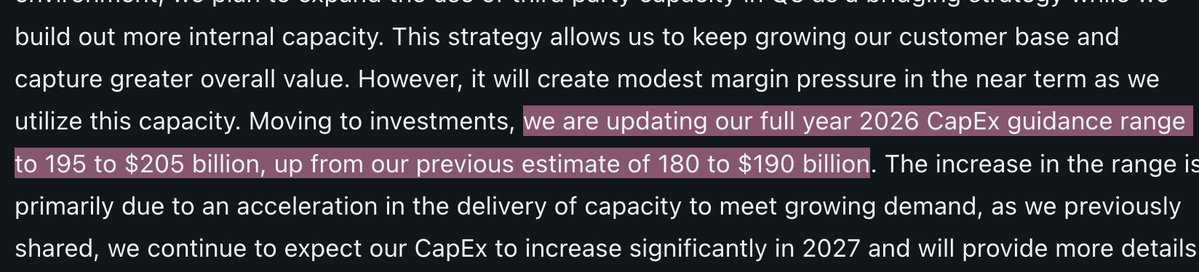
We are in the midst of the biggest technological revolution in modern history. Alphabet, $GOOGL, just raised their full-year 2026 CapEx guidance to up to $205 billion. This annual CapEx budget alone is larger than the market cap of all but 85 companies in the world. The Magnificent 7 will soon spend over $1 trillion in combined annual CapEx. This is a once-in-a-lifetime technological revolution.
English
198
574
6.4K
543.4K
Serenity
Serenity@aleabitoreddit·
$GOOGL updates FY 2026 capex guidance: To $195B-$205B. Up from $180B-$190B. Google is also expected to significantly increase capex in 2027. This is perhaps the most bullish read through on upstream semis from a hyperscaler.
Serenity tweet media
English
182
175
2K
260.1K
Askara
Askara@softmaxedx·
Unless this entire thing is an extraordinarily well calibrated scam, I genuinely do not understand what the catch is. CEOs are openly saying: Supply constraints are raising costs. Those higher costs are already included in their forecasts. They still expect attractive returns. And they are becoming even more confident because the actual demand numbers are coming in stronger than expected. So is the AI infrastructure thesis genuinely this obvious, with the only difficult part being identifying who captures the value? Or is the entire market already staring at the same obvious conclusion and simply no longer impressed by it?
Askara tweet media
English
2
0
7
442
Serenity
Serenity@aleabitoreddit·
@200pipss Hyperscalers upping AI capex revisions is especially going to show up on optical networking earnings. Watch and learn...
English
7
4
207
17.7K
bubble boi
bubble boi@bubbleboi·
I’m not really a stock guy. I just love innovation and technology.
English
26
5
228
15.4K
SemiAnalysis
SemiAnalysis@SemiAnalysis_·
BREAKING: GOOGLE CLOUD GENERATES REVENUE PRIMARILY FROM THE SALE OF TPU SYSTEMS! $GOOG Google Cloud has shifted from being a cloud to a hardware vendor, and this quarter was the first time they said "primarily" with meaningful language change. Is this Google bowing out of the race as they shift to becoming an NVIDIA competitor versus a hyperscaler? More on the call soon 🤞
SemiAnalysis tweet mediaSemiAnalysis tweet media
English
163
80
1.1K
420.9K
Askara
Askara@softmaxedx·
@beauty_oe I think many people got into photonics because of the hype not realising that it's a long term play
English
0
0
0
130
みみりん@投資系女子
$AAOI この下落で損切りした方もいたみたいですね🥺 さみしいですねえ🥺 私は追加。本日また買い‼️‼️ 立ち上がりはまだ先だと思ってます。 ただ、実行リスクはあります
日本語
7
2
145
11.4K
Askara
Askara@softmaxedx·
Listening to $GOOG earnings call API USAGE UP 20 BILLION TOKENS PER MINUTE FROM 16 BILLION TOKENS CRUSH BEARS!!!
GIF
English
2
0
6
511
Askara
Askara@softmaxedx·
@jukan05 $750B.....up from $600B in a few months. I wake up I see these numbers I drop resignation letter to my McDonald's boss I quit
GIF
English
0
0
2
1.8K
Jukan
Jukan@jukan05·
MORE COMPUTE
Jukan tweet media
English
22
69
776
307.8K